

Turmeric for Women Benefits: Doses, Evidence and Safety
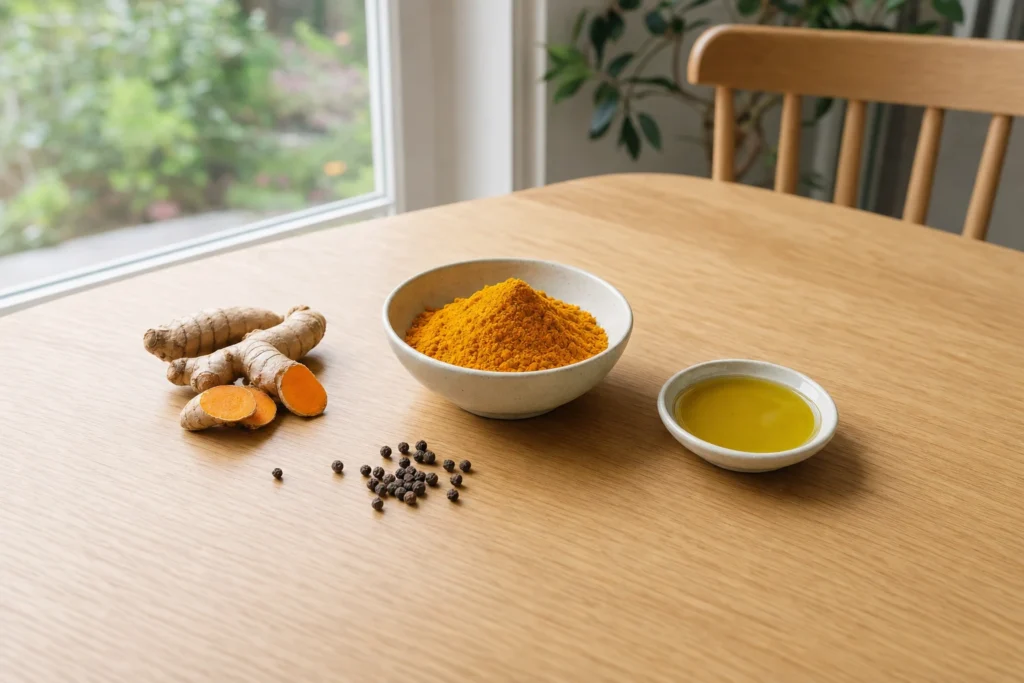
Turmeric for women benefits comes down to a short, real list. The strongest case is less joint pain from knee arthritis. That rests on 16 trials and 1,810 adults, with results as good as ibuprofen-type drugs. Trials have used 500 to 1,500 mg of standard extract a day, or 1.5 to 3 g of cooking powder, but those are study amounts rather than a personal prescription — clear any supplement amount with your doctor or pharmacist. Give it 8 to 16 weeks before you judge it. Check in with your clinician if you pass the 3-month mark.
Last updated: November 15, 2026
Cramps, hot flashes, and stubborn weight get far less support than social media claims. Each one carries a grade below, based on the human studies behind it. You will also see which form is worth the money and who should skip turmeric.
Quick Answer: Is Turmeric Worth Taking?
Yes, for two things. Joint pain and inflammation markers have the most trials behind them. Cooking powder at 1.5 to 3 g a day is a cheap start. A 500 mg standard extract capsule delivers far more curcumin. Do not start curcumin capsules — high-absorption ones especially — without checking with your doctor if you have gallstones, take a blood thinner, or run low on iron; those conditions make capsules a decision for your care team, not a label.
Turmeric for Women Benefits, Graded by Evidence
Not every claim deserves the same trust. Some rest on dozens of trials. Others rest on one small study, or on cells in a lab dish. This table sorts the claims by how much human data stands behind each one.
| Claim | Grade | What the numbers show |
|---|---|---|
| Less knee arthritis pain | Moderate | 16 trials, 1,810 adults, up to 16 weeks |
| Lower inflammation markers | Moderate | 66 trials; CRP down 0.58 mg/L |
| PCOS blood sugar and DHEA | Weak | 1 trial, 67 women, 12 weeks |
| Hot flashes | Weak | 1 trial, 93 women, 8 weeks |
| Pelvic pain from endometriosis | Weak | 1 trial, 8 weeks, added to a prescription drug |
| Period cramps and PMS | Weak to mixed | Best trial found no edge over placebo |
| Weight and waist size | Weak | About 2 kg over months, low certainty |
| Cancer prevention | Not supported | Trials are still early |
Two rows are worth real money. The rest are fine to try, and none of them justify a big supplement budget. Notice what is missing from that table. There is no row for detox, fat burning, or anti-aging.
Is Turmeric Good for Inflammation? What 66 Trials Found
Yes, and the effect is small but steady. A 2023 review pooled 66 trials in adults. Curcumin cut C-reactive protein by 0.58 mg/L and TNF-alpha by 3.48 pg/mL. It also lowered interleukin-6 by 1.31 pg/mL, per the GRADE-assessed review in Cytokine.
Those are blood markers doctors use to track swelling in the body. Moving them is a real effect. Feeling better is a separate question, and the trials do not answer it cleanly.
The NIH’s National Center for Complementary and Integrative Health keeps the frame steady. Its 2025 update says there is not enough evidence to call turmeric helpful for any health condition. Both things can be true. Markers move while symptoms improve less reliably.
Where does the spice fit in a real eating pattern? Our guide to anti-inflammatory spices compares turmeric with ginger and cinnamon.
How Much Turmeric Should I Take? A Dose Table by Form
No official daily dose exists. Any page that hands you one number is guessing. What does exist is what trials used, and that shifts sharply by form.
| Form | Daily amount in studies | What it delivers |
|---|---|---|
| Ground cooking turmeric | 1.5 to 3 g (half to one teaspoon) | About 15 to 180 mg curcumin (30 to 180 mg at a full teaspoon) |
| Standard 95% extract | 500 to 1,500 mg | About 475 mg per 500 mg capsule |
| High-absorption forms (phytosome, micellar) | 80 to 300 mg by label (trials used up to 1,000 mg of some forms) | More curcumin reaches your blood |
| Extract plus black pepper | Around 1,500 mg | No clear edge over plain extract |
Enhanced forms are not interchangeable: 80 mg of one nano-formulation and 1,000 mg of a micellar product are different products with different evidence behind them. Follow the label on the bottle you actually bought.
Whole turmeric is mostly not curcumin. NIH LiverTox puts curcumin at 1% to 6% of dry weight. One teaspoon, near 3 grams, gives you roughly 30 to 180 mg. That is why a cooking habit and a capsule trial are not the same test.
One teaspoon also carries 9 calories, 0.7 g of fiber, and 1.7 mg of iron, per USDA FoodData Central. Small numbers, and worth knowing for a reason we will reach.
Black pepper needs a correction. The famous 2,000% boost comes from one small, older study. A 2021 crossover trial gave 30 adults five forms. The pepper blend did no better than plain extract, per the Journal of Nutrition study. A micellar form, by contrast, was about 37 times better absorbed per milligram.
Pepper and fat still earn a place. They are cheap, they slow how fast your body clears curcumin, and they make food taste better. They do not turn a weak product into a strong one.
Turmeric Benefits and Side Effects: The Safety Picture
Most women handle turmeric well. The common complaints are gut-level: nausea, stomach pain, loose stools, and reflux. Those show up at high capsule doses, not at cooking amounts.
The rare risk needs real space. NIH LiverTox now lists turmeric as a well-documented cause of liver injury, with its top likelihood grade. It is the most common herbal cause of that injury in the United States.
How often? About 1 in 10,000 to 1 in 100,000 people exposed. Trouble tends to appear after 1 to 4 months of use. In a series of 10 cases, 80% were women and one person died.
Most cases clear within 1 to 3 months of stopping. Outcomes get worse when a woman keeps taking the product after symptoms start. So the symptom list is worth knowing by heart.
Stop the Supplement and Call Your Doctor If You Notice
- Unusual tiredness or weakness that does not pass
- Nausea, poor appetite, or stomach pain that lingers
- Dark urine or pale, light-colored stools
- Yellowing of the skin or the whites of the eyes
- Itching without a rash
Dose and form both shape the risk. High-absorption products pack more of the compound behind the problem. They are also the ones sold as the smarter buy.
Cooking amounts sit far below the doses in the reported cases. But they are not risk-free either. NIH LiverTox has recorded rare cases with plain ground turmeric powder and with turmeric herbal teas. That is why the symptom list above is worth knowing at any dose.
Turmeric for Period Cramps, PMS, and Hormones
This is where the internet and the research split. A widely cited 2024 review found curcumin eased period pain and PMS. That review was retracted in March 2025, and plenty of pages still quote it.
A careful trial came next. Researchers gave 124 women 500 mg of curcumin a day for three cycles. Dosing ran from 7 days before to 3 days after each period. Pain fell 64% on curcumin and 53.3% on placebo.
That gap was not significant, per the triple-blind trial in Phytotherapy Research. A placebo response that large explains why so many women swear by turmeric. Their relief is real. The evidence just cannot credit the spice for it.
PCOS has slightly firmer ground. In one trial, 67 women with PCOS took 1,500 mg of curcumin a day for 12 weeks, and fasting glucose fell about 4 mg/dL and DHEA about 27 micrograms/dL versus placebo. That is a study protocol, not a dose to copy — talk with your care team before using curcumin to influence blood sugar or hormones. Real, measurable, and small. A 4 mg/dL shift is not a treatment effect.
Pelvic pain from endometriosis has one recent trial, and it came with limits. Eighty-six women added nanocurcumin, 80 mg a day, to a prescription drug called dienogest. Pain scores improved over 8 weeks. Curcumin alone was never tested at that dose or form.
Hot flashes rest on a single 8-week trial of 93 women on 500 mg a day. Fewer episodes, with no change in mood or sexual function. A signal, not a settled answer. If hormones are your main concern, read our piece on ginger and cinnamon tea for hormone balance.
Turmeric for Weight Loss: What the Numbers Say
Turmeric does not burn fat, and no trial says it does. What exists is a small shift in people whose blood sugar is already off. A 2025 review pooled 20 trials in prediabetes and type 2 diabetes.
Weight fell about 1.9 kg in type 2 diabetes and 2.5 kg in prediabetes. Waist size dropped 1.9 to 2.9 cm. Certainty was rated low to moderate, and BMI did not move, per the Nutrition and Diabetes review.
That is roughly 4 pounds over months, not weeks. Note who was studied: people with high blood sugar. If your glucose runs normal, those numbers may not apply to you. There is also no detox here. Turmeric does not flush anything out of the body.
Turmeric and Iron: A Warning for Women
Turmeric can bind iron and block part of it from being absorbed. That matters. A woman who gets a period needs 18 mg of iron a day. Pregnancy raises it to 27 mg. Turmeric gets pushed to exactly that group.
One teaspoon of ground turmeric holds about 1.7 mg of iron, per USDA FoodData Central. That sounds like a bonus. At capsule doses, the binding can outweigh it.
If you take an iron supplement or have heavy periods, ask your doctor or pharmacist how to space turmeric from iron, and whether a ferritin check makes sense before you start a daily capsule. As a general habit, take turmeric with a meal that is not your main iron source.
Tiredness, breathlessness on stairs, and pale skin deserve attention. Our guide to iron deficiency symptoms in women explains what the numbers mean and when to ask for labs.
Who Should Be Careful With Turmeric
Cooking amounts suit most people. Capsules need more thought, and a few groups should skip them.
- Gallstones or bile duct problems. Turmeric can trigger gallbladder squeezes and make pain worse.
- Blood thinners or a bleeding disorder. It may slow clotting, which raises bruising and bleeding.
- Surgery coming up. Turmeric may slow clotting, so ask the doctor managing your procedure how long to stop a capsule beforehand — many surgical teams advise pausing about two weeks ahead, but follow their instruction.
- Liver disease. Given the injury signal, ask your doctor first.
- Diabetes drugs. Turmeric may add to the blood-sugar-lowering effect of diabetes drugs, so ask your pharmacist before starting it and check your glucose more often if you do.
- Low iron or heavy periods. Read the section above before you commit.
- Pregnancy and breastfeeding. Food amounts are considered fine. Capsules are not established as safe in pregnancy or breastfeeding, trace heavy metals are a separate concern, and your obstetrician or midwife should clear any supplement first.
If you take any daily prescription, ask a pharmacist before you add a curcumin capsule. Interaction lists are incomplete. One hot-flash drug, fezolinetant, already appears on them.
A 7-Day Starting Routine
You do not need a bottle to start. A week of food first tells you whether you like the taste and whether your stomach agrees.
- Days 1 and 2: Half a teaspoon (1.5 g) in scrambled eggs or roasted vegetables. Fat helps absorption.
- Days 3 and 4: The same 1.5 g in warm milk with a pinch of black pepper.
- Days 5 and 6: Work up to 1 teaspoon (3 g), split over two meals.
- Day 7: Decide. If you want a capsule, pick 500 mg of standard 95% extract and take it with food.
Track one symptom on a 1-to-10 scale: joint stiffness, cramp pain, or morning puffiness. Check again at week 8 and week 16. Memory plays tricks without a written score.
Need meals that carry the habit? Our list of anti-inflammatory foods pairs turmeric with things that do real work.
How we researched this
We reviewed 10 sources, including government health agencies, meta-analyses, and randomized controlled trials.
- Turmeric: Usefulness and Safety — government health agencies, 2025
- Turmeric – LiverTox: Clinical and Research Information on Drug-Induced Liver Injury — government health agencies, 2025
- Antioxidant and anti-inflammatory effects of curcumin/turmeric supplementation in adults: A GRADE-assessed systematic re — meta-analyses, 2023
- Effects of curcumin on menstrual pattern, premenstrual syndrome, and dysmenorrhea: A triple-blind, placebo-controlled cl — randomized controlled trials, 2021
- Effect of Curcumin on Dysmenorrhea and Symptoms of Premenstrual Syndrome: A Systematic Review and Meta-Analysis (RETRACT — meta-analyses, 2024, 379 participants
This article is for general information and is not a substitute for advice from your doctor or dietitian.
FAQ: Your Turmeric Questions Answered
Which benefits have the strongest evidence?
The turmeric for women benefits with the most support are joint pain and inflammation markers. Those two have the most trials and the steadiest results. Everything else runs from promising to unproven.
Is turmeric safe every day?
Cooking amounts, yes. Capsules are seen as likely safe at label doses for up to 2 to 3 months, per NIH guidance. The arthritis trials ran up to 16 weeks, but that is a research exposure, not a green light for months of continuous use. If you want to keep going past three months, review it with your doctor or pharmacist first.
Can I cook with turmeric instead of buying pills?
You can, and it costs pennies. One teaspoon gives about 30 to 180 mg of curcumin. A 500 mg 95% extract capsule gives near 475 mg. Cooking is a good habit, not a trial dose.
Does turmeric affect birth control or hormone therapy?
Nobody has studied this properly. Nothing in the sources we reviewed settles whether turmeric changes how hormonal birth control or hormone therapy works. The interaction picture for curcumin is still incomplete. Curcumin can influence the liver enzymes that clear some drugs, so tell your prescriber and your pharmacist what you take before you start a capsule. Fezolinetant, a drug used for hot flashes, already appears on published interaction lists.
How long before I know if it works?
Give it 8 to 16 weeks. Arthritis trials ran up to 16 weeks, the PCOS trial ran 12, and the endometriosis trial ran 8.
Is it safe with a blood thinner?
Ask your doctor first. Turmeric may slow clotting, and mixing it with warfarin and similar drugs is a known concern. Ask how long to stop before any planned surgery.
The Bottom Line
The real turmeric for women benefits are narrow and worth having. Less joint pain, lower inflammation markers, and a small metabolic edge if your blood sugar runs high. Cancer prevention is not on the list.
Start with food, give it 8 to 16 weeks, and choose a form you understand. If you take a blood thinner, have gallbladder trouble, or have heavy periods, talk to your clinician first. Small, cheap, low-risk habits beat expensive hope.