

Anti-Inflammatory Spices: What Actually Helps Your Heart
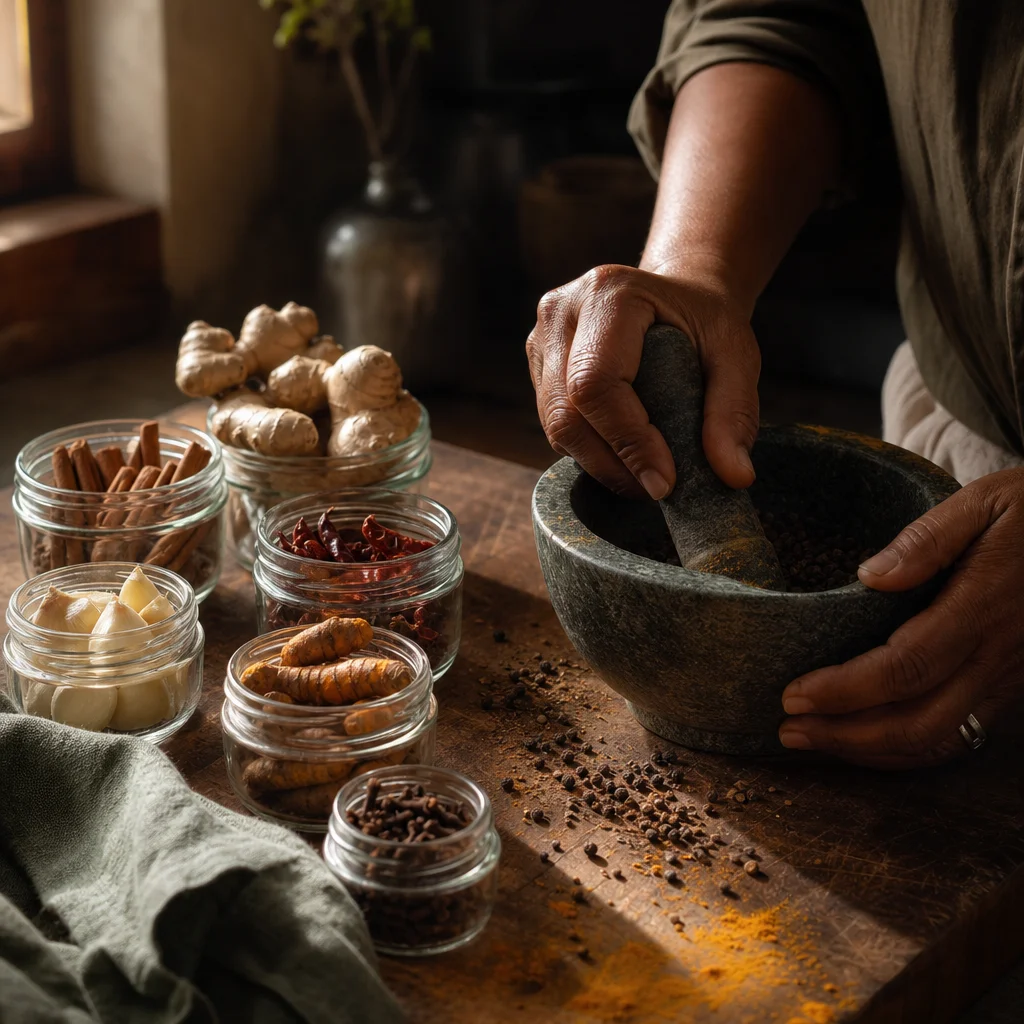
Key Takeaways
- Spices help your heart most by replacing salt, not by fighting inflammation.
- No trial has tested whether kitchen amounts of spice prevent heart disease.
- Cinnamon and garlic have the best data, but the doses studied were capsules.
- Concentrated spice supplements can interact with blood thinners and blood pressure drugs.
- A weekly rotation keeps jars from going stale before you finish them.
You reach for the salt shaker without thinking. A pinch on the eggs, a shake over the vegetables, a little more in the soup. Here’s the thing: that habit is one of the most fixable parts of your heart health picture. Anti-inflammatory spices are the simplest swap available, and a jar goes a long way.
But there’s a catch worth knowing before you buy six jars. Most coverage of these spices overstates the science and skips the safety. So let’s do it properly. This guide covers what the research shows, how much to use, and where the real risks sit.
Let’s be clear about what anti-inflammatory spices can and cannot do. They can make lower-salt food taste worth eating. They can’t undo a diet built on deli sandwiches and pizza.
Quick Answer: Do These Spices Really Help Your Heart?
Yes, but mostly through a side door. The FDA recommends herbs and spices in place of salt, and cutting sodium lowers blood pressure. That is the well-supported lever. The antioxidant story is real in a lab dish but unproven at kitchen amounts. So use anti-inflammatory spices generously in cooking, and skip concentrated capsules unless your clinician approves.
Why Anti-Inflammatory Spices Matter for Your Heart
Sodium is the most actionable number in most kitchens. The CDC reports that Americans average more than 3,300 milligrams a day. Federal guidance says to stay under 2,300 milligrams. That gap is what you are trying to close.
Here’s the part few people realize. One teaspoon of table salt holds about 2,400 milligrams of sodium. That is already above a full day’s limit. So the shaker matters, but less than you would guess.
Over 70% of the sodium we eat comes from packaged and prepared food, according to the FDA. Deli meat sandwiches, pizza, soup, chicken, bread and cheese all rank among the CDC’s top sources of sodium for adults. Cooking with spices reaches only the smaller share. Still, it is the share you control.
That same FDA page tells readers to try herbs and spices instead of salt. That single line is the strongest evidence in this whole article. A government agency is telling you to season with cumin and paprika rather than sodium. We’ve covered the herb half of that habit in our guide to anti-inflammatory herbs dietitians love.
So here is the honest framing. Anti-inflammatory spices earn their place at the table because they make lower-salt food taste good. Everything else is a bonus.
The Sodium Reality Check
Average US intake: more than 3,300 mg a day. Recommended limit: under 2,300 mg. Sodium in one teaspoon of salt: about 2,400 mg. Share of sodium from packaged and restaurant food: over 70%. Translation: spices fix your cooking, not your lunch order.
What the Evidence Says, One Spice at a Time
Now, you might be thinking that all anti-inflammatory spices work the same way. They don’t. The quality of evidence varies enormously from jar to jar. Here is where each one actually stands.
Cinnamon
This is the most interesting case. NIH states that research doesn’t clearly support using cinnamon for any health condition. Meanwhile, a GRADE-assessed review of 49 trials found real drops in blood pressure, CRP, LDL cholesterol and triglycerides. Both statements are true.
These findings don’t cancel out. They reflect two different standards of proof. The trials show small, genuine improvements in blood markers. NIH is waiting for harder evidence before recommending cinnamon for anything.
Dose matters too. A 2026 review in Food Research International found trials using 280 to 1,000 milligrams a day produced modest gains. Those gains showed up mostly in people whose blood sugar was already off.
Garlic
Garlic has the biggest evidence base on the rack. A 2026 meta-analysis pooled 108 trials and 7,137 adults. It found systolic pressure dropped 3.71 mmHg and LDL cholesterol fell 5.90 mg/dL. CRP dropped by 1.6 mg/L.
Notice where the benefits were largest, in people who already had elevated risk. That is a useful signal. Garlic helps most when there is something to fix.
Garlic is also the spice where kitchen amounts come closest to the amounts studied. The trials used powders, aged extracts and oils, so a clove is not a capsule. Still, one or two cloves a day is a realistic daily habit rather than a supplement regimen.
Chop them first and let them sit a few minutes before they hit the pan. That is a cooking habit, not a dose strategy.
Ginger
Ginger is genuinely useful, just not for your arteries. NIH lists reasonable evidence for nausea and menstrual cramps. It lists no cardiovascular indication at all.
Human trials of ginger supplements still look promising. A pooled analysis of 16 trials found ginger lowered CRP, hs-CRP and TNF-alpha. However, those results came from supplement doses, and the studies disagreed with each other a lot. Statistical heterogeneity ran from 89% to 98% across the outcomes.
The practical read: keep ginger for flavor, for queasiness, and for cutting salt in a stir-fry. Don’t count on it for blood pressure.
Turmeric and Black Pepper
Here is where the internet and the data part ways. A review of 19 trials in 1,344 people with chronic inflammatory conditions found turmeric and curcumin did not significantly lower CRP, IL-6 or TNF-alpha. Results came close, but they never crossed the line.
On the flip side, curcumin does look better for cholesterol. An umbrella review of 72 trials in Nutrition Reviews found LDL fell about 5.84 mg/dL and triglycerides about 13.15 mg/dL.
Absorption is the sticking point. The Linus Pauling Institute notes curcumin was undetectable in blood plasma below 3.6 grams a day. Turmeric is only about 2% to 9% curcuminoids by weight.
Black pepper helps here, because piperine slows how fast your body clears curcumin. That is why the pairing shows up everywhere. It also means pepper changes how you process some medicines.
Crushed Red Pepper
People who eat chile peppers often seem to live a little longer. A pooled analysis of four large cohorts covering 564,748 adults found 11% lower cardiovascular death among regular chile eaters. A separate analysis in the American Journal of Preventive Cardiology put it at 17%.
Other pooled estimates have landed between 11% and 18%. Regular meant once a week or more in that data, and no one knows what dose matters.
This is observational data, so it can’t prove the peppers did anything. People who cook with chiles may differ in a dozen other ways.
Cloves
Cloves bring eugenol, a compound with real antioxidant activity in the lab. What they lack is human data. No trial shows a pinch of ground cloves improves cholesterol or blood pressure.
That isn’t a reason to skip them. Cloves add deep flavor to beans, oats and braises without a grain of salt. Just don’t expect them to do clinical work.
The Dose Gap That Most Guides Skip
If the studies used capsules, why bother cooking at all? It’s a fair question. Here is the honest answer: cooking and supplementing are different acts with different risk profiles.
This is the gap in nearly all anti-inflammatory spices coverage. Trial amounts are measured in milligrams of extract. Kitchen amounts are measured in fractions of a teaspoon. Those are not the same thing.
Studied Doses vs. Your Spice Rack
Cinnamon trials in a 2026 review: about 280 to 1,000 mg a day. Ginger trials that moved CRP: roughly 1,000 to 3,000 mg a day. Curcumin trials: often 500 to 4,000 mg a day. Some formulations add piperine to boost absorption. That is also why the pill carries a drug-interaction warning. A generous pinch of cinnamon is a fraction of a gram. That is why food amounts are safe, and also why they are modest.
Food First, Capsules Second: The Safety Line
Culinary amounts of anti-inflammatory spices are low-risk. Capsules are a different product class entirely. NIH warns that garlic supplements may increase bleeding risk. It also notes these products are not approved by the FDA before they reach shelves.
Curcumin has its own concerns. The Linus Pauling Institute reports that curcumin inhibited platelet clumping in laboratory studies. That suggests it could raise bleeding risk for people on blood thinners. It also affects CYP3A4, an enzyme that processes roughly half of all prescription drugs in the US.
Piperine deserves a mention too. It can raise blood levels of drugs including phenytoin, propranolol, theophylline and carbamazepine by slowing their clearance. So the pepper you add for absorption can affect your medication.
Then there is the liver. A 2021 review in the British Journal of Clinical Pharmacology documented seven cases in Tuscany, all linked to high-dose, high-absorption curcumin formulations. It also identified 23 published reports of acute hepatitis; most of those patients were also taking at least one other medication, and 16 improved once the curcumin was stopped.
Most anti-inflammatory spices work best in food, not in pills. The line isn’t natural versus synthetic. It is food versus capsule.
Cassia or Ceylon? One Rule Settles It
Most cinnamon sold in North America is cassia. Ceylon, or true cinnamon, is the pricier one. They differ in one number that matters.
Cassia can hold up to 3.6 grams of coumarin per kilogram. Ceylon holds 15 milligrams per kilogram or less. That is roughly a 240-fold difference.
Coumarin affects the liver over time. NIH says normal culinary use doesn’t usually cause problems. However, prolonged high intake could matter for people with liver disease.
So the rule is simple. Cook with cassia freely in normal amounts. If anti-inflammatory spices become a daily habit at bigger doses, buy Ceylon.
Your Weekly Spice Rotation That Actually Works
Buying six jars at once is how spice racks die. Most people use one jar twice and forget the rest. So build a rotation instead, and let each spice earn its week. A rotation is how anti-inflammatory spices stay potent long enough to matter. The same weekly-rotation logic works for anti-inflammatory leafy greens too.
One Week, Six Jars, Zero Waste
- Monday: Cinnamon in overnight oats or coffee grounds.
- Tuesday: Chopped garlic rested five minutes, then added to a stir-fry.
- Wednesday: Fresh ginger simmered into soup or tea.
- Thursday: Crushed red pepper on roasted vegetables and eggs.
- Friday: Turmeric plus black pepper in a lentil or chickpea dish.
- Saturday: A pinch of cloves in beans or a braise.
- Sunday: Repeat whichever meal you loved most.
Keep jars lidded and away from the stove. Steam and direct sun flatten aroma faster than time does. Buy whole seeds and grind them as you need them. They hold their punch far longer than the pre-ground tubs. If you’d rather have the week mapped out meal by meal, our anti-inflammatory meal plan does exactly that.
Is My Old Jar Still Useful?
Almost always. Spices do not spoil the way food does. An old jar is unlikely to make you sick — it will just make you use twice as much to taste anything. When the color has gone dull and a sniff gives you nothing back, replace it.
Questions Readers Ask Most
A few questions about anti-inflammatory spices come up again and again. Here are the honest answers.
How much cinnamon is safe each day?
Normal cooking amounts are considered safe. NIH notes that prolonged high intake of cassia, the common type, could matter for people with liver disease. If you want cinnamon daily at larger amounts, switch to Ceylon.
Can I just take a supplement instead?
You can, but the risk changes. Spice supplements are not FDA-approved before sale. Garlic capsules may raise bleeding risk, and curcumin affects how your body clears several medications. Talk to your clinician first.
I take a blood thinner. What should I avoid?
Culinary amounts of these spices are generally considered fine. Avoid concentrated garlic and curcumin capsules unless your clinician clears them, because both can affect clotting. And mention any big jump in garlic or turmeric intake to whoever manages your anticoagulant. NIH specifically recommends that conversation.
Do I really need all six?
No. Three spices used often beat six going stale in a drawer. If you buy two, make them cinnamon and garlic. They have the strongest evidence and the widest everyday use.
The Bottom Line
Used well, anti-inflammatory spices do two quiet things. First, they make lower-salt cooking taste good enough that you keep doing it. Second, they add plant compounds that may nudge blood markers in the right direction. The first effect is proven. The second is promising but unproven at kitchen amounts.
Here is what I would actually do. Keep cinnamon, garlic, ginger and crushed red pepper on the shelf. Use them most days. Skip the capsules unless your clinician says otherwise. And read the sodium label on your soup and deli meat, because that is where most of the salt hides. For a fuller shopping list, see our anti-inflammatory foods grocery list.
You don’t need a perfect routine. You need a shaker you reach for less often, and a spice rack you actually use. That is a completely achievable place to start.