

Stretching for Flexibility: What Actually Changes
Key Takeaways
- Stretching does not meaningfully lengthen your muscles. A 2025 review of 65 studies found no change in muscle fiber length (fascicle length).
- What really changes is your stretch tolerance, plus a small drop in how stiff your tissue feels.
- Go dynamic before exercise. Save static holds for afterward. Long, hard holds before heavy lifting can briefly blunt strength.
- The evidence-based dose is simple: 60 seconds total per exercise, two or more days a week.
- If you stop, you keep part of your gains. They drift down over a few weeks, though, so a little upkeep helps.
You have been stretching for months. So why can you still not reach your toes? If you have kept up a stretching for flexibility routine and noticed you can reach a little farther, you probably assumed your muscles got longer. That is what most of us were taught. It is not quite right.
Here is what is actually happening. Your muscles barely change length at all. Instead, your body learns to tolerate the pull. Understanding that shift changes how you train, how long you hold, and what you should expect.
Below, we will walk through what the research shows. We will cover dynamic versus static timing, a simple routine, and two popular claims that do not hold up.
Quick Answer: Does Stretching Actually Lengthen Your Muscles?
No, not in any meaningful way. A 2025 review of 65 studies found that neither a single stretch nor weeks of training changed muscle fiber length. What does change is your tolerance for the stretch and how stiff your tissue feels. That alone is enough to give you more range of motion.
What Stretching for Flexibility Really Changes in Your Muscles
The honest answer is that stretching for flexibility changes how your system responds. It does not change how long your muscle is. Researchers pooled 65 studies covering 1,542 adults — mostly young men — in a 2025 review published in Sports Medicine. They measured three things.
First, muscle fiber length — researchers measure this as "fascicle length," the length of the fiber bundles inside the muscle. Second, passive stiffness. That means how much resistance your tissue gives when something pulls on it. Third, stretch tolerance. That is the most pull you are willing to put up with before your body says stop.
Here is the headline. Fiber length did not change. Not after one session, and not after weeks of sessions. Stiffness dropped a small amount. Stretch tolerance rose moderately, but only after repeated sessions. A single stretch did not move that needle.
What the Numbers Mean
Researchers measure change with something called an effect size. Think of it as a score for how big a difference really is. In that 2025 review, the drop in stiffness was small. The rise in stretch tolerance was moderate. The change in muscle length was essentially zero. So the tissue got slightly more forgiving, and your system got notably more comfortable.
Stretch Tolerance: Why You Can Suddenly Reach Farther
Your muscles are packed with sensors that report tension. When you sink into a stretch, those sensors fire. Your system reads the signal as a threat and pushes back.
Repeat the stretch often enough, and you learn to tolerate more of that pull before your body signals stop. You move further, not because the muscle grew, but because your tolerance grew. That is the whole engine behind stretching for flexibility.
A six-week study in the Journal of Sport Rehabilitation followed 40 healthy adults. The 20 people who stretched five times a week improved ankle range of motion by about 42%. Yet the researchers found no meaningful change in the reflex measures they tested. So the popular idea that you rewire your nervous system is not quite right either.
What I find interesting is how well that fits real life. A stretch that felt unbearable in week one feels ordinary by week six. Nothing structural changed. Your interpretation of the sensation did.
Static vs Dynamic: Getting the Timing Right
Static stretching means holding a position still. Dynamic stretching means moving through a range of motion. Think leg swings, arm circles, or bodyweight squats.
The practical rule for stretching for flexibility is short and clear. Move dynamically before exercise. Save static holds for after. That order comes from how each style affects your strength.
A 2025 narrative review from the University of Milan found that dynamic stretching raises range of motion without weakening you. Long or intense static holds, done right before max-effort work, can briefly reduce how much force you produce.
The review describes that dip as short-lived. So if you want to static stretch before training, keep the holds short. Then follow them with a few minutes of movement at your target intensity.
A pooled analysis of 17 studies found that dynamic and ballistic stretching together give a small but real boost before activity. That benefit showed up across ages, sexes, and muscle groups.
Worth knowing: stretching is not the only route. A 2026 network meta-analysis of 41 trials compared five methods for ankle range of motion. PNF, a technique where you tighten the muscle before relaxing it, and foam rolling ranked highest. Static stretching held its own for long-term maintenance. One catch: that analysis covered ankles in active adults only. Do not read it as proof that foam rolling beats stretching everywhere.
How Much Stretching for Flexibility Do You Actually Need?
You do not need an hour. Stretching for flexibility needs consistency, not volume. The American College of Sports Medicine sets the benchmark plainly. Stretch all major muscle groups for a total of 60 seconds per exercise, on two or more days a week.
Here is the part almost nobody explains. That 60 seconds is total time per exercise, not one long hold. Four 15-second holds count. So do three 20-second holds, or two 30-second holds.
Harvard Health puts the same advice in everyday language. Aim for two to three sessions a week, and build that 60 seconds out of shorter holds rather than one long push.
Your major muscle groups include your neck, shoulders, chest, trunk, lower back, hips, legs, and ankles. Skipping the ones you never think about is common. So is skipping your weaker side.
Wondering who actually benefits? A 2026 review of 79 randomized trials with 3,287 people found a moderate improvement in flexibility. Better still, the gain did not depend on age, sex, fitness level, or how flexible you started. Beginners and naturally bendy people both improved.
The NHS adds a useful reminder. Do flexibility work at least twice a week, and pair it with strength and balance training. Stretching alone is only one piece of a bigger picture.
Your Weekly Stretching Dose at a Glance
Two or more days per week. Sixty seconds total per exercise. Hit every major muscle group. Reach that 60 seconds however you like: 4 x 15 seconds, 3 x 20 seconds, or 2 x 30 seconds. Hold at tension, never at pain.
A Five-Move Stretch Routine for Real Life
First, warm up. Five minutes of brisk walking or marching in place gets blood moving. Cold tissue resists more, and it is easier to overshoot a stretch when you start cold. If brisk walking is your go-to warm-up, our guide to the best walking shoes for women can help you get the footwear right.
Next, work through five moves. Together they cover the spots most people skip: hips, hip flexors, hamstrings, upper back, and calves.
- Figure-4 glute stretch. Lie on your back with both knees bent and feet flat. Cross your right ankle over the left thigh so the legs form a number four. Thread your right hand through the gap and clasp the left thigh, then draw it toward your chest. Stop where you feel a deep pull in the right hip and glute.
- Kneeling hip flexor lunge. Drop your left knee to the floor and plant your right foot ahead of you, knee bent. Tuck your tailbone under, then glide your hips forward until the front of the left hip opens. Keep your ribs stacked over your pelvis instead of swaying.
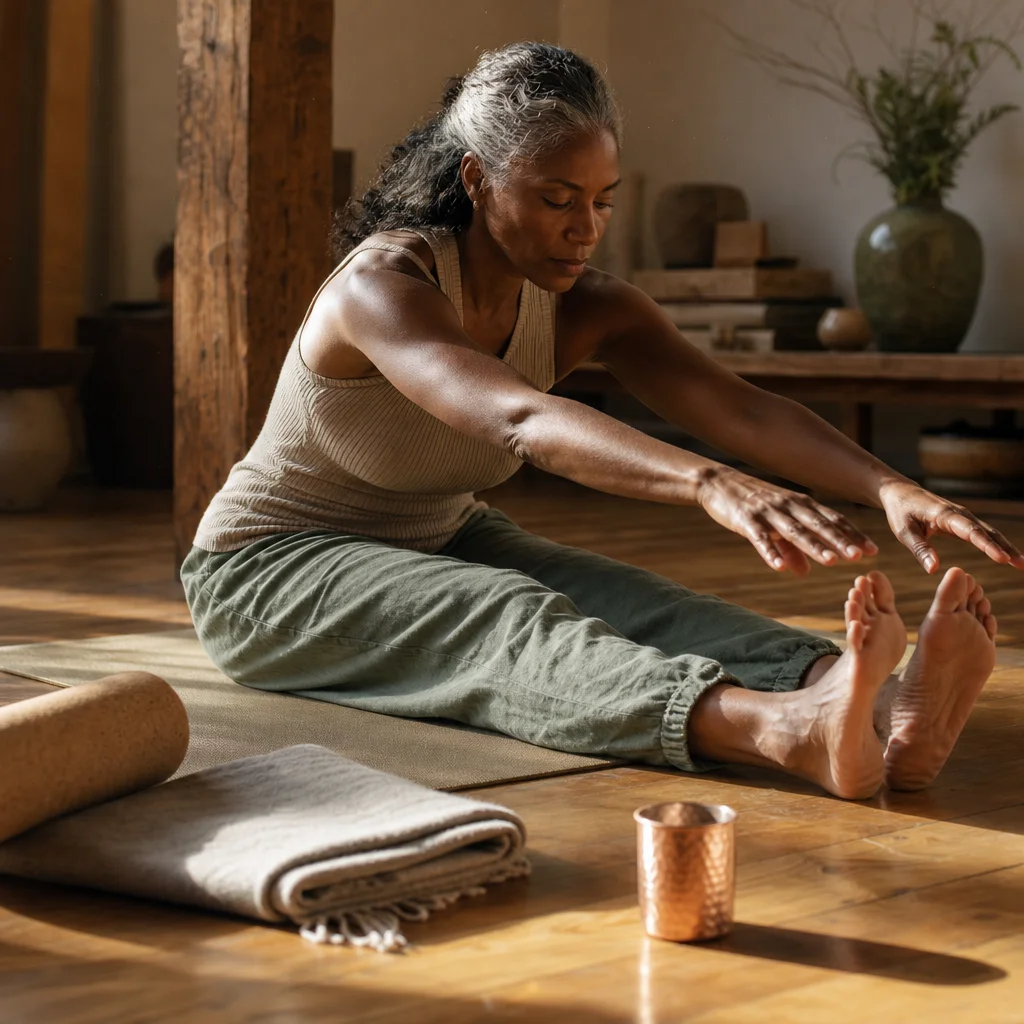
- Seated hamstring reach. Sit tall with your right leg long and your left knee bent. Hinge forward from the hips over the straight leg, keeping your spine long. Bend that knee a little if your lower back objects.
- Thread the needle. Start on all fours. Slide your right arm under your body, palm up, letting your right shoulder and cheek settle toward the floor. Reach your left arm forward or rest it behind you. Breathe slowly and let the upper back unwind.
- Heel drop off a step. Stand with the ball of your left foot on the edge of a step, heel hanging free. Let the heel sink below the step until you feel the calf lengthen. Hold a rail for balance if you need it.
Hold each static move for 15 to 30 seconds. Two or three rounds per side gets you to the 60-second target. If your range runs out before the clock does, ease back to a place that feels gently stretched, not sharp.
And skip the bouncing. Bobbing keeps the muscle braced instead of letting it settle. In practice, consistency beats intensity when it comes to stretching for flexibility. Two or three sessions a week is plenty to start.
Does Nutrition Make You More Flexible?
Not directly. No food or supplement makes your muscles longer or your joints looser. What good nutrition does is support the muscle function and recovery that help you keep showing up. That means steady hydration, enough protein, and regular meals. Not a magic powder.
Two Popular Claims That Do Not Hold Up
Let’s be honest about what stretching will not do. Two claims show up everywhere, and the evidence does not back either one.
Claim one: stretching prevents injury. Some sport-specific studies hint at a benefit. However, the overall evidence does not show that stretching lowers injury risk in general. What genuinely reduces risk is strength training, gradual loading, and balance work.
Claim two: stretching reduces next-day soreness. This one gets repeated constantly. The trial evidence does not support it. Light movement, good sleep, enough protein, and time do more for soreness than a post-workout stretch.
That does not make stretching for flexibility pointless. It makes it precisely useful. You stretch for range of motion. You train strength for resilience. Those are two different jobs.
What Happens If You Stop?
Picture this. You build a solid routine for three months, then life gets busy. Do you lose everything? No.
A 2025 meta-analysis of 13 studies with 556 people looked at exactly this. During training, range of motion improved a lot. After two to six weeks off, it stayed moderately above where participants started. It did dip slightly from peak.
Mayo Clinic makes the same point in plainer terms. Your range of motion may slide back if you stop stretching. The reassuring part is that it does not vanish.
One detail stood out. Only participants who stayed generally physically active kept their gains fully. So the maintenance plan for stretching for flexibility is not heroic. Keep moving, and stretch when you can.
The researchers graded their confidence as high for gaining flexibility and low for keeping it. Read that as a nudge rather than a promise.
Who Should Be Careful
Stretching for flexibility is gentle, but it is not risk-free for everyone. Stop and check with a clinician if a stretch causes pain, or if you notice numbness, tingling, weakness or an unexplained loss of mobility.
Get clearance first if you have had a recent injury or surgery. If you live with chronic pain, a physical therapist can build a plan around your body instead of a generic one.
Expect tension, not pain. Mayo Clinic’s guidance on stretching safely draws that line clearly. If it hurts, you have pushed too far. Back off to a range that feels comfortable, then hold there.
One more group deserves a mention: people with joint hypermobility. Clinicians often note that for people whose joints already move beyond a normal range, building strength and control matters more than gaining more range.
Aim for symmetry, not maximum range. Equal flexibility on both sides matters more than touching your toes. Uneven flexibility may be a risk factor for injury. If long hours at a desk are what leave you tight, our guide to posture practices for sitting at a desk all day pairs well with these stretches.
Frequently Asked Questions
How long until I notice a difference?
In one six-week study of 20 people, range of motion improved measurably at three weeks and again at six — so a few weeks of consistent practice is a reasonable timeframe to expect change.
Should I stretch before a workout?
Do dynamic movement before. Save static holds for after. If you really want to stretch first, keep the holds short and follow with a few minutes of activity.
Can I stretch every day?
The evidence-based minimum is two or more days a week. More frequent gentle stretching is generally fine, but avoid forcing range or repeatedly hammering the same tight muscle group.
Is stretching enough on its own?
No. Pair it with strength and balance training. Those do more for injury resilience than stretching does.
The Bottom Line
Stretching for flexibility works. It just does not work the way the myth suggests. You are not pulling your muscles longer. You are teaching your system to tolerate more tension while your tissue offers slightly less resistance.
Here is the reframe that makes stretching for flexibility feel like something you can keep. You do not need painful holds or daily hour-long sessions. You need moderate, regular work. Dynamic movement before activity. Static holds after. Sixty seconds total per exercise, two or more days a week.
Start small this week. Warm up for five minutes, run through five stretches, and stop at tension. Then do it again in a few days. That is the whole secret, and it is a genuinely healthy habit worth keeping.