
Ultra-Processed Baby Food: A Practical Parent’s Guide
Key Takeaways
- A major 2026 study found that 71% of baby foods sold in U.S. grocery stores are ultra-processed.
- Not all processing is bad — iron-fortified cereal and infant formula are important exceptions.
- Some additives (carrageenan, synthetic dyes, artificial flavors) are best avoided. Others (vitamin C, DHA, pectin) are harmless or helpful.
- The best approach is simple: prioritize whole foods, read labels carefully, and don’t aim for perfection.
- Early eating habits matter — babies who eat more whole foods in year one consume fewer ultra-processed foods later in childhood.
Picture this: You’re standing in the baby food aisle, comparing pouches. One says “organic.” One says “non-GMO.” Another boasts “no added sugar.” But what’s actually inside? A major 2026 study stopped parents in their tracks: over 70% of baby foods on shelves qualify as ultra-processed baby food. And the top ingredient in most of them wasn’t a fruit or vegetable. It was an additive.
Here’s the thing: this isn’t about making parents feel guilty. You have enough on your plate. This is about giving you a simple, practical framework. You can make informed choices without spending hours on every label. Let’s break down what “ultra-processed” really means. Here are the ingredients to watch for. And here is how to make swaps that work for real life.
Quick Answer: Is All Ultra-Processed Baby Food Bad for My Baby?
No. The key is knowing the difference. Some processing is for safety and nutrition. Other processing adds industrial additives. Iron-fortified infant cereal is a UPF. But it gives your baby key nutrients. Infant formula is another key exception. The goal is not to cut out all packaged foods. It is to know which ones to choose and which ones to limit.
What “Ultra-Processed Baby Food” Actually Means
You’ve seen the term in the news. But what does it actually mean? Scientists use the NOVA food system. It sorts foods into four groups based on how much they have been changed from their natural state.
- Group 1 (Unprocessed/Minimally Processed): Fresh or frozen fruits, veggies, meat, eggs, and milk. Think of a steamed sweet potato.
- Group 2 (Processed Cooking Ingredients): Oils, butter, salt, sugar, and honey.
- Group 3 (Processed): Canned veggies, jarred tomato sauce, cheese, and fresh bread. They mix Group 1 and Group 2.
- Group 4 (Ultra-Processed): Factory-made items. They have ingredients you would not use in your home kitchen. Think protein isolates, modified starches, artificial colors, and preservatives.
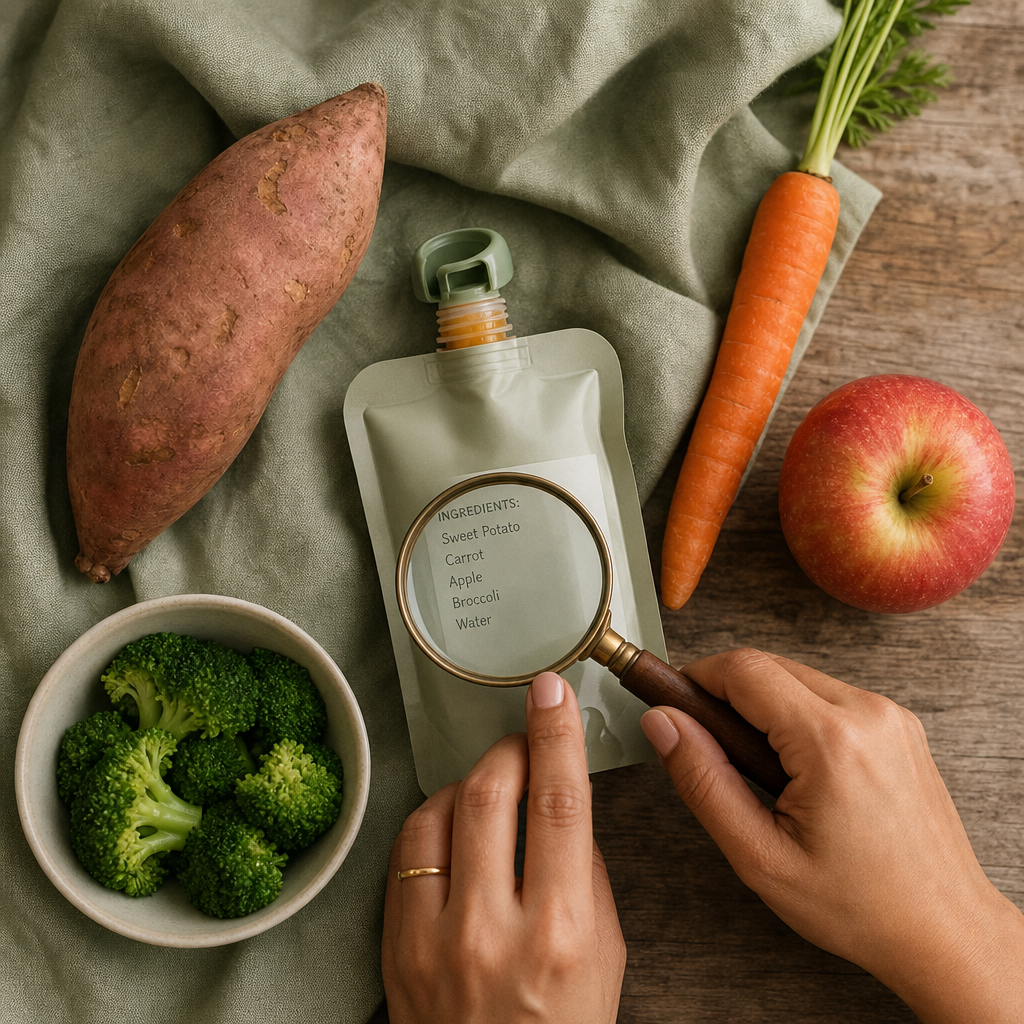
What does this mean for your baby? A jar of pureed sweet potatoes with just sweet potatoes and water is processed (Group 3). But a fruit pouch with apple puree, pear puree, ascorbic acid, pectin, natural flavor, and citric acid? That’s ultra-processed baby food (Group 4).
Here’s a simple rule of thumb
If the ingredient list is longer than two or three lines, and it contains things you do not have in your own kitchen (xanthan gum, natural flavors, soy lecithin, fruit juice concentrate), you are likely looking at ultra-processed baby food.
What the Science Actually Says About Ultra-Processed Baby Food
Let’s get into the hard numbers. A February 2026 study from the University of North Carolina was published in Nutrients journal. Researchers looked at 651 baby and toddler foods from the 10 biggest U.S. grocery stores. Here is what they found:
- 71% of the foods were ultra-processed baby food.
- They found 105 different additives across all products.
- The most common ones were flavor enhancers (36%), thickeners (29%), emulsifiers (19%), and colors (19%).
- Added sugar showed up only in ultra-processed products. And there was twice as much of it compared to minimally processed options.
- Some snack foods had up to 56 individual ingredients.
The lead researcher was shocked. “The top ingredient in 71% of these baby foods wasn’t a fruit or vegetable,” she said. “It was one or more additives.”
But here is where nuance matters. A 2024 study in Current Developments in Nutrition showed that infant diet quality predicts later UPF intake. Babies who ate more whole foods at 12 months ate less ultra-processed food later. At ages 2 to 5, they got 24% to 29% less energy from UPFs. Early choices really do shape long-term habits. But they do not have to be perfect.
The Environmental Working Group notes that regulatory oversight has not kept up. Nearly 99% of new food additives enter the market through the GRAS loophole. This lets makers decide safety on their own, without FDA review. The American Academy of Pediatrics has called for changes to this system.
The TEOHL Additive Decoder: What to Watch For
Shopping for ultra-processed baby food means reading labels closely. But how do you know what to skip? I have made a simple color-coded guide. Use it to scan packages fast.
Green: Generally Helpful or Harmless
Vitamin C (ascorbic acid) is used as a preservative. It’s good for your baby. Iron (ferrous sulfate) is added to fortified cereals. It prevents anemia. DHA is an omega-3 fat for brain growth. Pectin is a natural fiber from fruit. Live yogurt cultures are fine. These have a clear purpose and are well-studied.
Yellow: Proceed with Awareness
Xanthan gum and guar gum are plant-based thickeners. They are generally safe, but they show a high level of processing. Natural flavors is a vague term. It can cover many different chemicals. Sunflower or soy lecithin are emulsifiers. They are safe, but not needed in whole-food purees. Concentrated fruit juice adds sweetness. It lacks the fiber of whole fruit. These are not dangerous. But they tell you that you are holding an ultra-processed product.
Red: Best to Minimize or Avoid
Carrageenan is a seaweed-based thickener. Some studies link it to gut inflammation. Synthetic food dyes (Red 40, Yellow 5, Blue 1) are linked to behavior issues in some children. High fructose corn syrup and other added sugars are best avoided in the first two years. Artificial flavors are chemicals that copy natural tastes. If you see these, put the package back.
A Practical Framework for Real Families
Let’s be honest: making all your baby’s food from scratch sounds nice. But you are busy. Here is a realistic way to handle it.
The 80/20 Rule: Aim for 80% of your baby’s food to be whole or lightly processed. The other 20% can be convenient packaged foods. That emergency pouch in the diaper bag? That is the 20%. The mashed banana and steamed carrots at home? That is the 80%.
Stage-by-Stage Guide:
- Starting Solids (6-8 months): Use single-ingredient purees. Look for jars with one or two items. Make a batch of steamed carrots on Sunday. It takes 15 minutes.
- Exploring Textures (8-10 months): Mash up what you are eating. Roast a sweet potato with your dinner. Serve soft broccoli spears.
- Finger Foods (10-12 months): Skip the baby puffs. They are almost always ultra-processed baby food. Offer soft fruit slices, strips of omelet, or well-cooked pasta instead.
Label-Reading Hack: Flip the package over. If the list is longer than three lines, you may be holding ultra-processed baby food. Scan it with the Additive Decoder above. See a Red item? Put it back. Green and Yellow items are fine for the 20%.
Frequently Asked Questions
Is organic baby food ultra-processed too?
Yes. “Organic” tells you how the food was grown. It does not tell you how it was processed. An organic fruit pouch can have organic natural flavors, organic gum acacia, and organic concentrated juice. It is still ultra-processed. Organic sugar is still sugar.
What about baby puffs and teething crackers?
They are almost all ultra-processed. Most are made from rice or oat flour with added starches and sugars. A better choice? A chilled cucumber spear, a silicone teether, or a strip of lightly toasted bread.
Is infant formula ultra-processed?
Yes, under the NOVA system, it is. This is a key exception. Formula is strictly regulated. It gives complete nutrition for babies who are not breastfed. Do not avoid formula out of fear of processing. It is a safe and life-saving product.
How do I start cutting back?
Start small. Swap one pouch a day for a homemade or minimally processed option. Batch-cook one vegetable on Sunday. Small changes add up over time.
The Bottom Line
You are doing a great job. Reading this article shows how much you care. The goal is not to cut out every bit of ultra-processed baby food. That is not realistic. What matters is making smart choices most of the time.
Focus on variety. Watch for Red additives. Trust your gut. Babies do not need perfect nutrition every single day. They need loving parents who pay attention and make the best choices they can. Now you have the tools. Go ahead and feel confident in that grocery aisle.