

Diets for Slower Aging: What 10 Healthy Patterns Share
Key Takeaways
- A 2026 study of about 7,500 people linked ten different healthy eating patterns to slower biological aging.
- Researchers scored how closely people already ate against ten standards. Nobody was put on a diet.
- The effect was modest. In a US cohort study, the highest- and lowest-quality carbohydrate patterns differed by roughly one year of biological age — a measurable gap, not a reset button.
- A separate twin study found the link shrinks when family background is factored in.
- Fiber was the nutrient with the strongest and most consistent signal across these studies. Start there.
If you have been hunting for diets for slower aging, you have probably noticed the advice changes weekly. One headline says Mediterranean. The next says plant-based. Then someone insists it is all about cutting carbs. It is exhausting.
Here is what is actually happening. In 2026, a team at the German Center for Neurodegenerative Diseases published a study in Nature Communications. They looked at diet and biological aging in about 7,500 people.
Their conclusion surprised almost nobody in nutrition science and confused almost everyone else. Healthy eating was linked to slower biological aging. And it barely mattered which healthy pattern people followed.
That last part is the whole story. The researchers did not hand anyone ten diets for slower aging. They scored how closely people already ate against ten established healthy-eating standards. Let’s unpack what that means for your plate.
Quick Answer: Do I Have to Pick One Perfect Diet?
No. Ten different healthy patterns were linked to slower biological aging in the same study, and no pattern was clearly superior — the differences between them were modest in absolute terms. What mattered was overall diet quality — plenty of plants, whole grains, fiber, and fewer ultra-processed foods.
Diets for Slower Aging: What the Study Actually Tested
Most coverage got the premise slightly wrong, so let’s be precise. The team scored habitual diets against ten diet-quality standards. These are measuring tools, not meal plans you sign up for.
Several are familiar names: Mediterranean, Nordic, DASH, MIND, and a plant-based pattern. The others are established scoring systems that each measure diet quality in a slightly different way. Every one of them asks a specific question about your food.
Participants came from the Rhineland Study in Bonn, and the findings held up in a second German cohort. Together that was 6,470 people plus 1,034 more. All ten patterns pointed the same direction: better diet quality, slower biological aging.
One detail stands out. Almost nobody ranked in the top quarter of adherence on more than one standard at once. Healthy eating, it turns out, is not one behavior. It is a family of them.
What Is an Epigenetic Clock, in Plain English?
Your DNA picks up chemical tags over time. Those tags switch genes on and off, and they shift in a predictable way as you get older. Scientists read that pattern and turn it into an estimate of biological age. This study used three clocks and looked at about 850,000 sites in the DNA — roughly twice as many as most earlier studies.
Biological Age vs. Your Birthday Age
Your birthday age is fixed. Biological age is an estimate of how well your body is running right now. Two people born the same year can be years apart on that second number.
But here is the catch. Biological age is not one thing. Several formulas exist, and they do not always agree. In the Dutch Lifelines-DEEP analysis, one clock (PCGrimAge) showed the strongest and most consistent dietary associations, while the others lost significance once inflammation was accounted for.
So treat any “your biological age is X” result as a rough estimate, not a verdict. That goes double when someone is selling you the test. Diet is also only one piece — our guide to healthy aging strategies for the years ahead covers the rest.
The Five Habits Most Healthy Patterns Share
This is where the research becomes genuinely useful. Strip away the labels and the ten standards overlap heavily. Here is the common ground.
- Plants take up half the plate. The National Institute on Aging suggests vegetables and fruits fill one-half of your dish at meals.
- Whole grains beat refined ones. Aim for at least half your grain foods to be whole — oats, brown rice, whole wheat, barley.
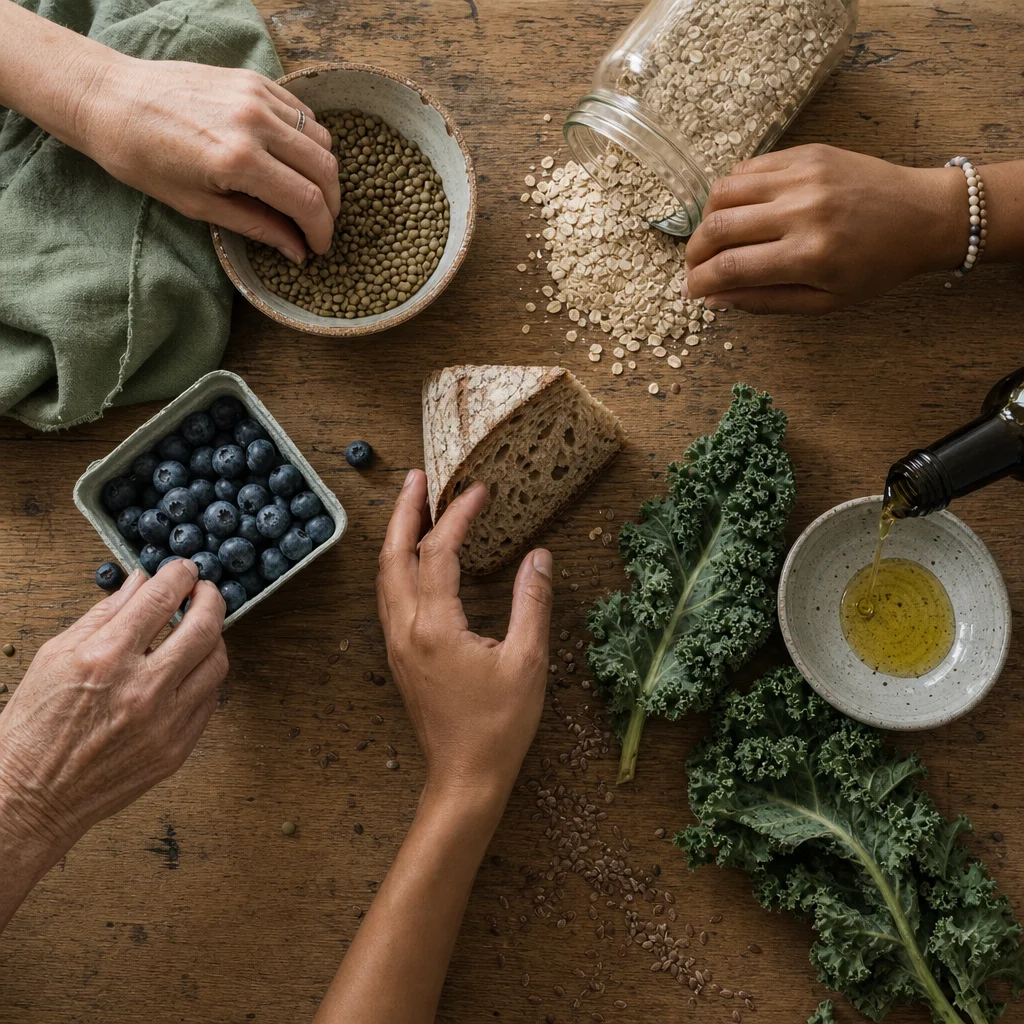
- Fiber gets priority. Beans, lentils, berries, and vegetables are the backbone of every pattern on that list.
- Oils replace solid fats. Plant oils over butter and lard. The NIA suggests 5 to 8 teaspoons of oils daily for older adults.
- Ultra-processed food shrinks. Sugary drinks, packaged snacks, and processed meats keep showing up unfavorably.
Most diets for slower aging, whatever the label, lean on these same five moves. A Mediterranean plate and a DASH plate look different. Underneath, they are cousins.
How Big Is the Effect, Really?
When people ask about diets for slower aging, they usually want one winner. The numbers suggest something less dramatic and far more useful.
One US cohort study compared the highest- and lowest-quality carbohydrate patterns among CARDIA participants. The top versus bottom group differed by about 1.2 years of epigenetic age acceleration.
Fiber-rich eating patterns showed a similar gap, roughly 1.1 to 1.3 years. So we are talking about a year, not a decade.
Worth saying plainly: that year-scale gap comes from US cohort data. The German ten-pattern study never reported one.
The DZNE authors did not put a year figure on their own results. They were candid about size instead. Prof. Monique Breteler, who directs the Rhineland Study, said in their announcement that the effects are “not massive, but they are measurable and relevant for prevention.” That is an unusually honest sentence for a press cycle.
The Caveat Almost Nobody Mentions
Here is where I want you to trust this article more than the rest. A separate 2026 study looked at identical twins. These are people who share almost all their genes and grew up together.
In simple analyses, eating closer to dietary guidelines looked protective. PCGrimAge ran 0.55 to 0.67 years lower. The pace of aging was 3.1% slower per point on the diet index.
Then the researchers compared twins to each other. The link weakened. Much of it could be explained by genetics and shared upbringing, not food alone.
So does diet not matter? It probably does. But the honest answer about diets for slower aging is smaller than the cheerleading suggests. Direction consistent, size uncertain.
What these studies cannot do is prove cause and effect. They are observational. They show that better diets travel with slower biological aging. They do not show that changing your diet will reset your clock.
Why Ultra-Processed Food Keeps Showing Up
If one food category deserves your attention, it is ultra-processed food. A 2026 Dutch study of 691 adults found a clear pattern worth knowing.
People who ate more ultra-processed food showed faster biological aging. Much of that link ran through low-grade inflammation — a quiet, body-wide irritation.
Vegetables and tea went the other way. Both were tied to slower aging, partly because they lower that background inflammation.
Start Here This Week
You do not need to memorize ten diets for slower aging or adopt a new identity. You need five small changes you can repeat. Pick one and start.
- Add fiber at breakfast. Oats, beans, berries, or ground flaxseed. In a 5,310-person Australian cohort, each 12 grams of daily fiber tracked with slower biological aging.
- Swap one sweetened drink. Sugary and artificially sweetened drinks both tracked with faster aging. Unsweetened tea and water are the easy wins.
- Make half the plate produce. Frozen and canned count. Choose the versions with the least added sugar and salt. One small upgrade: pairing tomatoes with olive oil boosts lycopene absorption.
- Pick one whole grain. Switch white rice for brown, or white bread for whole wheat. Small swaps stack.
- Cut one packaged snack. Not all of them. The one you eat most often on autopilot.
So do diets for slower aging require giving up bread, meat, or dairy? No. Plant-forward is the common thread, not veganism.
One more thing, and it matters. The researchers noted that having several healthy patterns to choose from leaves room for budget, culture, and taste. A rice-and-beans plate can score well on several of the patterns in this study, and it costs a fraction of what salmon and quinoa do. Budget is not a moral failing.
A Surprising Finding — and a Serious Warning
One result raised eyebrows. The diet-aging link was strongest in smokers.
Read that carefully. It does not mean smoking is fine. The authors stressed plainly that smoking is very harmful to health.
Their best guess is simpler. When your baseline health is worse, there is more room to gain from eating well. That is not a reason to light up. It is a reason to act if you already have risk factors.
Frequently Asked Questions
Do diets for slower aging have to be fully plant-based?
No. Several of the patterns studied include fish, eggs, and modest amounts of dairy. The shared feature is plenty of whole plant foods, not a total ban on animal foods.
Should I buy a supplement or an at-home biological age test?
None of the studies in this article tested a supplement, and there is no strong trial evidence that any supplement slows an epigenetic clock. The evidence points to whole-food eating patterns instead. As for the tests, they use different formulas and can give you different answers. Spend the money on groceries first.
Does this count if my diet is already pretty good?
Yes. Diets for slower aging appear to reward improvement, not perfection. The cohort studies measured a range of diet quality, and the benefits showed up across it. Small gains are still gains.
The Bottom Line
Here is the takeaway I want you to keep. Diets for slower aging work best as a pattern you keep, not a plan you finish.
The science says something quietly encouraging. You do not have to choose the perfect label. Ten different healthy patterns were linked to slower biological aging, and they share the same handful of habits.
Fill half your plate with plants. Choose whole grains. Eat more fiber. Cook with olive oil instead of butter. Cut back on ultra-processed food. Do it most weeks, not all weeks.
Movement is the other half of the equation — see the life-extending power of squats for that side of healthy aging.
And stay honest about the size of the prize. This is a modest edge, not a reset button. It is still one of the better edges you can give yourself — and you can start at your next meal.
The Research Behind This Article
- Tavares et al., Nature Communications (2026) — ten diet quality scores and epigenetic aging in two German cohorts.
- Nygaard et al., GeroScience (2026) — the monozygotic twin study on diet and epigenetic age.
- Cribb et al., GeroScience (2025) — fiber, sweetened drinks, and methylation-based aging in 5,310 adults.
- Yi et al., The Journal of Nutrition (2025) — carbohydrate quality and epigenetic age acceleration in CARDIA.
- Bordoni et al., Clinical Nutrition (2026) — ultra-processed food, inflammation, and epigenetic aging.
- National Institute on Aging — food group guidance and serving targets.