

Best Peanut Butter for Diabetics: Which Jar to Buy
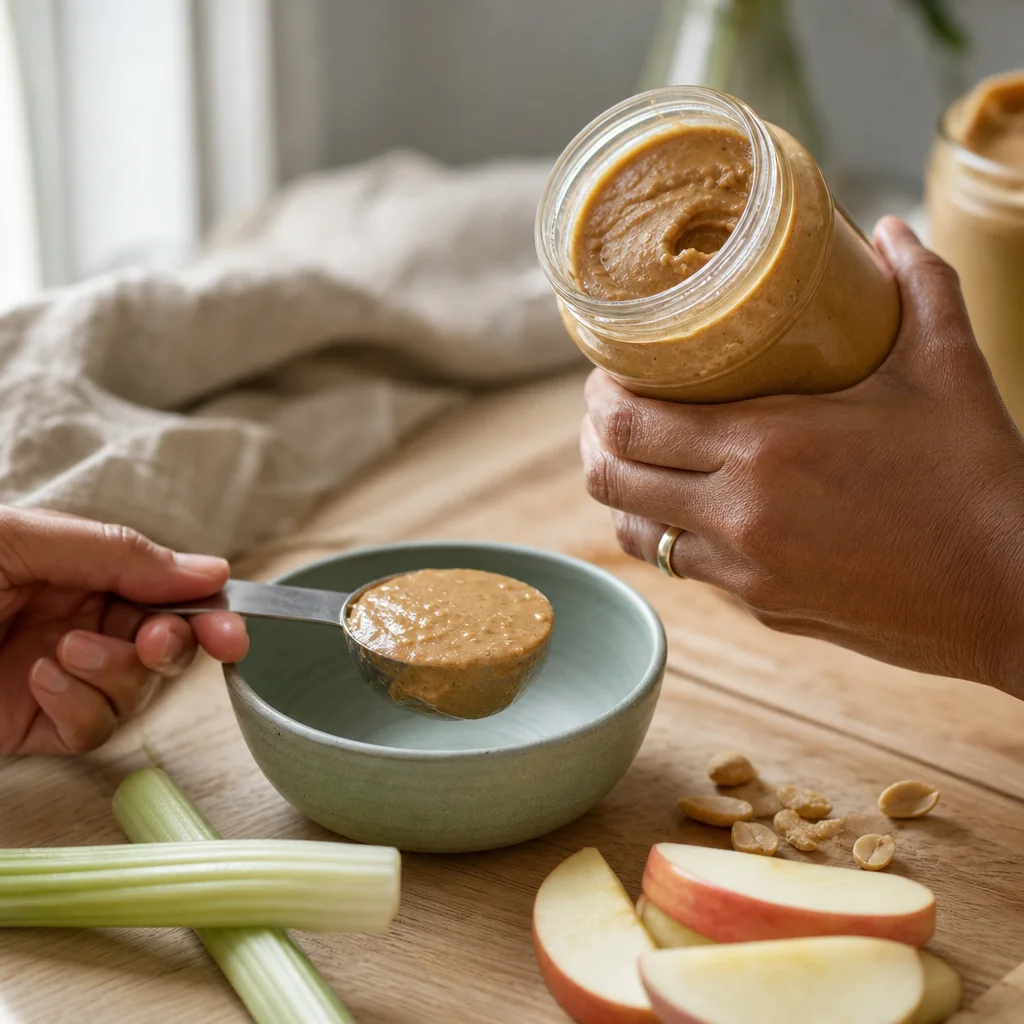
You’re in the peanut butter aisle with your meter in your bag and two jars in your hands. One says “natural” in big green letters. The other says “reduced fat” and sounds like the smarter choice. Which one goes in the cart? The best peanut butter for diabetics is the jar with the shortest ingredient list — here is how to choose it in practice.
Last updated: November 9, 2026
Quick Answer: Which Jar, And How Much
Two tablespoons of plain peanut butter gives you about 190 to 200 calories, 7 grams of protein, 6 to 7 grams of carbs, 1.5 grams of fiber, and 16 grams of fat. Three to 4 of those fat grams are saturated. The best peanut butter for diabetics is the jar that lists peanuts and maybe salt, and nothing else. Measure 2 tablespoons into a bowl, then count the carbs in whatever you spread it on.
Here’s the short answer. The best peanut butter for diabetics is plain, unsweetened peanut butter, kept to about 2 tablespoons a day. The rest is label reading, and it takes roughly 10 seconds once you know the three lines to check.
Below you’ll find the numbers per serving, five benefits each tied to a specific study, a shelf-by-shelf comparison table, and a safety section. Including the cautions the cautions that matter.
Best Peanut Butter For Diabetics: The 10-Second Label Screen
Turn the jar around. You only need three lines on that panel: the ingredient list, Added Sugars, and Sodium. Everything else can wait until you get home.
Start with ingredients. Peanuts. Maybe salt. Nothing else. If you spot palm oil, sugar, corn syrup, hydrogenated oil, or maltodextrin, put the jar back on the shelf.
Next comes the sugar trap, and it catches almost everyone. Plain peanut butter often shows 1 to 3 grams of Total Sugars per serving. Those sugars occur naturally in the peanuts. The line underneath is the one that matters: Added Sugars, which should read 0 g.
Shelf Styles Compared, Per 2 Tablespoons
| Jar style | Carbs | Fiber | Added sugar | Saturated fat |
|---|---|---|---|---|
| 100% peanuts, unsalted | 6–7 g | 1.5 g | 0 g | 3–4 g |
| 100% peanuts plus salt | 6–7 g | 1.5 g | 0 g | 3–4 g |
| No-stir, palm oil added | about 7 g | about 1.5 g | about 2 g | higher |
| Reduced-fat with maltodextrin | higher than regular | similar | often present | lower |
| Powdered (defatted) | check the label | varies | check the label | very low |
Figures are per 2-tablespoon (32 g) serving. Formulas vary by brand, so check your own jar.
The third line is sodium. A salted 2-tablespoon serving carries about 136 mg. If your blood pressure runs high, buy unsalted and spend your sodium elsewhere in the day.
Now the surprise. Reduced-fat jars are usually the worst pick for blood sugar. Makers replace fat with starch or maltodextrin, which pushes carbohydrate above regular peanut butter.
That’s the whole screen. The best peanut butter for diabetics is boring, plain, and usually cheap. Which is genuinely good news.
Does Peanut Butter Have Healthy Fats? The Half-Fat Serving Explained
By weight, a 2-tablespoon serving is about half fat — 16 g out of 32 g. Protein and carbohydrate come in at roughly 7 g each. So treat it as a fat source first and a protein source second.
Here’s what those 16 grams of fat look like in one serving. Only 3 to 4 grams are saturated. The other 12 grams or so are unsaturated, the same family you get from olive oil and avocado.
That gap is why peanut butter counts as a healthy fat source for most people. Saturated fat is not dangerous in a 3-gram dose. But four tablespoons doubles it, and that’s where portions start to matter.
Two tablespoons also brings a little fiber and a real mineral hit. That’s more than butter or jam contributes to the same slice of toast.
How Much Healthy Fat Is In Peanut Butter — And How Much Per Day
Two tablespoons is the working default, and it holds for most adults with type 2 diabetes or prediabetes. That’s your 16 grams of fat, roughly 190 to 200 calories, and 6 to 7 grams of carbs.
Why two and not four? Fat carries about 9 calories per gram. Doubling the spoon doubles the calories, and peanut butter disappears fast.
Pairing is where the blood sugar work happens. On celery or cucumber, peanut butter adds almost no carbs. On bread it does, so count that bread.
One rule keeps the snack simple: aim to keep the whole plate under about 15 grams of carbs. Two tablespoons plus a few celery sticks stays far below that. Two tablespoons plus two slices of toast blows past it.
Need more snack ideas that fit that budget? Our roundup of 25 snacks for diabetics that won’t spike your blood sugar is built around the same numbers.
This is exactly how NIDDK’s meal-planning guidance frames diabetes eating: watch carbohydrate, limit saturated fat and sodium, and control portions. Peanut butter fits that frame well at two tablespoons.
Benefit 1: The Fat-Fiber-Protein Trio Flattens The Post-Meal Curve
This is the benefit that matters most if you’re watching a meter. Fat slows digestion. Protein and fiber slow it further. Together they change the shape of the glucose curve after a meal.
The best-matched trial here is small but pointed. Fifteen women with obesity and high type 2 diabetes risk ate a carb-heavy breakfast with 42.5 grams of peanut butter added — about 2.5 tablespoons, a little more than the 2-tablespoon default here. The peanut butter group showed a lower glucose response in the second-meal window.
They also had higher levels of three satiety hormones and reported less desire to eat. That’s a real, measurable effect from one ingredient swap.
Now the part one detail matters. Insulin concentrations were higher at 120 minutes and again at 370 minutes after the peanut butter meal. The curve wasn’t lower so much as flatter, longer, and pushed later.
If you wear a continuous glucose monitor, expect that delayed rise. Check your reading at hour four or five, not only at hour one. That is the window the trial measured.
That same delay is why peanut butter is a poor fast fix for a low — the fat slows absorption by hours. Treat a low with fast-acting carbohydrate exactly as your care team has instructed, then add peanut butter afterwards to help steady things. Don’t rely on peanut butter alone to bring a low up.
Timing follows from the mechanism. Put your two tablespoons at breakfast or lunch, when you can move around afterward. If you eat it at night, pair it with protein and expect a later reading.
Benefit 2: About 21% Lower Diabetes Risk In The Largest Single Cohort Of Women
Here’s a number that gets quoted badly almost everywhere. The Nurses’ Health Study followed 83,818 women for 16 years. Women eating peanut butter five or more times a week had a relative risk of 0.79 for type 2 diabetes.
That’s roughly 21% lower risk. The association held regardless of body weight — it was not explained by peanut eaters being thinner.
The caveat comes next. A 2021 meta-analysis in the American Journal of Clinical Nutrition pooled the cohort data and found a smaller peanut butter estimate: a relative risk of 0.87.
That same analysis found no significant link for peanuts alone or for tree nuts. It also graded the certainty of the evidence as very low. No randomised trial has tested peanut butter against diabetes incidence.
So treat this as a reason to feel good about the jar, not a prevention promise. If you already have diabetes, the everyday value is the fat, fiber, and minerals.
For context on why low-glycemic foods matter at all, a 2024 meta-analysis of ten cohorts linked high-glycemic-index diets to 27% higher diabetes incidence.
Benefit 3: 49 mg Of Magnesium In A Group That Runs Low
Two tablespoons of smooth peanut butter supplies 49 mg of magnesium. That’s about 12% of the daily value, per the NIH Office of Dietary Supplements.
That figure lands differently for this audience. The same fact sheet lists people with type 2 diabetes among the groups most likely to run low. Higher glucose pushes more magnesium out through the kidneys.
Adult women need roughly 310 to 320 mg a day. Two tablespoons covers about one-sixth of that, which is a decent contribution on a busy morning.
Now the line that saves you money. The American Diabetes Association states there is not enough evidence to recommend magnesium supplements for blood sugar control. Get magnesium from food, not capsules.
Peanut butter also contributes potassium, another mineral involved in blood pressure regulation — though the magnesium figure above is the only mineral number we can quantify from a government source here. Between the magnesium, the potassium, and the unsaturated fat, it earns its place on a heart-conscious plate.
Benefit 4: Unsaturated Fat Beats Butter And Jam At The Same Spoon
Put two spreads side by side and the difference is obvious. Two tablespoons of peanut butter brings 16 grams of fat, mostly unsaturated, plus 7 grams of protein and some fiber.
Butter brings fat too, and it is mostly saturated, with little fiber. Jam brings sugar and little else. Chocolate-hazelnut spread brings added sugar and palm oil in the same spoon.
That makes peanut butter a swap, not an addition. You’re replacing something worse on the same slice of toast. The Nurses’ Health Study authors made exactly that point about calories.
Unsaturated-fat swaps add up across a week.
Benefit 5: Satiety And Weight At A Measured Two Tablespoons
Peanut butter is calorie dense. That part is true. But calorie dense is not the same as fattening, and the trial data on nuts is reassuring.
One meta-analysis pooled 86 randomised trials with 5,873 participants. Nuts had no adverse effect on body weight, at high certainty. Higher nut intake was actually linked to slightly lower body weight and body fat.
One catch matters here. Those trials measured nuts at set amounts. Nobody in a trial ate straight from the jar with a podcast on.
So keep the rule. Two tablespoons, into a bowl, then put the jar away. That’s the difference between a filling snack and 400 extra calories you never counted.
Weight matters for blood sugar, too. Losing 5% to 7% of body weight can improve glucose, cholesterol, and blood pressure, per NIDDK. Peanut butter helps most when it replaces refined carbs rather than piling on top of them.
Who Should Be Careful With Peanut Butter
Peanut butter is not right for everyone, and the reasons are specific. Here’s the list worth checking against your own health history.
Allergy, Sodium, And Medication Timing
Peanut allergy. This is a hard stop, not a caution. Peanut allergy can cause anaphylaxis, which is life threatening. If you’re allergic, talk to your allergist about safe swaps instead.
High blood pressure alongside diabetes. Salted peanut butter carries about 136 mg of sodium per 2 tablespoons. Choose unsalted and watch the rest of your day. Federal diabetes guidance points to limiting sodium and saturated fat together.
Insulin and sulfonylureas. A slower, longer curve can mean a later dip or a later rise. Talk to your care team before making peanut butter a daily habit, especially if you dose insulin.
Conditions Worth Discussing With Your Clinician
Very high triglycerides. A 2026 crossover study found nut butter raised post-meal triglycerides about 52% more than whole nuts. It was small and used healthy adults. Even so, this is one small study in healthy adults. Treat whole peanuts as a reasonable alternative, not a required swap. The same thing that flattens the glucose curve is what raises the triglyceride curve. Portion size is the lever.
Gastroparesis. Diabetes is the most common known cause of delayed stomach emptying. NIDDK recommends low-fat foods and five or six small meals. Sixteen grams of fat in one snack may be too much for you.
Chronic kidney disease. If you follow a renal diet, check with your kidney team first. Renal plans cap potassium and phosphorus, so your portion needs to fit yours.
Anyone watching their weight. Two tablespoons is roughly 190 to 200 calories. Four tablespoons is a meal’s worth of calories in a snack.
How we researched this
We reviewed the research package assembled for this article, including government data, clinical guidance and peer-reviewed studies.
This article is for general information and is not a substitute for advice from your doctor or dietitian.
FAQ: Peanut Butter And Blood Sugar Questions
Is peanut butter healthy to eat every day?
Yes, for most people with diabetes, at 2 tablespoons a day. It supplies protein, unsaturated fat, magnesium, and potassium for about 190 to 200 calories. The daily habit only backfires when the spoon comes from the jar instead of a measuring spoon.
Is peanut butter healthy at night?
It’s workable, but morning is better. Fat slows digestion, so a nighttime serving can show up as a delayed rise four to six hours later, often while you’re asleep. If you want it at night, keep it to 1 or 2 tablespoons and pair it with protein.
Is peanut butter healthy for weight loss?
It can be, at a measured portion. Trials on nuts show no weight gain at controlled intakes, and higher nut intake tracks with slightly lower body fat. The catch is portion size, because 2 tablespoons is calorie dense and 4 tablespoons is a snack-sized meal.
Is peanut butter healthy for the heart?
Mostly yes. The fat is largely unsaturated, and it supplies magnesium, which the NIH lists as involved in blood pressure regulation. The two things to watch are saturated fat at large portions and sodium in salted brands.
Is peanut butter healthy or unhealthy?
Both answers exist, and the jar decides. Plain peanut butter with no added sugar or palm oil, eaten at 2 tablespoons, is a solid diabetes-friendly food. Sweetened, reduced-fat, or flavored versions shift the balance toward carbohydrate and added sugar.
The Bottom Line
Buy the jar with peanuts on the ingredient list and 0 g of Added Sugars. Measure 2 tablespoons, eat it with a carb or a vegetable, and keep the whole snack under about 15 grams of carbs.
Then check your meter at hour four or five, not just hour one. Peanut butter doesn’t erase a glucose rise. It spreads it out, which is a very different promise.
One last thing worth saying plainly. If you’re on a fixed grocery budget, plain peanut butter is one of the most affordable sources of protein and unsaturated fat in the store. That’s rare, and it’s worth using.