

Protein Over 50: The Simple Timing Shift for Stronger Muscles
Key Takeaways
- Shift your focus to timing: Eating protein at every meal — not just dinner — helps your muscles use it better.
- Aim for 25 to 30 grams per meal: This amount supports the muscle-building signal your body needs after 50.
- Your total matters, too: Target 1.0 to 1.2 grams of protein per kilogram of body weight daily.
- Pair protein with strength training: Research shows protein helps most when you also do resistance exercises.
Let’s talk about something that sounds simple but is actually a biological game-changer for women in their 50s and 60s: protein. You’ve probably heard you need more of it as you age. And that’s true. Here’s what most advice gets wrong. It focuses entirely on the total for the day. The smartest way to think about protein over 50 isn’t just about eating more. It’s about eating it at the right times.
Here’s the problem. Most of us are accidentally doing the opposite. We skimp on protein at breakfast, grab a modest lunch, and then load up at dinner. This pattern misses the window for muscle support at breakfast and lunch. And for women over 50, that timing gap can make a real difference for your energy and strength.
Let’s walk through what the science says about protein over 50 — and how you can redistribute your intake for better results without cooking more.
Quick Answer: How Much Protein Over 50 Do I Need?
Aim for 1.0 to 1.2 grams of protein per kilogram of body weight each day. For a 150-pound woman, that’s about 68 to 82 grams of protein daily. The key is to divide that evenly across your meals — roughly 25 to 30 grams at breakfast, lunch, and dinner. This pattern helps your muscles build and repair all day long.
What Happens to Muscle Protein After 50?
After 50, your body starts to change how it handles protein. This process is called anabolic resistance — basically, your muscles become less sensitive to the amino acids in protein. The signal to build muscle gets weaker, even if you’re eating the same amount you did in your 30s.
Declining estrogen plays a big role here. It makes your body less efficient at turning dietary protein into lean muscle. The long-running Framingham study found that higher protein intake helped women preserve grip strength by nearly 50%. That’s a powerful incentive to adjust your intake.
On the flip side, if you don’t adjust, you lose muscle mass more quickly. That loss affects your metabolism, your balance, and your independence down the road. So how do you push past this resistance? That’s where distribution comes in.
How Much Protein Over 50 Do Women Actually Need?
The standard RDA of 0.8 grams per kilogram of body weight is outdated for women in this stage of life — we break down exactly why in our complete guide to daily protein needs. It was designed as the minimum to prevent deficiency, not the amount to help you thrive. For women over 50, the target is higher.
The European Society for Clinical and Economic Aspects of Osteoporosis (ESCEO) recommends 1.0 to 1.2 grams per kilogram of body weight daily, with 20 to 25 grams of high-quality protein at each main meal.
Here’s what that looks like in numbers. If you weigh 150 pounds, divide that by 2.2 to get your weight in kilograms. That’s 68 kilograms. Multiply that by 1.1, and your target is about 75 grams of protein per day. Spread evenly, that’s roughly 25 grams per meal.
Your Simple Protein Target
Step 1: Take your weight in pounds and divide by 2.2.
Step 2: Multiply that number by 1.1.
Example: 150 lbs ÷ 2.2 = 68 kg. 68 kg × 1.1 = 75 grams of protein per day.
The Leucine Threshold: Why 25g Per Meal Matters
You might be thinking, “Can’t I just have all my protein at dinner and call it a day?” Great question. Let’s look at why that doesn’t work as well after 50.
There’s a key amino acid called leucine that acts as a master switch for muscle building. Think of it as the key that unlocks your muscle-building machinery. High-quality proteins like eggs, dairy, meat, fish, and soy naturally provide enough leucine to trigger this process. That’s why getting 25 to 30 grams of protein at each meal matters even more after 50 — it ensures you get enough leucine with every meal to support muscle repair.
When you backload all your protein at dinner, you miss that muscle-building signal at breakfast and lunch. Your muscles go hours without the stimulus they need to repair and grow. Understanding this leucine concept is a crucial part of optimizing protein over 50.
Why Most Women Get Protein Timing Wrong (And How to Fix It)
The typical American eating pattern looks like this: 10 grams of protein at breakfast, 20 grams at lunch, and 50 grams at dinner. A national study found that only 19% of women over 51 consume at least 25 grams of protein at two or more meals daily. That means 81% of us are leaving muscle gains on the table.
The real secret to success with protein over 50 is fixing the “protein gap” at breakfast and lunch. Here are three simple swaps that redistribute your protein without requiring you to cook more.
3 Swaps to Redistribute Your Protein
- Swap 1: Instead of oatmeal with fruit, have Greek yogurt with berries, nuts, and a sprinkle of seeds.
- Swap 2: Instead of a lettuce wrap or salad for lunch, build a quinoa bowl with chickpeas, chicken, and a hard-boiled egg.
- Swap 3: Instead of a piece of fruit for a snack, pair it with peanut butter, a cheese stick, or a handful of almonds.
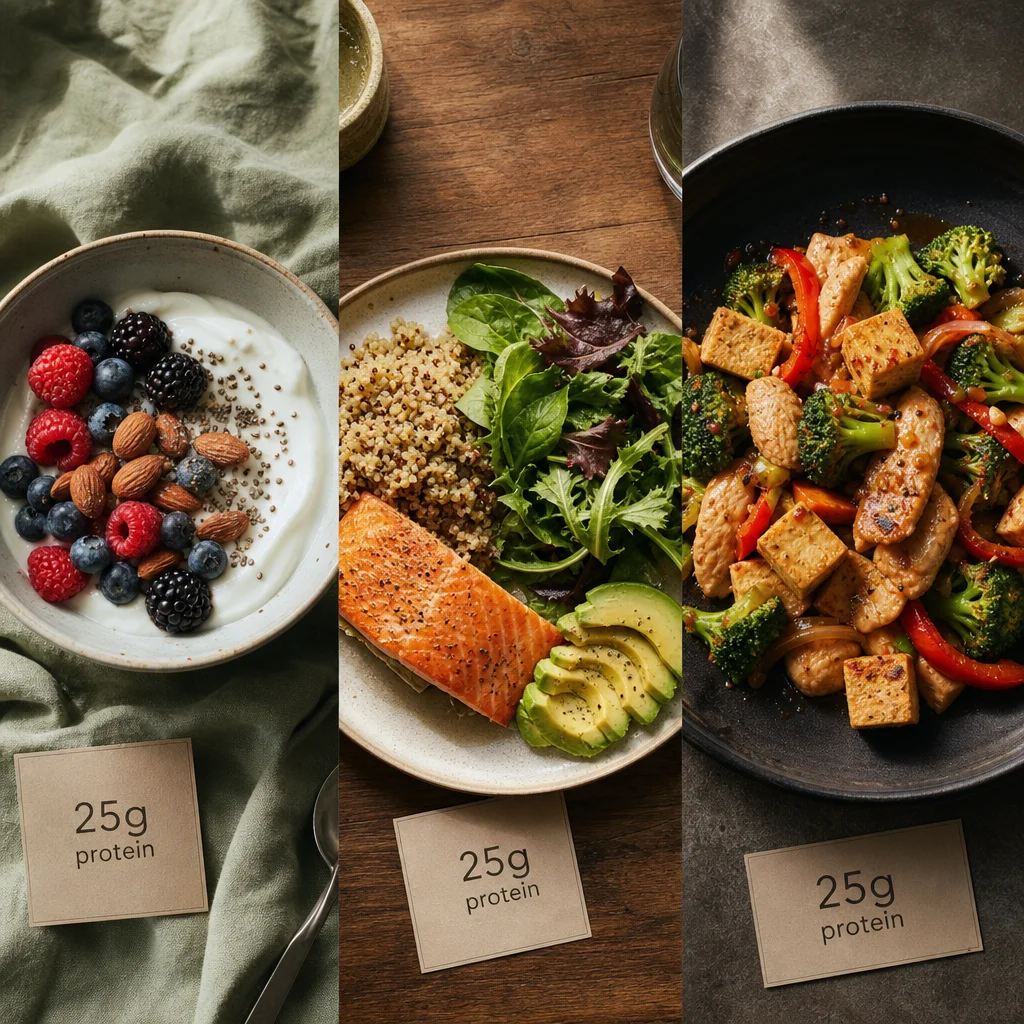
What 25 grams of protein looks like at each meal: At breakfast, that’s three eggs with a half-cup of black beans and some cheese. At lunch, it’s a 4-ounce chicken breast with a half-cup of quinoa. At dinner, it’s a 5-ounce salmon fillet with a cup of lentils.
Protein Over 50: A Simple Sample Day
Let’s bring the protein over 50 recommendations to life with a real day of eating. This sample day provides about 95 grams of protein total, which works well for a 150- to 170-pound woman. Notice how each meal includes a solid protein source. For a full week of protein-packed meals, explore our 7-day high protein meal plan for women.
Sample Day: Distributed Protein Pattern
Breakfast (25g protein): 7-ounce Greek yogurt parfait with 2 tablespoons of almonds and berries.
Lunch (30g protein): Salmon salad with 4 ounces of salmon, mixed greens, quinoa, and avocado.
Snack (15g protein): Half-cup of cottage cheese with sliced peaches.
Dinner (25g protein): Chicken stir-fry with tofu, broccoli, and bell peppers.
Planning your protein in advance makes distributed eating effortless — our high protein meal prep guide shows you exactly how to batch-cook and portion your meals for the week ahead.
The Protein + Strength Training Equation
I need to be really clear about something. Eating more protein alone will not automatically build muscle. A 2022 systematic review confirmed that protein supplementation only improved muscle strength when combined with resistance training. Without the training, it made no difference.
Here’s why. Resistance training sensitizes your muscle tissue to the protein you eat. It sends a signal to your body saying, “We need to repair and grow.” Protein then provides the actual building blocks for that repair. The combination is where the magic happens.
You don’t need a gym membership for this. Bodyweight squats, resistance bands, yoga, or lifting heavier grocery bags all count. Twice a week is enough to make a meaningful difference.
Is Eating More Protein Safe for Your Heart?
Many women worry that eating more protein, especially from animal sources, might harm their heart. The research tells a different story. A Duke University study found that a higher protein diet with 30 grams per meal actually improved cardiometabolic markers, including lower triglycerides.
Who Should Talk to a Doctor First?
If you have a pre-existing kidney condition, please work with your doctor or a registered dietitian to find the right protein target for your needs. The recommendations here are for generally healthy women. For everyone else, the 1.0 to 1.2 g/kg range is safe and well-supported by evidence.
The Bottom Line
Here’s your takeaway. Don’t just think about how much protein you eat. Think about when. The goal is to flip your protein pattern. Start strong at breakfast, keep it steady at lunch, and finish balanced at dinner. Pair that with twice-weekly strength training, and you’ve got a powerful formula for staying strong, energetic, and independent for decades to come.