

5 Body-Weight Visceral Fat Exercises for Women Over 50
Key Takeaways
- You don’t need a gym. Body-weight exercises like squats, planks, and lunges can effectively reduce visceral fat when done consistently.
- Combine strength with cardio. The best evidence shows that doing both resistance training and aerobic exercise gives the biggest reduction in visceral fat.
- Consistency beats intensity. Aim for at least 150 minutes of moderate-to-vigorous exercise per week. Even 30 minutes, 5 days a week, makes a real difference.
- Lifestyle matters too. Sleep, stress management, and eating enough protein and fiber all support your exercise efforts.
Have you noticed your waistband feeling a little tighter lately, even though the scale hasn’t budged much? You’re not alone. For many women, especially as we move through our 40s and beyond, fat tends to shift inward — wrapping around our internal organs as what’s known as visceral fat. The good news? You don’t need a gym membership, expensive equipment, or punishing workouts to fight back. The latest research shows that simple, body-weight visceral fat exercises can be incredibly effective, especially when you understand the science of why they work.
Here’s the thing: visceral fat isn’t just about how your clothes fit. It’s biologically active tissue that releases inflammatory compounds, and it’s linked to a higher risk of heart disease, type 2 diabetes, and other health issues. But research also shows that exercise is one of the most powerful tools we have to reduce it — even without dramatic weight loss. Let’s explore exactly which exercises work, how to do them, and how to build a routine that fits your life.
Quick Answer: Can Body-Weight Exercises Really Reduce Visceral Fat?
Yes. While most research uses weighted resistance training, body-weight exercises build muscle, improve insulin sensitivity, and create the metabolic demand needed to reduce visceral fat. A 2023 study in postmenopausal women found that 15 weeks of resistance training alone — without any aerobic exercise — significantly reduced visceral fat. The key is consistency and progressive overload: making your muscles work harder over time.
What Is Visceral Fat and Why Does It Matter?
Picture this: you have two types of belly fat. Subcutaneous fat is the pinchable stuff just under your skin. Visceral fat, on the other hand, sits deep inside your abdomen, wrapped around your liver, pancreas, and intestines. And it’s not just sitting there quietly.
As Harvard Health explains, visceral fat acts like an endocrine organ — it releases inflammatory chemicals that can disrupt your body’s normal function. This is why it’s linked to a higher risk of heart disease, type 2 diabetes, certain cancers, and even dementia. The good news? Visceral fat is also more metabolically active than subcutaneous fat, which means it responds well to exercise.
A simple way to check your risk: measure your waist at the level of your belly button. For women, a waist circumference of 35 inches or more suggests excess visceral fat. But here’s the encouraging part — even if your number is above that threshold, research shows that exercise can reduce visceral fat even without significant weight loss on the scale.
The Science: How Strength Training Reduces Visceral Fat
You might be wondering: how does doing a squat or a pushup actually burn fat deep in my belly? Let me explain what’s happening inside your body.
When you strength train, your muscles become more sensitive to insulin. This is a big deal because insulin resistance is one of the main drivers of visceral fat storage. When your muscles can use glucose (sugar) from your blood more effectively, your body doesn’t need to store as much of it as fat. A study in postmenopausal women found that 15 weeks of resistance training significantly reduced visceral fat — and the women who attended at least two of three weekly sessions saw the biggest benefits.
Strength training also helps lower chronic inflammation, another factor that drives visceral fat accumulation. And perhaps most importantly for women over 50, it preserves and builds muscle mass — which naturally declines with age. More muscle means a higher resting metabolism, which helps your body burn more calories even when you’re sitting still.
What the Latest Research Says
A comprehensive 2026 analysis of 61 studies found that all exercise types significantly reduce visceral fat. The most effective? High-intensity interval training (HIIT) ranked highest, followed closely by combined aerobic and resistance training. But here’s what matters for you: resistance training alone was also effective — especially for postmenopausal women. The takeaway? The best exercise is the one you’ll do consistently.
5 Body-Weight Visceral Fat Exercises You Can Do at Home
Now let’s get to the practical part. These five exercises target multiple large muscle groups, which creates the metabolic demand that helps reduce visceral fat. Each one includes a modification so you can start at your current fitness level and progress from there.
1. Body-Weight Squats
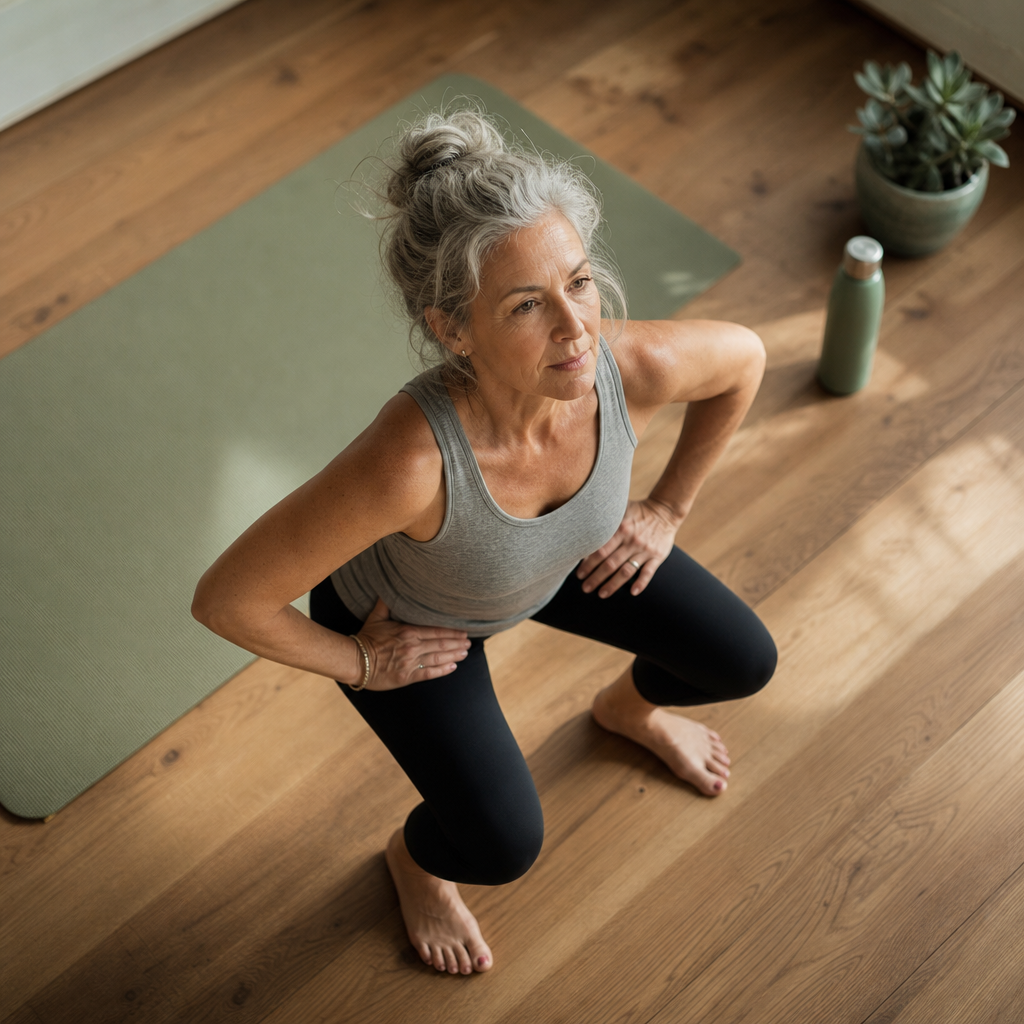
Body-weight squats target large muscle groups in the legs, hips and core. Your legs contain some of the largest muscles in your body. Working them creates a big metabolic response — meaning more calories burned and more fat mobilized.
How to do it: Stand with feet shoulder-width apart. Engage your core and keep your chest lifted. Bend your knees and push your hips back as if sitting into a chair. Lower until your thighs are nearly parallel to the floor (or as low as you can comfortably go). Push through your heels to stand back up. Aim for 8-12 reps, 2-3 sets.
Beginner modification: Try a seated squat. Sit on the edge of a sturdy chair with feet planted. Lean forward slightly, stand up fully, then slowly lower back down with control.
2. Step-Ups
Step-ups mimic stair climbing — a daily movement that also happens to be excellent for metabolic health. They recruit multiple muscle groups and elevate your heart rate.
How to do it: Stand in front of a low, stable step or bench. Step up with your right foot, pressing through the heel. Bring your left foot up to meet it. Step your left foot back down slowly, controlling the descent. Do 8-12 reps, then switch legs. Complete 2-3 sets per leg.
Beginner modification: Use a lower step (even a single stair step works) and hold a wall or railing for balance.
3. Plank
The plank is a full-body isometric exercise that builds core strength and stability. A strong core supports every other exercise you do.
How to do it: Start face-down with forearms on the floor, elbows under shoulders. Step your feet back to form a straight line from head to heels. Engage your core and glutes. Breathe steadily. Hold for as long as you can maintain good form — start with 20-30 seconds and build from there.
Beginner modification: Lower your knees to the ground while keeping alignment through your upper body.
4. Modified Pushups
Pushups work your chest, shoulders, arms, and core — all at once. The modified version (on your knees) makes this accessible while still building strength.
How to do it: Start on your knees with hands slightly wider than shoulder-width apart. Keep your body in a straight line from head to knees. Lower your chest toward the floor by bending your elbows — keep them close to your body, not flared out. Push back up. Aim for 8-12 reps, 2-3 sets.
Beginner modification: Do pushups against a wall or countertop. Stand at an angle and lower your chest toward the surface.
5. Walking Lunges
Walking lunges engage your legs, glutes, and core while also challenging your balance and coordination — skills that become increasingly important as we age.
How to do it: Stand with feet together. Step forward with your right leg and lower your body until both knees form 90-degree angles. Push through your right heel to stand, bringing your left leg forward into the next step. Continue alternating for 8-10 steps per leg. Do 2-3 rounds.
Beginner modification: Do stationary lunges instead — step forward and back to the same starting position, holding a wall for balance if needed.
How Much Visceral Fat Exercise Do You Need?
This is the question I hear most often: “How much do I actually need to do?” The evidence gives us a clear target.
A 2024 JAMA Network Open meta-analysis found that each 30 minutes of aerobic exercise per week reduced visceral fat area by about 1.6 cm². The dose-response was linear up to 300 minutes per week. For clinically meaningful results, the sweet spot was 150 minutes or more of moderate-to-vigorous exercise weekly.
Another 2026 systematic review found that combined training (aerobic + resistance) preferentially targets visceral fat over subcutaneous fat — nearly a 2:1 ratio. The optimal prescription: 3 or more sessions per week, 60 minutes each, with vigorous aerobic effort and moderate-to-low resistance effort.
Here’s a simple weekly structure to get you started:
- Monday: Body-weight strength circuit (squats, lunges, pushups, plank) — 30 minutes
- Tuesday: Brisk walk (make sure you have supportive walking shoes) or light jog — 30 minutes
- Wednesday: Body-weight strength circuit — 30 minutes
- Thursday: Brisk walk or cycling — 30 minutes
- Friday: Body-weight strength circuit — 30 minutes
- Saturday: Active recovery (gentle walk, stretching) — 20-30 minutes
- Sunday: Rest
This gives you 150 minutes of aerobic activity plus three strength sessions per week — right in line with the evidence.
Lifestyle Habits That Amplify Your Results
Exercise is powerful, but it works best as part of a bigger picture. Here are three habits that directly support visceral fat reduction:
Prioritize sleep. Poor sleep is strongly linked to higher visceral fat. When you’re sleep-deprived, your stress hormone (cortisol) rises, and your hunger hormones go haywire. Aim for 7-9 hours of quality sleep each night.
Eat enough protein. Protein supports muscle repair and growth, which is essential when you’re strength training. It also keeps you full longer, making it easier to maintain a healthy weight. Include a protein source at every meal — eggs, Greek yogurt, fish, chicken, beans, or lentils.
Move more throughout the day. Your formal exercise sessions matter, but so does everything else. Take the stairs. Park farther from the store. Do a few squats while waiting for your coffee to brew. These small movement bursts add up.
And if you’re experiencing a stubborn weight loss plateau, it may be related to how your body has adapted to previous dieting — a topic we explore in depth in our guide to metabolic adaptation and the 4-week fix.
Frequently Asked Questions About Visceral Fat Exercises
Can I lose visceral fat with bodyweight exercises alone?
Yes, especially if you apply progressive overload — meaning you make the exercises harder over time. You can do this by increasing reps, reducing rest between sets, or advancing to harder variations (like full pushups instead of modified). For best results, combine bodyweight strength work with aerobic exercise like brisk walking.
How long until I see results?
Most studies show measurable changes in visceral fat after 8-15 weeks of consistent exercise. You might notice your clothes fitting differently before you see a change on the scale. Waist circumference is a better measure of progress than body weight for visceral fat loss.
What if I have knee or back problems?
All five exercises above include modifications for joint issues. If squats bother your knees, start with seated squats. If planks hurt your wrists, do them on your forearms. If lunges are too much, try stationary lunges holding a wall. Listen to your body and never push through sharp pain. Consider working with a physical therapist for personalized guidance.
Should I do these exercises before or after cardio?
For best results, do your strength exercises first when your muscles are fresh. This allows you to lift with better form and get more out of each rep. Save your cardio (walking, cycling) for after strength work, or do them on separate days.
The Bottom Line
Here’s what I want you to take away from all of this: you don’t need a complicated gym routine or expensive equipment to reduce visceral fat. Simple, consistent body-weight exercises — done three times a week, combined with regular walking and good sleep — can make a real difference.
Start where you are. Do the beginner modifications if you need them. Focus on showing up consistently rather than pushing yourself to exhaustion. And remember: every squat, every lunge, every plank is sending a signal to your body to burn that deep belly fat and build the muscle that will keep you strong and healthy for years to come.
You’ve got this. And we’re here to help you every step of the way.