
Metabolic Adaptation: Why Women Over 40 Hit Weight Loss Plateaus (And the 4-Week Fix That Actually Works)
You’re doing everything right. You’ve cut calories, you’re hitting the gym, tracking every bite. The scale drops steadily for weeks, maybe months. Then suddenly—nothing. Two weeks pass. Three weeks. The number won’t budge. You cut calories even more. Still nothing. You add more cardio. The scale stays frozen.
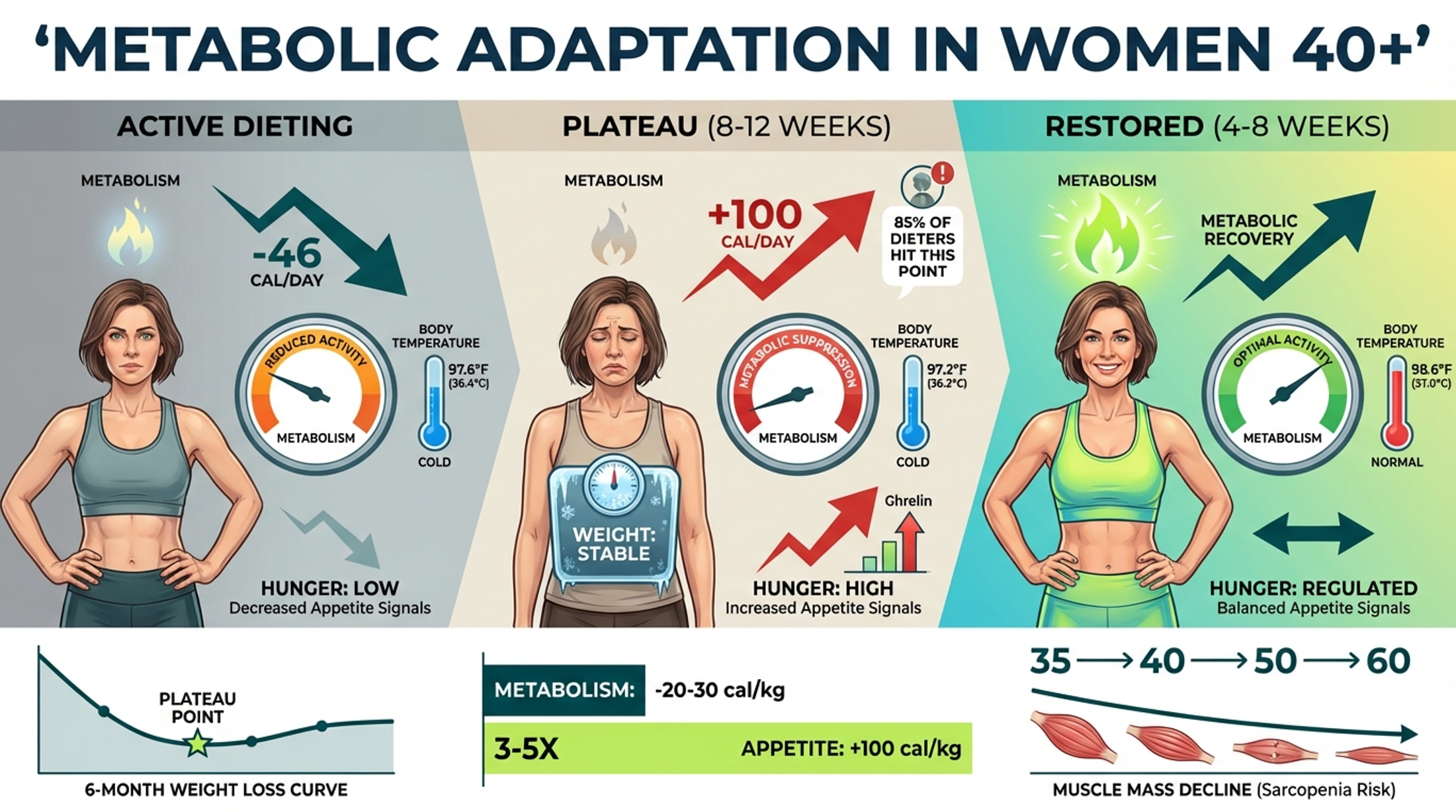
Welcome to metabolic adaptation, and you’re not alone. Research shows 85% of dieters hit weight loss plateaus, and if you’re a woman over 40, you’re facing a perfect storm of biological factors that make plateaus hit harder and last longer than they did in your 20s or 30s.
But here’s what nobody’s telling you: the solution isn’t eating less or exercising more. In fact, doing either of those things will make metabolic adaptation worse. The fix requires you to do something that sounds completely backwards—eat more strategically while training smarter, not harder.
Quick Answer: Can You Reverse Metabolic Adaptation?
Yes, metabolic adaptation is reversible in 4-8 weeks with strategic reverse dieting and strength training. Studies show women who increase calories gradually while prioritizing protein can restore metabolic rate and resume weight loss. The key isn’t eating less—it’s eating MORE strategically while preserving muscle mass.
What Is Metabolic Adaptation (And Why It’s Not Your Fault)
Metabolic adaptation, also called adaptive thermogenesis, is your body’s survival response to calorie restriction. When you diet, your body doesn’t know you’re trying to fit into smaller jeans. It thinks you’re starving.
Here’s what happens: as you lose weight, your resting metabolic rate (the calories you burn just existing) naturally decreases because you have less body mass to maintain. That’s expected. But metabolic adaptation goes beyond this normal decrease.
Your body’s biological drive to survive kicks in and slows your metabolism even MORE than what’s explained by weight loss alone. Your thyroid hormones shift, your muscle becomes more efficient (burning fewer calories), and your hunger hormones go haywire.
This isn’t a flaw in your willpower. It’s not because you’re not trying hard enough. It’s an ancient survival mechanism that kept our ancestors alive during famines. Unfortunately, your body can’t tell the difference between intentional dieting and actual starvation.
Why Women Over 40 Hit Metabolic Adaptation Harder
If you’re reading this and thinking “weight loss plateaus feel so much harder now than they did 10 years ago,” you’re absolutely right. Women over 40 face a triple threat that makes metabolic adaptation more severe and harder to reverse.
The Perimenopause Metabolism Crash
Between ages 45-55, women experience a hormonal earthquake. Estrogen levels plummet from 100-250 pg/mL during reproductive years to just 10 pg/mL after menopause. This isn’t a gentle decline—it’s a metabolic cliff.
Estrogen does far more than regulate your cycle. It’s a master metabolic hormone that controls insulin sensitivity, fat distribution, and appetite regulation. As it drops, your body becomes more insulin resistant, meaning you store fat more easily and burn it less efficiently. The fat you do store shifts from your hips and thighs to your abdomen, the most metabolically dangerous location.
This is why the same diet that worked in your 30s stops working in your 40s. These hormonal changes are part of the unspoken truth about women’s weight loss—your body is playing by completely different metabolic rules now.
The Muscle Loss Multiplier
Starting at age 30, women begin losing 3-8% of muscle mass per decade. After age 70, muscle loss accelerates to 0.5-1% per year, with women losing about 0.7% annually after age 75.
Why does this matter for metabolic adaptation? Because muscle is your metabolic engine. Every pound of muscle burns approximately 50 calories per day at rest. When you lose muscle, your resting metabolic rate drops accordingly.
Here’s the brutal math: if you’ve lost 10 pounds of muscle between ages 35 and 55 (a conservative estimate), that’s 500 fewer calories your body burns every single day just to exist. That’s why building strength through compound movements like squats becomes non-negotiable after 40.
When you combine natural muscle loss with calorie-restricted dieting that doesn’t prioritize protein and strength training, you accelerate muscle loss dramatically. This creates a vicious cycle: less muscle means slower metabolism, which means harder plateaus, which tempts you to cut calories further, which causes more muscle loss.
Lower Baseline Muscle Mass
Even before age-related muscle loss begins, women naturally have 30-35% less muscle mass than men. This means women start with a lower metabolic rate and less “buffer” against metabolic adaptation.
When a woman and man both lose 20 pounds, the woman experiences a proportionally larger impact on her metabolism because she had less muscle to begin with. A structured training program designed for women can help counteract this disadvantage.
The Shocking Truth: Your Hunger Matters More Than Your Metabolism
Here’s the stat that changes everything, and almost nobody talks about it.
When you lose weight, your metabolism slows by about 20-30 calories per day for every kilogram (2.2 pounds) lost. That’s the number everyone focuses on. But here’s what researchers discovered when they actually measured hunger hormones: your appetite increases by about 100 calories per day for every kilogram lost.
Read that again. Your hunger increases 3-5X more than your metabolism decreases.
This means the primary challenge during metabolic adaptation isn’t actually your slower metabolism—it’s your ravenous appetite. Your brain is receiving signals that you’re starving, and it’s cranking up hunger hormones like ghrelin while suppressing fullness hormones like leptin and GLP-1.
This explains why willpower feels impossible during a plateau. It’s not a character flaw. Your biology is literally fighting you with every hormonal weapon it has. Natural compounds like cinnamon may help manage blood sugar spikes that trigger hunger, but they can’t override this powerful biological drive on their own.
Signs You’re in Metabolic Adaptation
How do you know if you’re experiencing true metabolic adaptation versus just normal fluctuations? Here are the telltale signs:
Your scale hasn’t moved in 2+ weeks despite maintaining your diet and exercise routine. Normal weight fluctuations happen day to day, but metabolic adaptation creates a stubborn multi-week plateau.
You’re always cold, especially in your hands and feet. Your body is conserving energy by reducing heat production. If you’re reaching for sweaters when everyone else is comfortable, that’s a red flag.
You’re exhausted despite adequate sleep. Poor sleep is both a cause and symptom of metabolic adaptation. Your body is running on reduced energy, leading to chronic fatigue.
Your hair is thinning or falling out. When your body thinks it’s starving, it diverts resources away from “non-essential” functions like hair growth.
You’re constantly hungry despite eating. Remember the appetite stat? This is it in action. Your hunger hormones are screaming for more food.
Your workout performance is declining. You’re lifting lighter weights, running slower paces, or just can’t push as hard as you used to. This is your body conserving energy.
If you’re experiencing three or more of these symptoms, you’re likely in metabolic adaptation. The good news? Research shows it’s reversible.
The 4-Week Reverse Diet Protocol for Women Over 40
The solution to metabolic adaptation isn’t what you think. You don’t need to cut calories further or add more cardio. You need to strategically eat MORE to restore your metabolic rate.
This approach, called reverse dieting, has been proven effective in studies. Here’s exactly how to do it:
Weeks 1-2: Initial Calorie Increase
Add 100-150 calories per day to your current intake, focusing entirely on protein. Calculate your protein needs—you should be eating 0.8-1g per pound of goal body weight (not current weight).
If you’re currently eating 1,200 calories, increase to 1,300-1,350. If you’re struggling to hit protein targets through food alone, high-quality protein powder can help bridge the gap.
Monitor your weight daily but look at weekly averages. You might see a small 1-2 pound increase initially—this is water weight from increased food volume, not fat gain. Don’t panic.
Weeks 3-4: Continue the Climb
Add another 100-150 calories per day. Now you’re 200-300 calories above where you started. Continue prioritizing protein, but now you can add strategic carbohydrates around your workouts.
Understanding your macro balance becomes crucial here. Aim for 30% protein, 40% carbs, 30% fat as a starting point, adjusting based on your response.
Some women find carb cycling helps break through stubborn plateaus during this phase—higher carbs on strength training days, lower on rest days.
Weeks 5-8: Assess and Adjust
By week 5, most women notice energy returning, hunger normalizing, and body temperature rising. The scale might not have changed much, but measurements often show you’re maintaining or even losing inches.
Your goal is to increase calories until you reach your maintenance level (the amount where your weight stabilizes). For most women over 40, true maintenance is 1,600-2,000 calories, not the 1,200 many are told to eat.
Why Strength Training Prevents Metabolic Adaptation
If reverse dieting is the nutritional solution, strength training is the physical one. Here’s why it’s non-negotiable.
When you lose weight through diet alone, about 25% of what you lose is muscle. When you combine diet with cardio, you might increase that to 30% muscle loss. But when you combine diet with progressive strength training, you can preserve or even build muscle while losing fat.
Every pound of muscle you preserve is 50 calories per day that your metabolism doesn’t lose. Over time, this adds up tremendously. It’s the difference between maintaining weight loss effortlessly versus constantly fighting to keep pounds off.
Strength training also triggers EPOC (excess post-exercise oxygen consumption), meaning you continue burning extra calories for 24-48 hours after your workout. Cardio doesn’t provide this same sustained metabolic boost.
For women over 40, compound movements like squats, deadlifts, and rows should be your foundation. These exercises work multiple muscle groups simultaneously, giving you the most metabolic bang for your buck.
And contrary to popular belief, strength training doesn’t just build muscle—it’s also the most powerful tool for brain health, improving cognitive function and reducing dementia risk.
What NOT to Do During a Plateau
When faced with a stubborn scale, most women make these mistakes. Avoid them at all costs:
Don’t cut calories further. This is like throwing gasoline on a fire. You’ll deepen metabolic adaptation and make your plateau worse. Instead, learn how to jumpstart weight loss the right way.
Don’t add more cardio. While cardio has benefits, adding hours of it burns muscle along with fat, worsening your metabolic situation. Your body becomes more efficient at cardio over time, meaning you burn fewer calories for the same workout.
Don’t ignore protein needs. Protein is the most metabolically expensive macronutrient to digest (burning 20-30% of its calories during digestion) and the building block of muscle. Skimping here accelerates muscle loss.
Don’t skip strength training. If you’re only doing cardio or diet alone, you’re losing valuable muscle with every pound. This makes future plateaus even worse.
Don’t expect overnight results. Metabolic adaptation didn’t develop overnight, and it won’t reverse overnight. Give the reverse diet protocol a full 4-8 weeks before making judgments.
Don’t rely on supplements alone. While peptides and cinnamon extract may support weight loss, they can’t replace proper nutrition and training. Use them as tools, not solutions.
Who Should NOT Reverse Diet Without Medical Supervision
Reverse dieting is safe for most women, but certain conditions require doctor oversight:
History of eating disorders. If you have a history of anorexia, bulimia, or binge eating disorder, work with both a therapist and registered dietitian specialized in eating disorders before attempting reverse dieting.
Type 1 diabetes or insulin-dependent Type 2 diabetes. Changing your food intake affects insulin needs. Your endocrinologist needs to adjust medication accordingly.
Severe hypothyroidism (untreated). While hypothyroidism doesn’t prevent reverse dieting, untreated severe cases need medical management first.
Taking medications that affect metabolism. Some medications (certain antidepressants, antipsychotics, corticosteroids) significantly impact metabolism. Discuss with your prescribing physician.
Pregnant or breastfeeding. This isn’t the time for metabolic experimentation. Focus on adequate nutrition for you and your baby.
Timeline Expectations: When Will You See Results?
One of the biggest frustrations with metabolic adaptation is not knowing when things will improve. Here’s what research tells us about realistic timelines:
Plateau typically hits at 8-12 weeks into a diet. Studies show most people achieve maximum weight loss at 6 months, after which weight maintenance or slow regain begins.
Metabolic adaptation develops over 12-16 weeks of calorie restriction. The longer and more severely you’ve restricted, the more pronounced the adaptation.
Reverse diet should last 4-8 weeks minimum to restore metabolic function. Some women need 12 weeks, especially if they’ve been dieting severely for months or years.
Results become visible 2-4 weeks into the reverse diet. You’ll notice energy returning, hunger normalizing, and strength improving before the scale moves.
Full metabolic recovery takes 6-12 weeks. Research on women shows metabolic adaptation averaging -46 calories per day can resolve with proper refeeding.
Weight loss can resume once your metabolism is restored. After the reverse diet, you can return to a small deficit (200-300 calories) and resume losing—but this time, your body won’t fight you as hard.
Once your metabolism is restored, return to foundational weight loss strategies for women over 40 to continue making progress.
Important Note: If you’re over 50, specific strategies for women over 50 may be more appropriate. Women over 60 face additional challenges and should read our complete guide for women over 60.
Frequently Asked Questions
How do I know if I’m in metabolic adaptation or just not trying hard enough?
If your scale hasn’t moved in 2+ weeks despite maintaining your diet and exercise, you’re cold all the time, constantly exhausted, and ravenously hungry—that’s metabolic adaptation, not lack of effort. The truth is, it’s almost never about “trying harder”—your biology is working against you. Track your symptoms: cold hands/feet, fatigue despite adequate sleep, declining workout performance, and persistent hunger are all signs your metabolism has adapted.
Will reverse dieting make me gain weight?
You may see a small 1-3 pound increase initially, but this is water weight from increased food volume and glycogen storage, not fat gain. Most women maintain their weight or even continue losing slowly during a reverse diet because their metabolism speeds up. Track your macros carefully to ensure you’re increasing the right nutrients (prioritize protein) in the right amounts (100-150 calories every 1-2 weeks).
Can I reverse metabolic adaptation from years of yo-yo dieting?
Yes, but it takes longer. If you’ve been cycling between restrictive diets and regain for years, your metabolism has learned to adapt quickly. Expect to spend 8-12 weeks reverse dieting instead of 4-6. The good news? Your metabolism can be reset at any age. Focus on building muscle through strength training while gradually increasing calories. This is a marathon, not a sprint—but it’s absolutely reversible with patience and consistency.
The Bottom Line: Work WITH Your Body, Not Against It
Metabolic adaptation isn’t a character flaw or a sign you’re not trying hard enough. It’s your body’s sophisticated survival response, evolved over millions of years to keep you alive during famine. The problem is, your body can’t distinguish between intentional dieting and actual starvation.
For women over 40, this biological reality is compounded by declining estrogen, progressive muscle loss, and lower baseline muscle mass. These factors create the perfect storm for stubborn plateaus that feel impossible to break.
But here’s the empowering truth: metabolic adaptation is reversible. The solution isn’t eating less or exercising more—it’s eating MORE strategically while training smarter. The 4-week reverse diet protocol, combined with progressive strength training, can restore your metabolism and get you losing weight again.
Remember these key takeaways:
Your appetite increases 3-5X more than your metabolism decreases during weight loss. This is why hunger feels overwhelming—it’s biology, not willpower failure.
Women over 40 lose 3-8% of muscle mass per decade, with loss accelerating after 60. Preserving muscle through strength training is your most powerful metabolic weapon.
Reverse dieting works by gradually increasing calories (100-150 per 1-2 weeks) while prioritizing protein, allowing your metabolism to recover before resuming weight loss.
Timeline matters: give yourself 4-8 weeks for the reverse diet, then return to a small deficit once metabolic function is restored.
Metabolic health is foundational for healthy aging—what you do today shapes your vitality for decades to come.
Your body isn’t broken. It’s not betraying you. It’s doing exactly what it evolved to do. Once you understand this, you can work WITH your biology instead of fighting against it. And that’s when real, sustainable progress becomes possible.
Need additional support? Explore these 5 free strategies specifically designed for women’s weight loss to complement your reverse diet protocol.
Related Articles
- Weight Loss for Women Over 40: Complete Evidence-Based Guide
- Weight Loss for Women Over 50: Complete Guide 2026
- How to Jumpstart Weight Loss After 40: Women’s Guide
- Training Programs for Women’s Weight Loss: What Actually Works
- Squats and Longevity: The Ultimate Healthy Aging Exercise
- Macros for Weight Loss Women: Complete Calculation Guide
- How Much Protein Do I Need Daily? Women’s Calculator
- Carb Cycling for Women’s Weight Loss: Complete Protocol
- Sleep Architecture and Women’s Weight Loss: The Connection
- Women’s Weight Loss Program: 5 Free Evidence-Based Strategies