

Is Your Period App Wrong? What Hormone Tracking Reveals About Your Cycle
Key Takeaways
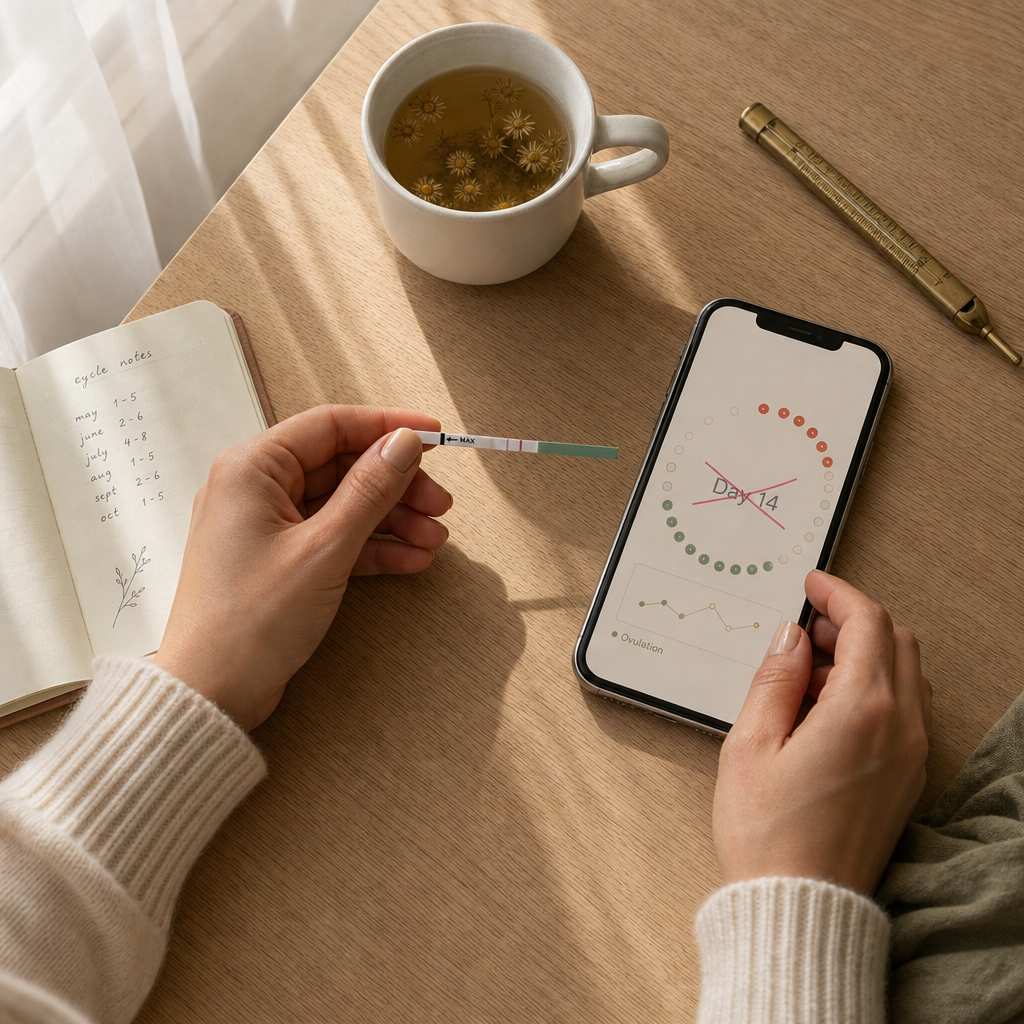
- Generic period apps often get ovulation wrong. Research shows only 13% of women ovulate on day 14, and app prediction accuracy can be as low as 21%.
- At-home hormone tracking gives you real data. Urine LH strips, PdG tests, and multi-hormone monitors can confirm ovulation and reveal your actual fertile window.
- Inexpensive OPK strips work just as well as premium brands. A 2025 study found that budget-friendly brands like Easy@Home and Pregmate had equal or better accuracy than Clearblue.
- Your data is a tool for self-advocacy. Bringing a log of your hormone patterns to your doctor can lead to faster answers and more informed care.
- Hormone tracking isn’t just for fertility. It can help with cycle irregularity, PCOS awareness, perimenopause preparation, and general body literacy.
Imagine this: you’ve used a period tracking app for years. It tells you when you ovulate. You trust it. But what if it’s been wrong the whole time? That’s what Rumer Willis found out. After having her daughter in 2023, she tried an at-home fertility monitor called Mira. The results shocked her. “I realized through using Mira that when I was ovulating, according to the algorithms, that I was actually much later,” Willis said. “If I had been trying to get pregnant, I would have missed it every month.” Her story points to a big issue: many women rely on apps that use averages, not their own biology. Here’s what you need to know about hormone tracking, why it matters, and how to pick the right method for you.
Quick Answer: What is hormone tracking?
Hormone tracking means measuring your actual hormone levels — usually through urine tests or wearable sensors — to see where you are in your cycle. Unlike period apps that guess based on averages, hormone tracking detects what’s really happening. It can confirm ovulation, find your fertile window, and give you data to share with your doctor.
Why Your Period App Might Be Wrong
Here’s the thing: most period apps use a simple rule. They assume a 28-day cycle with ovulation on day 14. But research shows that’s not how most bodies work. A 2024 analysis by researchers at the University of Sydney and the University of Newcastle, published in The Conversation, found that only 13 to 16 percent of women have a 28-day cycle. And only 13 percent ovulate on day 14. For more than half of women, cycle length changes by five or more days from month to month. Hormones influence cycle health in ways that can be easy to overlook — as we explored in our coverage of how overlooked hormone issues can affect women’s overall health.
A 2018 study cited by experts at Cedars-Sinai Medical Center found that the accuracy of ovulation prediction by menstrual cycle apps was no better than 21 percent. That means four out of five times, the app’s guess could be off. “Unless someone is checking ovulation through physical means, like by using an ovulation prediction kit, the cycle app is just providing an estimate,” says Dr. Jessica Chan, a fertility expert at Cedars-Sinai.
This doesn’t mean apps are useless. They can help you track patterns and symptoms. But if you rely on one to time pregnancy or avoid it, you might be working with bad data.
What Hormone Tracking Actually Measures
Hormone tracking moves past guesswork. Instead of averages, you measure the actual hormones that drive your cycle. Here are the key ones and what they tell you.
Luteinizing Hormone (LH). This hormone surges 24 to 36 hours before ovulation. Standard ovulation predictor kits (OPKs) find this surge. When you get a positive result, ovulation is likely coming soon. A 2025 study in Fertility and Sterility found that at-home OPKs are highly accurate — over 91 percent — for finding the LH surge compared to blood tests.
Estrogen (E3G). Estrogen rises in the days before the LH surge. Some advanced monitors track estrogen with LH to give you more warning before ovulation. This helps you spot your fertile window earlier.
Progesterone (PdG). After ovulation, progesterone rises and stays high if ovulation worked. PdG tests — which measure a breakdown product of progesterone in urine — can confirm that ovulation actually happened. Standard OPKs can’t do this. They only predict that ovulation might happen.
Follicle-Stimulating Hormone (FSH). FSH helps your ovaries get an egg ready. Some multi-hormone monitors track FSH too, which can help you understand ovarian reserve or approaching perimenopause.
The Key Difference: Prediction vs. Confirmation
Standard OPKs predict ovulation by finding the LH surge. But a surge doesn’t always mean ovulation happens — a condition called luteinized unruptured follicle syndrome (LUFS). Multi-hormone monitors that track PdG can confirm ovulation by finding the progesterone rise that follows. This matters a lot if you’re trying to get pregnant or understand cycle issues.
Your Options for Hormone Tracking: A Full Comparison
The world of hormone tracking has grown far beyond the basic calendar app. Here’s a look at your options, from simplest to most advanced.
1. Ovulation Predictor Kits (OPKs)
These are urine test strips that find the LH surge. You can buy them at any drugstore or online. A 2025 study in Fertility and Sterility tested five popular brands — Easy@Home, Wondfo, Pregmate, Clearblue, and Clinical Guard — and found all were over 91 percent accurate at finding the LH surge compared to blood tests. Here’s the surprise: the cheap strip tests (Easy@Home, Wondfo, Pregmate) had better sensitivity than the pricier Clearblue and Clinical Guard. So you don’t need to spend a lot to get good results.
Cost: Low — roughly $10 to $30 per month for daily testing (prices vary by brand). What it measures: LH only. Best for: Finding the LH surge and timing sex for pregnancy.
2. Multi-Hormone Fertility Monitors
These are more advanced devices that measure several hormones from one urine sample. The Mira monitor (the one Rumer Willis used) tracks LH, estrogen (E3G), and PdG. The Inito monitor tracks LH, estrogen, PdG, and FSH. Clearblue has a digital monitor that tracks LH and estrogen.
The upside? You get a fuller picture. You can see your estrogen rise before the LH surge, giving you earlier notice of your fertile window. And the PdG measurement confirms that ovulation actually happened. The downside is cost. These monitors need a one-time device buy (moderate to significant upfront cost) plus ongoing test stick costs each month.
Cost: Moderate to significant upfront investment, plus ongoing monthly costs. What it measures: LH, estrogen, PdG (and sometimes FSH). Best for: Confirming ovulation, tracking cycle health, and getting the most complete data.
3. Wearable Devices
Smart rings, wristbands, and arm patches can track body changes that relate to your cycle. A 2024 review in the Journal of Medical Internet Research found that wearables — worn on the wrist, finger, or inside the ear — showed high accuracy for finding the fertile window by tracking changes in heart rate, heart rate variability, temperature, and breathing rate. Devices like the Oura Ring, Apple Watch, and Tempdrop fall into this group.
The trade-off? Wearables are easy — you don’t have to pee on a stick each morning. But they don’t measure hormones directly. They measure body changes that relate to your cycle. This can be less exact than urine testing, especially if you have irregular cycles or certain health issues.
Cost: One-time device purchase, varies by brand. What it measures: Temperature, heart rate, HRV, breathing rate. Best for: Easy, passive tracking without daily testing; general cycle awareness.
4. Traditional Fertility Awareness Methods (FAMs)
Before all this tech, women tracked cycles using basal body temperature (BBT), cervical mucus changes, and calendar math. The American College of Obstetricians and Gynecologists (ACOG) recognizes these as valid family planning methods. The best approach is the symptothermal method, which mixes BBT and cervical mucus tracking. When used perfectly, fewer than 1 to 5 women out of 100 will get pregnant in the first year. With typical use, that number rises to 12 to 24 out of 100.
Cost: Free (just a thermometer and a chart). What it measures: Temperature and cervical mucus. Best for: Women who want a no-cost, non-digital approach and are willing to spend time learning.
How to Choose the Right Hormone Tracking Method for You
The best method depends on your goals. Here’s a simple way to think about it.
If you’re trying to get pregnant: Start with standard OPKs. They’re cheap, accurate, and work well for timing sex. If you’ve been trying for several months without success, think about a multi-hormone monitor that can confirm ovulation with PdG testing. This can help you and your doctor see if ovulation is actually happening.
If you’re using tracking to avoid pregnancy: Be careful with calendar-based apps alone. The proof for app-based birth control is limited. A 2026 systematic review found typical-use failure rates of 5.8 to 6.8 percent for cycle tracking apps, with cumulative pregnancy rates up to 8.3 percent — comparable to condoms. But the quality of the studies is low, and most were paid for by the app companies. If you want to use fertility awareness to avoid pregnancy, learn the symptothermal method from a trained teacher. Mixing BBT, cervical mucus tracking, and OPKs gives you the most reliable picture.
If you want to understand your cycle for general health: A wearable device like the Oura Ring or a simple BBT thermometer can give you useful insights without daily testing. You’ll learn about your cycle length, whether you’re ovulating, and how stress or lifestyle changes affect your patterns.
If you have irregular cycles or PCOS: Some women with PCOS may have elevated baseline LH, which can make standard OPK results harder to interpret. A multi-hormone monitor that tracks PdG can help you confirm whether ovulation is actually happening. Work with your healthcare provider to understand what your results mean for you.
Using Your Hormone Tracking Data with Your Doctor
This is where hormone tracking becomes truly powerful. As Rumer Willis put it, “Finding tools, especially tools that you can have at home, that you have the power in your own hands to be able to then say to a doctor, ‘Hey, here’s my data… I need you to listen to me because I have this wealth of knowledge that you can’t dispute.'” Turning personal health data into action is especially important given how often women’s concerns are dismissed — as highlighted in our reporting on maternal health outcomes for women worldwide.
Dr. Kecia Gaither, a double board-certified OB/GYN, suggests pairing your hormone tracking with a simple cycle log that tracks start dates, flow patterns, and symptoms. Share these results with your doctor. Having several months of data can help your doctor spot patterns, see if you’re ovulating, and decide if more tests are needed.
Here’s a practical tip: bring a printed or digital summary of your last three months of tracking to your next visit. Include your cycle lengths, OPK results, and any symptoms you’ve noticed. This turns a vague chat about “irregular periods” into a data-driven talk about what’s really happening in your body.
Safety and Things to Keep in Mind
Hormone tracking is generally safe and non-invasive. But there are a few things to think about.
Data privacy. Period tracking apps collect sensitive personal data. This was already a concern before 2022. Now it’s even more important. If you use an app that stores your data in the cloud, check their privacy policy. Some apps have shared data with third parties. If privacy matters to you, think about using a device that stores data on your phone rather than uploading it to company servers.
Hormone tracking is not a replacement for medical care. If you have irregular cycles, painful periods, or trouble getting pregnant, tracking can give you useful data — but it can’t diagnose or treat health issues. Share your data with a doctor who can look at it in the context of your overall health.
False results. OPKs can sometimes give confusing results in women with PCOS, and they can miss the LH surge if you test at the wrong time of day. Multi-hormone monitors reduce but don’t remove these issues. No method is 100 percent perfect.
Frequently Asked Questions About Hormone Tracking
When should I start hormone tracking in my cycle?
For standard OPKs, start testing around day 10 of your cycle (day 1 is the first day of your period). For multi-hormone monitors, follow the device instructions — some say to start as early as day 6. If you have shorter cycles, start earlier. If you have longer cycles, you may need to test for more days.
What time of day should I test?
Most experts say to test with your first morning urine, when hormone levels are highest. For OPKs, some women test twice a day (morning and afternoon) to avoid missing a short LH surge. Being consistent matters more than the exact time.
Can I use hormone tracking if I’m on birth control?
Hormonal birth control stops your natural cycle, so hormone tracking won’t give you useful data about ovulation. If you’re on the pill, patch, ring, or hormonal IUD, your LH, estrogen, and progesterone levels will show the hormones from your birth control, not your natural cycle. Non-hormonal methods like the copper IUD won’t affect tracking.
How long should I track before I can trust the data?
For basic cycle awareness, one to two months can give you useful info. For fertility planning or finding patterns, three to six months of data is more reliable. ACOG notes that fertility awareness methods usually need three or more months of tracking before they become reliable for birth control.
The Bottom Line
Rumer Willis’s story is a good reminder: our bodies don’t always follow the averages. Generic period apps can be a helpful start, but they’re not a replacement for real data. Hormone tracking — whether through simple OPK strips, a multi-hormone monitor, or a wearable device — gives you real facts about what’s happening in your cycle.
The best approach is the one you’ll actually use. Start simple. See what you learn. And remember: this data is yours. It can help you understand your body, plan your family, and speak up for your health with confidence.
As Willis said, “I think that all women deserve access to that.” We agree.