

Muscular Strength in Women Predicts How Long You Live — New JAMA Study of 5,472 Women Proves It
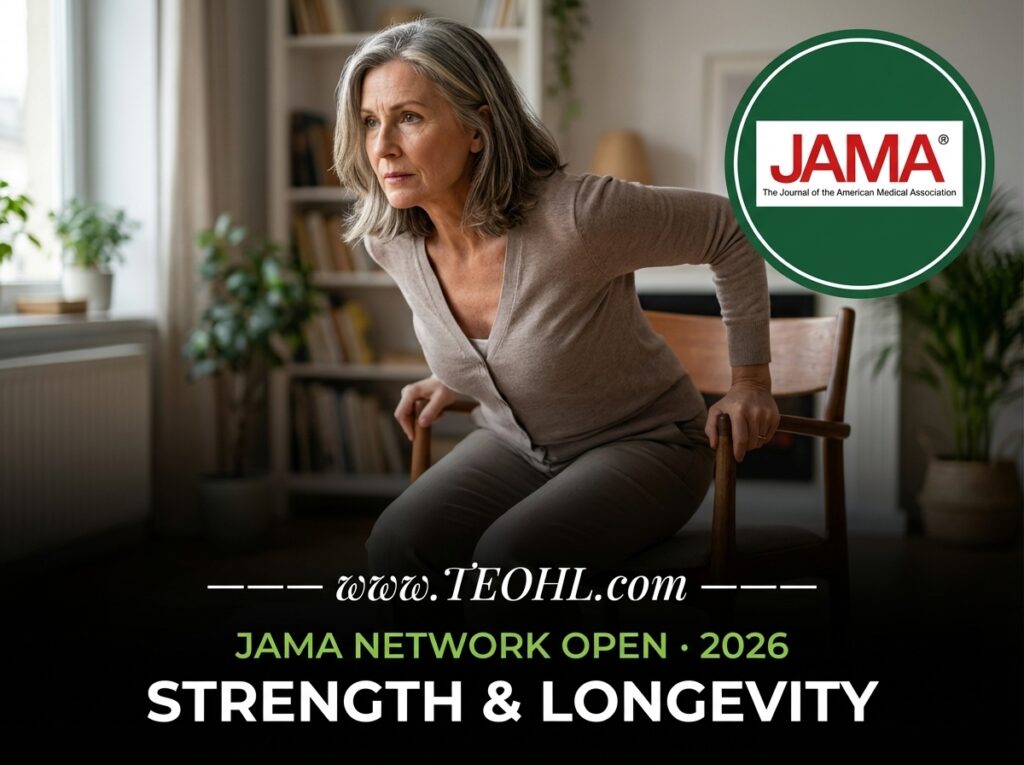
New research published in JAMA Network Open confirms that muscular strength women build and maintain in their 60s, 70s, and beyond directly predicts how long they live. This is the largest study of its kind — and it changes the way we need to think about movement, aging, and what it truly means to be strong.
Quick Summary: What This Study Found
Women with the highest grip strength had a 33% lower risk of death over eight years. Women who completed five chair stands fastest had a 37% lower risk. Both results held true even in women who did not meet standard physical activity guidelines — meaning muscular strength predicts longevity independently of how much you exercise overall.
The Study Behind the Headlines
Researchers at the University at Buffalo, led by epidemiologist Dr. Michael J. LaMonte, followed 5,472 women between the ages of 63 and 99 for an average of 8.4 years. The study — called the Objective Physical Activity and Cardiovascular Health (OPACH) cohort — tracked participants from March 2012 through February 2023. During that time, 1,964 deaths were recorded.
The women represented a racially diverse group: 33.8% Black, 16.7% Hispanic or Latina, and 49.5% White. Muscular strength was measured in two ways — dominant hand grip strength using a dynamometer, and the time needed to complete five consecutive unassisted chair stands. Both tests are simple, low-cost, and widely available in clinical settings.
Crucially, researchers used accelerometer data — not just self-reported exercise — to measure actual physical activity and sedentary time. They also controlled for walking speed and levels of C-reactive protein, a blood marker of systemic inflammation. Even after all these adjustments, muscular strength remained a strong, independent predictor of survival.
Muscular Strength Women Need: The Exact Numbers
The study divided grip strength into four groups. Women in the strongest group — those gripping over 24 kilograms — had a 33% lower risk of death compared to the weakest group (under 14 kg). Even women in the third quartile (19–24 kg) showed a statistically significant survival advantage.
For chair stands, women who completed the five repetitions in 11.1 seconds or less had a 37% lower mortality risk compared to those who needed more than 16.7 seconds. Additionally, for every 7 kilograms of grip strength gained, mortality risk dropped by an average of 12%. For every 6-second improvement in chair stand time, mortality risk fell by 4%.
These numbers are not small. They are comparable to the survival benefits associated with quitting smoking or managing high blood pressure. Strength is not a vanity metric — it is a vital sign.
Test Yourself At Home — Right Now
Chair stand test: Sit in a firm chair with your arms crossed over your chest. Stand up and sit down five times without using your arms. If you complete it in under 11.1 seconds, you are in the top strength quartile. If it takes more than 16.7 seconds, building leg strength is a priority. Grip strength: Without a dynamometer, notice whether you can open jars easily, carry groceries, and maintain a firm handshake. These daily tasks reflect your real-world grip capacity.
Why Muscular Strength Women Maintain Predicts Longevity
Muscle is not just about movement. Skeletal muscle plays a central role in regulating blood sugar, energy metabolism, and hormonal signaling. When women lose muscle mass — a process called sarcopenia that accelerates after menopause — they also lose metabolic resilience. This directly increases the risk of type 2 diabetes, cardiovascular disease, and frailty.
Dr. LaMonte explained that strength reflects the coordinated health of multiple body systems simultaneously — muscles, bones, the nervous system, and metabolism. When those systems work together efficiently, the body is better equipped to handle illness, injury, and the physiological demands of aging.
Furthermore, the finding that strength predicted survival even in women who were not meeting standard exercise guidelines is particularly significant. It suggests that strength training provides a protective benefit that aerobic activity alone cannot fully replicate. If you are walking regularly but skipping strength work, this study shows you are leaving longevity on the table. You can read more about how exercise protects your brain and longevity in our dedicated guide.
The Menopause Connection Every Woman Should Know
Estrogen decline during perimenopause and menopause accelerates muscle loss. Women can lose up to 3–5% of muscle mass per decade after age 30 — and that rate increases significantly after menopause. This is not inevitable, but it requires deliberate action.
The hormonal shifts of menopause also reduce bone density, increase visceral fat, and impair insulin sensitivity — all factors that interact directly with muscle health. Maintaining strength during and after the menopause transition is therefore not optional. It is one of the most evidence-based strategies for healthy weight management and metabolic health after 40.
Moreover, Dr. LaMonte noted that women ages 80 and older are the fastest-growing age group in the United States. The public health implications of monitoring and maintaining muscular strength in this population are enormous — and largely untapped.
How to Build Strength — Starting Today
The researchers were clear: you do not need to look like an athlete. You need functional strength — the kind that lets you rise from a chair, carry groceries, climb stairs, and maintain your independence for decades.
Effective strength-building options include resistance bands, free weights, bodyweight exercises such as wall presses and modified push-ups, chair squats, and Pilates. According to current physical activity guidelines, adults should perform muscle-strengthening activities at least twice per week, targeting all major muscle groups.
Protein intake also plays a critical role. Muscle protein synthesis requires adequate dietary protein — research supports aiming for 1.2–1.6 grams per kilogram of body weight per day for older women actively trying to preserve or build muscle. You can explore how much protein you actually need daily in our complete guide.
Additionally, walking remains valuable — but pair it with strength training. The combination of aerobic activity and resistance exercise provides synergistic benefits that neither approach achieves alone. Our guide on squats for longevity and healthy aging is a practical starting point.
TEOHL Point of View
Strength is not aesthetic. It is biological. This study — 5,472 women, eight years of data, JAMA-level rigor — confirms what we have always believed at TEOHL: how strong you are matters more than how you look. The fitness industry has spent decades selling women cardio for weight loss. The science says build muscle to live longer. These are not the same goal — and only one of them will add years to your life.
What This Means For You
Do the chair stand test today. Add strength training at least twice a week — even bodyweight exercises count. Prioritize protein at every meal. And if your doctor has never assessed your grip strength or functional strength, ask them to. These two simple tests now have JAMA-level evidence behind them as predictors of how long you will live.