

1 Cup Cooked Orzo Calories: Is Orzo Healthy?
Is orzo healthy—or is it just rice in disguise? If you’ve ever scooped this tiny pasta into your bowl and wondered whether it was secretly sabotaging your health goals, you’re asking exactly the right question. The truth about orzo is more interesting than most nutrition sites will tell you—especially when it comes to weight loss, blood sugar, and a surprisingly clever cooking trick that changes everything. Here’s what a dietitian actually wants women to know before their next meal.
Quick Answer: Is Orzo Healthy?
Yes—orzo can be a healthy part of a balanced diet, especially when you choose whole wheat varieties, control portions, and pair it strategically with protein and vegetables. It delivers 7 grams of protein per serving, B vitamins, iron, and magnesium. For women focused on weight loss or blood sugar balance, there’s also a science-backed preparation trick—cooking and cooling orzo—that makes it significantly more metabolically favorable.
What Is Orzo? (It’s Not What Most People Think)
Orzo looks exactly like a large grain of rice. It has a similar shape, a similar creamy color, and behaves like rice in soups and salads. But orzo is not rice at all—it’s pasta. Specifically, it’s a small, rice-shaped pasta made from durum wheat semolina, the same hard wheat variety used in most Italian pasta.
The name “orzo” literally means “barley” in Italian, which gives you a sense of just how convincingly grain-like this pasta appears. It cooks in about 8–10 minutes, absorbs flavors beautifully, and works in an impressive range of dishes—from Mediterranean salads and soups to risotto-style preparations and grain bowls.
Understanding what orzo actually is matters nutritionally, because pasta and rice behave differently in the body. Orzo has more protein than white rice, a different starch structure, and—as you’ll discover shortly—some genuinely interesting properties when cooked and cooled.
Is Orzo Healthy? The Nutrition Facts Women Need
Let’s start with the numbers. A standard 2-ounce (56g) dry serving of orzo—which cooks up to approximately ¾ cup cooked—contains roughly 200 calories, 40–42 grams of carbohydrates, 7 grams of protein, 1 gram of fat, and 2 grams of fiber. When enriched (as most commercial orzo is), it also provides meaningful amounts of B vitamins including thiamin, niacin, and folate, plus iron, magnesium, zinc, and phosphorus.
Compared to white rice at a similar serving size, orzo delivers roughly twice the protein and comparable carbohydrates, while containing more folate—a B vitamin particularly important for women of reproductive age and those managing energy metabolism.
That said, standard orzo made from refined semolina is relatively low in fiber. This is where whole wheat orzo becomes genuinely worth seeking out.
Whole Wheat Orzo vs. Regular Orzo: The Critical Difference
Regular orzo is made from refined semolina—the bran and germ have been stripped away, leaving mostly starch and some protein. Whole wheat orzo, by contrast, retains the entire grain kernel, preserving its fiber, B vitamins, minerals, and plant compounds.
Practically, this means whole wheat orzo has significantly more fiber per serving, a lower glycemic impact, and a richer micronutrient profile. For women focused on digestive health, blood sugar stability, or sustained energy, whole wheat orzo is the smarter choice—every time. It’s harder to find in mainstream supermarkets but increasingly available in health food stores and online.
Is Orzo the Same as Rice?
No—orzo looks like rice but is actually pasta made from durum wheat. Compared to white rice, orzo contains nearly twice the protein per serving and more B vitamins. White rice is higher in starch and lower in protein, while brown rice offers more fiber than regular orzo (though whole wheat orzo closes that gap considerably). For women comparing carbohydrate options, orzo’s higher protein content supports better satiety than white rice at a similar calorie count.
The Surprising Truth About Orzo and Weight Loss
Here’s where the orzo conversation gets genuinely interesting for women focused on weight management. Most nutrition articles will tell you orzo is “fine in moderation”—and stop there. But there’s a simple, research-backed preparation technique that makes orzo significantly more favorable for weight loss and blood sugar control.
The trick? Cook your orzo, then refrigerate it for at least 24 hours before eating it—either cold or reheated.
The Science of Resistant Starch: Why Cooled Orzo Is Different
When pasta cools, the starch molecules undergo a process called retrogradation. The glucose chains rearrange into a tighter, more crystallized structure that resists digestion in the small intestine—earning the name “resistant starch.” According to Ohio State University’s registered dietitians, refrigerated pasta has fewer digestible calories and leads to a smaller blood glucose peak than the same pasta eaten freshly cooked.
Research published in PMC confirms that cooling and reheating pasta causes measurable changes in postprandial glucose response, with a quicker return to fasting blood glucose levels in both cooled and reheated conditions compared to hot, freshly cooked pasta. Critically, reheating the pasta after refrigeration does not eliminate these benefits—the retrograded amylose crystallites largely retain their structure even after reheating.
For women managing insulin sensitivity—which naturally declines during perimenopause and beyond—this distinction is genuinely meaningful. Orzo pasta salads, chilled grain bowls, and meal-prepped anti-bloat bowls made with orzo aren’t just convenient—they’re metabolically smarter.
How Resistant Starch Supports Women’s Weight Loss Goals
Resistant starch acts like dietary fiber in the body. It passes through the small intestine largely undigested, then ferments in the large intestine, feeding beneficial gut bacteria and producing short-chain fatty acids (SCFAs). These SCFAs have anti-inflammatory properties, support gut barrier integrity, and stimulate satiety hormones like glucagon-like peptide-1 (GLP-1) and peptide YY.
Research on resistant starch and energy balance, published in PMC, shows that resistant starch reduces appetite, increases feelings of fullness, and may support lipid oxidation—the metabolic process of burning fat for fuel. For women working to break through weight loss plateaus after 40, optimizing carbohydrate choices to include more resistant starch is a practical, evidence-based strategy.
Furthermore, resistant starch improves insulin sensitivity. This is particularly relevant for women with prediabetes, PCOS, or the metabolic shifts that come with hormonal changes. Combining cooled orzo with lean protein and healthy fats like avocado creates a meal that manages blood sugar with impressive effectiveness.
Orzo Health Benefits for Women: What the Evidence Shows
Beyond the resistant starch angle, orzo offers several meaningful nutritional benefits for women’s health.
Iron for Energy and Blood Health
Orzo is a good source of iron, especially when made from enriched flour. Iron is essential for carrying oxygen in the blood and producing energy at the cellular level. Women lose iron through menstruation each month, making dietary iron especially important through the reproductive years. Fatigue, brain fog, and reduced exercise capacity are common signs of suboptimal iron intake—all of which affect quality of life significantly. Pairing orzo with vitamin C-rich vegetables (tomatoes, bell peppers, lemon juice) enhances iron absorption considerably.
B Vitamins for Metabolism, Mood, and Hormonal Balance
Orzo provides thiamin, niacin, and folate—B vitamins that play central roles in energy metabolism, nervous system function, and the biosynthesis of neurotransmitters like serotonin and dopamine. Folate is particularly important for women: it supports DNA synthesis, reduces the risk of neural tube defects during pregnancy, and is linked to lower risk of depression. Enriched orzo delivers a meaningful contribution toward daily folate needs.
Magnesium for Sleep, Stress, and Bone Health
Magnesium is one of the most common micronutrient deficiencies in women, yet it’s critical for over 300 enzymatic reactions in the body. It supports quality sleep, helps regulate the stress response by modulating cortisol, supports bone density, and plays a role in insulin signaling. Orzo contributes to daily magnesium intake—a small but meaningful addition when compounded across meals. For women navigating perimenopause and beyond, adequate magnesium is especially relevant to hormonal balance and sleep quality.
Protein for Satiety and Muscle Maintenance
With 7 grams of protein per serving, orzo delivers more protein than most comparable grains and significantly more than white rice. While orzo alone shouldn’t be your primary protein source, that baseline protein content supports satiety and helps protect lean muscle mass—especially important for women over 40, when maintaining muscle becomes increasingly critical for metabolic health. Pairing orzo with high-protein options like salmon or chicken creates a genuinely balanced, metabolically supportive meal.
Is Orzo Healthy Compared to Other Carbs?
Women often want a direct comparison. Here’s an honest look at how orzo stacks up against its closest competitors.
Orzo vs. White Rice
At a comparable cooked serving size, orzo and white rice have similar calorie counts. However, orzo contains roughly twice the protein (7g vs. 3–4g) and more B vitamins. White rice has a higher glycemic index than pasta in general—meaning it raises blood sugar more rapidly. For women managing blood sugar, orzo is generally the better choice over white rice, particularly when cooled and used in salads or reheated bowls.
Orzo vs. Brown Rice
Brown rice has more fiber than regular orzo, making it a slightly better choice for digestive health and blood sugar management in that direct comparison. However, whole wheat orzo closes this gap considerably, while matching or exceeding brown rice’s protein content. Brown rice also takes considerably longer to cook. For practical meal prepping, whole wheat orzo offers an excellent nutritional trade-off with a major time advantage.
Orzo vs. Couscous
Couscous is another tiny pasta that often gets compared to orzo. The nutritional profiles are broadly similar—both are refined wheat products with modest protein and low fat. Orzo tends to have a slightly lower glycemic index due to its denser starch structure, and it holds up better in salads and cold dishes, making the cooled/resistant starch benefits easier to apply.
Orzo vs. Rice: Quick Nutrition Comparison (per cooked cup)
Orzo: ~200 cal, 40g carbs, 7g protein, 1g fat, 2g fiber. White rice: ~200 cal, 44g carbs, 4g protein, 0.5g fat, 0.6g fiber. Brown rice: ~220 cal, 46g carbs, 5g protein, 1.8g fat, 3.5g fiber. Whole wheat orzo: ~180 cal, 36g carbs, 8g protein, 1g fat, 4–5g fiber. The takeaway: whole wheat orzo offers the best overall nutritional profile among these options, combining the protein advantage of regular orzo with fiber levels that rival brown rice.
Potential Downsides of Orzo Women Should Consider
Being realistic about orzo’s limitations is part of evidence-based nutrition. Here’s what to watch for.
First, portion control matters enormously. Orzo is a dense, calorie-efficient food—which is great when you’re controlling portions but problematic when it’s easy to scoop out twice what you intended. Because the pieces are so small and uniform, they pack into a measuring cup deceptively. A reasonable serving is ¾ cup cooked, not the heaping bowlful that often ends up on the plate.
Second, regular orzo is low in fiber. Standard semolina orzo has only about 2 grams of fiber per serving—well below the 25–38 grams women need daily. Relying on orzo as your primary carbohydrate without adding fiber-rich vegetables and legumes leaves a significant nutritional gap. This is solvable—stir in spinach, add chickpeas, toss with roasted vegetables—but it requires intentionality.
Third, orzo contains gluten. Women with celiac disease or non-celiac gluten sensitivity cannot eat traditional orzo. Gluten-free alternatives made from chickpea or quinoa flour are available and offer their own nutritional advantages (higher protein and fiber), though they have a somewhat different texture.
Fourth, watch what you cook it in. Orzo made with heavy cream, excess butter, or processed cheese sauces shifts from a nutritious grain base to a calorie-dense dish quickly. The pasta itself is not the issue—preparation choices make or break its nutritional value.
How to Make Orzo Work for Weight Loss: A Practical Guide
Getting the most from orzo nutritionally comes down to a few consistent habits. Follow these and you’ll transform a basic pasta into one of your most useful meal-prep tools.
Step 1: Choose Whole Wheat When You Can
Whole wheat orzo provides more fiber, more minerals, and a lower glycemic impact than its refined counterpart. Look for it in natural food stores or online. If you can’t find whole wheat orzo locally, regular orzo used with the cooking-cooling method (step 2) is still a solid choice.
Step 2: Cook It, Then Cool It
This is the single most impactful thing you can do to improve orzo’s metabolic profile. Cook your orzo as normal, then spread it on a tray or transfer it to a container and refrigerate for at least 24 hours. According to researchers at Ohio State University, this cooling process converts digestible starch into resistant starch—which behaves like fiber, feeds gut bacteria, and blunts blood sugar spikes. Reheat it if you prefer it warm, or use it cold in salads. Either way, the resistant starch benefits largely persist.
Step 3: Build a Balanced Bowl
Never eat orzo alone. Always build a complete meal around it. Use ¾ cup cooked orzo as your base, then add 4–6 ounces of lean protein (grilled chicken, shrimp, salmon, or legumes), at least two cups of non-starchy vegetables, and a healthy fat source (olive oil, avocado, tahini, or feta). This combination delivers a balanced macronutrient profile that manages blood sugar, supports satiety, and hits your fiber targets.
Step 4: Meal Prep in Batches
Orzo is an excellent meal-prep grain. Cook a large batch on Sunday, refrigerate it (starting the resistant starch conversion automatically), and use it throughout the week in salads, soups, and bowls. This approach also saves time significantly, making it easier to maintain a consistent macros-based eating pattern on busy days when healthy cooking feels impossible.
Healthy Orzo Meal Ideas for Women
Need inspiration? These meal ideas apply everything covered above—whole grains, resistant starch, smart pairings, and real flavor.
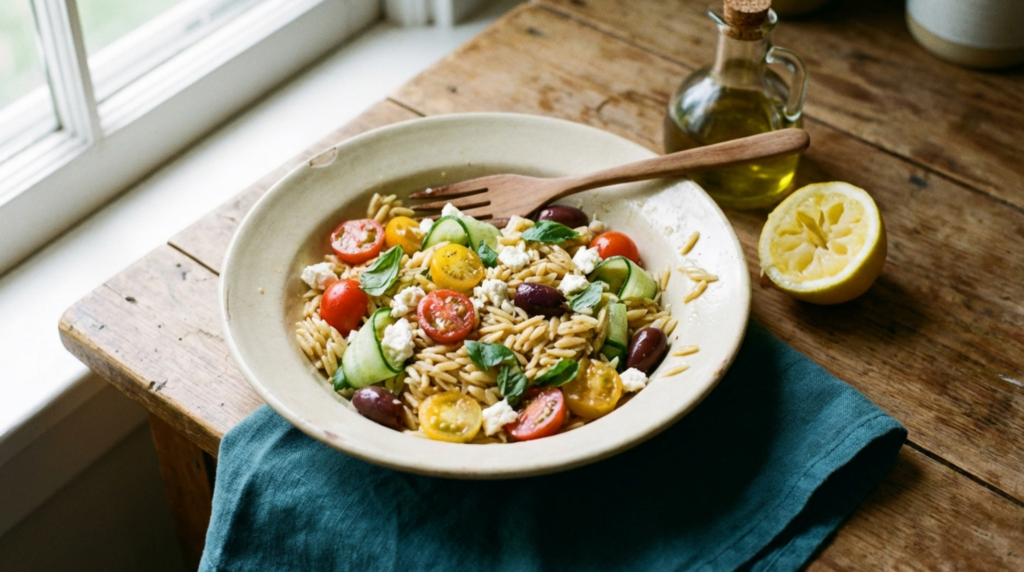
A Mediterranean orzo salad is one of the best ways to enjoy this pasta. Combine refrigerated cooked orzo with cherry tomatoes, cucumber, kalamata olives, roasted red peppers, chickpeas, a crumble of feta, and a lemon-olive oil dressing. Serve it cold. You get resistant starch from the cooled pasta, plant protein from the chickpeas, healthy fats from the olive oil, and a full spectrum of antioxidants from the vegetables. It travels well, stores for three days, and genuinely satisfies.
For a warm meal, try an orzo soup with white beans, spinach, garlic, and lemon broth. The orzo absorbs the broth beautifully, the white beans add plant protein and fiber, and spinach delivers iron, folate, and magnesium. Pair with a whole wheat pita on the side for a complete Mediterranean-style meal that supports both gut health and hormonal balance.
A shrimp and orzo bowl with avocado, roasted corn, and lime dressing makes an excellent high-protein lunch. The shrimp delivers lean protein, the avocado contributes healthy monounsaturated fats, and the cooled orzo provides resistant starch. This combination hits the trifecta of satiety, blood sugar stability, and genuine nutritional value.
Is Orzo Healthy for Women Over 40?
Women in midlife face a specific set of metabolic challenges: declining insulin sensitivity, shifting body composition, reduced gut microbiome diversity, and the energy fluctuations that come with hormonal transitions. Orzo, used strategically, addresses several of these simultaneously.
The resistant starch produced by cooling orzo is particularly valuable here. It feeds beneficial gut bacteria, which produce short-chain fatty acids that help regulate both appetite and inflammation. As estrogen declines, gut microbiome diversity tends to decrease—and dietary resistant starch is one of the most accessible, food-based tools available to support it.
Moreover, the magnesium and B vitamins in orzo support sleep quality and energy metabolism—two areas that frequently deteriorate during perimenopause. A consistent, varied diet that includes whole grain carbohydrate sources is associated with better weight management outcomes for women over 40, compared to extreme carbohydrate restriction strategies that often prove unsustainable.
The key, as always, is the approach. Orzo eaten carelessly—in large portions, without protein, in cream-based sauces—contributes to caloric excess. Orzo used thoughtfully—cooled, portioned, paired well—becomes one of the most practical, satisfying carbohydrate tools in a woman’s nutritional arsenal.
Is Orzo Good for Gut Health?
Yes—particularly when cooled. Cooled orzo contains resistant starch, which acts as a prebiotic by feeding beneficial bacteria in the colon. These bacteria ferment resistant starch into short-chain fatty acids, which support gut barrier integrity, reduce intestinal inflammation, and may help regulate appetite hormones. For women, a diverse and balanced gut microbiome is also linked to healthier estrogen metabolism and better mood regulation. Combining orzo with other prebiotic and fiber-rich foods creates a gut-supportive meal pattern worth building on.
Is Orzo Gluten-Free?
No—traditional orzo is made from durum wheat and contains significant amounts of gluten. Women with celiac disease or non-celiac gluten sensitivity should avoid it. Gluten-free orzo alternatives made from chickpea, quinoa, or corn flour are available and can actually offer superior nutritional profiles—higher in protein and fiber. If you need a gluten-free swap, chickpea orzo is worth trying; it’s creamy, satisfying, and brings additional plant protein to the table.
How Much Orzo Should I Eat Per Serving?
A standard serving is 2 ounces dry (about ¾ cup cooked). Because orzo is small and dense, it’s easy to overpour—measuring the first few times helps calibrate your eye. At ¾ cup cooked, you’re looking at approximately 200 calories and 40 grams of carbohydrates. Paired with lean protein and non-starchy vegetables, this portion supports a balanced, satisfying meal without excess calories.
Can You Eat Orzo on a Weight Loss Diet?
Yes—orzo can fit into a weight loss diet when portioned correctly and paired strategically. Choosing whole wheat varieties, cooling the cooked orzo to increase resistant starch, and building meals around it with protein and vegetables all support satiety and blood sugar management. The Mediterranean-style eating patterns that frequently feature orzo are among the most evidence-supported dietary approaches for sustainable weight management in women. For a deeper look at the overall framework, our guide on weight loss for women over 40 covers the full picture.
Is Orzo Healthier Than Pasta?
Orzo is pasta—just in a different shape. The nutritional profile of regular orzo is nearly identical to other semolina-based pasta like penne or spaghetti. What makes the comparison interesting is that orzo’s small size and shape make it ideal for cold salads and meal-prep bowls, encouraging the cooking-and-cooling technique that creates resistant starch. In that practical sense, orzo enables a healthier eating approach more naturally than long-form pasta does.
The Bottom Line: Is Orzo Healthy for Women?
Yes—orzo is a healthy carbohydrate option for women when approached thoughtfully. It delivers protein, B vitamins, iron, and magnesium in a versatile, convenient format that lends itself beautifully to balanced meal building. It’s not a superfood, and it’s not going to transform your health on its own. However, it’s also not the refined-carb villain it sometimes gets painted as.
The resistant starch story is what elevates orzo from “acceptable carb” to “strategic tool.” Cooking it ahead, cooling it for 24 hours, and using it in salads or reheated bowls is a simple, zero-cost, science-backed technique that meaningfully improves its metabolic profile. For busy women who meal prep, this is genuinely game-changing.
Choose whole wheat orzo when available, control your portions, build your meals around protein and vegetables, and use the cooling technique consistently. Do those four things, and orzo becomes one of the smarter carbohydrate choices you can make—not in spite of its pasta identity, but because of it.