

Ultra-Processed Foods and Cancer: What the Label Hides
Key Takeaways
- In 461,682 US adults followed for nearly 19 years, total ultra-processed food intake was not linked to colorectal cancer.
- The label hides opposite effects. Ultra-processed bread, cereal, and dairy tracked with lower risk.
- Reconstituted meat and fish tracked with higher risk. Processed meat is still a Group 1 carcinogen.
- This is not a green light for soda, candy, or packaged snacks. Those were not separately exonerated.
- Sort your cart by fiber, calcium, and whether a food is a cured meat. Not by processing level.
Ultra-processed foods and cancer risk have been tangled together in scary headlines for years. So when a study of 461,682 Americans found no overall link to colorectal cancer, the story spread fast. Here’s the problem. The headline was too simple.
The same study found that some ultra-processed foods were linked to lower risk. Others were linked to higher risk. The category itself turned out to be a poor way to sort a grocery cart.
Let’s be honest. If you feel whiplash from nutrition news, that reaction is completely normal. Below, we’ll walk through what the study measured, why the label fails, and what to buy instead.
Quick Answer: Do Ultra-Processed Foods Cause Cancer?
No study has shown that ultra-processed foods cause cancer in humans. That distinction matters. This new research found no association between total ultra-processed intake and colorectal cancer, but specific foods inside the category did show links in both directions. Whole grains and dairy tracked with lower risk. Reconstituted meats tracked with higher risk.
What the Ultra-Processed Foods and Cancer Study Actually Found
Researchers from the National Cancer Institute followed 461,682 US adults. Everyone was between 50 and 71 when they joined in 1995 and 1996. The team tracked cancer cases through 2018, a median of 18.8 years. By the end, they had recorded 10,075 colorectal cancer cases. The results appeared in PLOS Medicine.
Then came the number that made news. People who ate the most ultra-processed food had almost the same colorectal cancer rate as people who ate the least. The hazard ratio was 0.97, with a confidence interval of 0.91 to 1.03. A hazard ratio of 1.0 means no difference. This estimate sat right on that line.
That narrow interval matters. This was not a fuzzy maybe. The study had enough people and enough follow-up to rule out a large effect. For total intake, the answer was a clear no.
What a Hazard Ratio Actually Means
A hazard ratio compares risk between two groups. A value of 1.0 means the groups were the same. Below 1.0 means lower risk, and above 1.0 means higher risk. The numbers in parentheses form the confidence interval. If that range crosses 1.0, the finding is uncertain.
One Label, Two Opposite Results
An average can hide a lot. When the researchers split the bucket into specific foods, the pattern flipped from item to item. Here is what they found, with values below 1.0 meaning lower risk:
- Ultra-processed bread: hazard ratio 0.91 (0.86 to 0.97)
- Breakfast cereal: 0.84 (0.79 to 0.90)
- Frozen desserts and milk drinks: 0.82 (0.77 to 0.88)
- Fiber from ultra-processed sources: 0.72 per 10 grams a day (0.64 to 0.80)
- Calcium from ultra-processed sources: 0.77 per 300 milligrams a day (0.69 to 0.86)
- Reconstituted meat and fish products: 1.10 (1.04 to 1.18)
Read that list again. A slice of packaged whole-grain bread and a hot dog share one label. Yet they pulled risk in opposite directions. That is the ultra-processed foods and cancer story in two lines.
Why Ultra-Processed Foods and Cancer Studies Keep Disagreeing
Here’s where it gets interesting. A 2026 systematic review and meta-analysis pooled nine cohort studies and five case-control studies. It found a 12% higher digestive cancer risk with higher intake (hazard ratio 1.12, 1.05 to 1.20). Ultra-processed meat and protein products alone showed a 33% higher risk. That matches the direction the NIH-AARP cohort found for reconstituted meat and fish products.
So two careful analyses reached different answers. Is nutrition science just flaky? Not quite. The two studies were measuring different diets under the same name.
Look at the numbers. In this US cohort, 82.8% of all whole grain intake came from ultra-processed sources. In the European EPIC cohort, ultra-processed meat intake was nearly double, at 36.2 grams a day versus 20.1. Bread went the other way. It was 43.6 grams a day in Europe versus 57.3 in the US.
In other words, the American study mostly tested ultra-processed whole grains and dairy. The European studies partly tested ultra-processed meat. Same label. Different food. That one fact explains most of the ultra-processed foods and cancer confusion.
Measurement adds another layer. Studies define intake in grams, in calories, or in servings. Change the ruler and the answer can shift. Most headlines never tell you which ruler was used.
What This Study Does Not Say
Let’s be clear about the limits. This was an observational study, so it cannot prove cause and effect. Participants filled out one diet questionnaire at the start. Then researchers followed them for almost two decades, while their eating habits surely changed.
The sample was also older and mostly white. Findings may not carry over to younger or more diverse groups. And the authors could not separate plain yogurt from flavored yogurt. The questionnaire measured nutrients, not processing. Additives were never measured at all, which is why that question stays open — we went deeper on it in our look at food additives and cancer.
Most importantly, this is not a green light for soda, candy, and packaged snacks. Those foods were not separately exonerated. Nothing here suggests they are harmless. The National Cancer Institute notes that, with few exceptions, human population studies have not yet shown definitively that any dietary component causes or protects against cancer.
Meanwhile, the WHO cancer agency’s assessment still links higher intake to cancer and cardiometabolic disease. Its 2023 analysis of 266,666 people across seven countries located the signal in animal-based products and artificially sweetened drinks. That is exactly where this new study also found harm. On that point, the two agree.
Processed meat also remains a Group 1 carcinogen. That classification did not move, and this study did not move it. One more finding deserves attention. Poor diet quality was associated with higher colorectal cancer risk at both low and high intake levels. That means ultra-processed foods and cancer risk are two dials, not one. Weight is a third dial. Ultra-processed diets reliably push calorie intake up, which is why ultra-processed foods cause weight gain, and obesity raises colorectal cancer risk on its own.
Colorectal cancer is only one outcome, of course. The ultra-processed foods and cancer question is really a question about labels in general. The same category has been studied for mood and brain health, with caveats of its own — our piece on ultra-processed foods and depression walks through them.
Your Grocery Swap List
None of this asks you to rebuild your diet from scratch. The direction is simple: more fiber and calcium, less cured and reconstituted meat. Here are five swaps that follow the data.
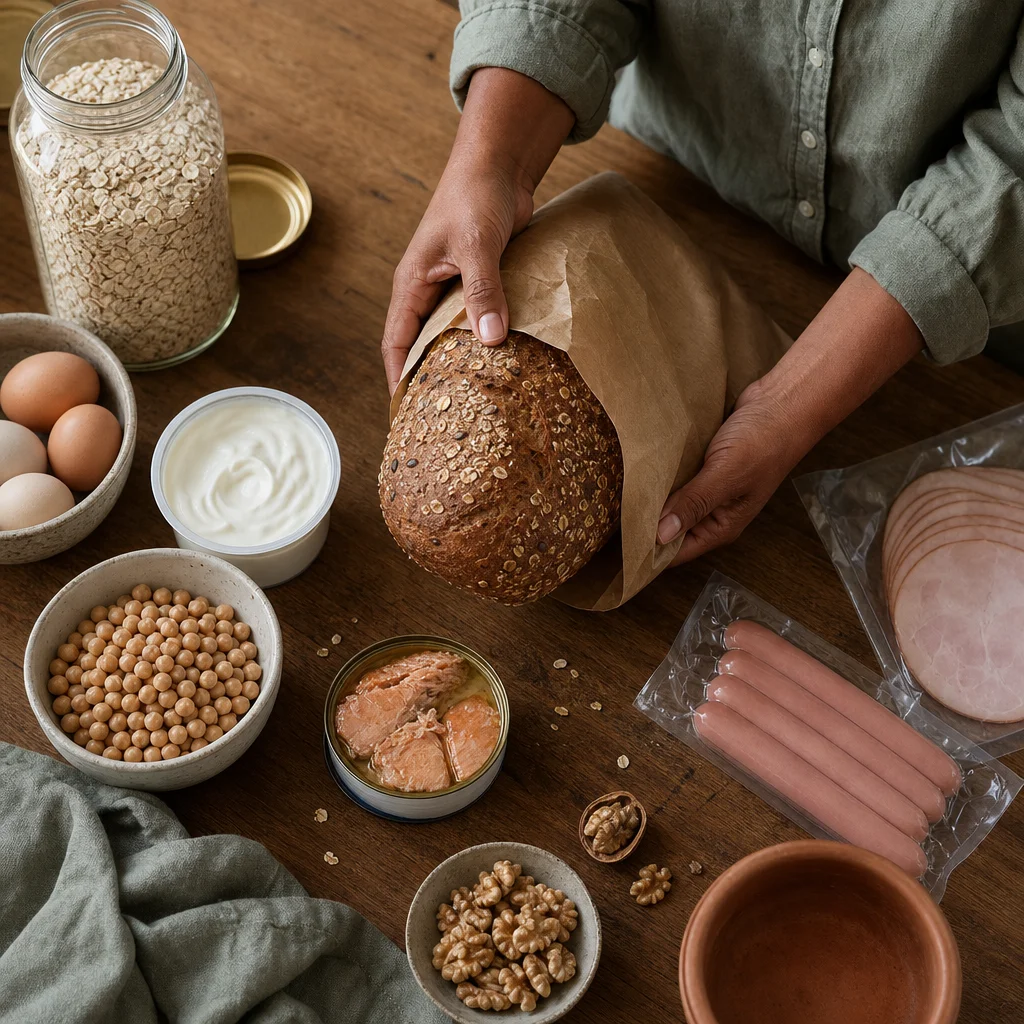
- Deli counter: trade sliced deli meat for canned salmon, eggs, chickpeas, or leftover roast chicken.
- Yogurt aisle: trade a flavored yogurt cup for plain yogurt with fresh fruit and cinnamon.
- Cereal shelf: trade a sugary cereal for a whole-grain one with more fiber, or plain oats.
- Drinks: trade soda and sweetened iced tea for sparkling water or unsweetened tea.
- Snack bin: trade packaged pastries for whole-grain bread with nut butter, or nuts and fruit.
Notice what stayed. Bread did not get cut. Dairy did not get cut. In this study, both were linked to lower risk. Swapping 10% of ultra-processed grams for less processed food tracked with 2% lower colorectal cancer incidence. In the European cohort, the same swap showed 6%. What you swap matters more than how much. If you want the whole cart instead of five swaps, our guide to foods for heart and gut health builds it out.
The Lever Most Articles Skip
Here’s a practical point that rarely makes these stories. Screening finds growths before they turn into cancer. Diet shifts risk slowly, over decades. Screening acts on a much shorter timeline. If you are due, book the appointment. Ask your clinician when that is.
Common Questions
Does this study prove ultra-processed foods and cancer are unrelated?
No. It shows that the processing label was a weak risk marker in one large US cohort. The pooled evidence still points toward higher risk for some subgroups, especially processed meats.
Is diet soda ultra-processed?
Yes, under the NOVA system it is. This study did not report diet soda as its own subgroup. The WHO agency’s analysis flagged artificially sweetened drinks, so a null overall result is no reason to relax.
Does store-bought bread beat fresh bakery bread?
Not at all. It means fiber and whole grains matter more than the label. Buy the loaf with more fiber and fewer refined grains. Both options can be healthy.
How much processed meat is safe?
The 2026 meta-analysis could not identify a reliable threshold for ultra-processed intake overall — each 10-percentage-point increase tracked with about 6% higher risk. For ultra-processed meat and protein products specifically, high versus low intake was associated with 33% higher risk (hazard ratio 1.33, 1.15 to 1.53). Keep processed meat occasional rather than routine.
The Bottom Line
Ultra-processed foods and cancer is a story about lazy labels, not broken science. The new study did not clear the whole category. It showed that the category was never a good sorting tool.
So stop scanning the package for a processing score. Start scanning for fiber, protein, calcium, and sodium. Keep bread and plain dairy in your cart. Move cured meats to occasional. Skip the soda and candy, not because a label told you to, but because nothing in the data ever gave them a pass.
That is a calmer way to shop. And it holds up even after the next headline lands.