
Rebounding Workouts: Science-Backed Benefits & How to Start
Key Takeaways
- High cardio, low impact: Rebounding workouts give you an intense cardiovascular challenge without punishing your joints.
- Full-body engagement: The unstable surface forces your core, stabilizers, and leg muscles to work harder.
- Science-backed benefits: Research shows improvements in balance, coordination, bone density, and aerobic fitness.
- Fun factor: It doesn’t feel like exercise, which makes you more likely to stick with it.
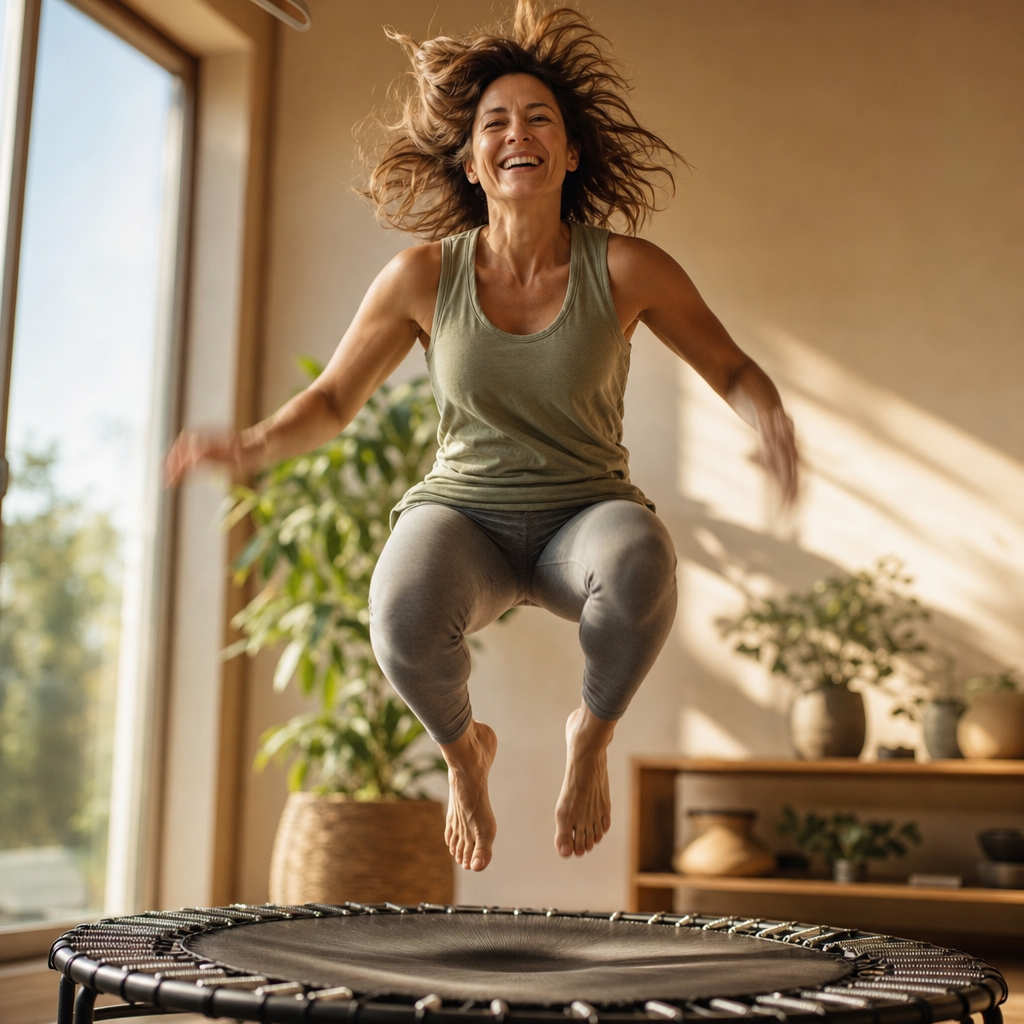
Picture this: you’re a kid again, jumping on a trampoline. You’re laughing, barely out of breath, but you know your body is working. Now imagine getting that exact feeling as an adult — but with serious, science-backed health benefits. That’s the promise of rebounding workouts. If you’re bored with the treadmill or uninspired by your usual routine, this playful form of exercise might be the change you need. In this guide, we’ll break down what rebounding workouts actually do for your body, how to start safely, and what to look for in a rebounder.
Quick Answer: What is a Rebounding Workout?
A rebounding workout is any form of exercise performed on a mini-trampoline. It can be a gentle bounce to get your blood flowing or a high-intensity, choreographed routine. Because the mat absorbs much of the impact, it is easier on your joints than running, while still providing excellent cardiovascular, balance, and strength benefits.
What Exactly Are Rebounding Workouts?
Rebounding has been around for decades, but it is having a major resurgence. And for good reason. A rebounding workout uses a mini-trampoline — often called a rebounder — to create an unstable, springy surface. Unlike running on pavement, which sends shockwaves through your joints, the trampoline mat absorbs the majority of that force.
“It’s a great introduction to low-impact activities,” says physical therapist Sydney Darrah. “It helps people return to running and jumping safely.” But it’s not just for rehab. The unstable surface means your body has to constantly micro-adjust. Your ankles, hips, and core fire with every single bounce. That’s why rebounding workouts challenge your body in a way that solid ground simply cannot.
The movements can range from a simple “health bounce” (where your feet never leave the mat) to high-intensity jumps, twists, and jacks. It’s scalable for any fitness level, which makes it incredibly versatile.
The Science: What Rebounding Does for Your Body
Here’s the thing. Rebounding workouts are not just fun and games. The scientific research backs up the hype. Let’s look at what happens inside your body when you start bouncing.
1. Cardiovascular Fitness
A 2018 study on overweight women found that 12 weeks of mini-trampoline rebounding exercise improved VO2max and work capacity. That means your heart and lungs get a real workout — enough to see measurable gains in aerobic fitness. In fact, researchers reported VO2max increased from 15.4 to 16.9 mL/kg/min, a meaningful jump for cardiovascular health.
2. Balance and Coordination
Because the surface is unstable, your body is forced to recruit small stabilizer muscles that are often ignored in traditional strength training. A 2019 study on older women (ages 56-83) with osteopenia found that a 12-week mini-trampoline program significantly improved balance, functional mobility, and gait. It even reduced their fear of falling — a major win for confidence and independence.
3. Bone Density
Like other weight-bearing exercises, rebounding produces mechanical loading that can stimulate bone-building cells. The same 2019 study on women with osteopenia found that those in the rebounding group showed some improvement in bone mineral density at the femoral neck (within-group, p<0.05), though the difference between groups was not statistically significant (p=0.073). More research is needed to confirm bone density benefits.
4. Lymphatic Flow
The lymphatic system relies on movement and gravity to circulate lymph. While some fitness experts suggest rebounding may support this process, more rigorous research is needed to confirm a direct benefit. For now, the strongest evidence points to the cardiovascular and balance gains.
5 Key Benefits of Rebounding Workouts
We know the “how,” but let’s talk about the “why.” The key benefits of rebounding workouts go far beyond just burning calories. Here is what you can expect when you make bouncing a regular part of your routine.
- High Cardio, Zero Joint Pain: You can get your heart rate into Zone 2 or even Zone 3 with almost no pounding on your knees or hips.
- Total Body Engagement: Your arms, legs, core, and even your deep spinal stabilizers all fire in sequence to keep you balanced.
- Injury Rehab and Prevention: Because it is low-impact, it is a safe way to rebuild strength and confidence after an ankle, knee, or hip injury — similar to how foundational exercises like squats support long-term mobility and healthy aging.
- Better Balance: The constant micro-adjustment trains your proprioception — your brain’s awareness of where your body is in space.
- Mood and Play: Let’s be honest. It’s hard to be stressed out and miserable when you are bouncing. The fun factor lowers cortisol and increases joy.
A Beginner’s Guide to Rebounding Workouts
Excited to try it? Good. But before you start jumping, here is how to do it right. Starting rebounding workouts is simpler than you think, but a little preparation goes a long way in preventing injury.
What to Look for in a Rebounder
Not all rebounders are created equal. You want something built to last and safe to use.
- Strong Frame: Look for a steel frame that can hold at least 300 lbs.
- Springs vs. Bungees: Springs give a more responsive bounce for high-intensity work. Bungee cords are quieter and gentler on the joints, making them better for rehab or gentle bouncing.
- Handlebar: If you have any balance concerns, get a rebounder with an adjustable handlebar. It makes a huge difference.
- Mat Size: Standard mats are about 38-40 inches in diameter. Make sure you have enough room to move without stepping off the edge.
Your First Routine: The 15-Minute Beginner Bounce
Here is a simple routine to get you started. Physical therapists recommend starting with just 5-10 minutes and building up from there.
- The Health Bounce (5 minutes): Stand with feet hip-width apart. Keep your knees soft and your core tight. Gently push into the mat so your feet barely leave the surface. This warms up the connective tissue.
- Alternating Knee Lifts (3 minutes): At a moderate pace, lift one knee toward your chest, then the other. It feels like a slow jog on a cloud.
- Side-to-Side Bounces (4 minutes): Keep your feet together and gently bounce side to side. This targets your inner and outer thighs.
- Cool Down (3 minutes): Return to the health bounce. Slow your breathing. Focus on staying balanced as you wind down.
Safety First: Who Should Be Cautious?
Rebounding is safe for most healthy adults. However, it is not for everyone. Here is when you should talk to your doctor or skip it entirely.
- Pelvic Floor Issues: The up-and-down motion puts pressure on the pelvic floor. If you have incontinence, prolapse, or are postpartum, start very gently. If you notice leaking or a feeling of heaviness, stop and see a pelvic floor physical therapist.
- Severe Osteoporosis: While light bouncing can help bone density, severe cases may increase fracture risk. Always get medical clearance first.
- Vestibular Disorders: If you have Meniere’s disease or chronic vertigo, the bouncing may trigger symptoms.
- Joint Instability: If you have a recent hip, knee, or ankle injury, wait until you have full stability and strength before adding the challenge of an unstable surface.
Frequently Asked Questions
Q: Is rebounding better than running for weight loss?
A: Both are excellent for burning calories. The advantage of rebounding workouts is sustainability. Because it is easier on your joints and genuinely more fun, you are far more likely to do it consistently.
Q: How often should I do rebounding workouts?
A: Start with 2-3 times per week for 15-20 minutes. Your body needs time to adapt to the unstable surface. After a few weeks, you can build up to 30-45 minutes, 4-5 times per week.
Q: Can I do rebounding workouts at home?
A: Absolutely. That is one of the best parts. A good rebounder is compact and portable. There are thousands of free routines on YouTube, as well as paid streaming memberships with full-length classes.
Q: Do I need special shoes?
A: Most people bounce barefoot or in socks. Barefoot allows your foot muscles to engage naturally. If you want shoes, choose lightweight cross-trainers with good lateral support.
The Bottom Line
Rebounding workouts are more than a nostalgic trend. They are a legitimate, evidence-backed form of exercise that can improve your heart health, balance, bone density, and mood — all while being gentle on your body.
But the biggest benefit is the one you cannot measure. It brings back a sense of play. If you have fallen into a fitness rut, if every workout feels like a chore, this might be what you need to fall in love with movement again. The best exercise in the world is the one you will actually do.