

Processed Meat Cancer Risk: What the Numbers Really Mean
Key Takeaways
- Eating about 50 g of processed meat daily is linked to roughly 17–18% higher relative colorectal cancer risk.
- That is a relative number, and relative numbers sound bigger than they are. An 18% rise on a 5-in-100 baseline adds less than one extra case per hundred people.
- A 2025 re-analysis put the same exposure closer to 7%. Both figures are honest. The difference is the comparison group.
- “Nitrate-free,” “uncured,” and “celery powder cured” are not safety upgrades. They change the source of the nitrite, not the chemistry.
- Fibre at 25–29 g a day is linked to 15–30% lower colorectal cancer risk. That protective effect is bigger than the harmful one.
Your lunch bag probably has a turkey sandwich in it right now. If so, you have wondered about processed meat cancer risk. Deli meat is the default lunch for a lot of busy people. It is cheap, fast, and needs no reheating. So when a headline links processed meat to cancer, the real question is narrower. It is whether your Tuesday sandwich is part of it.
Here is what’s actually happening. The risk gets reported as one scary number, then quietly softened to “everything in moderation.” Neither version helps you decide anything. This guide does the middle version properly.
We will look at what the numbers really mean, what 50 grams looks like on a plate, why “nitrate-free” is not the answer, and the swaps that do the most good.
Quick Answer: Is One Hot Dog a Day Actually Risky?
Daily is the word that matters. Eating processed meat most days is linked to a small but real rise in colorectal cancer risk. Eating it every few weeks is a different exposure entirely. Frequency is the lever, and it is one you can actually pull.
What the Processed Meat Cancer Risk Numbers Actually Mean
In 2015, the World Health Organization’s cancer agency reviewed the human evidence on red and processed meat. It placed processed meat in Group 1. That is the same category as tobacco and asbestos. The comparison gets shared constantly. It also gets misread constantly.
WHO’s own explanation is unusually clear on this. The categories measure how strong the evidence is that something can cause cancer. They do not measure how much cancer a given dose causes.
Group 1 means we are confident this can cause cancer. It does not mean it is as dangerous as smoking. Those are two very different sentences, and most headlines blur them together.
The processed meat cancer risk figure you see most often is 17–18%. The 18% dates to the 2015 IARC review. A 2018 meta-analysis of 16 cohort studies landed in essentially the same place. It found a relative risk of 1.17 for every 50 g a day, which is 17% higher.
Then there is the newer number. A 2025 Burden of Proof analysis in Nature Medicine found only a 7% higher colorectal cancer risk. That study compared eaters against people who ate none at all.
Both figures are honest. They answer slightly different questions. The older one compares 50 g a day against low intake, using a standard model. The newer one uses true zero as the baseline and models the whole curve conservatively. The defensible range for processed meat cancer risk is roughly 7% to 18%.
Now here is the part almost nobody explains. These are relative risks. Here is the clearest way to picture it. Take any hypothetical baseline of 5 cases per 100 people. An 18% relative increase turns that into roughly 6 per 100. That shift of one case per hundred is the real size of the change. Small for any one person, large across a whole country.
What 50 Grams Looks Like on a Real Plate
Fifty grams is an abstraction. Food is not. NHS guidance publishes cooked weights for ordinary portions, which makes this concrete.
50 Grams, Measured in Real Food
- One slice of ham — about 23 g
- One slice of corned beef — about 38 g
- One standard hot dog — roughly 45–50 g
- One quarter-pound burger — about 78 g
- Two sausages plus two rashers of bacon — about 130 g
- A large doner kebab — about 130 g
So two slices of ham on a sandwich land close to 50 g. A full cooked breakfast sails past it. This is not a scare tactic. It is just useful to know where the line actually sits.
One more thing worth knowing. Sliced chicken and turkey breast count as processed meat. So does pâté. Smoked salmon is cured and smoked fish, so it sits in the same processing family, though it is not counted in the standard processed-meat category and it brings omega-3 fats with it.
Why “Nitrate-Free” Is Not a Safety Pass
Walk the deli aisle and you will see labels promising “no nitrates added,” “uncured,” and “naturally cured with celery powder.” They sound like upgrades. Mostly, they are not.
Celery powder contains nitrate. In your body it converts into the same compound family as conventional curing salt. The label tells you the source. It does not tell you the nitrite is absent.
This is where the processed meat cancer risk conversation gets interesting. The nitrite story is far less settled than most articles admit. A study of 367,463 people tracked nitrite-derived compounds in the diet. It found no link to colorectal cancer at all.
The hazard ratio was 1.01, which means no measurable difference. That does not make processed meat safe. The overall cancer link held in that same population. It does mean the tidy “nitrites are the culprit” story is unproven.
And it means the premium label buys you nothing you can measure. If you want less of this food, buy less of it. Do not pay extra for a different word on the packet.
Does Processed Meat Cancer Risk Apply to You?
Let’s be honest about the strength of the evidence. A review of 56 cohort studies covering more than 6 million people called the absolute effects “very small.” It rated the certainty low to very low.
A 2026 umbrella review of 54 meta-analyses landed in a similar place. It confirmed the 17% association and graded certainty low to very low. The pattern is consistent. The precision is not.
The same thing happens all across food-and-cancer research. We saw it in our own look at chili peppers cancer risk, where only the very highest intakes looked alarming and moderate eaters looked fine.
So when someone asks whether processed meat cancer risk applies to them, the answer is frequency. A hot dog at a ballgame every few weeks is not the same exposure as deli meat five lunches a week. Your regular pattern is the thing worth changing.
It also helps to know what else stacks on top. Alcohol and cancer risk behaves much the same way: dose and frequency do most of the work, and cutting back beats all-or-nothing rules.
WHO has also declined to say there is no safe level. Their guidance states the data “did not permit a conclusion” either way. Anyone claiming a single rasher is dangerous has gone further than the evidence allows.
The Swap Ladder: Cut Frequency, Not Flavour
This is the part of the processed meat cancer risk story you can actually control. Big dietary changes fail because they ask for everything at once. A ladder works better. Pick one rung, hold it two weeks, then climb.
A Six-Rung Swap Ladder
- Rung 1: Swap one lunch a week to rotisserie chicken or canned tuna.
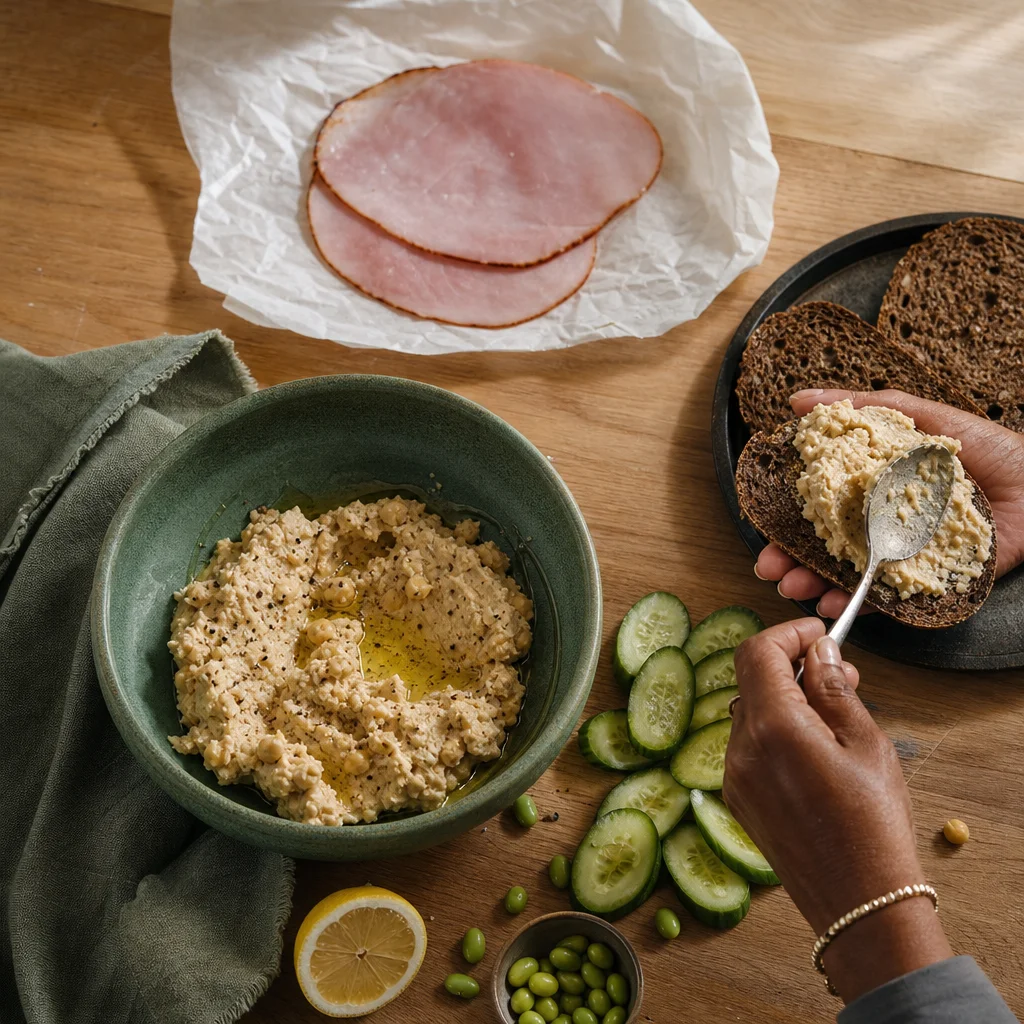
- Rung 2: Move to two swap days. Try chickpea smash with lemon and olive oil.
- Rung 3: Make it three. Hummus on whole grain with cucumber and tomato holds up well.
- Rung 4: Add one bean-based dinner — black bean chilli, lentil soup, or an edamame stir-fry.
- Rung 5: Keep deli meat for weekends only.
- Rung 6: Keep it for cookouts and travel, not routine.
You do not need specialty products. Canned beans, eggs, tofu, frozen edamame, and a supermarket rotisserie chicken cover most of it.
The goal is not a perfect record. It is a lower weekly total. Three swap days a week beats one heroic month followed by a return to old habits.
The Protective Half of the Plate
Processed meat cancer risk gets the headlines. The protective side of the plate gets far less attention, and it is arguably better news.
A Lancet analysis of 185 prospective studies found that the highest fibre eaters had 15–30% lower colorectal cancer incidence. The sweet spot was 25–29 g a day.
Put those numbers side by side. The protective effect is larger than the harmful one. That is genuinely encouraging, and it reframes the goal. You are not chasing perfection. You are loading the plate in your favour.
Whole grains, vegetables, fruit, and dairy all showed protective associations in the same meta-analysis that flagged processed meat. Same review, same search, same modelling. That makes the comparison fair rather than cherry-picked.
So when you do eat a hot dog, build around it. Vinegar slaw, charred broccoli, a handful of blueberries. Does that cancel the risk? No — and no study shows a side of slaw undoes a hot dog. What the evidence does link to lower risk is your overall pattern across the week. That is why the fibre target matters more than any single meal.
If you want the wider version of that idea, our guide to colon cancer prevention puts fibre alongside the other levers that carry real evidence, plus a weekly plan for stacking them.
What About Kids’ Lunchboxes?
Nearly every article on this topic skips children. That is odd, because rising early-onset colorectal cancer is the reason we are talking at all.
If that trend is new to you, the early onset colorectal cancer warning signs are worth knowing, because symptoms in younger adults are often dismissed as something else.
No study has measured processed meat cancer risk from a childhood ham sandwich. What we can say is simpler: a lunchbox gets packed dozens of times a term, so whatever goes in it becomes the default. A varied lunchbox is a reasonable goal, not a perfect one.
The practical version is rotation. Deli meat one or two days. Then hummus, egg, cheese, leftover chicken, or sunflower butter. That is not restriction. It is variety with a side benefit.
The Screening Conversation
Screening is the most concrete item on this page. US guidance now starts at 45, not 50. Recent data shows uptake climbing since that change, though it still trails the 80% national target.
You have options. Colonoscopy is one. A stool-based FIT test is another, and it is far less disruptive. Newer blood-based tests are arriving too, and our guide to the colon cancer blood test covers what they catch and what they miss. The right interval depends on which test you choose, so ask about it when you book.
One caveat. A strong family history or a known genetic predisposition can mean starting earlier than 45. That is a clinician conversation, not a rule you can look up.
Frequently Asked Questions
Is one hot dog a day bad for you?
The pattern matters most. Daily processed meat is linked to a modest rise in colorectal cancer risk. Occasional eating is a different exposure and a different conversation.
Is smoked salmon as risky as bacon?
It is technically processed and fairly salty. It is not a like-for-like swap for bacon, and salmon brings omega-3 fats along with it. Treat it as an occasional food, not a daily one.
Does cooking method matter?
Somewhat. High heat and charring create extra compounds, though the human evidence there is weaker than most articles imply. Gentler methods are a low-cost precaution, not a proven fix.
Do I need to go vegetarian?
No. WHO notes that meat can be part of a healthy diet. Cutting frequency and raising fibre captures most of the benefit without an all-or-nothing rule.
The Bottom Line
Processed meat cancer risk is real, small, and dose-dependent. That sentence is more useful than either “bacon is the new smoking” or a shrug about moderation.
Three moves do most of the work. Know what 50 grams looks like. Keep deli meat out of the daily routine. Push fibre toward 25–29 g a day. Then add screening at 45 to the list.
None of it requires perfection. A hot dog at the ballpark is fine. A ham sandwich every single day is the pattern worth changing. That is the honest middle, and it is a genuinely workable place to stand.