

Omega-3 Fatty Acids: Benefits, Foods & How Much You Need
Key Takeaways
- Most American women get only about 90 mg of EPA and DHA daily. That’s far below the 250 mg target linked to heart benefits.
- Food comes first: two servings of fatty fish a week covers the gap. Plant sources provide ALA, but your body converts it poorly.
- Supplements are a bridge, not a replacement. Algae-based DHA works well for people who skip fish.
- Typical supplement doses don’t raise heart-rhythm risk. That concern is limited to high-dose therapy in cardiac patients.
Here’s a number that might surprise you. Most American women get about 90 milligrams of EPA and DHA from food each day. Those are the two most useful forms of omega-3 fatty acids.
Experts suggest at least 250 milligrams. That leaves a big gap. It’s why omega-3 fatty acids rank among the most under-consumed nutrients in the American diet.
Your body can’t make omega-3 fatty acids on its own. You have to get them from food or supplements. The good news? Closing the gap is simpler than you might think. This guide covers what omega-3s actually do, how much you need, and the easiest ways to get more — with or without fish.
Quick Answer: What are omega-3 fatty acids?
Omega-3s are essential fats your body needs for heart, brain, and eye health. There are three types: ALA from plants, plus EPA and DHA from fish and algae. For healthy adults, most experts recommend 250-500 mg of combined EPA and DHA daily. That’s about two servings of fatty fish per week.
Why omega-3 fatty acids are the under-consumed nutrient
Let’s be honest: most of us aren’t thinking about EPA and DHA when we plan dinner. But the numbers tell a striking story. According to the NIH’s omega-3 fact sheet, U.S. adults average about 90 mg of EPA plus DHA per day from food.
The European Food Safety Authority recommends 250 mg daily for adults. You can see the gap.
It’s not that we’re failing at ALA — the plant form of omega-3. Women typically get about 1.6 grams of ALA daily, which passes the 1.1 gram target. The shortfall is EPA and DHA specifically.
Both are omega-3 fatty acids your body can use right away. And here’s the catch: your body converts ALA into EPA and DHA at a rate below 15%. So flax seeds and walnuts, while healthy, won’t reliably raise your EPA and DHA levels.
You need direct sources. Many experts also note our diets skew heavily toward omega-6 fats. That’s another reason to be intentional about omega-3s.
EPA, DHA, and ALA: The three types of omega-3 fatty acids
Think of omega-3 fatty acids as a family with three members. They’re related, but not interchangeable.
ALA (alpha-linolenic acid) is the plant version. You’ll find it in flaxseed, chia seeds, walnuts, canola oil, and soybeans. Your body can convert some into EPA and DHA, but the rate is under 15%, per the NIH.
EPA (eicosapentaenoic acid) comes from fatty fish and marine algae. It’s the heart-health champion. It also helps manage inflammation.
DHA (docosahexaenoic acid) is the structural heavyweight. It’s a key building block of your brain and retina. Like EPA, you’ll find it in fish, shellfish, and algae.
Quick cheat sheet: ALA equals plants. EPA equals fish and heart health. DHA equals fish and brain health. For most health goals, you want EPA and DHA directly, not just ALA.
What omega-3s can do for your heart and brain
Heart health
Here’s the thing about omega-3s and heart health: the evidence is real, but it’s nuanced. The most consistent finding? Supplements lower triglycerides — a type of fat in your blood — by about 15%. That comes from a 2020 Cochrane review of 86 trials with 162,796 people.
A 2019 meta-analysis of 13 trials with 127,477 people found real heart benefits. Marine omega-3s lowered the risk of heart attack and heart disease death. Benefits were strongest in people with existing heart disease or low fish intake. The VITAL trial also found 28% fewer total heart attacks.
However, some large trials found no benefit for healthy people. That’s why NCCIH’s omega-3 supplement explainer recommends seafood first. Fish brings protein, vitamin D, selenium, and other nutrients that work together. Supplements are modest helpers, not magic bullets.
The FDA also allows a qualified health claim. It says supportive but not conclusive research shows EPA and DHA may reduce the risk of coronary heart disease.
Brain health
Your brain and retina hold high amounts of DHA. That’s why omega-3s get so much attention for brain health. Observational studies link higher intake of omega-3 fatty acids with a lower risk of cognitive decline.
One 2025 study in The Journal of Nutrition tracked people at risk of Alzheimer’s. Those with higher blood DHA showed better cognitive trajectories over three years.
Now for the honest part. Randomized trials show no benefit for people already diagnosed with Alzheimer’s. And a 2025 study in Nutrients found no link between dietary omega-3s and memory in healthy adults. It did link EPA and DHA to better mood.
On the flip side, evidence for depression is weak. A 2021 review of 35 studies found any effect may be too small to matter. Omega-3s are not a substitute for professional care.
The takeaway? Omega-3s may help protect your brain over time, especially if you start early. They’re not a treatment.
Food-first: How to get more omega-3s this week
Now for the practical part. The American Heart Association recommends two servings of fatty fish per week. Per MedlinePlus guidance, a serving is about 3.5 ounces — slightly bigger than a checkbook.
Here’s what that looks like, based on data from the NIH and Cleveland Clinic:
- Cooked Atlantic salmon (3 oz): about 1.8 g EPA+DHA
- Herring (3 oz): about 1.7 g
- Sardines (3 oz): about 1.2 g
- Mackerel (3 oz): about 1.0 g
- Light canned tuna (3 oz): about 0.5 g
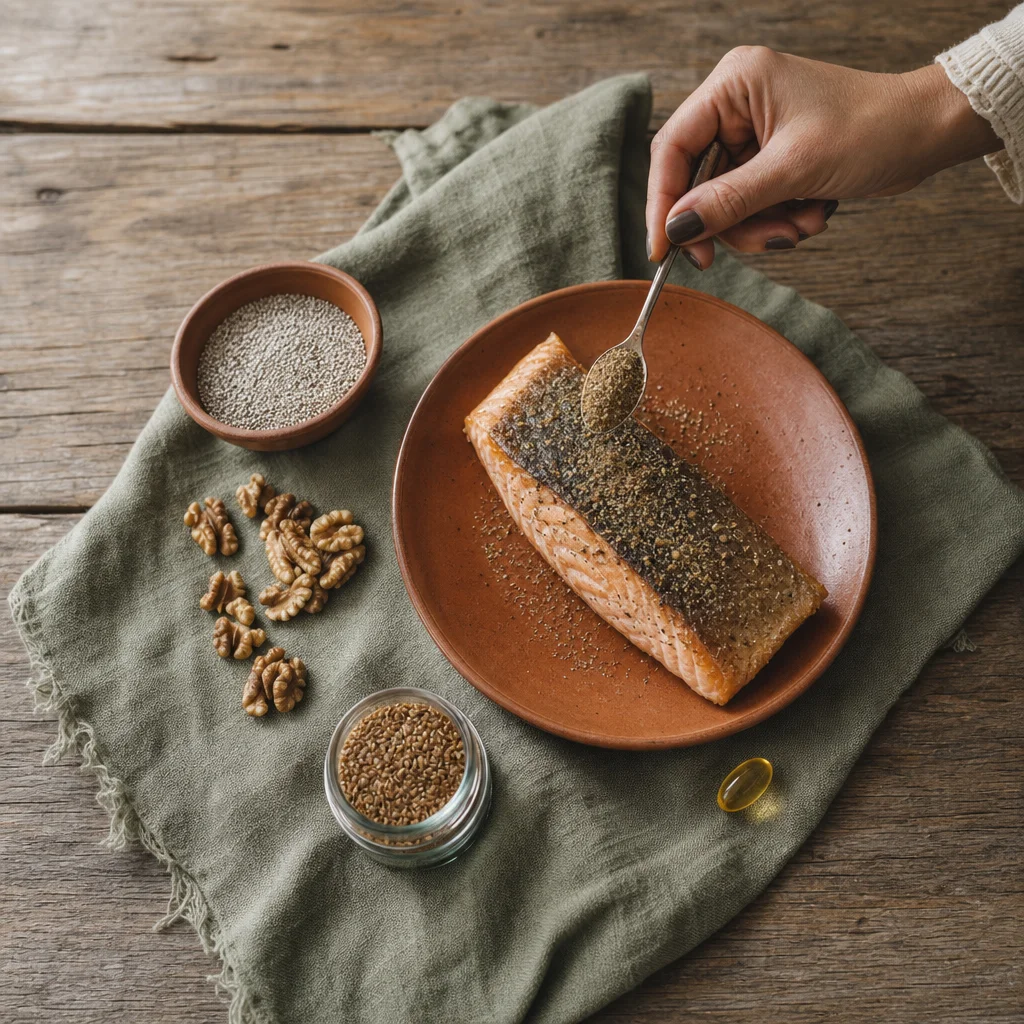
One salmon dinner alone covers about a week’s worth of that 250 mg daily target. Don’t love fish? Canned salmon and sardines are budget-friendly staples. Try them on toast, over salads, or tossed with pasta. A simple pattern: two fish-based dinners a week, plus walnuts in your oatmeal and chia seeds in your smoothie.
For plant-based eaters, ground flaxseed is a great ALA source — about 2 tablespoons daily. Chia seeds pack about 5 grams of ALA per ounce. Just remember: ALA is beneficial, but it doesn’t replace EPA and DHA. That’s where algae-based supplements come in.
Omega-3 supplements: A bridge for non-fish-eaters
If fish isn’t your thing, supplements can close the gap. Our omega-3 guide covers evidence, dosing, and food sources. The most important skill? Reading the label.
A typical fish oil capsule holds 1,000 mg of fish oil. Yet only about 180 mg of EPA and 120 mg of DHA are in it. That’s the number that matters. Look for the EPA + DHA line, not the total oil weight.
For plant-based women, omega-3 fatty acids from algae are the only vegan source of DHA. Some algae oils include EPA too. The NIH notes that DHA from algae absorbs just as well as DHA from cooked salmon.
Here’s something most articles miss: fish get their omega-3s from marine microalgae. A 2026 review of omega-3 formulations highlights algae-based oils as a sustainable alternative.
Want proof it’s working? Ask about the omega-3 index. It’s a blood test that measures EPA and DHA in your red blood cells.
In Western populations with low fish intake, it sits around 3-5%. In Japan, it’s about double. It’s not routine, but it can show if your efforts are working.
Safety, side effects, and who should check first
Omega-3s are generally safe. The FDA considers up to 5,000 mg of combined EPA and DHA daily as safe for most people. But more isn’t better. Talk to your provider if you plan to take 3 grams or more per day.
Common side effects are mild: fishy taste, bad breath, heartburn, nausea. Taking capsules with meals can help. If you take blood thinners, check with your clinician first. Omega-3s can interact with those medications.
Now, about those atrial fibrillation headlines. Some studies did link omega-3 supplements to a higher risk of this heart-rhythm condition. But a 2026 meta-analysis of 35 trials — the largest yet — found the risk only with high-dose therapy.
That’s over 1.5 grams daily in people already at high heart risk. The absolute risk increase was tiny: 0.8%.
At typical supplement doses, no increased risk appeared. If you have heart rhythm problems, talk to your doctor. Otherwise, don’t let the headlines scare you off a reasonable dose.
Pregnancy: what omega-3s really do (and don’t do)
If you’re pregnant or planning to be, omega-3s deserve special attention. DHA builds up quickly in the baby’s brain during the third trimester. A 2018 Cochrane review of 70 trials with 19,927 women found a clear benefit.
Omega-3 supplements reduced preterm birth before 37 weeks by 11%. Early preterm birth before 34 weeks dropped by 42%.
What it doesn’t do? Make babies smarter. A 2026 systematic review of prenatal DHA found no benefit on any measure of child development. So take DHA for the preterm-birth benefit and your own health.
Pregnant women should aim for 8-12 ounces of low-mercury seafood weekly. Great choices: salmon, sardines, shrimp, light canned tuna. Skip swordfish, shark, king mackerel, and tilefish.
Your omega-3 questions, answered
Can I get enough omega-3s from plants alone?
Not for EPA and DHA specifically. ALA conversion is under 15%. Plant-based women should consider an algae-based DHA supplement.
What’s the difference between a cheap and a premium fish oil?
Often the EPA and DHA concentration, plus purity testing. Look for third-party seals like NSF or USP. And check the actual EPA + DHA content on the label.
Should I worry about mercury in fish?
Omega-3 supplements don’t contain mercury — it’s removed during processing. For fish, stick to lower-mercury choices like salmon, sardines, anchovies, and trout.
The Bottom Line
Omega-3 fatty acids won’t magically fix your heart or sharpen your memory overnight. But they’re one of the few nutrients with genuine evidence for both. And most of us aren’t getting enough.
Start with food: two servings of fatty fish a week. Add walnuts to your oatmeal and chia seeds to your smoothie. If fish isn’t on your plate, a quality supplement with real EPA and DHA content is a reasonable bridge.
Your heart and brain have been asking for more. Now you know how to answer.