
Morning Light for Sleep: A Science-Backed Protocol
Key Takeaways
- Getting bright light within 30–60 minutes of waking is one of the most effective, free ways to improve sleep quality.
- A 2025 study of 1,762 adults found that every 30 minutes of morning sun shifted sleep timing 23 minutes earlier.
- Even cloudy outdoor light is far brighter than indoor lighting — you don’t need direct sun to get the benefit.
- Consistency matters more than duration: a daily 10–30 minute morning light habit beats long weekend sessions.
- On dark winter mornings, a light therapy box (10,000 lux) is a proven backup when natural light isn’t available.
You’ve tried everything: blackout curtains, a strict 10 p.m. bedtime, no screens after dinner. Yet you still lie awake, staring at the ceiling. What if better sleep doesn’t start at night — but the moment you open your eyes in the morning? That’s the promise of morning light for sleep, a science-backed strategy that uses your body’s natural clock to help you fall asleep faster and sleep deeper. And the best part? It’s free, it’s simple, and it works.
Quick Answer: Does Morning Light Actually Help You Sleep Better?
Yes — and the evidence is strong. Exposing your eyes to bright natural light within the first hour of waking resets your internal body clock (circadian rhythm). This signals your brain to start a biological countdown that leads to melatonin release when darkness falls. The result: you feel sleepy at the right time, fall asleep more easily, and wake up less during the night. It’s not a cure-all, but for many women struggling with sleep onset, it’s a game-changer.
Why Morning Light for Sleep Works: The Science
Let’s get specific. A 2025 study of over 1,700 adults published in BMC Public Health found that every additional 30 minutes of morning sunlight (before 10 a.m.) shifted the midpoint of sleep 23 minutes earlier. Participants also reported better overall sleep quality.
Another daily diary study from the Journal of Health Psychology followed 103 adults for up to 70 days. The key finding: morning sunlight predicted better next-night sleep quality — and the timing of light mattered more than how long you stayed outside.
Together these studies make a strong case that morning light for sleep is one of the most powerful tools you have. The science is consistent across decades of circadian research — your body is wired to respond to morning brightness.
How Morning Light for Sleep Resets Your Internal Clock
Here’s the thing: your internal clock runs on a slightly longer-than-24-hour cycle. Every morning, bright light acts like a reset button that synchronizes it with the outside world. When sunlight hits your retina, it signals your brain to stop producing melatonin (the sleep hormone) and start producing cortisol (the alertness hormone).
That morning cortisol spike does more than wake you up. It starts a biological process that leads to melatonin release roughly 14 to 16 hours later — a pattern well documented in circadian science. As a 2026 review from the University of Basel explained, morning light can advance your melatonin timing by 10 to 30 minutes within the same day. That means even a single morning of good light exposure can start shifting your sleep timing earlier.
What Happens When You Don’t Get Morning Light for Sleep
Think a dim indoor morning is no big deal? Think again. A 2026 randomized controlled trial from Charité – Universitätsmedizin Berlin split healthy adults into two groups: one spent mornings in 55 lux light (like a dim living room) and the other in 800 lux light (bright office). After just five mornings, the low-light group lost about 25 minutes of total sleep, had higher evening cortisol levels, and reported more sadness and sleepiness.
The researchers concluded that insufficient morning light doesn’t just affect sleep — it shifts stress hormones and mood in the wrong direction. That’s a big deal for anyone who spends early mornings indoors under artificial light and then wonders why their morning light for sleep routine isn’t working. (Hint: they may not be getting enough light in the first place.)
Your Morning Light for Sleep Protocol: When and How Long
Ready to put this into practice? Here’s a simple, science-backed morning light for sleep routine you can start tomorrow.
The TEOHL Morning Light Protocol
Timing: Get light within 30–60 minutes of waking. This is when your body is most sensitive.
Duration: Aim for 10–30 minutes. More is fine, but consistency matters more than length.
Intensity: Step outside. Even on cloudy days, outdoor light is dramatically brighter than indoor lighting. The Sleep Foundation notes that outdoor daylight can reach 10,000 lux, while indoor office lighting rarely exceeds 500 lux — so yes, you really do need to step out.
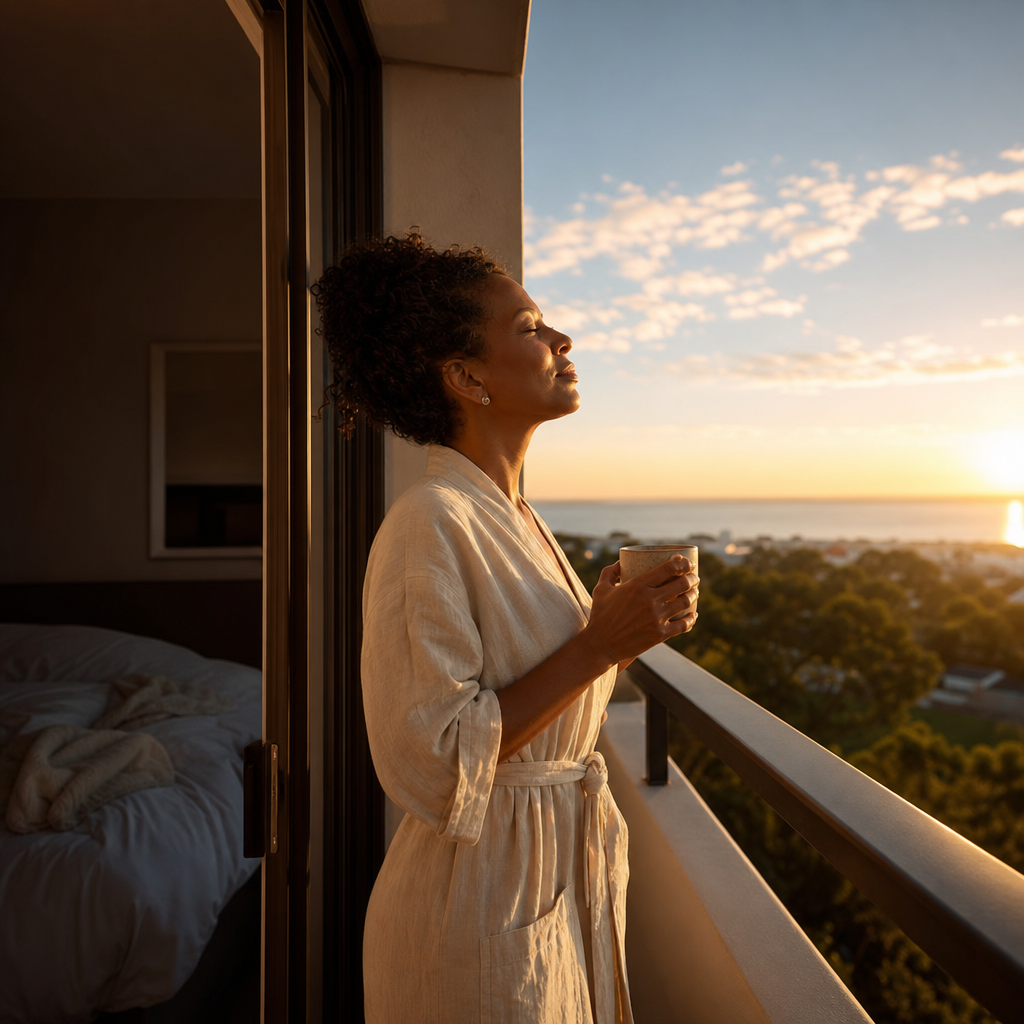
Method: Go for a walk, drink your coffee on the patio, or simply sit outside. Don’t stare at the sun — just let natural light reach your eyes.
Sunglasses: If it’s safe, skip them for the first few minutes to maximize light input. (Clear glasses and contacts are fine.)
Safety: Never look directly at the sun. If you have eye conditions or take photosensitizing medications, check with your doctor first.
Banner Health experts recommend 5–15 minutes of morning light within the first hour — even on cloudy days. The key takeaway: outdoor light is dramatically brighter than indoor light, so stepping outside even briefly makes a real difference.
What About Dark Winter Mornings?
This is a common concern — and a valid one. If you wake up before sunrise, natural light isn’t an option. Here’s what works to still get your morning light for sleep benefits:
- Light therapy boxes: Look for a box that delivers 10,000 lux and filters UV light. Use it within 30–60 minutes of waking for 20–30 minutes, positioned about 16–24 inches from your face.
- Sit by a window: Even indoor light near a window is brighter than central artificial light — especially if you open the blinds wide.
- Plan your day: If it’s still dark when you wake, get your light exposure as soon as the sun rises, even if that means a short walk mid-morning.
The key is consistency. Your body clock responds to reliable daily cues, so do your best to get bright light at roughly the same time every day.
Making Morning Light for Sleep a Daily Habit
Here’s where many people slip. During the workweek, they’re inside under artificial light, then they spend hours outside on Saturday and wonder why their sleep still isn’t great. Consistency is the secret sauce.
Research suggests that people with consistent daily bright light — not just weekend bursts — tend to have deeper, more restful sleep. Your body clock craves routine.
Try this: pair your morning light for sleep habit with something you already do. Drink your coffee outside. Walk your dog right after waking. Do a 10-minute stretch on the porch. Soon, it’ll feel automatic — and your sleep will thank you.
Morning Light for Sleep: Frequently Asked Questions
Can I get morning light through a window?
Yes, but it’s less effective. The Sleep Foundation notes that outdoor daylight can reach 10,000 lux, while even bright indoor lighting rarely exceeds 500 lux. Sitting near a wide window is better than nothing, but stepping outside — even for 5 minutes — makes a real difference because outdoor light is dramatically brighter.
What if I wake up before sunrise? Should I still try?
If it’s still dark, artificial light is better than nothing. Turn on all your lights, open curtains as soon as sunrise hits, and consider a light therapy box for the first 20–30 minutes of your day. Then get outside when the sun appears.
How quickly will I notice better sleep?
Some people feel a difference within a few days. For others, it takes a week or two of consistent morning light. Your circadian rhythm adjusts gradually, so patience and consistency are key.
Do I need to skip sunglasses?
For maximum circadian benefit, skipping sunglasses for the first few minutes (if safe — no direct sun) helps your eyes absorb more of the light signal. Regular prescription glasses and contacts are fine. If it is very bright, wear sunglasses after your initial exposure.
The Bottom Line on Morning Light for Sleep
Better sleep doesn’t begin when you climb into bed — it begins when you open your eyes. Getting morning light for sleep is one of the simplest, most effective, and totally free tools you have. It resets your internal clock, helps you fall asleep earlier, and supports deeper, more restorative rest.
Start small: tomorrow morning, take your coffee outside. Sit for 10 minutes. Do that for a week and notice what changes. Your sleep — and your mornings — may never be the same.