

How to Improve Posture: Movement Beats Sitting Straight
Key Takeaways
- Forcing yourself to sit up straight doesn’t work — or last.
- There’s no single “perfect” posture. Even physiotherapists disagree.
- What helps: strength in your glutes, core, and upper back — plus regular movement.
- Move for 1–2 minutes every 30–60 minutes. It reduces discomfort and protects your health.
- Posture affects your pelvic floor and digestion, too — not just your back.
You’re deep in an email when you notice it. Shoulders rounded. Chin drifting toward the screen. You’d love to improve posture — so you sit up straighter. A few seconds later, you sink back into the same slump.
Here’s the thing: that’s not a willpower problem. It’s a design problem. The body craves variety — it’s built for movement, not for holding one pose. The movement science points somewhere unexpected — away from “sit up straight” and toward strength, mobility, and regular movement breaks.
In this guide, we’ll unpack why the old advice fails — and share the simple system that actually helps you stand taller.
Quick Answer: Can You Improve Posture?
Yes — and the fastest route to improve posture is movement, not muscle-holding. What works: strength in your glutes, core, and upper back. Plus short movement breaks every 30 to 60 minutes.
Why “Sit Up Straight” Won’t Improve Posture
For decades, the advice sounded simple: stand tall, pull your shoulders back, and hold. The problem? Your muscles aren’t built to hold any position for hours. Lock yourself into a rigid pose, and tension builds. Muscles fatigue. Then you collapse — usually within a minute. That’s the tension–fatigue–collapse pattern — and it’s why “stand up straight” never sticks.
The perfect-posture idea is also scientifically shaky. In a 2019 study, researchers asked 544 physiotherapists to identify the “optimal” posture. They chose three different sitting postures and two standing postures. There was no consensus. The team concluded that no strong evidence links any specific posture to better health outcomes.
Even more striking: sensor-based research on 266 adults found no sitting-posture differences between people with chronic back pain and pain-free people. The gaps appeared in movement. The pain group moved with less range, more stiffness, and a slower rhythm.
Here’s what that means for you. Slouching isn’t a moral failure — and it’s probably not the villain it’s made out to be. What matters is how long you hold one position, and how well you move. That’s the shift at the heart of the movement-first view. And the real science of how to improve posture begins here.
What Actually Happens When You Sit All Day
Most of us sit more than we realize. The NIH reports that Americans ages 12 and up spend roughly 8 to 10 hours a day sitting. And a 2018 study linked long sitting hours to measurably reduced mid-back mobility. That link was strongest in people who also got little exercise. Exercise duration, by contrast, strongly correlated with better spinal rotation.
Harvard Health explains the mechanics. Long screen hours overstretch and weaken the muscles in the back of your shoulders. The chest muscles in front shorten and tighten. Your deep core — the muscles that hold you upright — grows weak from underuse. Then gravity pulls everything forward.
Hunching over your phone does the same thing. Text neck is real — and neck strain responds well to movement and strength work (see our text neck guide for the details).
That’s why “sit up straighter” fails as a way to improve posture. You likely don’t have a posture problem. You have a strength and movement problem. And that’s genuinely good news, because both are fixable at any age. As Harvard Health puts it: “We can’t change bones, but we can change muscle mass.”
How to Improve Posture: The Movement-First System
So what actually works? You build a body that holds you upright on its own. Fitness educator Gabby George, founder of GGStudio, describes posture as a byproduct. When you have mobility and strength, better alignment shows up naturally — no constant reminders needed.
“Mobility gives you the freedom to move, and strength gives you the ability to control that movement,” George says. “Better posture is often the result of having both.” Together, they make posture automatic. Here’s a simple, no-equipment starter kit built on that idea. Pick three moves and do them two or three times a week.
Your No-Equipment Starter Kit
- 360 breathing. Lie on your back, knees bent. Breathe in and expand your ribs, back, and belly in every direction. Breathe out and draw your navel toward your spine. Take 10 slow breaths. This trains the diaphragm, deep core, and pelvic floor — your internal support system.
- Rows. Anchor a resistance band at chest height, or hold light dumbbells. Pull your elbows back and squeeze your shoulder blades. This rebuilds the upper-back muscles that keep your shoulders from rolling forward. Do 10 to 12 reps, 2 to 3 sets.
- Dead bugs. Lie on your back, arms up, knees bent at 90 degrees. Slowly lower one arm and the opposite leg. Keep your lower back pressed into the floor. Return, then switch sides. Do 8 to 10 reps per side. This builds core stability and coordination.
- Glute bridges. Lie on your back, knees bent, feet flat. Squeeze your glutes and lift your hips. Lower slowly. Do 12 to 15 reps. Strong glutes ease pressure on your lower back and help your pelvis sit evenly.
The research backs this approach. Harvard Health recommends the same pattern — scapula squeezes, rows, planks, and chest stretches — as the way to retrain posture. And a 2026 randomized trial offered a women-focused proof point. Breastfeeding mothers with forward head posture did 8 weeks of Pilates. They showed measurable gains in neck alignment, plus less neck pain and fatigue.
See a pattern? None of this requires thinking about your posture all day. That’s the point. To improve posture for the long haul, you train your body until good alignment becomes automatic.
The Daily Desk Habit That Beats Any Posture Gadget
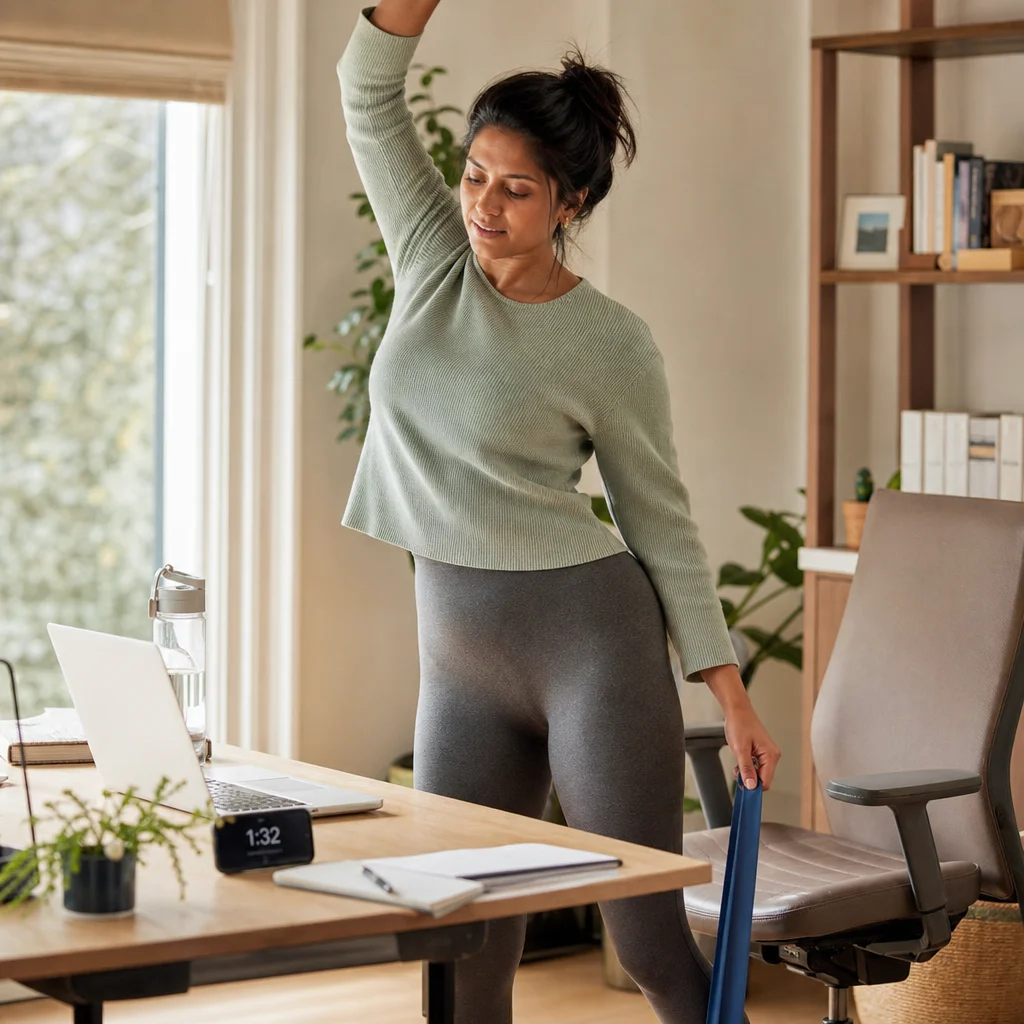
One of the best ways to improve posture is hiding in plain sight: movement snacks. These are short, frequent breaks where you stand, walk, or stretch.
The Evidence for Movement Snacks
The evidence is solid. A 2018 systematic review of office workers found that active breaks with postural change reduce discomfort. They may also ease pain. Just as important: breaks didn’t hurt productivity.
How often? Harvard’s experts say change your position every 30 to 60 minutes. “We don’t want people in fixed postures for hours at a time,” says physical therapist Meghan Markowski of Harvard-affiliated Brigham and Women’s Hospital.
Reminders actually work too. A 2025 meta-analysis of 18 trials found that computer-prompt reminders work. They cut sitting time by about 12.5 minutes per workday — and added roughly 1,000 steps. The NIH recommends the same idea: set an alarm and move for 1 to 2 minutes every hour.
Do Posture Gadgets Actually Work?
A quick word on gadgets. Posture correctors and wearable braces are popular — and tempting. But no strong research shows they change posture long-term. At best, they remind you to shift. A phone alarm does that for free. If you’re tempted by anything that promises to improve posture for you, skip it. Spend that money on a resistance band or a few sessions with a physical therapist instead.
Ergonomics still matter — just think of your setup as a movement tool, not a cage. Raise your monitor to eye level. Keep your feet flat. If a lumbar cushion feels good, use it. Then stand for phone calls and walk during meetings. Variety is the goal. For the full workstation checklist, read our 7 best posture practices for sitting at a desk all day.
Why Posture Matters Beyond Your Back
Posture isn’t just about aches. Harvard Health highlights links that matter for many women — and most posture guides miss them.
The Pelvic Floor Connection
Slouching increases pressure in the abdomen. That pressure presses on your bladder — and makes it harder for the pelvic floor to hold. Experts say this is why slouched sitting can contribute to stress incontinence. It’s common — and it’s addressable.
A neutral spine minimizes the pressure instead. Strong pelvic floor and deep core muscles help here — which brings us right back to 360 breathing.
Toilet posture? Yes, it counts. Hunched over with knees below your hips can make constipation worse. Resting your feet on a small stool shifts your hips above your knees. That helps — same idea as a squat.
Heartburn and slow digestion round out the list. Slouching after a meal puts pressure on the abdomen. That can push stomach acid in the wrong direction. Experts also suspect slouched posture may slow digestion.
These links are expert-informed, not proven by large trials. But they’re practical reasons to take posture seriously. And if you’re postpartum, there’s encouraging news. The 2026 Pilates trial improved posture, pain, disability, and fatigue in breastfeeding mothers in just 8 weeks. Targeted movement can help your body recover.
Red Flags: When Posture Needs a Professional’s Eyes
Most stiffness and slouching is normal, and movement usually resolves it. One sign deserves special attention: a hump at the upper back that doesn’t straighten. Harvard Health notes this can signal an osteoporosis-related compression fracture, which needs a clinician’s evaluation.
Beyond that, trust your body. If pain is persistent, worsening, or getting in the way of daily life, a physical therapist is the best first stop. You don’t need to monitor your posture all day — that’s the old way of thinking. The movement-first approach means you build strength, take active breaks, and let better alignment emerge on its own. If discomfort lingers, an expert can help pinpoint what’s actually driving it.
Harvard Health adds one caution: if you have a spinal cord injury or surgical fusions, check with your care team first. Otherwise, a physical therapist can design a program around your body’s needs — and that’s how posture changes stick.
This guide is for general education, not medical advice. When in doubt, talk to your clinician.
Your Simple Daily Plan
Morning: 10 slow rounds of 360 breathing before you get up. Workday: one 1–2 minute movement snack every hour. Evening: 10–12 rows and 10–15 glute bridges while dinner cooks. That’s it. That’s the system.
Is my slouching causing my back pain?
Not necessarily. The science of how to improve posture doesn’t support the guilt. Sensor-based research found no sitting-posture difference between adults with and without chronic back pain. Pain is complex — movement quality, strength, stress, and sleep all play a role. Keep moving, and see a professional if pain persists.
Do posture correctors work?
The evidence is thin. No strong research shows they change posture long-term. They may remind you to shift positions, but so does a phone alarm — for free. Building strength and taking movement breaks is the reliable path.
How often should I move during the workday?
Every 30 to 60 minutes is the expert recommendation. Stand, walk, or stretch for 1 to 2 minutes. Set a timer. Research links this habit to less discomfort — with no loss in productivity.
The Bottom Line
Posture isn’t a pose to police. It’s a reflection of how you move, rest, and build strength.
If you take one thing from this guide, let it be this. The most reliable way to improve posture is to stop holding yourself still. Start building a body that moves well instead.
Set a timer. Do three strength moves. Take a walk between meetings. And let “sit up straight” fade into history.