

High-Fiber Breakfast: Your Easiest Win for Weight & Energy
Key Takeaways
- Most US adults get only about half the fiber they need, the CDC reports.
- A high-fiber breakfast is the easiest place to start closing that gap.
- Split your daily goal across three meals and you land near 7 to 10 grams at breakfast.
- Fiber plus protein keeps you fuller and steadier than fiber alone.
- Ramp up slowly and drink water. That is what prevents gas and bloating.
You get one easy shot at fiber every morning, and most of us sleep right through it. A high-fiber breakfast does something no lunch or dinner can do. It front-loads your day with the nutrient almost every adult falls short on. Better yet, it steadies your morning energy and keeps you full until noon.
Here is what I want to be clear about, though. This is not a recipe list, and it is not about smoothies. It is about the why. How fiber actually works in your body, how much you need, and how to build a high-fiber breakfast that fits a real, rushed morning.
Quick Answer: Why Is a High-Fiber Breakfast Worth It?
Fiber slows digestion, feeds your gut bacteria, and helps keep blood sugar steady instead of spiking. It also makes a meal feel more filling without adding many calories. A high-fiber breakfast lets you bank those benefits early, when your schedule and your willpower are both at their best.
Why a High-Fiber Breakfast Is Your Easiest Win
Start with the gap. Most US adults eat only about half the fiber they need each day, according to the CDC. Closing that gap sounds like a chore. In reality, it is mostly a timing problem, as our high-fiber breakfast guide for weight loss explains.
Fiber is bulky. Squeezing 25 grams into dinner is hard. Spreading it across three meals is not.
The long-term payoff is real, too. A 2025 umbrella review of more than 17 million people looked at fiber and long-term health. It found convincing evidence that higher fiber intake lowers the risk of dying from heart disease. The same review also linked fiber to lower rates of pancreatic cancer and diverticular disease.
Then there is the short game. Soluble fiber forms a gel in your stomach and slows digestion. As a result, glucose enters your bloodstream more gradually instead of all at once. That is why a high-fiber breakfast tends to feel steady rather than buzzy.
How Much Fiber Do You Actually Need?
The official target for adults is 22 to 34 grams a day, depending on age and sex, per the Dietary Guidelines for Americans. The National Academy of Medicine frames it a little differently: 25 grams for women up to age 50, and 21 grams for women over 50. For men, the range runs from 30 to 38 grams.
Notice how wide those numbers are. That is because fiber needs shift with age, sex, and how much you eat overall. Instead of memorizing one figure, split your daily goal across three meals.
For most adults, that works out to roughly 7 to 10 grams of fiber before 9 a.m. It sounds like a lot until you see how fast it adds up.
What a High-Fiber Breakfast Looks Like on a Plate
Forget single superfoods. Think in building blocks instead: a whole grain, a protein, something from a plant, and a spoonful of seeds or nuts. Stack those blocks and the fiber math takes care of itself. It is the same approach behind our high-fiber Mediterranean breakfast.
| Building block | Fiber (about) | Why it helps |
|---|---|---|
| Cooked oatmeal, 1 cup | 4 to 5 g | Soluble fiber that slows digestion |
| Chia seeds, 2 tablespoons | 8 g | Thickens into pudding; soluble fiber |
| Half a medium avocado | 7 g | Fiber plus heart-friendly fat |
| Cooked black beans, 1/2 cup | 7.5 g | Fiber and plant protein together |
| Raspberries, 1 cup | 8 g | The highest-fiber berry in the bowl |
| Whole-grain English muffin | 3 g | Whole grains beat refined flour |
| Whole-grain cereal, 1 serving | 5 g or more | A no-cook option for chaotic mornings |
Read that table again and one thing stands out. These are ordinary foods. Oats, beans, berries, avocado, whole-grain bread. A high-fiber breakfast is not a specialty diet. It is the breakfast you already eat, with a couple of upgrades.
Dairy-Free and Gluten-Free Swaps
Going dairy-free? Use soy milk, hemp milk, or coconut yogurt, and try a tofu scramble in place of eggs. Going gluten-free? Certified gluten-free oats, quinoa, buckwheat, and chia pudding all work beautifully. In other words, the framework stays the same even when the ingredients change.
Pair Fiber With Protein for Real Staying Power
Fiber is only half the story. In a 2016 randomized trial of egg-and-fiber breakfasts, researchers compared three meals with equal calories. The egg-and-fiber version lowered the blood sugar response after eating. It also cut how much people ate at their next meal, by about 69 calories.
Fullness is where protein earns its keep. A 2024 randomized breakfast satiety study found that a protein-rich morning meal raised fullness and sharpened focus before lunch. Here is the honest asterisk, though. It did not reduce total calories for the day.
So use a simple rule. Aim for 20 to 30 grams of protein alongside your fiber. Picture Greek yogurt with berries and chia. Or eggs with black beans and salsa. Or oats made with soy milk and a spoon of nut butter. Our high-protein high-fiber snacks follow the same pairing rule.
Does Eating Breakfast Actually Help With Weight Loss?
Let us be honest about this one, because plenty of articles are not. A meta-analysis of randomized breakfast trials found that skipping breakfast modestly lowered body weight, by about 0.54 kg over roughly nine weeks. However, it also raised LDL cholesterol.
In other words, the act of eating breakfast is not the lever. The composition is. Fiber, protein, and whole grains shape your appetite and your blood sugar. Simply sitting down to eat does not.
The Honest Takeaway
Breakfast is a tool, not magic. What you put on the plate is what moves the needle, and a fiber-forward plate is the one worth building.
Make-Ahead Ideas That Beat the Morning Rush
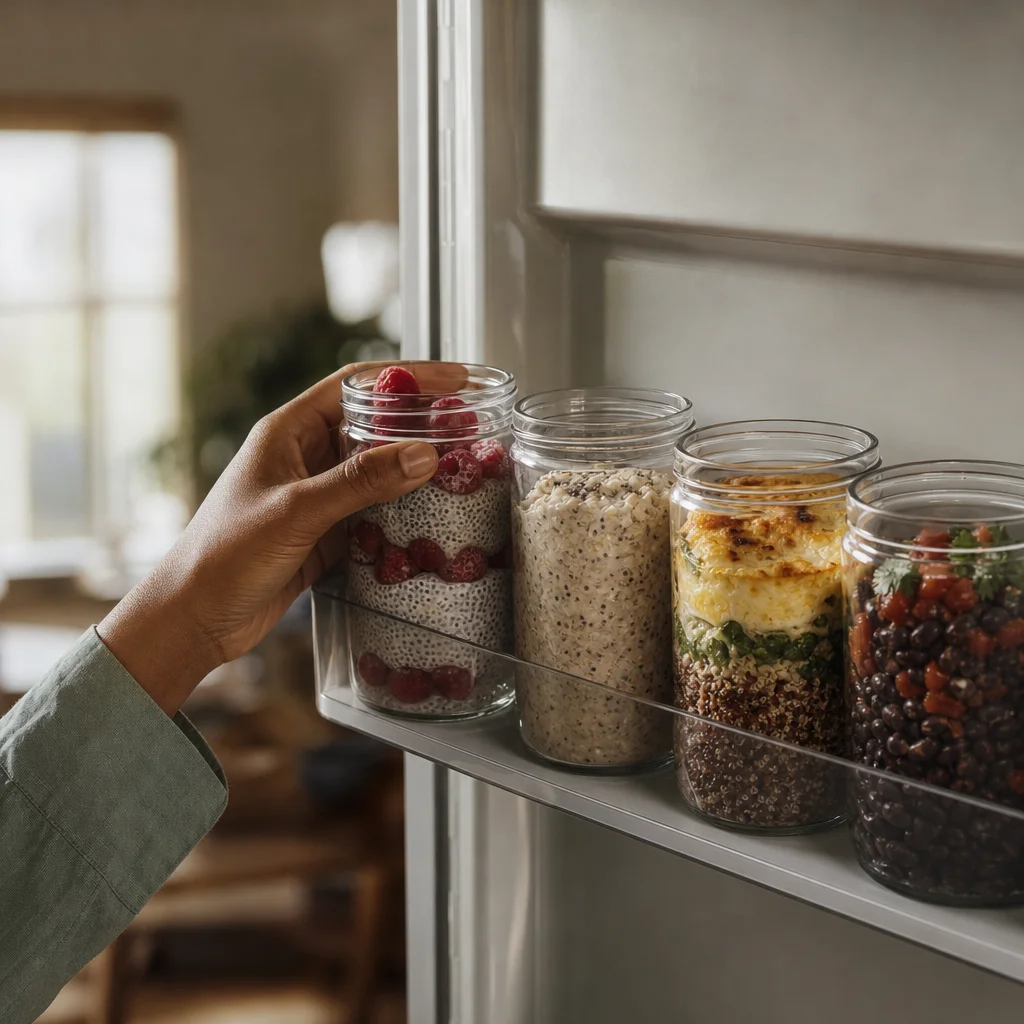
None of this works if it takes 40 minutes at 6:45 a.m. So pick formats you can prep once and eat all week. For portable options, see our healthy breakfast on the go ideas.
- Overnight oats. Oats, chia, milk or yogurt, and berries. Assemble four jars on Sunday.
- Chia pudding. About two tablespoons of chia to half a cup of liquid. Refrigerate overnight.
- Veggie-and-egg bake. Add a can of white beans, bake once, then freeze in single portions.
- Savory grain bowl. Cook a batch of quinoa or farro, then reheat with an egg and greens.
- Bean burrito. Black beans, eggs, and salsa rolled in a whole-wheat wrap. Freezes well.
Batch cooking is how a high-fiber breakfast survives a busy week. Pick two formats, prep them once, and you have covered five mornings.
How to Add Fiber Without the Bloating
This is the part most lists skip entirely. Jumping from 12 grams of fiber a day to 30 grams overnight will leave you gassy, bloated, and ready to quit. Your gut bacteria simply need a few weeks to adjust.
The fix is not complicated. Add fiber slowly over several weeks. Drink plenty of water, because fiber needs fluid to keep things moving. Spreading new fiber across meals helps as well.
If one food still bothers you, try a smaller portion before cutting it out for good. Beans are a common culprit, and half a serving often sits fine.
Who Should Be Careful With Fiber
For most people, more fiber is a clear win. For a few groups, it needs a conversation with a clinician first.
That includes anyone recovering from certain GI surgeries, people with narrowing in the intestines, and those going through radiation therapy or living with gastroparesis.
Fiber is also not helpful during a Crohn’s disease or ulcerative colitis flare. Additionally, many doctors ask patients to cut back before a colonoscopy. If any of that sounds like you, check with your doctor or a dietitian before making big changes.
Your Questions, Answered
Can I hit my fiber goal without oats?
Absolutely. Oats are popular, not essential. A bean-and-egg bake, a quinoa bowl, or chia pudding all deliver the same range.
Does this help if I have prediabetes?
The evidence points that way. A review of 51 randomized trials found that fiber improved fasting glucose, fasting insulin, and insulin sensitivity in adults with excess weight. A meta-analysis of 34 randomized trials reached a similar conclusion. Ask your care team how it fits your plan.
What if I am not hungry in the morning?
Then start small. Even a few grams, such as yogurt with chia, moves you forward. Forcing a large meal you do not want will not help.
The Bottom Line
A high-fiber breakfast is the least dramatic, most reliable change you can make to your morning. It steadies your blood sugar, feeds your gut, and quietly closes a fiber gap that most of us have carried for years.
So do not overthink it. Pick two building blocks you like, add a source of protein, and prep it ahead. Then add fiber slowly, drink your water, and let your body catch up.
Your breakfast is your first chance to hit your fiber goal. That is a small win you get to collect every single morning.