
Gut Health Aging: The Surprising Fall and Frailty Link
What if the key to how well you age isn’t just in your genes or your gym routine, but in the trillions of microbes living in your gut? It’s a question researchers are asking with growing urgency. A groundbreaking new study suggests that the diversity of your gut microbiome might be one of the most overlooked markers of healthy aging. The research links gut health aging directly to your risk of falls, frailty, and even how long you live. Here’s what the science says about the gut health aging connection, and what you can do about it starting today.
Key Takeaways
- A major 2026 study of over 2,000 women found that higher frailty scores — which are strongly linked to lower gut microbiome diversity — are tied to more falls, hip fractures, and a 5x higher risk of death.
- Beneficial bacteria that produce butyrate — a compound that fights inflammation — are depleted in women who age less resiliently.
- You can actively support your gut microbiome through diet, exercise, sleep, and stress management.
- Aiming for 30+ different plant foods per week is one of the most effective ways to boost microbial diversity.
The Study: What the Research Found About Gut Health Aging
Let’s be honest — most of us don’t think about our gut bacteria when we think about staying strong and mobile as we age. But maybe we should. In July 2026, researchers from the University of Gothenburg published a landmark study in Nature Communications that changed how we understand the connection between our gut and how we age.
The study, called SUPERB, looked at 2,081 Swedish women between the ages of 75 and 80. Researchers collected stool samples to analyze each woman’s gut microbiome. They didn’t just look at which bacteria were present — they measured diversity, gene richness, and what those microbes were capable of doing. Then they compared those results with a detailed measure of frailty that included walking speed, chair stand performance, body weight, mental well-being, and more.
The findings were striking. Women who were more frail had less diverse gut bacteria. They had fewer bacterial species, lower gene richness, and a reduced ability to carry out key metabolic functions. But here’s what really got our attention: those microbial differences were linked to real-world outcomes. Women with higher frailty scores — which were strongly tied to lower gut microbiome diversity — had a 63% higher risk of injurious falls, more than double the risk of hip fracture, and a five times higher risk of dying during the study period.
The Numbers That Matter
In the SUPERB study, higher frailty scores (which correlate with lower gut microbiome diversity) were associated with:
• 63% higher risk of injurious falls
• 2.4x higher risk of hip fracture
• 5x higher risk of death
These findings were cross-validated in an independent Chinese cohort of 1,448 older adults, suggesting the gut-frailty link may be universal.
The Good Guys vs. The Bad Guys: Which Bacteria Matter for Gut Health Aging
The SUPERB study identified 404 bacterial species that were significantly linked to frailty. That’s a lot of microbes. But the pattern was clear: women who were aging well had more of the beneficial bacteria, while women who were more frail had more of the harmful ones.
The beneficial bacteria — species like Faecalibacterium prausnitzii, Roseburia, and Dysosmobacter — are known for one important job: they produce butyrate. Butyrate is a short-chain fatty acid that your gut microbes create when they ferment dietary fiber. Think of it as a super-fuel for your body. It helps maintain the gut lining, supports your immune system, reduces inflammation throughout the body, and may even help preserve muscle and metabolic health.
On the flip side, women with greater frailty had more pro-inflammatory bacteria — species like Enterocloster, Clostridium Q symbiosum, and Eggerthella lenta. These bacteria are associated with inflammation, which is a key driver of age-related decline. This pattern has been confirmed in multiple studies, including the large SUPERB cohort and a 2024 systematic review of 11 studies.
How Your Gut Affects Your Body as You Age
You might be wondering: how does what’s happening in my gut affect whether I can get up from a chair or avoid a fall? It’s a fair question. The connection is what researchers call the “gut-muscle axis.”
Here’s how it works. When you eat fiber-rich foods, your gut bacteria ferment that fiber and produce butyrate. Butyrate travels through your bloodstream and helps reduce inflammation throughout your body. Less inflammation means your muscles can repair and maintain themselves better. It also means your bones stay stronger. And when your muscles and bones are healthy, you’re less likely to fall and less likely to get hurt if you do.
Research on the diet-gut-muscle axis in older adults found that those with higher fiber intake and higher lean mass had higher levels of butyrate-producing bacteria. They also had better physical function, including faster walking speed and stronger grip strength. The takeaway? What you eat today literally shapes how well your body works tomorrow.
5 Science-Backed Ways to Support Your Gut for Healthy Aging
Now for the good news: your gut microbiome is remarkably responsive to what you do. You can start supporting it today. Here are five evidence-based strategies that directly target the bacteria linked to healthy aging.
1. Eat a Wide Variety of Plant Foods
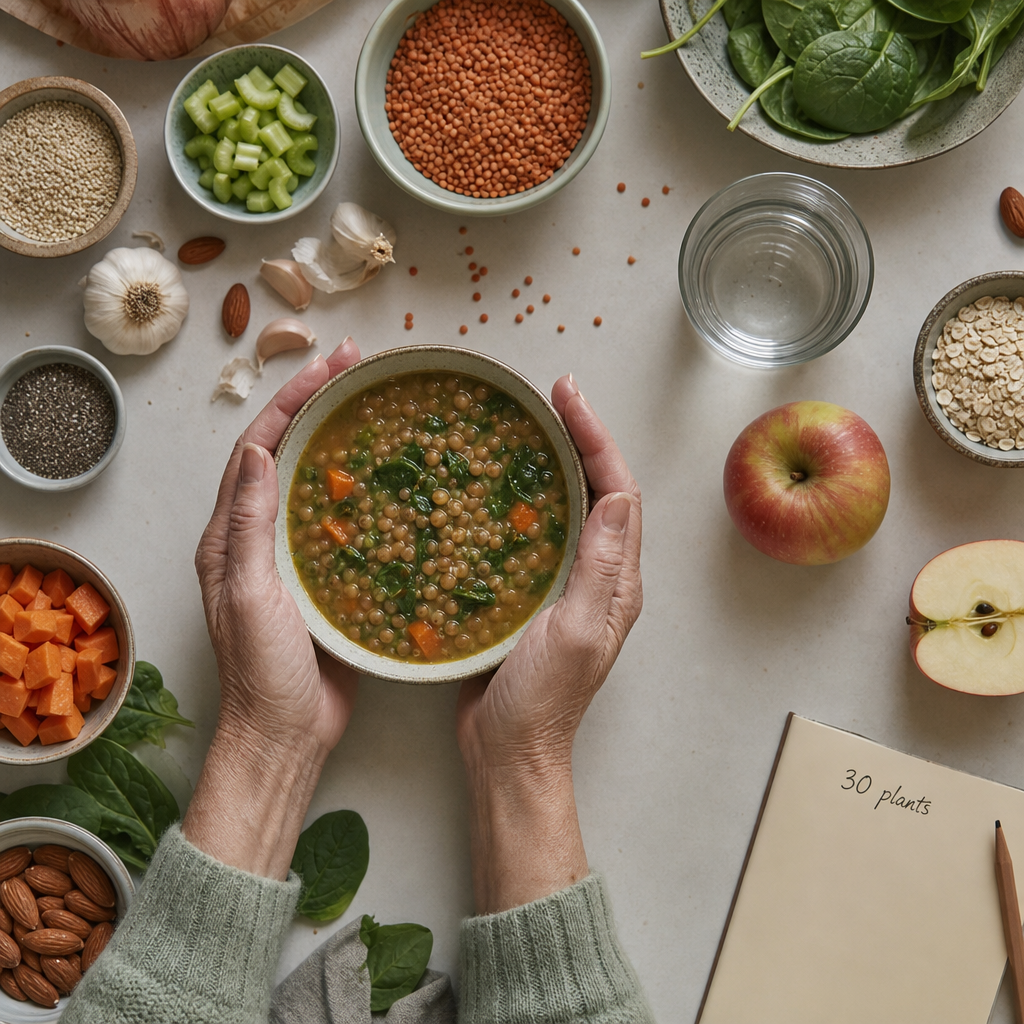
This is the single most powerful thing you can do. Different bacteria eat different types of fiber. If you eat the same foods every day, you’re only feeding a few types of bacteria. The goal is to eat 30 or more different plant foods per week. That includes fruits, vegetables, whole grains, nuts, seeds, legumes, herbs, and spices. Each one feeds a different set of beneficial microbes.
Aim for 25 to 35 grams of fiber per day. Most of us get less than half that. Good sources include lentils, chickpeas, oats, berries, apples, broccoli, Brussels sprouts, avocados, almonds, chia seeds, and quinoa. Harvard Health experts recommend focusing on dark leafy greens, legumes, and whole grains as your fiber foundation.
2. Include Fermented Foods Regularly
Fermented foods like yogurt, kefir, sauerkraut, kimchi, and kombucha contain live beneficial bacteria. While the SUPERB study focused on dietary fiber as the primary driver of butyrate-producing bacteria, fermented foods can help increase overall microbial diversity. Aim for one serving per day. Start with plain yogurt or a small serving of sauerkraut with your meal.
3. Stay Active — Especially Strength Training
Exercise doesn’t just build muscle — it also changes your gut microbiome. Research shows that regular physical activity, particularly when you combine aerobic exercise with resistance training, increases microbial diversity. Aim for 150 to 270 minutes of moderate activity per week — as we explore in our guide to squats for healthy aging. That could be brisk walking, cycling, swimming, or strength training. Even a 20-minute walk after dinner makes a difference.
4. Prioritize Sleep and Stress Management
Your gut and your brain are in constant communication. Chronic stress and poor sleep can disrupt your gut microbiome by increasing inflammation and changing how your body processes food. Aim for 7 to 9 hours of quality sleep per night. Practice stress management techniques like deep breathing, meditation, or simply taking 10 minutes of quiet time each day. Your gut bacteria will thank you.
5. Stay Hydrated
Water is essential for healthy digestion. When you become dehydrated, material moves more slowly through your digestive tract, which can alter your gut microbiome. Aim for 4 to 6 cups of water per day as a baseline, more if you’re active or live in a warm climate. Herbal teas and water-rich fruits and vegetables also count.
A Day of Gut-Healthy Eating for Aging Well
Here’s what a day of eating for gut diversity might look like. This isn’t a strict plan — it’s a template to show you how easy it can be to feed your beneficial bacteria.
Breakfast: Oatmeal topped with berries, sliced almonds, and a tablespoon of chia seeds — a perfect gut health breakfast — that’s 4 plant foods right there.
Lunch: A large salad with mixed greens, chickpeas, shredded carrots, cucumber, and a handful of walnuts. Add a side of whole-grain crackers. That’s 6 more.
Snack: An apple with a tablespoon of peanut butter. That’s 2 more.
Dinner: Lentil soup with onions, garlic, celery, carrots, and spinach, served with a side of quinoa. That’s 6 more.
Total: 18 different plant foods in one day. Do that for a week and you’ll easily hit 30+.
Quick Tip: The 30-Plant Challenge
Try counting how many different plant foods you eat in a week. Include fruits, vegetables, whole grains, nuts, seeds, legumes, herbs, and spices. If you’re under 30, look for easy ways to add more variety. Swap your usual apple for a pear. Add a handful of spinach to your smoothie. Sprinkle pumpkin seeds on your salad. Every new plant food feeds a different set of beneficial bacteria.
Frequently Asked Questions About Gut Health Aging
Can I improve my gut microbiome if I’ve been eating poorly for years?
Yes. Your gut microbiome is remarkably adaptable. Research shows that dietary changes can begin to shift your microbiome composition within days to weeks. The key is consistency — the more regularly you eat fiber-rich, diverse plant foods, the more your beneficial bacteria will thrive.
Do I need probiotics or prebiotics?
Prebiotics — which are types of fiber that feed your existing beneficial bacteria — are more reliably effective for increasing overall microbial diversity. Probiotics (live bacteria in supplements or fermented foods) can be helpful in specific situations, like after taking antibiotics. For most people, focusing on a diverse, fiber-rich diet is the most effective strategy.
How quickly can I see results from changing my diet?
Some changes in your gut microbiome can happen within days of changing your diet. However, building a more diverse, resilient microbiome takes weeks to months of consistent healthy eating. Think of it as a long-term investment in your health — every fiber-rich meal is a deposit.
The Bottom Line
The connection between your gut microbiome and how well you age is one of the most exciting areas of health research right now. The SUPERB study gives us compelling evidence that the diversity of your gut bacteria is linked not just to digestion, but to your risk of falls, frailty, and even how long you live.
Here’s the empowering part: you have more control over your gut microbiome than you might think. Every meal is an opportunity to feed the bacteria that support your health. Every walk you take, every good night’s sleep, every moment of stress management — it all adds up.
Start small. Add one new plant food to your diet this week. Take a 10-minute walk after dinner. Drink an extra glass of water. Your gut — and your future self — will thank you.