

How Accurate Are Calorie Tracking Apps? What Research Says
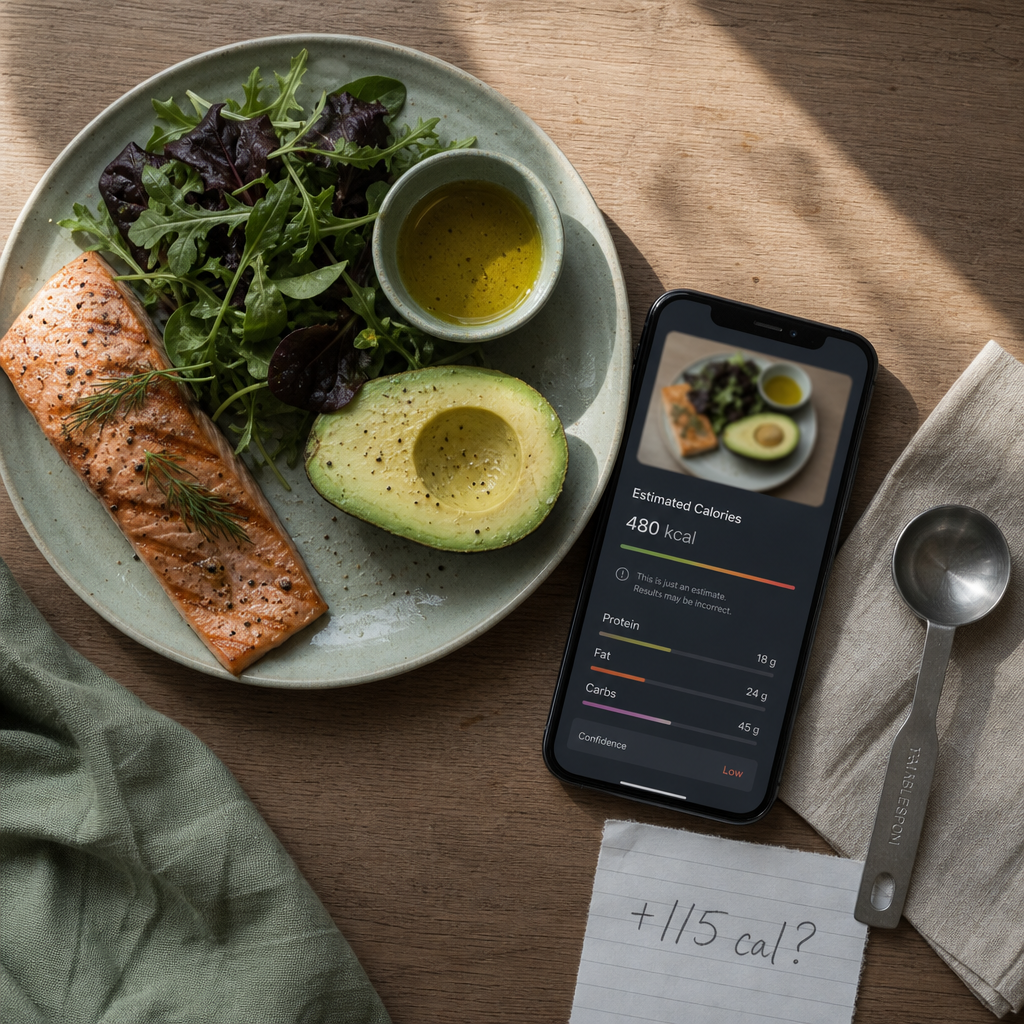
Have you ever snapped a photo of your lunch and trusted the number that popped up from your calorie tracking apps? That number looks official. But peer-reviewed research from 2026 shows these AI tools have real blind spots. The good news? Understanding where they fall short helps you use them smarter. Here’s what the latest verified science actually finds and how to adjust.
Key Takeaways
- All apps have bias. Multiple 2026 peer-reviewed studies confirm that calorie tracking apps show systematic errors. The direction and size vary by app and food.
- Fat is a challenge. High-fat foods are especially hard for AI to estimate, though some studies show apps overestimate fat while others show underestimation.
- Protein is hardest for AI. One study found professional nutritionists outperformed AI by 672% for protein estimation.
- Treat your app as a guide, not a scale. Small tweaks like manually logging cooking fats can make a big difference in accuracy.
Here’s the thing. Calorie tracking apps are incredibly convenient. Open the camera, take a picture, and your meal is logged. But are the numbers real? A growing body of peer-reviewed research says the answer is more complicated than a simple yes or no.
Let’s look at what three verified 2026 studies actually found and how you can keep using the convenience without getting misled.
Quick Answer: Can You Trust Calorie Tracking Apps?
Yes, with caution. Studies show average biases around 115 calories per meal, with larger errors for high-fat foods. The direction of error varies by app. Think of your app as a helpful guide for spotting patterns, not a precise measurement tool.
What Research Actually Finds About Calorie Tracking Apps
Several 2026 studies put calorie tracking apps to the test against professional methods. Let’s walk through what each one found. The results paint a consistent picture: these tools have limits, but you can work around them.
One study in Nutrition (July 2026, PMID 41903345) compared the Yazio app against professional dietary analysis software called NutriComp using 22 three-day dietary records with the same foods entered into both tools. The result? Yazio showed a systematic bias of about 115 calories per meal, plus or minus 197 calories. Notably, Yazio overestimated fat content rather than under-reporting it. This bias was statistically significant for all macronutrients, not just fat.
Another study in Scientific Reports (2026, PMID 42350490) tested how well AI systems estimate calories from food photos compared to trained nutritionists. The key finding: professional nutritionists were much more accurate than AI. Protein was the hardest macronutrient for the AI, performing about 672% worse than humans at estimating protein content. Giving the AI ingredient descriptions helped a little, but the design of the AI model itself mattered most for accuracy.
A third study in Nutrients (March 2026, PMID 41901155) found that an AI system overestimated all macronutrients, including fat and carbs. So the direction of error is not consistent across apps or studies. One app may overestimate fat while another underestimates it. That inconsistency makes it hard to trust any single number.
What ties these studies together? They all confirm that calorie tracking apps have real blind spots. The exact error varies, but the takeaway is the same: the number on your screen is an estimate, not a fact.
Why High-Fat Foods Trip Up These Apps
You might be wondering why fat causes so much trouble for food tracking. It comes down to how AI image recognition works. Most apps use a neural network trained on thousands of food photos. The AI looks at the shape, color, texture, and volume of what’s on your plate. Then it compares that to similar foods in its database.
Here’s the problem. Fat looks very different depending on the food. A fatty piece of salmon looks nothing like a plate of avocado or a drizzle of olive oil. Rice looks like rice, bread looks like bread, and pasta looks like pasta. But fat is slippery. It hides in sauces, dressings, cooking oils, and marinades. The AI can’t tell if your salad has one tablespoon of dressing or three. It can’t see the butter melted over your vegetables.
Now, you might be thinking: “So which direction is the error — over or under?” The research shows it depends on the app. The Nutrition study found Yazio overestimated fat. The Nutrients study also found overestimation across all macros. The key point is that the error is larger for fatty foods, regardless of direction. If you follow a lower-carb or high-fat way of eating, the numbers you see may be consistently off.
What About the ‘345-Calorie’ Report?
You may have seen headlines about a ScienceDaily report from July 2026 claiming that four popular AI-powered apps underestimated calories and fat by about one-third, with a 345-calorie gap per meal for high-fat keto dishes. This report got a lot of attention — and for good reason. A 345-calorie difference is huge.
However, the original study behind this report has not been independently verified or located in PubMed. While ScienceDaily is a well-known science news platform, the fact that the primary research can’t be found means those specific figures should be treated with caution. The verified peer-reviewed studies tell a more measured story: biases around 115 calories (for Yazio, in one study), with the direction of error varying.
Does this mean the 345-calorie figure is wrong? Not necessarily. But it does mean we can’t rely on it as a verified finding. The takeaway is the same either way: calorie tracking apps have meaningful blind spots, especially with high-fat foods, and you need strategies to work around them.
How to Use Food Tracking Apps More Accurately
Here’s the good news. You don’t need to throw out your app. These tools are still useful for building awareness, spotting patterns, and getting a general sense of your eating habits. You just need a few smart strategies to work around the blind spots.
1. Double-check high-fat meals manually. If you had a salad with olive oil dressing or a stir-fry cooked in coconut oil, take an extra 30 seconds. Look up the oil or dressing separately in the app’s database and add it as a separate entry. This catches the hidden fat that the AI often misses or miscalculates.
2. Use a food scale for fat-heavy ingredients. You don’t need to weigh everything. But weighing oil, butter, nuts, seeds, cheese, and avocado just once or twice can teach you what a tablespoon or ounce actually looks like. That visual reference makes your app estimates more accurate over time.
3. Think of app numbers as a range, not a fact. Instead of treating each number as exact, assume your actual intake for higher-fat meals could be anywhere from 20% lower to 30% higher than what the app shows. For simpler, single-ingredient meals, the app is likely closer to reality. This mental adjustment alone can prevent frustration. Exploring the concept of calorie density can also help you focus on eating satisfying portions without fixating on every number.
4. Scan barcodes when you can. For packaged foods, the barcode scanner in calorie tracking apps pulls from verified nutrition databases. This is far more accurate than photo recognition. When you have the choice between snapping a photo and scanning a barcode, choose the barcode every time.
5. Track consistently, even if imperfect. Here’s what I find interesting. The research doesn’t mean you should stop tracking. Pairing your app with structured meal ideas — like these 500-calorie dinners designed for weight loss — can make the process more practical. Consistency matters more than perfection. If you use the same app the same way every day, you’ll still see trends and patterns. Just be aware that the numbers for fatty foods are not exact.
The Takeaway for Keto and Low-Carb Eaters
If you follow a ketogenic or low-carb diet, you eat more fat than the average person. That means you face more tracking errors — whether over or under. You don’t need to abandon your app. But add two things to your routine: manually log cooking fats and oils, and check your portion sizes for high-fat foods at least a few times a week with a scale or measuring spoon. Your macros will be much closer to reality.
Frequently Asked Questions
Q: Are all calorie tracking apps equally inaccurate?
A: No. Different apps use different databases and AI models. The Nutrition study found Yazio had a bias of about 115 calories per meal. The Nutrients study found overestimation across all macros. The overall pattern is that all apps struggle with high-fat foods, but the exact error size and direction differ.
Q: Should I stop using my app based on this research?
A: Not at all. The studies highlight limitations, not failures. These apps are still great tools for awareness, consistency, and pattern recognition. The key is understanding where they fall short and adjusting accordingly.
Q: How can I track fat more accurately without a food scale?
A: Learn visual cues. One tablespoon of oil fills a standard soup spoon. A thumb-sized portion of nut butter is about two tablespoons. A golf ball-sized portion of cheese is about one ounce. Practice measuring a few times, and you will build accurate visual references that help you adjust app estimates.
Q: Does this mean I should avoid high-fat foods?
A: No. Healthy fats from whole foods like avocado, nuts, seeds, olive oil, and fatty fish are important for overall health. Just be aware that your app may misestimate them. Logging fat-containing ingredients manually alongside your photo can help close the gap.
The Bottom Line
Calorie tracking apps are a useful tool, not a perfect science. Peer-reviewed research from 2026 confirms that AI image recognition has real blind spots — especially with high-fat foods. The reported 345-calorie gap from an unverified ScienceDaily report may be overstated, but smaller biases (around 115 calories) have been documented in published, PubMed-indexed studies. The direction of error varies by app.
Here’s the honest truth. These apps work best as a guide for building awareness, not as a precise measurement device. If you understand where they fall short, you can adjust. Double-check high-fat meals, scan barcodes when you can, and use a food scale for the fatty ingredients that really count. That small effort makes a big difference.
The goal isn’t perfect tracking. It’s better awareness. And with a few practical tweaks, calorie tracking apps can still help you get there.