

Calorie Density: Eat More, Lose Weight Naturally
What if you could eat more food and still lose weight? It sounds like a gimmick, but it’s actually backed by solid science. A recent analysis of a landmark NIH study found that when people switched to a diet of whole, unprocessed foods, they ate a whopping 57% more food by weight — yet they consumed about 330 fewer calories per day. The secret isn’t willpower or counting every bite. It’s a simple principle called calorie density, and understanding it might just change the way you think about eating forever.
Key Takeaways
- Calorie density is the number of calories in a given weight of food. Low-density foods (like vegetables and fruits) fill you up with fewer calories.
- A 2026 study found people naturally ate 57% more food by weight on a whole-foods diet but still took in fewer calories overall.
- You don’t need to eat less — you need to eat differently. A simple visual framework (fill half your plate with the lowest-density foods) makes it easy.
- One common pitfall: healthy fats like nuts, avocado, and olive oil are calorie-dense too. They’re still good for you, but portion awareness matters.
What Is Calorie Density?
Let’s start with a simple definition. Calorie density (also called energy density) is the number of calories in a specific amount of food, usually measured per gram. Think of it as how “packed” a food is with calories.
Here’s the thing: foods with high water and fiber content have a low calorie density. They take up space in your stomach and signal fullness without delivering many calories. On the flip side, foods high in fat or sugar are calorie-dense — a small amount packs a big calorie punch.
The Mayo Clinic’s guide to energy density explains it clearly: three main factors determine a food’s calorie density — water, fiber, and fat. Vegetables and fruits are mostly water, so they’re very low in density. Fats, at 9 calories per gram, are the most dense.
Calorie Density Spectrum: From Very Low to Very High
Think of it as a spectrum. At one end, you have foods you can eat in large volumes for very few calories. At the other end, foods that are concentrated calorie sources.
- Very Low (0-0.7 kcal/g): Most non-starchy vegetables (leafy greens, broccoli, cucumbers, tomatoes), broth-based soups
- Low (0.7-1.5 kcal/g): Most fruits, starchy vegetables (potatoes, corn, peas), legumes, whole grains, lean meats, low-fat dairy
- Moderate (1.5-4 kcal/g): Whole eggs, full-fat dairy, fatty fish, avocados, dried fruit
- High (4-9 kcal/g): Nuts, seeds, nut butters, oils, butter, cheese, chocolate, fried foods, pastries
The Science Behind Calorie Density
You might be thinking, “This sounds too simple. Does it actually work?” The answer is yes — and the research is surprisingly strong.
Let’s start with the landmark NIH study on ultra-processed foods and calorie intake. In 2019, Dr. Kevin Hall and his team at the National Institutes of Health admitted 20 adults to a clinical center and fed them either an ultra-processed diet or an unprocessed diet for two weeks, then switched them to the opposite diet. The meals were matched for presented calories, energy density, and macronutrients. The result? On the ultra-processed diet, people ate about 508 more calories per day and gained weight. We explore why ultra-processed foods drive this overeating in our dedicated guide. On the unprocessed diet, they lost weight — without being told to eat less.
But here’s where it gets even more interesting. In 2026, researchers at the University of Bristol re-analyzed that same data and found something remarkable. A 2026 University of Bristol study on whole foods and calorie intake showed that when people ate unprocessed meals, they chose meals that were 57% larger by weight — yet those meals contained about 110 fewer calories per meal. How? They naturally gravitated toward low-energy-density foods like vegetables and fruits.
The researchers call this “micronutrient deleveraging” — a fancy term for the idea that your body may naturally seek out micronutrient-rich foods. Early evidence from one study suggests this could be a factor, though more research is still needed. When you eat whole foods, your body prioritizes those micronutrients, which naturally steers you toward vegetables and fruits. These foods are low in calorie density, so you end up eating more volume but fewer calories.
This isn’t just one study. A systematic review on energy density and calorie intake published in 2022 looked at 31 studies and found that lowering the energy density of food led to a large, consistent reduction in daily calorie intake. The effect was linear — the lower the density, the fewer calories people ate. And here’s the key: people didn’t compensate by eating more at other meals.
Why Calorie Density Works Without Willpower
Now, you might be wondering: “Isn’t this just another diet?” Not exactly. Here’s what makes the calorie density approach different.
Most diets ask you to eat less. They rely on willpower, which we all know runs out by 8 p.m. on a Tuesday. Calorie density flips the script. It asks you to eat differently — not less. You’re not restricting; you’re swapping.
Think about it this way. A cup of grapes has about 100 calories. A quarter cup of raisins (which are just dried grapes) has about 120 calories. The grapes take up more space in your stomach, have more water, and take longer to eat. The raisins are gone in two bites. Same fruit, completely different effect on fullness.
This approach works because it works with your body’s natural signals, not against them. Your stomach stretches in response to volume, triggering fullness hormones. Water and fiber slow down digestion, keeping you satisfied longer. And because you’re eating whole foods, your body gets the micronutrients it craves.
A study comparing volumetric eating to intermittent fasting published in 2025 found that a low-energy-density approach (meals at or below 1.5 calories per gram) was just as effective for weight and fat loss as time-restricted eating — without requiring an eating window. Both approaches worked, but the volumetric approach didn’t require skipping meals.
How to Apply Calorie Density: A Simple Visual Framework
Let’s get practical. Here’s a simple system you can use starting with your next meal.
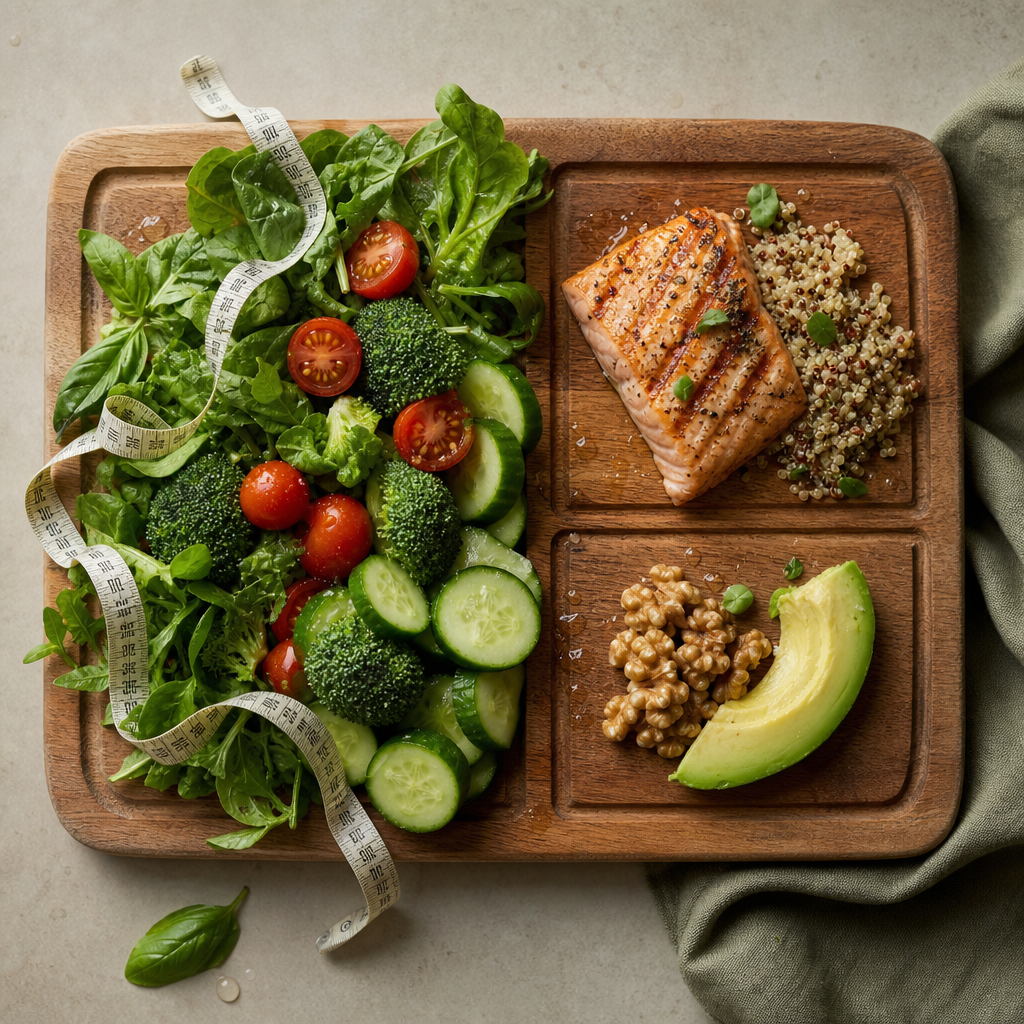
Fill half your plate with the lowest-density foods. That means non-starchy vegetables — leafy greens, broccoli, bell peppers, cucumbers, tomatoes, cauliflower, zucchini. These foods are mostly water and fiber. You can eat a huge volume for very few calories.
Fill a quarter with moderate-density foods. This is where your protein and complex carbs go — lean chicken, fish, beans, lentils, quinoa, sweet potatoes, whole grains. These foods are nutrient-dense and satisfying but still relatively low in calorie density.
Fill the remaining quarter with higher-density foods. This is where healthy fats and more concentrated foods go — a drizzle of olive oil, a sprinkle of nuts or seeds, a slice of avocado, a bit of cheese. These foods are calorie-dense but nutrient-rich. A little goes a long way.
Simple Swaps: High-Density to Low-Density
| Instead of This | Try This |
|---|---|
| Granola (500 cal/cup) | Fresh berries (50 cal/cup) |
| Dried fruit (400 cal/cup) | Fresh fruit (80 cal/cup) |
| White rice (200 cal/cup) | Cauliflower rice (25 cal/cup) |
| Creamy pasta sauce | Tomato-based sauce with veggies |
| Crackers and cheese | Veggie sticks with hummus |
| Soda or juice | Sparkling water with lemon |
The One Pitfall: Healthy Fats Are Calorie-Dense Too
Here’s the nuance that many articles miss. Avocados, nuts, seeds, olive oil, and fatty fish are incredibly healthy. They’re packed with heart-healthy fats, vitamins, and antioxidants. But they are also calorie-dense. A single tablespoon of olive oil has about 120 calories. A quarter cup of almonds has about 200 calories.
This doesn’t mean you should avoid them. It means you should be mindful of portions. The goal isn’t to eliminate healthy fats — it’s to use them strategically. A drizzle of olive oil on your vegetables is great. A half-cup of nuts eaten mindlessly while watching TV can add up fast.
The key is to keep higher-density foods in the “quarter of your plate” zone. They add flavor, satisfaction, and nutrition — but they shouldn’t be the star of the show.
A Day of Low-Density Eating
Here’s what a full day might look like using the calorie density approach. Notice that no meal is tiny or restrictive.
Breakfast: A large bowl of mixed berries and sliced banana topped with plain Greek yogurt and a tablespoon of chopped walnuts. The berries provide volume and low-density bulk. The walnuts add healthy fats in a controlled amount.
Lunch: A big salad with mixed greens, cucumber, bell peppers, cherry tomatoes, shredded carrots, chickpeas, and grilled chicken. Dressed with a simple vinaigrette (one part olive oil, two parts vinegar). The vegetables fill the bowl. The chickpeas and chicken provide protein and staying power.
Dinner: A large bowl of vegetable soup (broth-based, loaded with carrots, celery, onions, and kale) followed by a plate of roasted salmon with a generous portion of roasted broccoli and a small sweet potato. The soup starts the meal with high-volume, low-density food. The salmon provides healthy fats. The broccoli fills half the plate. For more low-density meal ideas, check out our 500 calorie dinners formula.
Snack: An apple or a handful of baby carrots. Both are low-density, portable, and satisfying.
Frequently Asked Questions About Calorie Density
Is calorie density the same as the Volumetrics diet?
Yes, essentially. The Volumetrics diet, developed by Dr. Barbara Rolls at Penn State University, is based on the same principle: eating foods with low energy density to feel full on fewer calories. The term “calorie density” is the more general concept, while Volumetrics is a specific program built around it.
Do I need to count calories for this to work?
Not at all. That’s the beauty of this approach. You don’t need to track numbers. You just need to shift the composition of your meals toward lower-density foods. Your body’s natural fullness signals do the counting for you.
Can I still eat out at restaurants?
Yes. Look for dishes that start with a vegetable base — salads, broth-based soups, grilled vegetables. Ask for dressings and sauces on the side. Choose grilled or roasted proteins over fried. And don’t be afraid to ask for extra vegetables instead of rice or fries.
What about foods like nuts and avocado that are healthy but calorie-dense?
Include them — but in controlled amounts. A small handful of nuts (about 1/4 cup) or a quarter of an avocado adds healthy fats and satisfaction without derailing your goals. The problem isn’t healthy fats; it’s eating them in unlimited quantities without realizing how quickly the calories add up.
The Bottom Line
Here’s the liberating truth. You don’t need to eat less to manage your weight. You need to eat differently. The calorie density approach — backed by decades of research and the latest 2026 findings — shows that when you shift toward whole, unprocessed foods, your body naturally regulates itself. You eat more volume, feel more satisfied, and consume fewer calories.
Start simple. At your next meal, fill half your plate with vegetables. Add a moderate portion of protein and whole grains. Finish with a small amount of healthy fats. Notice how full you feel. Notice that you didn’t have to count a single thing.
That’s the power of calorie density. It’s not a diet. It’s a smarter way to eat.