

Bananas for Blood Pressure: What the Evidence Shows
Key Takeaways
- Bananas for blood pressure comes down to potassium: one medium banana gives about 422 mg, or roughly 9% of the daily value.
- Potassium helps your kidneys clear extra salt. It also helps relax blood vessel walls.
- The average American woman eats about 2,320 mg of potassium a day. The goal is 2,600 mg.
- Nine everyday foods outrank a banana on potassium per serving.
- Ask your doctor first if you have kidney disease or take ACE inhibitors, ARBs or potassium-sparing diuretics.
You cut back on salt. Your doctor was pleased. Yet your blood pressure numbers barely moved. That is a common and very annoying place to land. Salt is only half the story. The other half — potassium — gets far less airtime. That is where bananas for blood pressure comes in.
So does a daily banana help? A little, yes. Just not in the dramatic way headlines promise. Here is what the research says about how much potassium you need, what one banana really gives you, and who should be careful.
We will keep this plain. No miracle talk. No scare tactics. Just the honest math behind a very ordinary fruit.
Quick Answer: Do Bananas Lower Blood Pressure?
Not on their own. A banana gives you potassium — about 422 mg for a medium fruit. A higher-potassium way of eating is tied to lower blood pressure. Both the NIH and the American Heart Association suggest it for adults with elevated or high blood pressure who are otherwise healthy. So think of one banana as part of a pattern, not a treatment.
Why Bananas for Blood Pressure Comes Down to Potassium
Potassium is a mineral your body needs. It helps your nerves send signals. It helps your muscles contract. It helps your heart keep a steady beat.
It also does one very specific thing for your arteries.
Eat more potassium, and your kidneys push more salt out through urine. That lowers the fluid inside your blood vessels. As a result, the pressure in those vessels drops. At the same time, potassium helps ease tension in the vessel walls themselves.
The American Heart Association puts it in one line: the more potassium you eat, the more sodium you lose through urine. Two jobs, one mineral.
But here is the twist. The research is not really about bananas. It is about potassium. A banana is just an easy, cheap, portable way to get some.
That single point explains why bananas for blood pressure advice gets oversold so often — and why the real answer is more boring, and more useful, than a headline.
If you want to go deeper on the mineral itself, our guide to lower blood pressure naturally walks through the full potassium picture.
What One Banana Actually Does — and What It Does Not
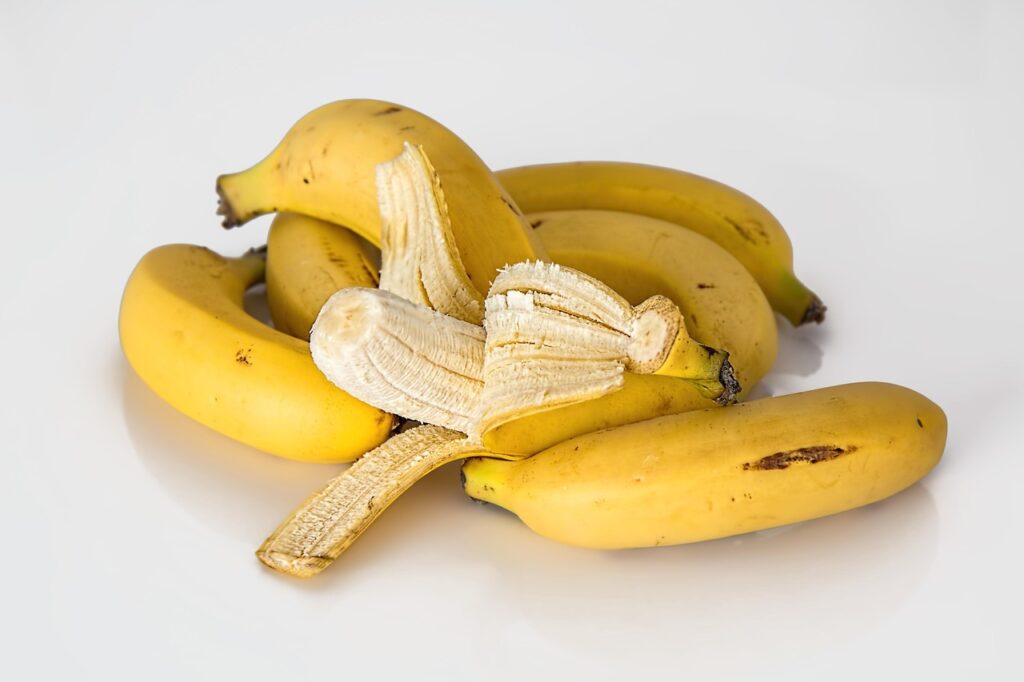
One medium banana holds about 422 mg of potassium, per the NIH. That is close to 9% of the daily value.
Now, you might be thinking that 9% sounds small. It is small. And that matters, because the internet treats bananas like a potassium jackpot. They are not.
The NIH keeps a table of potassium in common foods. A medium banana lands tenth on that list. Dried apricots give you 755 mg in half a cup. Cooked lentils give you 731 mg. Acorn squash, prunes, raisins, a baked potato, canned kidney beans, boiled soybeans and orange juice all beat a banana per serving.
Potassium Per Serving: How a Banana Compares
- Dried apricots, half cup — 755 mg
- Cooked lentils, one cup — 731 mg
- Acorn squash, mashed, one cup — 644 mg
- Dried prunes, half cup — 635 mg
- Raisins, half cup — 618 mg
- Baked potato, flesh only, one medium — 610 mg
- Canned kidney beans, one cup — 607 mg
- Orange juice, one cup — 496 mg
- Soybeans, boiled, half cup — 443 mg
- Banana, one medium — 422 mg
None of that makes bananas useless. However, it does change your plan. A banana is a starter, not a fix. The honest answer about bananas for blood pressure is that the fruit matters far less than the plate around it.
The Sodium-to-Potassium Balance: The Part Most Advice Skips
Most blood pressure advice stops at salt. Cut the salt. Read the labels. Skip the chips. That advice is right, and it works.
But salt and potassium act like a pair on a seesaw. An umbrella review in Annals of Medicine pooled 21 meta-analyses, covering 91 outcomes. It found that each extra gram of sodium per day lifts systolic pressure by about 0.60 mmHg. The same review found that cutting sodium also lowers your sodium-to-potassium balance. And it raises the potassium in your urine.
In other words, the goal is not “less salt” or “more potassium.” It is a better balance between the two. That reframe helps, because now you have two levers instead of one.
So keep watching packaged food. Also add potassium-rich plants to your plate. Both moves pull the same balance the right way. That is why bananas for blood pressure advice only makes sense next to a salt talk.
How Much Potassium Do You Need Each Day?
Here is why so many people feel confused. Three different potassium numbers float around online. Almost nobody says which is which.
Three Potassium Numbers, Explained
- Adequate Intake (National Academies, 2019; reported by NIH): 2,600 mg a day for adult women, 3,400 mg for adult men. This is a general health goal.
- Daily Value (FDA): 4,700 mg. This is the number printed on food labels.
- AHA goal: 3,500 to 5,000 mg for adults with elevated or high blood pressure.
The Adequate Intake is a general goal for good health. The Daily Value is a label tool. The AHA figure is a treatment goal for people who already have a blood pressure concern.
Now the reality check. The NIH reports that the average American woman eats about 2,320 mg of potassium a day. The average man eats about 3,016 mg.
So most women fall a few hundred milligrams short of the Adequate Intake. That gap is smaller than one extra banana. Hitting 3,500 mg, though, takes a pattern, not a piece of fruit. On bananas alone, you would need eight or more.
This is why bananas for blood pressure advice should start with math, not hype.
The Sugar Question: Do Bananas Raise Blood Sugar?
Let us be honest. Sugar is the main reason many people quietly stop eating bananas. Here is the thing: bananas for blood pressure only help if you actually eat them.
So what is really going on? Ripeness changes the fruit’s carbohydrate make-up — the greener the banana, the more of it is starch and resistant starch, and the less rapidly available sugar. The researchers cited below measured exactly that: they grouped three banana cultivars by colour and found far more resistant starch and fibre in the greener fruit.
A firm banana with green tips will move your blood sugar less than a heavily speckled one.
One small study in Plant Foods for Human Nutrition tested this. Ten healthy women drank a sugar drink. A week later, they drank the same thing with green banana pulp added. Their blood sugar fell by about 15% over two hours. The group was tiny, so treat that as a hint, not proof.
Pairing helps too. Add peanut butter, nuts or plain yogurt. Protein and fat slow the sugar response. Your blood pressure does not care which version you pick. Our blood sugar foods list has more steady-energy pairings.
Who Should Be Careful With Potassium-Rich Foods?
For most healthy adults, a daily banana is fine, so bananas for blood pressure is not a worry. But that changes for some people.
The National Library of Medicine notes that a diet rich in potassium helps offset some of salt’s effects on blood pressure. The NIH adds that high potassium from food poses no risk when your kidneys work well. In fact, no tolerable upper limit has ever been set for potassium at all — the National Academies found the research too thin to set one.
That changes when kidneys cannot clear potassium well. Then it can build up in the blood. Doctors call it hyperkalemia, and it can affect your heart rhythm.
Medicine matters too. And this is where a lot of online advice gets the direction backwards.
Blood Pressure Medicine and Potassium: Two Opposite Directions
These can RAISE potassium levels:
- ACE inhibitors — benazepril (Lotensin)
- Angiotensin receptor blockers, or ARBs — losartan (Cozaar)
- Potassium-sparing diuretics — amiloride (Midamor), spironolactone (Aldactone)
These can LOWER potassium levels:
- Loop diuretics — furosemide (Lasix), bumetanide (Bumex)
- Thiazide diuretics — chlorothiazide (Diuril), metazolone (Zaroxolyn)
That second list surprises people. Loop and thiazide diuretics push potassium out through urine and can cause low potassium. The NIH says so directly. So if you take a water pill, the question may be whether you need more potassium, not less. Only your doctor can answer that with your lab results.
Diabetes belongs on the careful list too, but for a different reason. It is about blood sugar, not potassium. How ripe the fruit is and what you eat with it are your levers there.
Kidney advice has shifted lately as well. The KDIGO 2024 guidelines, summed up in a 2026 review, now call for personal potassium plans. They focus on limiting potassium your body soaks up fast — often from processed food and additives — rather than banning fruits and veg out of hand.
So the right question is not “should I avoid bananas?” It is “what do my labs and my medicine say about my potassium?” That is a talk to have with your care team, not a decision to make alone.
If you are pregnant or breastfeeding, potassium needs rise a little. Food sources are generally fine. Ask your doctor before using potassium pills or salt substitutes.
Does Gut Health Play a Role?
One more path is worth knowing about. Firmer bananas hold resistant starch. That is a type of fiber your small intestine cannot digest. Instead, it feeds the good bugs in your gut.
Why would that matter for blood pressure? A 2026 review in The Journal of Nutrition explains it. Those gut bugs turn fiber into helpful compounds. Those compounds may ease vessel walls and calm the body’s stress signals.
But here is the honest caveat. Much of the strongest data comes from animals, not people. A rat study in Phytotherapy Research found that resistant starch lowered blood pressure in rats bred to have high pressure.
So does that change the bananas for blood pressure picture? Not yet. The human evidence is not in yet — large trials are still needed. Treat this path as promising, not proven.
Bananas for Blood Pressure: Building a Higher-Potassium Plate
Bananas for blood pressure is a starting point, not a finish line. If you want to raise potassium in a real way, build a plate instead of leaning on one fruit. Our high blood pressure foods grocery list is a good place to start.
Beets work through a different route — dietary nitrate — and have their own blood pressure evidence. See beets for blood pressure for what the research actually shows.
Salt substitutes are another practical lever. A 2026 network review in BMC Medicine pooled 34 trials and 37,063 adults. Swapping regular salt for a low-salt, moderate-potassium blend lowered systolic pressure by about 4.4 to 4.6 mmHg.
Be careful here. One teaspoon of salt substitute can hold 440 to 2,800 mg of potassium. That is between roughly one and six bananas’ worth in a single spoon. Anyone with kidney disease or on potassium-raising medicine should clear it with a doctor first.
One more caveat. Most of the death and heart-event benefit in that review came from one large trial in China. It may not fully carry over to other groups, and the authors say so themselves.
What the Evidence Really Shows
Let us be straight with each other. The case for potassium is strong, but it is not airtight.
Most pooled studies find that potassium pills lower systolic pressure by about 4 to 5 mmHg. The effect runs bigger in people who already have high blood pressure — closer to 6 or 7 mmHg. A 2024 review in the Journal of Hypertension found an average drop of 3.69 mmHg across 36 trials.
On the flip side, a 2006 Cochrane review of the six highest-quality trials — never updated — found no clear effect. Also, a US Agency for Healthcare Research and Quality review found uneven links between potassium from food and blood pressure.
Those results do not cancel each other out. They reflect small trials, wide ranges and real doubt. Food science rarely hands you clean answers.
There is one more nuance almost nobody mentions. A dose-response analysis of 32 trials found a U-shaped curve. Benefits faded above a certain intake. At high pill doses, pressure actually rose in people already on blood pressure medicine.
So here is the honest version of the bananas for blood pressure story. Potassium from food is safe and helpful. Mega-dosing pills is a whole different question.
Worth knowing: US potassium pills are capped at 99 mg per serving. That is about 2% of the daily value. The cap exists because of FDA safety concerns. A pill simply cannot do what a plate can.
One last finding deserves attention. Higher potassium intake is tied to lower stroke risk. A pooled look at 639,440 people found a 15% lower risk at the highest intakes.
Even after adjusting for blood pressure, risk stayed 13% lower. That hints potassium does something beyond the cuff reading.
Frequently Asked Questions
How many bananas a day is right for blood pressure?
There is no official number. For healthy adults with normal kidney function, the NIH notes that potassium from food poses no risk. So a banana a day is a fine part of a higher-potassium pattern. Since it gives you only about 9% of the daily value, your overall way of eating matters far more than the count.
Can bananas replace my blood pressure medicine?
No, and please do not try. Never stop or change a prescribed medicine because of a diet change. Food supports your treatment plan. It does not replace it.
Do bananas raise blood sugar?
They can, somewhat — most of all when very ripe and eaten alone. Pair a banana with protein or fat. And if blood sugar is a concern, a firm banana with green tips is a better choice than a heavily speckled one.
What if I have kidney disease?
Talk with your doctor and your dietitian before you change your potassium intake. Current KDIGO guidance favors personal plans over blanket food bans. But that call needs your own lab results.
Should I just take a potassium pill instead?
For most people, no. Food sources are preferred, and US pills are limited to 99 mg per serving. The NIH also says to meet your needs mainly through food.
Putting It Into Practice
Spread potassium across the day instead of chasing one big dose. If you are eating bananas for blood pressure reasons, or simply want more of the mineral, here is a simple start.
- Add one potassium-rich food to breakfast — plain yogurt, a banana with nut butter, or an orange.
- Swap one packaged snack for dried apricots or a small handful of unsalted nuts.
- Keep the skin on your baked potato, and add beans or lentils to two dinners each week.
- Compare the sodium label against your potassium intake for the same day.
- Write down every medicine you take and bring the list to your next visit.
Your doctor can review your potassium level, your kidney function and your medicine list together. That mix is what makes advice personal instead of generic. The NHLBI fact sheet on getting more potassium is a good read before that visit.
The Bottom Line
So where does that leave bananas for blood pressure? In a useful but modest place.
One banana gives you about 422 mg of potassium. That is close to 9% of the daily value. It is a real gift. Just not a cure, and it never was.
The bigger wins sit around it: less salt, more plants, a better balance between the two minerals, and an honest talk with your doctor if your kidneys or your medicine are in play.
So eat the banana. And do not stop there.