

Anti-Inflammatory Breakfast: The Protein + Fiber Formula
Key Takeaways
- Protein and fiber do different jobs at breakfast. You want both on the plate.
- Fiber supports weight and blood sugar control. Protein helps you feel full sooner.
- Feeling fuller is not the same as eating less all day. That is the honest limit.
- Anti-inflammatory eating is mostly about adding whole foods, not cutting favorites.
- Raise fiber slowly. Doubling it overnight can cause gas and bloating.
You eat oatmeal with berries. By mid-morning you are hungry again. Nothing about your breakfast changed, so what happened? The answer usually is not the oats. It is the balance. An anti-inflammatory breakfast works best when protein and fiber arrive together, in amounts you can actually see. That is the part most recipe roundups skip. They hand you a gallery of options and never say how much of anything you need.
This guide does something different. Instead of another list of fifteen recipes, you get a formula, real targets, and a straight answer about what breakfast can and cannot do for your energy and your weight.
Let’s start with what the word “anti-inflammatory” actually means on a plate.
Quick Answer: What Makes an Anti-Inflammatory Breakfast Work?
Mostly what you add, not what you remove. Berries, leafy greens, nuts, olive oil, legumes and fatty fish form the core. Refined carbs, fried foods, sugary drinks and processed meat are the ones worth limiting. Our working target is about 20 grams of protein and 8 to 10 grams of fiber. The fiber figure is well evidenced; the protein figure is a practical starting point, not a tested optimum.
What Makes an Anti-Inflammatory Breakfast Different
Here is the part that surprises most people. There is no official anti-inflammatory breakfast list. Harvard Health Publishing describes the pattern in broad strokes instead. Whole plant foods, nuts, olive oil and fatty fish go in. Refined carbohydrates, fried foods, sugary drinks and processed meat get limited.
Cleveland Clinic makes the same point from a clinical angle. Its dietitians describe anti-inflammatory eating as an overall style, not a specific regimen. The Mediterranean and DASH patterns carry the best evidence.
So an anti-inflammatory breakfast is not a special product. It is a normal breakfast built from those foods. Berries instead of a pastry. Oats or beans instead of white toast. Olive oil or walnuts instead of margarine.
That reframe matters more than it sounds. You are not buying anything. You are rearranging what is already in your kitchen.
If you would rather start from a shopping list than a recipe, our anti-inflammatory foods grocery list covers the staples that fill every slot below.
Why Protein and Fiber Do Different Jobs
Now, you might be thinking: isn’t oatmeal with berries already healthy? Yes, it is. But healthy and steady are two different things.
Protein and fiber take separate routes through your body. Protein slows digestion and triggers fullness signals. Fiber adds bulk, slows how fast glucose reaches your blood, and feeds gut bacteria.
A 2026 trial in the British Journal of Nutrition put them side by side. Nineteen adults with overweight or obesity took part. Each ate two 28-day weight loss diets, one higher in fiber and one higher in protein.
The higher-fiber diet produced more weight loss — 4.87 kg versus 3.87 kg. The higher-protein diet did a better job of suppressing appetite.
Read that again. Fiber won on weight. Protein won on hunger. They are not competing. They cover different ground.
Then comes the uncomfortable part. A 2024 crossover study in the Journal of Dairy Science tested 30 women. Each got a high-protein breakfast, a high-carb breakfast, or no breakfast. The high-protein meal raised fullness and cut hunger for three hours. It also lifted concentration scores before lunch.
But lunch intake did not change. Neither did total daily calories.
Sit with that for a second. An anti-inflammatory breakfast can make your morning easier. It will not do the math for you.
How to Build an Anti-Inflammatory Breakfast Formula
Recipes are useful until you run out of them. A formula lasts longer. Fill these five slots and you have an anti-inflammatory breakfast without opening a cookbook.
The Five-Slot Formula
- Protein anchor: eggs, Greek yogurt, cottage cheese, beans, lentils, smoked salmon, tofu
- Fiber anchor: oats, chia seeds, ground flax, quinoa, whole-grain bread, white beans
- Two produce items: berries, spinach, roasted peppers, tomatoes, mushrooms, avocado
- A fat: olive oil, walnuts, almond butter, tahini, pumpkin seeds
- Optional ferment: kefir, plain yogurt, sauerkraut
Notice what is missing. No powder. No capsules. No specialty greens blend. Every slot gets filled at a normal grocery store.
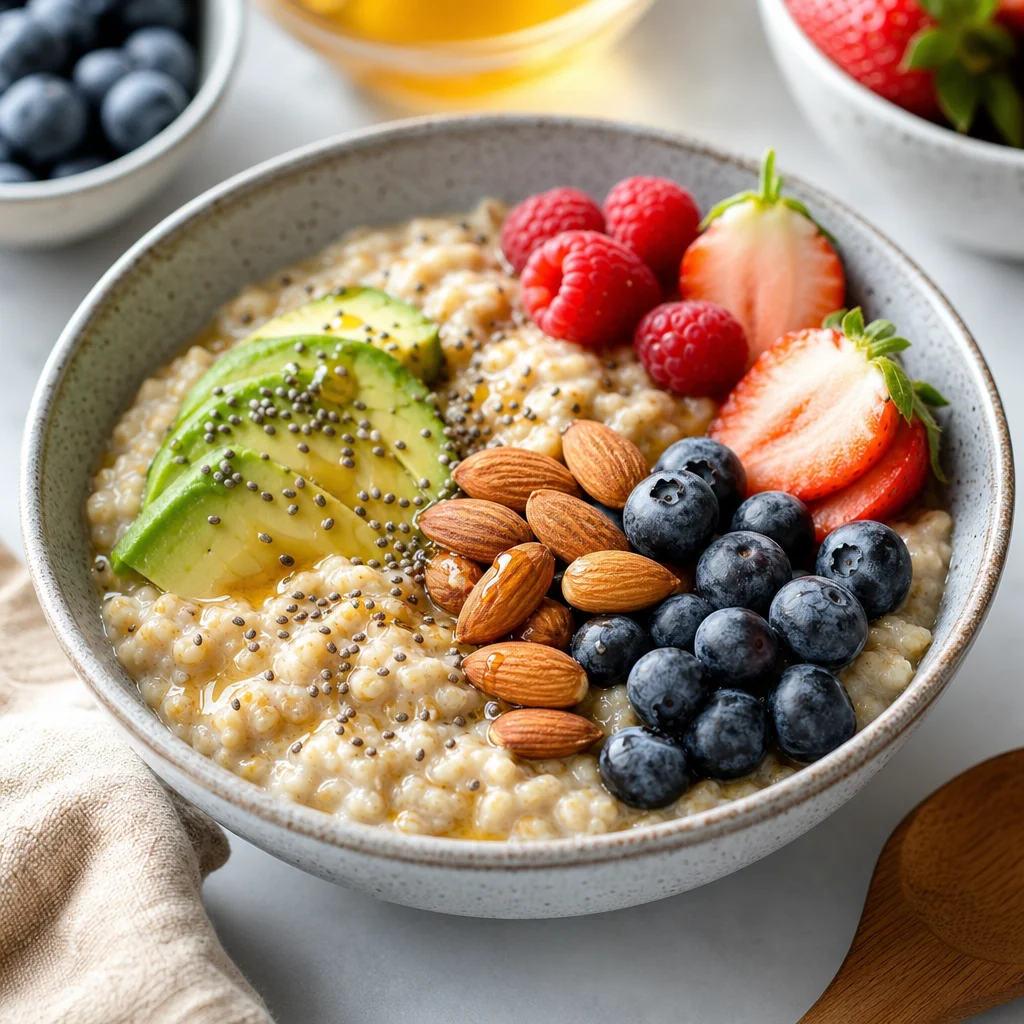
Here is how it reads in practice. Eggs with sautéed spinach, half a cup of white beans and olive oil. Or oats with chia, berries, walnuts and kefir. Both are anti-inflammatory breakfast options. One is savory, one is sweet, and neither takes more than ten minutes.
Variety does more than any single ingredient. Different plants carry different protective compounds. So rotating colours across the week is a simple way to cover more of those compounds than eating the same bowl every day.
Protein and Fiber Targets You Can Actually Hit
This is where almost every article goes quiet. They say “high in protein” and “high fiber” and never give a number. Let’s fix that.
Fiber comes first, because the evidence is strongest. A PLOS Medicine review pooled 42 trials and two cohorts of adults with prediabetes or diabetes. Increasing fiber reduced body weight by 0.56 kg and waist size by 1.42 cm. Nobody was told to cut calories.
The review also compared 35 grams a day against a typical 19 grams in those same adults with diabetes. That gap was linked to a 35 percent lower risk of death from any cause. That is a large difference for a modest change. However, that review does not establish the effect in generally healthy adults.
So treat 30 to 35 grams a day as the destination. At breakfast, aim for roughly 8 to 10 grams. Think a bowl of oats with a spoon of chia, or eggs with beans and vegetables. For bowl-by-bowl numbers, our high fiber breakfast guide breaks down how to hit that target.
Protein is less settled, and I want to be straight with you. No trial in this research set tested one ideal gram amount. A practical working target is about 20 grams at breakfast. That number is an editorial starting point, not a lab finding.
The British Journal trial did structure its diets so 45 percent of daily calories landed at breakfast. Breakfast was not a snack in that study. It was the main meal.
You do not have to go that far. But if your breakfast is a small yogurt and coffee, size is your first problem, not balance.
Savory Options for People Who Do Not Want Sweet
Most anti-inflammatory breakfast advice assumes you want fruit. If you don’t, you are left with egg muffins and mild despair. Two savory formats hold up well.
The egg and vegetable bake. Whisk eight eggs with a cup of cottage cheese. Fold in sautéed spinach, mushrooms and roasted peppers. Bake at 375°F for about 30 minutes. The cottage cheese keeps it tender and adds protein without heaviness.
The bean and egg sheet pan. Spread a drained can of white beans and chopped vegetables on a sheet pan. Roast at 425°F until the edges brown. Crack eggs into wells, then return the pan to the oven until they set. Beans bring fiber, eggs bring protein, one pan does both.
Both freeze well. Portion them on Sunday and four mornings are handled.
Setting Honest Expectations About Inflammation
Let’s be honest about timelines. You will see a lot of promises online, and most of them outrun the evidence. We have written before about the breakfast foods diet culture got wrong.
A 2026 randomized trial in Cell Metabolism gave 53 adults a fully provided Mediterranean diet for eight weeks. The dietary separation between groups was clear. High-sensitivity CRP did not budge.
Then the researchers added twice-weekly fasting. Weight came down. CRP finally fell, alongside better insulin sensitivity and lower blood pressure.
Two things follow for your morning meal. Diet quality improved cholesterol early, before any weight change. But measured inflammation moved with weight loss.
There is more support at the pattern level. An umbrella review in Nutrition Reviews covered 30 reviews and 225 studies. It found the Mediterranean pattern was the only one with consistently favorable evidence for lowering CRP and IL-6, though certainty ranged from high to low. A vegetarian pattern showed a weaker CRP association at very low certainty. The evidence for other named anti-inflammatory diets was inconclusive.
So an anti-inflammatory breakfast is a habit, not a treatment. Expect weeks for better energy. Expect months for bloodwork.
Go Slow With Fiber — The Warning Nobody Gives You
If you jump from a low-fiber diet to beans, chia and bran overnight, you may be uncomfortable. MedlinePlus is blunt about it. Raising fiber too fast causes gas, bloating and cramps.
The fix is boring and it works. MedlinePlus’s advice is simply to go slowly. A practical pace is about five grams more per week over two to three weeks. Drink more water than feels natural, and spread beans across two meals instead of one.
Most people quit high-fiber eating in week one because nobody warned them. Now you have been warned.
Where Anti-Inflammatory Marketing Goes Too Far
Turmeric is the clearest example. It gets credited with fighting inflammation almost everywhere you look. The honest version is duller. Most curcumin research uses concentrated extracts at hundreds of milligrams. A teaspoon in scrambled eggs is not that.
Keep the spice. It tastes good and belongs in a Mediterranean-style kitchen. Just don’t count on it to move your CRP.
Whole grains follow a similar pattern. A meta-analysis in Advances in Nutrition pooled 14 randomized trials with 1,238 adults. Whole grain intake showed no significant overall effect on CRP, IL-6, TNF-alpha or PAI-1.
Benefits did appear in people who started with elevated CRP. So whole grains are a solid fiber vehicle. They are not a drug. Credit the fiber, not the bread.
And you probably don’t need supplements. The strongest outcome evidence comes from fiber as it occurs naturally in food, not from supplements. That is not to say supplements are excluded, just that the outcome data rests on food. No protein powder, turmeric pill or greens blend is required here.
Your Sunday Prep Plan
Forty minutes on Sunday buys five calm mornings. Here is the order that works.
- Bake first. Get the egg and vegetable bake into the oven. It takes the longest.
- Build the jars. Layer oats, chia and berries into four containers. Add yogurt or kefir in the morning.
- Chop once. Wash spinach, peppers and mushrooms, then store them sealed.
- Portion and freeze. Cool the bake, slice it, wrap individual pieces.
That is the whole plan. Four jars, one bake, one container of chopped vegetables. No recipe spiral, no fifteen tabs open.
If your mornings are more grab-and-run than sit-down, these healthy breakfast on the go ideas follow the same five-slot logic.
Common Questions About a Steadier Morning Plate
Do I need to give up carbs?
No. Whole grains, beans and fruit are carbohydrate foods, and they are the backbone of this pattern. What you limit is refined carbohydrate — white bread, pastries, sugary drinks. Both the Harvard and Cleveland Clinic limit lists focus there.
Will an anti-inflammatory breakfast help me lose weight?
It can help, but not the way most articles claim. The fiber evidence shows measurable weight and waist reductions without calorie counting. The protein evidence shows stronger fullness. What the trials do not show is that breakfast alone cuts your daily intake. It supports weight goals indirectly, by making appetite easier to manage. If you want the whole day mapped out, our anti-inflammatory meal plan for visceral fat loss does that.
I don’t eat eggs. What else works?
Cottage cheese, Greek yogurt, tofu, lentils, smoked salmon and canned beans all work as a protein anchor. Three of those are plant-based, which also gives dairy-free readers options. Skip the eggs entirely and the formula still holds.
How long before I notice anything?
Cleveland Clinic suggests three to six months for diet changes to show up. Symptom relief from removing a trigger food can appear in two to three weeks. Energy and appetite changes usually show up sooner than bloodwork.
Is a smoothie a real breakfast?
It can be. A smoothie built on Greek yogurt, chia and spinach is a real anti-inflammatory breakfast. A smoothie that is mostly fruit juice and banana is a drink with a health halo. The difference is protein and fiber, not the blender.
The Bottom Line
Breakfast is the easiest meal to make anti-inflammatory because you build it from scratch anyway. No family dinner negotiation. No restaurant menu. Just five slots and a few numbers.
Aim for about 20 grams of protein and 8 to 10 grams of fiber. Add two produce items. Use olive oil, nuts or seeds for fat. Rotate colors across the week instead of eating the same bowl.
Then match your expectations to the evidence. You will likely feel steadier within a few weeks. Bloodwork may take months, and part of that shift tracks weight change rather than any single food.
An anti-inflammatory breakfast is not a cleanse and not a cure. It is one repeatable habit that makes the rest of your day easier to steer. That is worth forty minutes on a Sunday.
Where This Evidence Comes From
- Harvard Health Publishing: Foods That Fight Inflammation
- Cleveland Clinic: Should You Follow an Anti-Inflammatory Diet?
- PLOS Medicine: Dietary Fibre and Whole Grains in Diabetes Management
- British Journal of Nutrition: Big Breakfast Diet Composition and Appetite Control
- Journal of Dairy Science: Protein-Rich Breakfast, Satiety and Concentration
- Cell Metabolism: Weight Loss, Diet Quality and Inflammation
- Nutrition Reviews: Umbrella Review of Dietary Patterns and Inflammation
- Advances in Nutrition: Whole Grains and Inflammatory Biomarkers
- MedlinePlus: Dietary Fiber