

Mediterranean Diet for Longevity: Does It Really Work?
Key Takeaways
- New blood-marker research gives the Mediterranean diet for longevity claim its strongest test yet.
- People with the highest scores had a 23% lower risk of death from any cause.
- The pattern held across four separate groups, tracked for up to 25 years.
- Each step up the scale counted, which means partial credit is real.
- Heart protection is proven. A longer life is strongly linked, but not proven.
You’ve seen the headline by now — 25 years of data, a longer life, and a fresh surge of interest in the Mediterranean diet for longevity. Maybe you skimmed it, felt a flicker of hope, and moved on. Fair enough. Nutrition headlines promise the world, then walk it back six months later.
Here’s the thing, though. This study is different in one small but real way. It finally measures how closely you follow this pattern without relying on your memory of last Tuesday’s lunch.
So let’s look at what the researchers actually did. Then we’ll get to the useful part: what to eat, what to skip, and where the hype outruns the data. And no, you don’t need a blood test to benefit.
Quick Answer: Does the Mediterranean Diet for Longevity Really Hold Up?
Mostly, yes, with one honest caveat. People who eat this way are consistently less likely to die over the years studied. The heart protection is proven in a randomized trial. The longer-life part is a strong link, not a proven cause. That difference matters, and we’ll get to why.
The Mediterranean Diet for Longevity: What 25 Years of Blood Data Actually Show
The study appeared in the American Journal of Clinical Nutrition. Researchers did something clever. Instead of asking people what they ate, they measured a signature of 67 metabolites in their blood.
Metabolites are small molecules your body makes as it breaks down food. Think of them as chemical fingerprints left behind by your habits.
The signature itself was built and validated in earlier research. In this study, the team measured 302 compounds in each blood sample and applied that 67-marker signature to score how closely each person’s eating matched the Mediterranean pattern.
They started with a Spanish trial called PREDIMED. Of 7,447 participants, 1,880 had blood samples usable for this analysis. Those people were followed for a median of 13.2 years.
Then came the real test. Could the pattern hold in a completely different population? Researchers repeated the analysis in 12,704 people from three large U.S. cohorts. That group was 83% women and followed for an average of 25 years.
It held. That replication is why the Mediterranean diet for longevity conversation feels different this time. One study can be luck. Four studies pointing the same way is a signal.
What a Metabolite Signature Actually Is
Food questionnaires have a known weakness. People misremember, underreport, and round up their vegetables. That isn’t dishonesty. It’s human.
A blood signature sidesteps that problem. It reflects what your body has actually been processing over months, not what you recall.
Here’s the detail that surprised me most. The link to lower death risk stayed strong even after researchers adjusted for what people said they ate. In other words, the blood marker caught something the diary missed entirely.
That does not make it a test you can order at your doctor’s office. It’s a research tool for now. But for the Mediterranean diet for longevity question, it suggests this way of eating leaves a real, measurable trace.
Why You’ll See Both 23% and 19% in the Same Study
If you’ve read anything about the Mediterranean diet for longevity, you’ve probably seen both numbers. They aren’t competing. They’re two different rulers.
The 23% compares the highest-scoring group to the lowest. That’s a wide gap. It captures the full distance between someone who eats this way daily and someone who rarely does.
The 19% is per standard deviation. A standard deviation is a statistics term for one meaningful step along the scale. It’s a smaller span than jumping from bottom to top.
So the two figures simply describe different comparisons. One measures the extreme gap. The other measures the change per step. Both are true, and neither is a promise.
If a headline throws one number at you without saying which ruler it used, that’s your tell. It usually means nobody checked.
Partial Credit Counts: Why You Don’t Need a Perfect Score
This is the part I want you to sit with for a moment. A 2026 review of 54 cohort studies pooled data on more than 1.8 million people. Each one-point increase in how closely someone followed the pattern was linked to 4% lower risk of death.
Four percent per point sounds modest. But it isn’t all-or-nothing. It’s a slope, and you can start climbing from wherever you happen to stand.
A separate dose-response analysis of 29 studies found the same shape. Nearly 1.68 million people, and 10% lower risk for every two-point increase.
This is the most hopeful finding in all the Mediterranean diet for longevity research. Improvement counts at any starting point. Perfection was never the mechanism, and it was never the requirement.
What the Evidence Proves, and What It Doesn’t
Now for the honesty section. Because this is where most coverage goes quiet.
The heart benefit has real trial evidence behind it. PREDIMED assigned 7,447 high-risk adults to one of three diets. After a median of 4.8 years, major heart events were lower in both Mediterranean groups.
The risk ratios were 0.69 with olive oil and 0.72 with nuts, compared with a reduced-fat control diet. That works out to roughly 28% to 31% fewer events. That is causal evidence, and it is rare in nutrition research.
For a closer look at how this pattern stacks up against low-fat eating, read our breakdown of Mediterranean diet benefits versus low-fat.
Worth knowing: the trial handed participants free olive oil or nuts for the whole study period. No home cook gets that supply. The realistic takeaway is the pattern, not the volume.
The longer-life claim is a different animal. Every death-rate study in this article watched people over time. None of them assigned anyone to a diet.
And here’s the result almost nobody reported. In the 2026 study, the change in a person’s blood score from baseline to year one was not significantly linked to death risk.
Read that again. It suggests the level you sit at matters more than short-term movement. So the Mediterranean diet for longevity story is about a pattern you sustain, not a two-week sprint.
There’s a geographic wrinkle too. That same 2019 meta-analysis found the link noticeably weaker outside the Mediterranean. Two extra points of adherence tracked with about 18% lower risk in Mediterranean countries, and about 8% lower risk elsewhere.
That’s probably not because Italian food is magic. It hints that how you eat, and the quality of the food itself, may matter as much as the checklist.
In short, this research does not prove that changing your diet will add years. It shows that people already eating this way tend to live longer. Those are related sentences, but they are not the same sentence.
Where the Benefit Really Comes From: Five Beginner Swaps
Most articles on this topic lead with olive oil. The data suggests fruit and vegetables deserve that spotlight instead.
A component-by-component analysis of 30 studies broke down which foods carried the signal. Above-median fruit intake was linked to 12% lower risk of death. Vegetables came in at 6%. Above-median meat intake pointed the other way, at 7% higher.
That’s a useful reality check. Here’s the surprise: the Mediterranean diet for longevity story starts with produce, not oil. And produce is the cheapest thing in the grocery store.
Five Swaps That Do the Most Work
- Swap the fat, don’t add it. Olive oil in place of butter, not on top of it.
- Put beans where they fit. Half a can of lentils stirred into whatever you were already making — the soup, the salad, the rice.
- Change what’s in your hand at 3pm. Walnuts or almonds with an orange or an apple, in place of a biscuit or a cereal bar.
- Make vegetables the biggest thing on the plate. Two fists’ worth, served first. Frozen counts.
- Fish twice a week. Canned sardines and salmon cost less and need no skill.
Notice what’s missing: no calorie counting, no banned food groups, nothing exotic to buy.
Want more than five? Our guide to six easy Mediterranean diet swaps to start today picks up where these leave off.
Safety: Alcohol, Iron, Calcium, and the Olive Oil Trap
You can read a lot about the Mediterranean diet for longevity without ever hearing this next part. So let’s say it plainly.
The traditional pattern includes wine with meals. Some research even finds moderate drinking is the single component most strongly tied to lower death risk. But that finding is heavily muddied. People often stop drinking when they get sick, which makes non-drinkers look unhealthier than they are.
The NIH’s own patient guidance is blunt. It advises avoiding wine if you are pregnant, prone to alcohol overuse, or at risk for breast cancer.
For many women, that last one is the deciding factor. Here’s the reassuring part: a non-alcoholic Mediterranean pattern is fully valid. You lose nothing by skipping the wine.
Two more cautions worth knowing. Eating less meat can lower iron, so pair iron-rich foods with vitamin C to help absorption. Cutting dairy can lower calcium, so ask your clinician whether a supplement makes sense.
And watch the olive oil trap. Pouring extra oil onto an otherwise unchanged diet mostly adds calories. The NIH warns that weight gain is a genuine risk with this pattern’s olive oil and nuts.
Swap, don’t add. That one phrase prevents the most common mistake.
A Realistic Day on a Plate
So what does the Mediterranean diet for longevity look like on an actual Tuesday? Not a cooking show. A normal day.
One Day, No Specialty Store Required
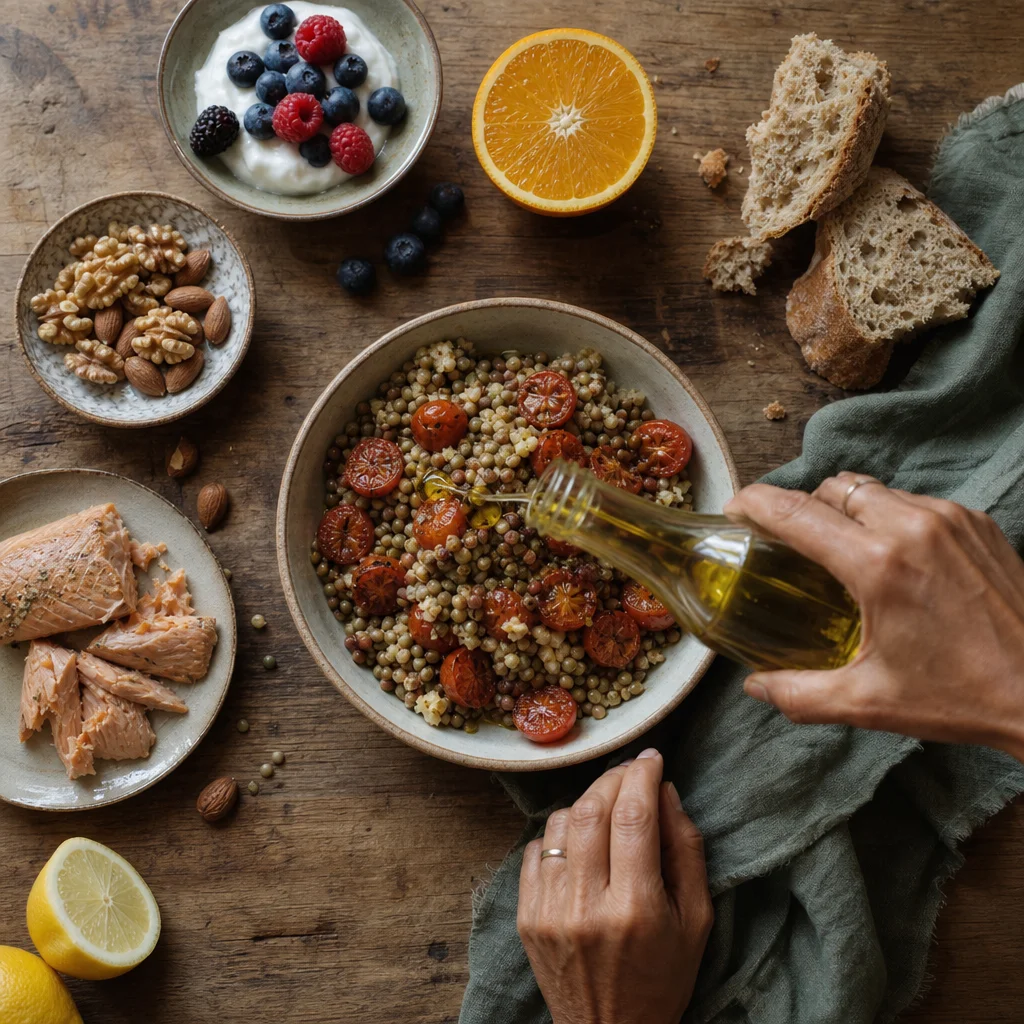
- Breakfast: Plain yogurt with walnuts and berries, or oats with fruit.
- Lunch: Lentil soup, whole grain bread, olive oil and lemon.
- Snack: A handful of almonds and an orange.
- Dinner: Canned salmon cakes or baked fish, a big pile of roasted vegetables, barley or farro.
- Dessert: Fruit. Coffee or tea.
Nothing here needs a specialty shop. Frozen vegetables and canned fish keep the cost down. Cook once, eat twice, and you’ve handled two days of lunches. Cost is the usual question — our Mediterranean diet on a budget guide answers it.
Is It Too Late to Start? Plus Your Other Honest Questions
Most of the Mediterranean diet for longevity questions I see come down to timing and trade-offs. Let’s take them in order.
Is it too late if I’m older?
No. One study of 5,200 adults aged 65 and older followed participants for a median of 8.1 years. A meta-analysis including it found each one-point improvement linked to about 5% lower risk of death. Improvement counts whenever it starts.
Is this a weight-loss diet?
Not really, and the honest answer serves you better. It’s a heart and metabolic pattern. Weight depends on total intake, and olive oil plus nuts make overeating easy. The NIH warns weight gain is possible.
Can I get a blood test to check my score?
Not yet. The 67-marker signature is a research tool, not a clinical test. Nobody should be selling you one.
What if I already have heart disease?
This pattern still matters. A 2026 review of people with existing heart disease linked closer following to 26% lower risk of death. But it works alongside medication, never instead of it.
The Bottom Line
If you take one thing from all of this, make it this. In the end, the Mediterranean diet for longevity is not a regimen. It’s a direction.
The evidence is strongest for heart protection. It’s solid for lower death risk. And it’s honest about what it cannot prove.
You don’t need a perfect score. You don’t need imported olive oil or macadamia nuts. You need more plants, less processed meat, fish a couple of times a week, and a fat that replaces butter rather than joins it.
Add one swap this week. Beans in your soup. Olive oil on your toast instead of butter. Nuts instead of the cookie. That isn’t a diet. It’s a pattern, and patterns get built one small step at a time.