

Constipation Relief Foods: The Science-Backed Lunch Plan
Key Takeaways
- Two kiwifruit a day rival psyllium — a standard fiber supplement — in clinical trials for constipation relief.
- The best lunch pairs soluble fiber (softens stool) with insoluble fiber (adds bulk).
- Fiber is a sponge. It needs water. Without it, more fiber can backfire.
- Aim for 25–30 grams of fiber daily, added gradually over a few weeks.
- See a clinician if constipation brings bleeding, severe pain, fever, vomiting, or weight loss.
Picture this: It’s mid-morning, and you still haven’t gone. Your stomach feels tight. You’re a little bloated. And honestly? You can’t stop thinking about it. If you’ve been searching for constipation relief foods that actually work, here’s the good news. The science is stronger than you think. And it starts with lunch.
In this guide, you’ll learn which foods have the strongest clinical evidence. You’ll see why they work — it’s all about fiber and water. And you’ll get a full-day plan you can start today. We’ll also bust a few myths that waste people’s time.
Quick Answer: What Should You Eat for Constipation Relief?
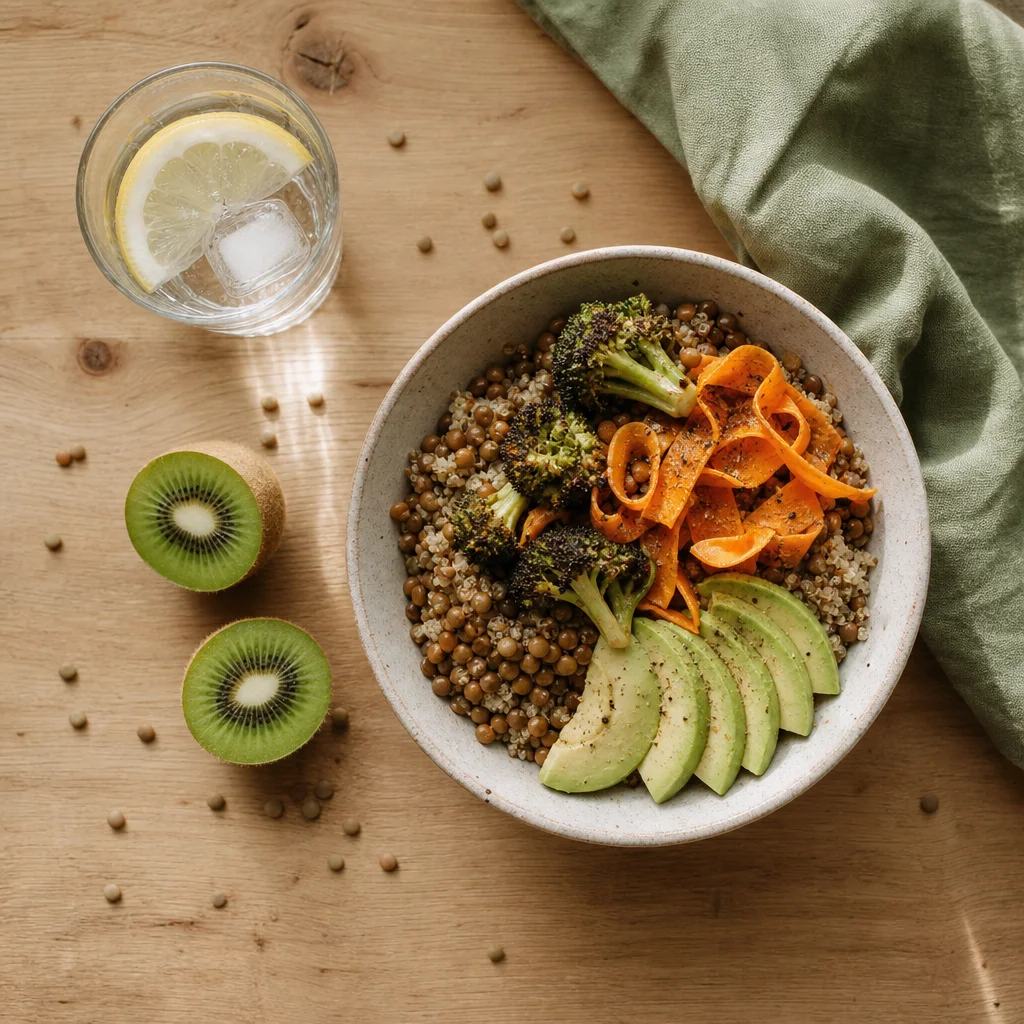
The constipation relief foods with the strongest evidence are kiwi and prunes. For lunch, build a bowl with lentils, whole grains, cooked vegetables, and avocado. Add two kiwifruit on the side — green or gold. Then drink a large glass of water. Expect steady results over days and weeks, not magical afternoon urgency.
Which Constipation Relief Foods Have the Strongest Evidence?
Among constipation relief foods, two stand out from the research: kiwi and prunes. In 2025, the British Dietetic Association published the first comprehensive dietary guidelines for adult constipation. Built on 75 randomized trials, the guidelines made food-specific recommendations for kiwifruit, prunes, and rye bread.
Why kiwi? In a 2022 trial in the journal Nutrients, researchers gave adults with constipation two kiwifruit daily for four weeks. The fruit matched psyllium — a standard fiber supplement — gram for gram at 7.5 grams of fiber. People also reported less straining.
A 2019 crossover trial in the Journal of Nutritional Science told a similar story. Three kiwifruit a day increased complete spontaneous bowel movements from 3.3 to 6.3 per week versus baseline — and roughly two more per week than the psyllium group (6.3 vs 4.5).
Prunes are just as impressive. In 2011, a trial in Alimentary Pharmacology & Therapeutics tested dried plums. About 100 grams a day — roughly ten prunes — improved stool frequency and consistency. It outperformed psyllium. A 2014 systematic review in the same journal reached similar conclusions.
In 2021, the American Journal of Gastroenterology reviewed over-the-counter constipation therapies. It gave fruit-based options — kiwi, mango, and prunes — a moderate evidence grade. Translation: food-first is a legitimate strategy, not a wellness trend.
The Evidence at a Glance
- Kiwi: two daily equaled psyllium (7.5 g fiber) in a 4-week trial.
- Prunes: about 100 g daily beat psyllium for stool frequency and consistency.
- Psyllium: the supplement standard, with moderate evidence for constipation.
Why Fiber Type Matters: Soluble vs Insoluble
Now, you might be thinking: isn’t all fiber the same? Here’s the thing — it’s not.
Soluble fiber dissolves in water and forms a gel. That gel softens stool and helps it slide through. Insoluble fiber adds bulk and helps keep things moving. Your gut needs both.
A 2026 network meta-analysis in Food & Function looked at 17 trials with 1,423 adults. Viscous soluble fibers — the water-holding kind in kiwi, avocado, and oats — most reliably improved stool consistency, frequency, and straining.
This explains why the lentil bowl works. Lentils, whole grains, and cooked vegetables bring insoluble fiber. Avocado and kiwi bring soluble fiber. Softness plus bulk, in one meal.
Build the Constipation Relief Lunch
- Base: ½ cup cooked lentils plus 1 cup quinoa or another whole grain.
- Color: ½ cup cooked vegetables — broccoli, carrots, or leafy greens.
- Cream: ⅓ to ½ of an avocado, sliced.
- Fruit: two kiwifruit on the side.
- Drink: a large glass of water, then steady sips all day.
- New to high-fiber meals? Use half the avocado. Save one kiwi for later. Choose cooked vegetables over raw. Build up slowly.
The Sponge Principle: Why Fiber Needs Water
Here’s the part most articles skip. Fiber works like a sponge. It can only soften stool if there’s water to absorb. These constipation relief foods need a partner: water. Without enough fluid, extra fiber can make constipation worse.
A 2019 MRI study in Alimentary Pharmacology & Therapeutics showed why. People who ate kiwifruit held more water in their small bowel and colon. Stool frequency rose from 1.14 to 1.46 stools per day. Stools also became softer.
The NIDDK (National Institutes of Health) puts it simply: drink plenty of liquids so fiber can do its job. Adding fiber slowly matters, too. The agency recommends a gradual increase, not a sudden spike.
The 2025 BDA guidelines also made recommendations for high-mineral water — expert reviews note magnesium-rich water in particular — though the evidence was modest. This is why the lunch includes a big glass of water. Hydration isn’t a side note. It’s the engine that makes fiber go.
A Full Day of Foods That Help Constipation
Lunch is a great start. But regularity is a full-day project. Experts suggest 25 to 30 grams of fiber daily for constipation. NIDDK puts the adult range at 22 to 34 grams, depending on age and sex.
A full day of constipation relief foods doesn’t require fancy recipes. It just needs smart staples you already know — think high-fiber foods like oats, berries, and beans. At the same time, go easy on ultra-processed, low-fiber foods — chips, fast food, and frozen dinners — which can crowd out the good stuff.
In a 2025 review of expert guidelines, eight of ten panels agreed on one thing: increase fiber gradually. Four panels named 25 to 30 grams as the daily target.
A Sample Day at 25–30 Grams of Fiber
- Breakfast: oatmeal topped with raspberries and a spoonful of chia seeds.
- Lunch: the lentil grain bowl, two kiwis, and plenty of water.
- Snack: a small handful of prunes with a few almonds.
- Dinner: barley or quinoa with black beans, cooked greens, and roasted sweet potatoes.
- Swap white bread for rye when you can. The 2025 British Dietetic Association guidelines specifically recommend rye.
- New to fiber? Start at half portions. Ramp up over a few weeks.
Daily Habits That Support Regularity (and What’s Overhyped)
Here’s the thing: constipation relief foods do their best work when you pair them with simple habits. Your body sends signals — don’t ignore them. Repeatedly postponing a bowel movement can throw off your natural rhythm.
Mayo Clinic also suggests a regular schedule, especially after meals. That’s when your body’s natural reflex is strongest. Give yourself a few unhurried minutes on the toilet. No rushing. A small footstool can make the position more comfortable, too.
What about the famous after-lunch walk? The evidence is mixed. A 2025 systematic review in Clinical Nutrition ESPEN found that physical activity advice for constipation was low to moderate and sometimes conflicting.
However, walking is good for your health in countless ways. Just don’t expect it to be a cure on its own.
And if food isn’t enough? The 2021 ACG review gives two over-the-counter laxatives — polyethylene glycol (PEG) and senna — grade A evidence. Those are solid options to discuss with your clinician. Food first doesn’t mean food only.
Four Myths Worth Dropping
- Myth: “One high-fiber meal will fix everything.” Reality: the benefit builds over weeks of consistent eating. No single lunch is a laxative.
- Myth: “Kiwifruit extract works like the fruit.” Reality: a low-dose extract (1 gram daily) failed in a 2015 trial in the Asia Pacific Journal of Clinical Nutrition. Eat the fruit.
- Myth: “Dairy causes constipation.” Reality: dairy is simply low in fiber. Unless you have lactose intolerance, no need to ban it — just balance it.
- Myth: “More fiber is always better.” Reality: a sudden spike causes bloating and gas. Ramp up slowly.
When to Talk to Your Clinician
Constipation usually isn’t an emergency. But see a doctor if it lasts more than three weeks or gets in the way of daily life. Seek care promptly if constipation comes with blood in your stool or on the toilet paper, black stools, stomach pain that doesn’t stop, or weight loss without trying. Get help quickly if you also have vomiting, a fever, or can’t pass gas.
Your Questions, Answered
How long do constipation relief foods take to work?
Some people notice a shift within days. In an MRI study, healthy adults held more water in their colon after just three days of kiwifruit. For steady regularity, think in weeks. The strongest kiwi trials ran four weeks.
Are kiwi or prunes better?
Both are evidence-backed, and no head-to-head trial has settled the match. Choose two kiwifruit a day or about 100 grams of prunes. The best pick is the one you’ll actually eat daily.
Should I try a fiber supplement instead?
Psyllium has moderate evidence, and it works well for many people. However, whole foods add vitamins and water that supplements don’t. And remember: a low-dose kiwi extract failed where whole fruit succeeded. Eat real food first.
The Bottom Line
Here’s your takeaway. Constipation relief foods don’t need to be complicated, expensive, or strange. Start with lunch tomorrow: two kiwis, a lentil bowl with avocado and cooked vegetables, and a big glass of water.
Then repeat it. Add fiber gradually, hydrate steadily, and give your gut a few weeks to adjust. Consistency beats any single miracle meal. And if things don’t improve — or worrying symptoms appear — talk to your clinician. That’s not failure. That’s smart, healthy self-care.