

How to Build a 7 Day Meal Plan That Actually Works
Key Takeaways
- A healthy 7 day meal plan is built on whole foods from five food groups — not 21 perfect recipes.
- The updated Dietary Guidelines raise protein to about 82–109 grams a day for a 150-pound woman.
- Flexible, person-centered plans beat rigid menus for long-term results.
- Use the mix-and-match formula and a reusable shopping list template to make healthy weeks stick.
- Skip 1,200-calorie plans. They’re too low for most adults to meet nutrient needs.
It’s Sunday evening. The fridge looks empty. The farmers market haul is wilting. And you’re already dreading the “what’s for dinner?” question. You’re not alone in feeling this way. A 7 day meal plan can turn that stressful week into a calm one. But only if it’s a plan you’ll actually enjoy following. Here’s the thing: you don’t need 21 perfect recipes or a rigid grid of meals. You need a simple, repeatable framework. That’s exactly what you’re getting here.
We’ll start with what a healthy week of eating actually looks like. Then I’ll walk you through a three-step method to build your own plan. You’ll also get a boredom-proof mix-and-match formula and a shopping list template that cuts waste and cost. And I’ll show you a full sample day with macros, so you know what “enough” really looks like. Let’s dive in.
Quick Answer: What’s the Best 7 Day Meal Plan?
The best 7 day meal plan is the one you’ll actually stick with. That means flexible, built on whole foods and seasonal produce, and matched to your real life. Skip anything that pushes extreme calorie cuts — yes, that includes most 1,200-calorie plans.
What a Healthy 7 Day Meal Plan Really Looks Like
Before you build anything, let’s set the foundation. The Dietary Guidelines for Americans 2025–2030 keep things simple. Eat minimally processed whole foods from five food groups. Those groups are protein, dairy, vegetables, fruits, and whole grains. And limit highly processed foods, like packaged snacks and sugary drinks.
There’s also a major update you should know about. The new guidelines raise the protein target to 1.2–1.6 grams per kilogram of body weight each day. For a 150-pound woman, that’s roughly 82 to 109 grams of protein daily. That’s a big jump from older advice — and it’s actually great news.
Why? Protein keeps you full and supports your muscles. It also makes a 7 day meal plan feel satisfying instead of restrictive. Aim for 25 to 30 grams of protein at each meal. You’ll hit the mark without obsessing over numbers. New to planning? Our 7-Day High-Protein Meal Plan for Beginners shows exactly how that looks.
Whole grains matter too. Think oats, brown rice, quinoa, and whole-wheat bread. The guidelines suggest 2 to 4 servings a day. Pair those with plenty of produce and a couple of dairy servings. Then add healthy fats from olive oil, avocado, nuts, and fish. That sums up a healthy week in one sentence.
Why a Flexible 7 Day Meal Plan Beats a Rigid Menu
Here’s what the research says. The European Association for the Study of Obesity published a position statement in 2023 that’s worth knowing. Their main conclusion? There is no single best diet. Flexible, person-centered eating patterns are the most sustainable approach to weight management. Rigid plans tend to fall apart by Thursday.
Other evidence points the same way. Flexible, evidence-based eating patterns like the DASH plan set daily serving targets instead of rigid meal rules. Cooking more meals at home is linked to higher diet quality. And meal planning is a learnable skill, not something you’re born with. One study found that teaching meal planning and grocery-list skills helped people change their habits. They reported fewer fast-food meals and more whole grains.
On the flip side, many popular weekly plans quietly under-feed you. Some “weight loss” menus land at 1,100 to 1,200 calories a day. That’s true even when they say they’re aiming for 1,500. Current guidance is clear: 1,200 calories is too low for most adults to meet their nutritional needs.
So let’s be honest. A fixed menu of 21 recipes isn’t a 7 day meal plan — it’s a chore list. What works is a flexible framework you can adapt. That’s what we’re building next.
Your 3-Step Framework: Menu, Pantry, List
Now, you might be thinking, “Okay, but where do I start?” Good question. The Academy of Nutrition and Dietetics lays out a three-step method that’s hard to beat. Make a menu. Stock your pantry. Keep a running grocery list.
Step 1: Make a menu. Pick two breakfasts, two to three lunches, and three to four dinners for the week. Here’s the thing: you don’t need a different meal every day. The Academy is explicit about this. It’s perfectly fine to eat oatmeal or yogurt with berries several times a week. Repeating meals is how real people meal plan.
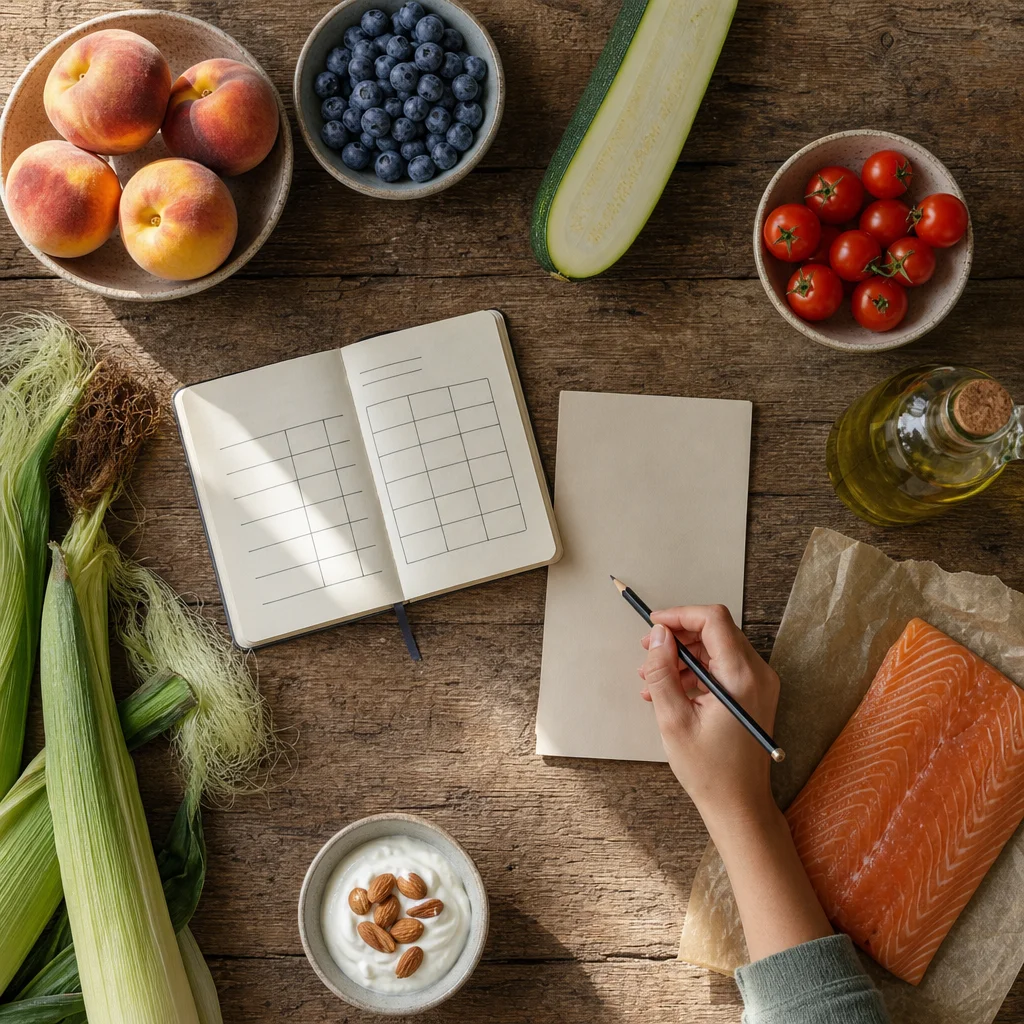
Let the season guide you. In late summer, peaches, berries, tomatoes, zucchini, and corn are at their peak — and we’ve mapped a full week of them in our 7-Day Summer Meal Plan with Grocery List. That means better flavor, more nutrients, and lower prices. In-season produce tends to cost less, which helps your grocery budget.
Step 2: Stock your pantry and freezer. Keep canned beans, lentils, whole grains, nuts, frozen berries, and frozen vegetables on hand. When your kitchen already has healthy basics, a 7 day meal plan stops feeling like a scramble.
Step 3: Keep a running grocery list. Jot items down as you run out. Then build your weekly list from your menu. Check your pantry first, so you buy only what you actually need. Research shows shopping with a list is tied to buying more healthy foods. The list isn’t just organization. It’s a behavior tool.
The Mix-and-Match Formula That Prevents Boredom
Picture this: it’s Wednesday, and you’re already tired of your plan. That’s completely normal. The fix is a simple formula: protein + vegetables + whole grain + flavor. Pick one from each column, and you have a balanced meal. Mix and match across the week, and you’ll rarely eat the same plate twice.
Here’s how that plays out with late-summer produce:
- Breakfasts: Greek yogurt with peaches and a sprinkle of nuts. Eggs with tomato and zucchini on whole-wheat toast. Overnight oats with berries.
- Lunches: White bean and tomato salad with herbs. Quinoa bowl with corn, black beans, and avocado. Tuna salad over sliced tomatoes.
- Dinners: Sheet-pan salmon with zucchini and potatoes. Grilled chicken with peach salsa. Caprese chickpea bowls with brown rice.
See the pattern? The protein changes, the produce stays seasonal, and the flavors do the work. That’s the boredom-proof engine of your 7 day meal plan. You get variety without cooking 21 different recipes.
Your Reusable Shopping List Template
Let’s talk about the part most meal plans get wrong: the shopping list. A good list isn’t a one-week ingredient dump. It’s a reusable template you can adjust every week.
Your Weekly Shopping List Template
- Pantry staples (check first): beans, lentils, oats, quinoa, brown rice, whole-grain pasta, canned tomatoes, olive oil, nuts, seeds.
- Freezer: frozen berries, frozen vegetables, salmon fillets, chicken, whole-grain bread.
- Fridge staples: eggs, Greek yogurt, milk or soy milk, cheese, hummus.
- Fresh produce (buy weekly): whatever’s in season — right now, that’s peaches, berries, tomatoes, zucchini, corn, and leafy greens.
- Proteins (from your menu): chicken, salmon, shrimp, tofu, or ground turkey.
Why does this work? Research offers two good reasons. First, in a 2025 study of mostly women, a low-cost program that improved the home food environment — stocking, prep and planning — measurably improved diet quality scores. It’s the environment, not willpower, that drives your eating. Second, the list keeps you focused in the store. You buy what your menu needs, not what the displays want you to buy.
This template also cuts waste. You use what you already have. You let the season decide your produce, which keeps costs down. That’s a healthier week and a smaller grocery bill. Love make-ahead lunches? Our mason jar meal prep formula pairs perfectly with this framework.
Sample Day: A Realistic 1,700-Calorie Day With Macros
Okay, let’s make this real. Here’s a full day from a 7 day meal plan built on the framework above. It lands around 1,700 calories with roughly 100 grams of protein. Macros? That’s just a short way of saying protein, carbs, and fat. The day balances all three. Your needs may differ, and that’s completely normal.
One Day at a Glance
- Breakfast (about 400 calories, 25 g protein): Greek yogurt parfait with sliced peaches, berries, and a sprinkle of granola and almonds.
- Lunch (about 500 calories, 30 g protein): White bean and tomato salad with olive oil and herbs. Add grilled chicken and a slice of whole-grain toast.
- Snack (about 200 calories, 10 g protein): Apple slices with peanut butter, or cottage cheese with berries.
- Dinner (about 600 calories, 35 g protein): Sheet-pan salmon with zucchini and cherry tomatoes, plus 3/4 cup cooked quinoa.
Notice what this day does. Half the plate is produce at lunch and dinner. A quarter is protein. The rest is whole grains. That’s the plate method. And the evidence behind it is solid. A 2026 analysis of 14 studies found that visually guided portion control supports modest weight loss. The effect shows up in the first few months. It also improves blood sugar and cholesterol over time.
One more thing worth knowing: plate size isn’t the magic trick. A controlled experiment found that smaller plates didn’t change how much people ate. A larger plate actually boosted vegetable servings. So skip the “tiny plate” advice. Focus on proportions instead.
Weight Management Without Diet-Culture Rigidity
Now, the weight-loss question. If you’re hoping to lose weight, a flexible 7 day meal plan can genuinely help. But let’s set realistic expectations. Health guidelines suggest a safe pace of about 1 to 2 pounds per week. That’s not dramatic — and that’s the point. Gradual changes are the ones that last.
Here’s what obesity researchers emphasize. Flexible, person-centered eating patterns that focus on food quality are the most sustainable approach. Approaches that avoid rigid calorie rules can improve quality of life and body image, too. In plain terms? You don’t have to white-knuckle your way through a diet to see results.
So track what helps: energy, sleep, confidence in the kitchen, how your clothes fit. Not just the scale. Plateaus are normal. Your weight will pause, and that’s biology, not failure. Keep the framework going, and let the habits do the work.
Your Questions, Answered
Can I eat the same meals more than once a week?
Yes — and you probably should. Repeating meals is standard practice in any 7 day meal plan. Two rotating breakfasts and two or three lunches will cut your cooking time in half.
What if I don’t like a recipe in my plan?
Swap it using the formula. Keep the same vegetable and grain, then change the protein or the flavor. If you hate salmon, try chicken or chickpeas in the same sheet-pan setup. The plan bends — that’s the whole point.
Is a 1,200-calorie meal plan ever okay?
Only under medical supervision. For most adults, 1,200 calories is too low to meet nutritional needs. It’s also unsustainable, which is why so many people rebound. If you’re working with a clinician, follow their guidance instead.
The Bottom Line
You don’t need a perfect 7 day meal plan. You need one that works for your week, your tastes, and your budget. Start with the framework: menu, pantry, list. Add the mix-and-match formula so you never get bored. And let the season fill your plate with the best produce of the moment.
This week, try this:
- Pick two breakfasts, two lunches, and three dinners. Write them down.
- Check your pantry and freezer, then build a short shopping list.
- Cook one dinner that makes enough for two nights. Leftovers are your friend.
That’s it. You’ve just built your own flexible 7 day meal plan — and you can reuse it every single week. Want a fully mapped-out week instead? TEOHL’s high-protein meal plan and Mediterranean meal plan are ready to go. Healthy eating should feel doable. Now it does.
A quick note: calorie needs vary with age, activity, and health. This article is general guidance, not medical advice. If you have diabetes, food allergies, or another health condition, check with your clinician or a registered dietitian.