

Chia Seed Breakfast: 8 Gut-Healthy Recipes for Busy Mornings
Key Takeaways
- Two tablespoons of chia seeds deliver about 8 grams of fiber — nearly a third of the daily target for most women.
- Chia’s soluble fiber forms a gel that feeds good gut bacteria and helps keep you regular.
- Pair chia with yogurt or kefir to combine prebiotic fiber with live probiotics in one bowl.
- Start with 1 tablespoon a day and drink extra water to avoid bloating and gas.
- Always soak chia for at least 15 minutes before eating. Dry seeds are a choking hazard.
Picture this: it’s 7:30 a.m., you’re racing out the door, and your stomach already feels off. You know you should eat more fiber. But a bowl of bran cereal sounds about as exciting as a spreadsheet. Here’s the thing: a chia seed breakfast might be the easiest gut-health upgrade you make all year.
These tiny seeds are barely bigger than poppy seeds. Yet they pack a serious dose of the fiber your gut bacteria love. They cost about $5 a bag. And they practically make themselves while you sleep.
In this guide, we’ll cover the science behind chia and gut health, the ratio that prevents lumpy pudding and bloating, and eight make-ahead breakfasts that pair fiber with probiotics. No expensive powders. No restrictive rules.
Why a Chia Seed Breakfast Supports Your Gut
Look at the chia seed nutrition facts from Cleveland Clinic. One number stands out: about 9.8 grams of fiber per ounce. That’s roughly two tablespoons of seeds. It also delivers protein, calcium, magnesium, and plant omega-3s.
Here’s what actually matters for your gut. Chia’s fiber is mostly soluble. That means it dissolves in water and forms a gel. This gel slows digestion, which helps you feel full longer. It also becomes food for the beneficial bacteria living in your colon.
When those bacteria break down the fiber, they produce short-chain fatty acids — tiny molecules that nourish your gut lining. That’s what makes a chia seed breakfast more than just filling. It actively feeds your gut. The dietary fiber overview from the National Library of Medicine confirms fiber aids digestion and prevents constipation. And the daily fiber recommendations from Mayo Clinic set the target at 25 grams for women 50 and under (and 21 grams for women over 50). For more high-fiber breakfast ideas, see our high-fiber breakfast guide.
What the Science Actually Says About Chia and Gut Health
Superfood hype or real science? Fair question. Let’s sort the solid evidence from the shaky claims.
What Fiber Really Does
Start with regularity. A 2026 network meta-analysis in the journal Food & Function pooled 17 randomized trials. It found that gel-forming fiber and constipation relief go together. These fibers ease straining with high certainty and improve stool consistency and frequency with moderate certainty.
The prebiotic story is real, but nuanced. Chia’s fiber does feed gut bacteria. However, a 2025 study comparing chia vs flaxseed fiber and gut bacteria found flax fermented more readily. So chia helps, but variety wins. Rotate chia, flax, oats, and berries through your week. For more berry-forward breakfasts, try our berry breakfast recipes. Another 2025 study in healthy adults linked fiber and beneficial gut bacteria in healthy adults — a four-week fiber boost raised levels of helpful microbes.
Fullness and Blood Sugar: What the Trials Show
What about the “keeps you full” claim? A 2017 study in the European Journal of Clinical Nutrition showed that chia seeds slow digestion and increase fullness by forming a thick gel. A separate 2017 trial found that chia added to yogurt helps you feel fuller. People also ate less at their next meal.
Here’s the honest part. Those are short-term findings. One 12-week trial found no changes in weight or cholesterol from daily chia. So the fair promise is this: chia helps you feel full and steadies your morning blood sugar. It is not a weight-loss miracle. If you’re managing blood sugar, our diabetes breakfast recipes offer more ideas. A systematic review of chia seed clinical trials also rated the overall evidence as low quality. Most studies were small and short-term.
One more nuance. Chia’s omega-3 is ALA, a plant form. Your body converts it to EPA and DHA at a limited rate. So chia is a great plant source — but not a fish-oil replacement.
The Fiber + Probiotic Pairing: A Gut-Healthy Breakfast Blueprint
Here’s where many chia articles go fuzzy. They say yogurt “adds protein” and move on. But the real magic is the pairing itself.
Chia provides prebiotic-type fiber — fuel for your good bacteria. Yogurt and kefir provide probiotics — the live bacteria themselves. Put them together, and you feed your microbiome while adding new helpers. The best chia seed breakfast formula comes down to these two ingredients.
Quick terms check: prebiotics are the fuel. Probiotics are the fire. Chia is the fuel; yogurt is the fire. It’s a common mix-up, even on reputable sites. We’ll keep it straight.
This pairing isn’t just theory. The yogurt study above used this exact combo. Participants felt fuller and craved fewer sugary foods.
How to Eat Chia Seeds Without the Bloat
Let’s be honest. Chia can cause bloating if you dive in headfirst. The fix is simple: start slow and drink enough water.
The Golden Ratio and Soak Rules
Use 1 part chia to 4 parts liquid. That’s 2 tablespoons of chia to 1/2 cup of milk, kefir, or plant milk. This gives a creamy pudding texture — not soup, not sludge.
Soak for at least 15 minutes. Overnight is even better. Stir once after about 5 minutes to break up clumps. Chia absorbs up to 12 times its weight in water. That’s why soaking matters.
Ramp Up Slowly, Hydrate Often
Soluble fiber needs water to do its job. When you boost fiber, add an extra glass or two of water during the day. This keeps stool soft and things moving.
Ramp up over three weeks. Week one: 1 tablespoon daily. Week two: 1 1/2 tablespoons. Week three: a full 2-tablespoon serving. Your first chia seed breakfast should use the smaller amount. This gives your gut bacteria time to adjust.
Ground or whole? Ground chia absorbs faster and may unlock more nutrients. Whole chia works beautifully in puddings and smoothies, where it gets plenty of soak time.
Bloating Troubleshooting
Feeling gassy after adding chia? Check three things. Are you starting with just 1 tablespoon? Are you drinking enough water? Are you soaking the seeds fully? Scale back, hydrate, and build up more slowly. If discomfort persists for more than a week, check with a clinician.
8 Easy Chia Seed Breakfast Recipes for Busy Mornings
Every recipe below is make-ahead friendly. Each chia seed breakfast pairs prebiotic fiber with probiotic-rich or high-fiber ingredients. Fiber counts come from the chia alone — fruit and grains add even more.
Puddings and Parfaits: Mix Tonight, Grab Tomorrow
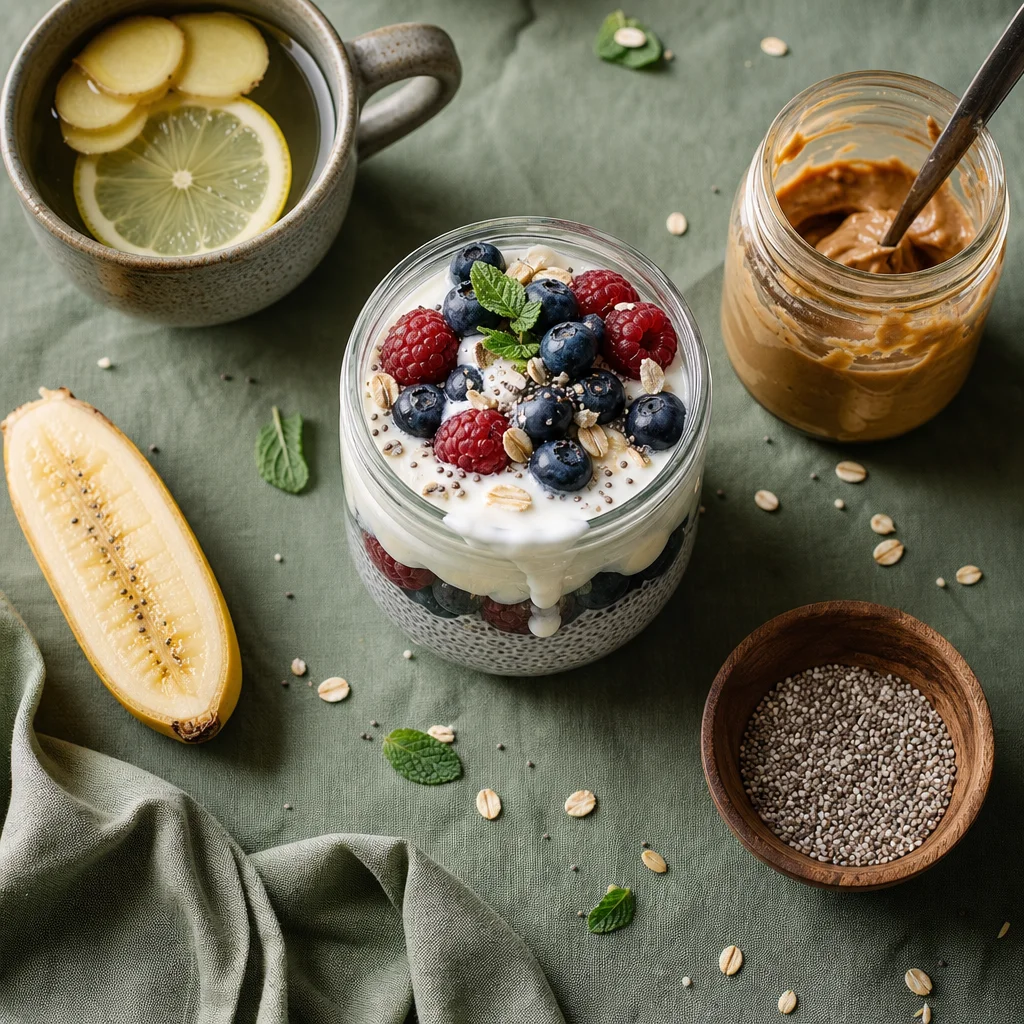
1. Blueberry-Kefir Chia Pudding. Stir 2 tablespoons chia into 1 cup kefir. Add 1/2 cup blueberries and a drizzle of maple syrup. Let it sit overnight. You get about 8 grams of fiber from the chia, plus live probiotics from the kefir. This chia seed breakfast is the ultimate grab-and-go.
2. Peanut Butter Banana Overnight Oats. Combine 1/2 cup rolled oats, 1 tablespoon chia, 1 cup milk, 1 tablespoon peanut butter, and half a sliced banana in a jar. Refrigerate overnight. Chia adds about 4 grams of fiber and helps thicken the oats. Morning you will be very happy.
3. Cocoa-Mint Chia Pudding. Whisk 2 tablespoons chia, 1 cup milk, 1 tablespoon cocoa powder, and a few fresh mint leaves. Sweeten lightly, then chill overnight. It tastes like a thin mint — with about 8 grams of fiber and zero regret.
4. Layered Raspberry-Chia Yogurt Parfait. Make a simple pudding with 2 tablespoons chia and 1/2 cup milk. Layer it in a jar with Greek yogurt, fresh raspberries, and a sprinkle of granola. Every layer adds fiber, probiotics, or crunch.
Smoothies, Toasts, and Warm Bowls
5. Green Gut Smoothie. Blend a handful of spinach, one kiwi, half a banana, 1/2 cup Greek yogurt, 1 tablespoon chia, and your milk of choice. It’s creamy and mildly sweet. Chia brings about 4 grams of fiber, and yogurt brings probiotics.
6. Strawberry Chia “Jam” Toast. Mash 1/2 cup strawberries with 1 tablespoon chia and a squeeze of lemon. Let it sit 30 minutes, then spread it on whole-grain toast. Top with Greek yogurt for protein. This chia seed breakfast feels like a treat.
7. Savory Chia Breakfast Bowl. Not a sweet-morning person? Simmer 2 tablespoons chia in 1 cup broth for about 5 minutes until thickened. Top with wilted spinach, a soft egg, and black pepper. Warm, savory, and full of fiber.
8. Lemon-Ginger Chia Morning Tonic. For a light start, stir 1 tablespoon chia into a glass of water with lemon juice and a slice of ginger. Wait 15 minutes, stir again, and drink. It’s hydrating, with 4 grams of fiber to begin your day.
Is It Safe to Eat Chia Every Day?
For most people, yes. A 2019 EFSA safety assessment of chia seeds found no safety concerns with chia as a food, aside from allergenicity. But a few cautions matter. Is a chia seed breakfast safe daily? For most of us, absolutely.
Always soak first. Dry chia can expand in the esophagus and cause choking — especially in children. Mix soaked chia into yogurt, oatmeal, or pudding.
Mind your medications. Chia’s fiber slows digestion. That can change how your body absorbs certain drugs, including diabetes, blood pressure, and blood-thinning medications. If you take any of these, talk to your clinician.
Know your health history. Chia contains oxalates, so people with calcium oxalate kidney stones should ask their doctor first. Allergies are rare but possible, especially with sesame or hazelnut sensitivities. If you have IBS or need a low-fiber diet for a medical condition, check with your care team.
One more thing. If constipation continues despite more fiber and water, see a clinician. Fiber helps most people. But it’s not a cure-all, and ongoing symptoms deserve a professional look.
Your Chia Questions, Answered
Do I really need to soak chia seeds? Yes. Soak for at least 15 minutes. Dry seeds can expand in your esophagus and cause choking.
Is ground chia better than whole? Ground chia absorbs faster and may release more nutrients. Whole chia is fine in recipes that soak overnight.
Will chia make me bloated? Only if you add too much too fast or skip the water. Start with 1 tablespoon a day and build up slowly.
Is chia better than flax for gut health? They offer different fibers. One study found flax fermented more easily. For a truly healthy gut, eat both.
The Bottom Line
Here’s the takeaway. Supporting your gut doesn’t require expensive powders or complicated routines. A chia seed breakfast gives you real, evidence-backed fiber that feeds your good bacteria, keeps you full, and supports regularity — all for the price of a $5 bag of seeds.
Start small. Soak a tablespoon of chia in your yogurt tonight. Add berries. Notice how your gut feels. Next week, try a full pudding. Before you know it, you’ll have a gut-healthy breakfast habit that sticks.
Your gut works hard for you every day. A breakfast that works just as hard? That’s what we call healthy living.