

Low Spoons Meals for PCOS: 5 No-Cook Ideas That Work
You know those days. Your brain feels like it’s running on dial-up. The thought of chopping a vegetable feels like a marathon. And the idea of following a recipe? Absolutely not. If you have PCOS and ADHD (or just really low energy days), you know this struggle well. You want to eat in a way that supports your blood sugar and insulin levels, but your executive function has left the building. That’s where low spoons meals come in. This guide is for the days when you need to eat well but have almost nothing to give. We’ll cover what to eat, what to keep in your kitchen, and how to feed yourself without a single recipe.
Key Takeaways
- Low spoons meals are about assembly, not cooking. Think open, dump, and eat.
- Pair carbs with protein every time. This is the single most important rule for blood sugar.
- Build a “zero-spoon” kitchen kit with shelf-stable proteins, pre-washed greens, and frozen veggies.
- On your worst days, “fed is best” wins. A protein shake is better than nothing.
- Texture aversions and food “ick” are real. Have 2-3 safe meals you can always fall back on.
What Are Low Spoons Meals, Exactly?
The “spoon theory” comes from the chronic illness community. It describes how people with limited energy have a finite number of “spoons” each day. Every task — showering, working, cooking — costs a spoon. On low-spoon days, you have very few left for food.
Low spoons meals are meals that cost almost zero spoons. They require no recipe, minimal decision-making, and little to no cooking. For someone managing PCOS and insulin resistance, the goal is to get fed in a way that supports stable blood sugar — without the mental load of traditional cooking.
Here’s the thing. You don’t need to follow a complicated meal plan. You don’t need to meal prep for hours on Sunday. You just need a few reliable strategies that work when your brain is offline.
Why Low Spoons Meals Matter for PCOS
PCOS affects about 1 in 10 women of childbearing age, according to the Office on Women’s Health. The condition is driven by hormonal imbalance and insulin resistance. That means what you eat directly affects your symptoms.
A 2026 systematic review of nutrition interventions for PCOS found that low-glycemic index (GI) diets consistently improve insulin sensitivity — and anti-inflammatory eating patterns offer similar benefits for metabolic health. Another network meta-analysis comparing dietary interventions for PCOS ranked the DASH diet as most effective for reducing insulin resistance, with Mediterranean and low-GI diets also showing strong benefits.
But here’s what those studies don’t tell you: how to actually eat that way when you can’t function. That’s where this guide comes in.
The One Rule That Matters: No Naked Carbs
If you remember nothing else from this guide, remember this: never eat carbs alone. Protein, fat, and fiber all slow down how quickly your body absorbs sugar. This prevents the blood sugar spike and crash that makes PCOS symptoms worse.
A 2025 meta-analysis on carbohydrate quality and PCOS outcomes confirmed that high-fiber, low-GI carbohydrate choices significantly reduce fasting glucose and insulin resistance. The key is pairing — not eliminating.
So crackers? Fine — if you eat them with cheese or peanut butter. Toast? Great — add an egg or avocado. Pasta? Yes — toss it with canned chicken and olive oil. The rule is simple: protein + carb = better blood sugar.
Your Low Spoons Meals Kitchen Kit
The secret to low spoons eating is having the right ingredients on hand — think smart picks from a dietitian for stocking your pantry without stress. When you’re out of spoons, you can’t go to the store. You need a pantry, fridge, and freezer stocked with things that require zero thought.
Pantry Staples (Shelf-Stable)
Canned tuna, salmon, or chicken • Canned beans (black, chickpea, kidney) • Lentils (canned or quick-cook) • Nut butters (almond, peanut, sunflower) • Nuts and seeds • Olive oil and vinegar • Canned olives • Protein powder (unflavored or vanilla) • Low-sugar protein bars • Oats (rolled or quick) • Canned coconut milk • Broth or bone broth
Fridge Essentials
Greek yogurt (plain, full-fat or 2%) • Cottage cheese • Pre-washed salad greens • Baby spinach • Cherry tomatoes • Pre-shredded cheese • Rotisserie chicken (buy and shred immediately) • Hummus • Guacamole cups • Hard-boiled eggs (pre-cooked) • Pickles and sauerkraut
Freezer Heroes
Frozen berries • Frozen spinach or broccoli • Frozen edamame • Frozen pre-cooked chicken strips • Frozen salmon fillets (individually wrapped) • Frozen brown rice or quinoa • Frozen cauliflower rice • Frozen protein waffles
Low Spoons Meals: 5 No-Recipe Ideas
These meals require zero cooking skill. You open containers, dump things on a plate, and eat. That’s it.
1. The Adult Lunchable
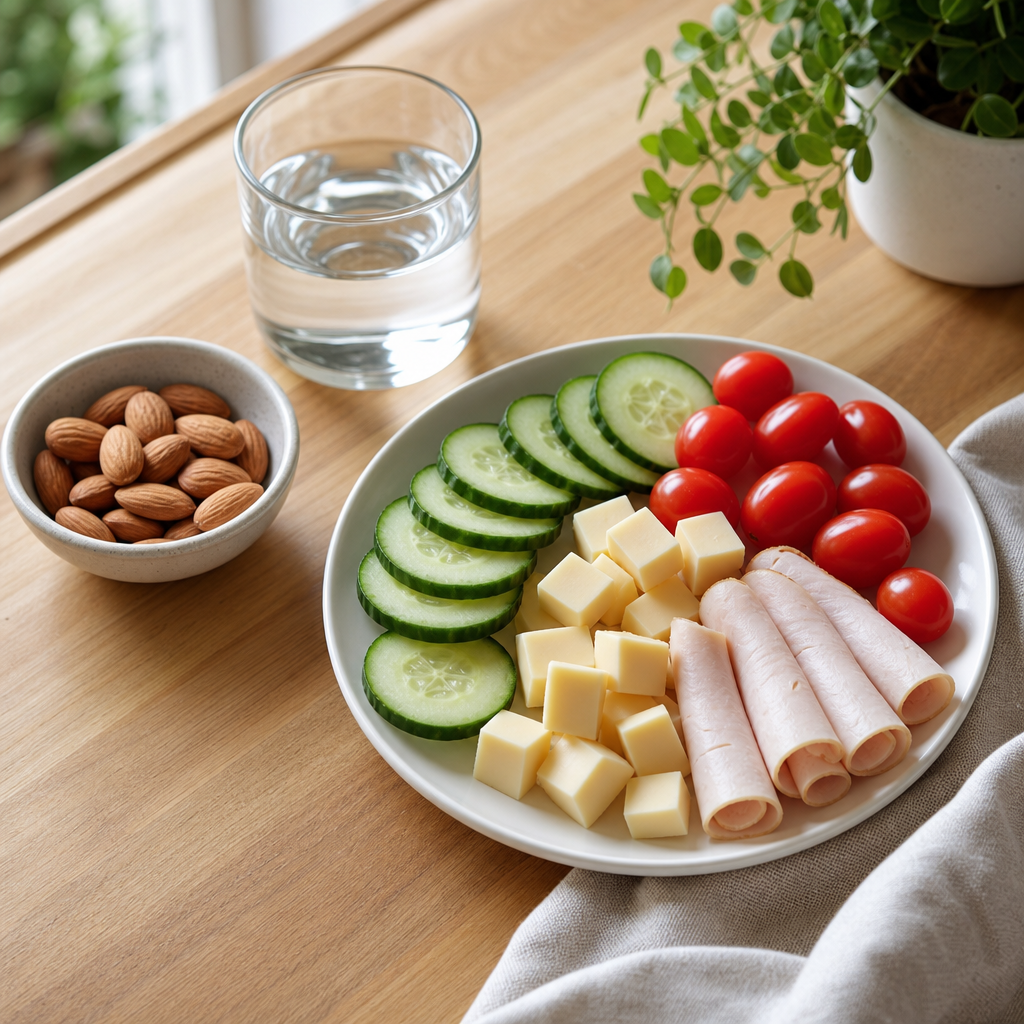
On a plate: sliced cheese, rolled-up deli turkey or rotisserie chicken, a handful of nuts, cherry tomatoes, and a few crackers. That’s it. Protein, fat, fiber, and a little carb — all in one no-cook meal. Swap the crackers for cucumber slices if you want lower carbs.
2. Greek Yogurt Bowl (Savory or Sweet)
Savory version: Plain Greek yogurt + canned tuna + a drizzle of olive oil + salt and pepper. Eat with crackers or cucumber slices. Sweet version: Plain Greek yogurt + frozen berries (thawed for 30 seconds in the microwave) + a spoonful of almond butter. Both versions deliver 20+ grams of protein with zero cooking.
3. The 5-Minute Microwave Bowl
Open a bag of frozen brown rice or quinoa (90 seconds in the microwave). Top with canned black beans (rinsed), pre-shredded cheese, and a spoonful of salsa. If you have energy, add a handful of baby spinach. This is a complete meal with fiber, protein, and healthy carbs.
4. Emergency Smoothie
In a blender: 1 scoop protein powder + 1 cup unsweetened almond milk + 1 handful frozen spinach + 1/2 cup frozen berries + 1 tablespoon nut butter. Blend and drink. This takes 2 minutes and gives you 25-30 grams of protein plus fiber and healthy fats. No chewing required.
5. Open a Can, Eat It
This is for your absolute zero-spoon days. Open a can of sardines or smoked oysters. Eat them with crackers or straight from the can. Open a can of chickpeas, drain, and eat with a spoonful of hummus. Open a container of cottage cheese and top with everything bagel seasoning. No shame. You’re eating. That’s a win.
What About Texture Aversions and Food “Ick”?
If you have ADHD, you know the struggle. A food you loved yesterday suddenly feels wrong. The texture, the smell, the thought of it — it’s a hard no. This is completely normal. Your brain’s sensory processing works differently, and that’s okay.
Here’s how to handle it:
- Have 2-3 safe foods at all times. These are foods you can always eat, no matter what. For some people it’s Greek yogurt. For others it’s cheese and crackers. For others it’s a specific protein bar. Stock these religiously.
- Don’t force it. If a food gives you the ick, don’t eat it. Your body is telling you something. Move on to a safe option.
- Change the texture. If you can’t handle the texture of chicken, try canned tuna instead. If yogurt feels wrong, try cottage cheese. If crunchy is the only texture that works, go for nuts, crackers, and raw veggies.
- Use the “same food, different form” trick. Can’t face eggs? Try egg salad. Can’t face a salad? Try the same ingredients blended into a smoothie. Sometimes changing the form changes everything.
The Hierarchy of Spoons: What to Eat at Each Energy Level
Not all low-spoon days are the same. Here’s a simple framework to help you decide what to eat based on how much energy you have.
Green Spoons (Some Energy)
You can stand at the counter for 5-10 minutes. Make a microwave bowl with frozen rice, canned beans, and cheese. Open a can of tuna and mix with mayo and relish. Make a smoothie. Heat up a frozen salmon fillet in the microwave (2-3 minutes) and eat with pre-washed salad greens.
Yellow Spoons (Limited Energy)
You can open containers and assemble. Make an adult lunchable plate. Eat Greek yogurt with frozen berries. Have cottage cheese with nuts. Open a can of chickpeas and eat with olive oil and salt. Eat a protein bar and an apple.
Red Spoons (Zero Energy)
You can barely lift your head. Drink a protein shake. Eat a protein bar. Eat a handful of nuts. Drink a glass of milk. Eat a spoonful of peanut butter. Open a can of sardines and eat them with your fingers if you have to. The only rule: eat something. Anything. Fed is best.
Frequently Asked Questions
Can I eat carbs on a low-spoon day?
Yes. The science is clear: carbohydrate quality matters more than quantity. Choose fiber-rich carbs like beans, lentils, oats, and berries when you can — we’ve covered high fiber breakfast ideas to inspire your mornings. But if all you have is crackers or bread, pair them with protein — cheese, peanut butter, or canned fish — and you’re doing fine.
What if I can’t stomach eggs?
Eggs are a common texture trigger. Good alternatives: Greek yogurt, cottage cheese, canned fish, protein powder, tofu, edamame, and pre-cooked chicken strips. You can get plenty of protein without ever eating an egg.
Is it okay to eat the same thing every day?
Absolutely. Many people with ADHD thrive on food repetition. It reduces decision fatigue. If you find a low-spoons meal that works for you, eat it as often as you want. Variety is optional. Nourishment is not.
What about meal prep?
If you have a good day, use it to prep components, not full meals. Cook a batch of chicken thighs. Hard-boil 6 eggs. Wash and dry a container of greens. Make a big batch of quinoa. Then on low-spoon days, you can mix and match. But if you never have good days for prep, that’s okay too. The no-cook options above don’t require any prep at all.
The Bottom Line
Low spoons meals for PCOS don’t have to be complicated. The science supports simple principles: pair carbs with protein, choose fiber-rich options when you can, and prioritize getting fed over getting it perfect.
Your job on low-spoon days is not to cook a beautiful, balanced meal. Your job is to eat something that gives your body fuel. A can of tuna and some crackers is a win. A protein shake is a win. A handful of nuts and a cheese stick is a win.
You’re not failing. You’re surviving. And sometimes, that’s exactly what your body needs.