

The Tongue Posture That Reshapes Your Face (Mewing Science Explained)
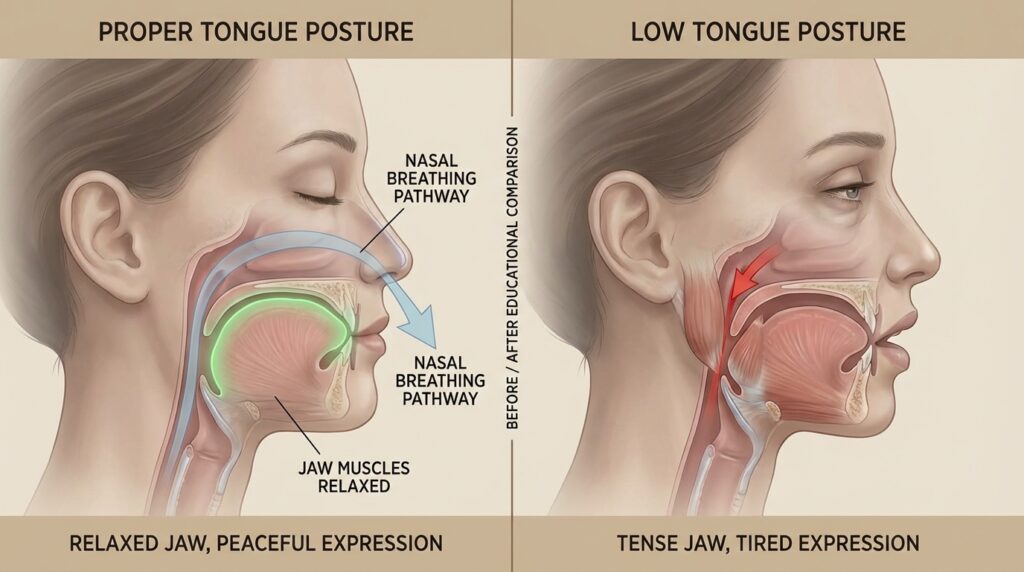
Have you heard that tongue posture reshapes face structure? While social media is full of dramatic before-and-after claims, the truth about tongue posture and face shape is more nuanced—especially for women over 40. Understanding how tongue posture reshapes face development can help you set realistic expectations and focus on the real health benefits that matter most.
Quick Answer: Can Tongue Posture Actually Change Your Face?
For adults with fully developed bones, tongue posture is unlikely to dramatically reshape your face. However, proper tongue posture offers genuine benefits: improved breathing, reduced TMJ pain, better sleep quality, and support for facial muscle tone. The real value isn’t in chasing aesthetic changes—it’s in the health improvements that come from correct oral posture.
Why Everyone’s Talking About How Tongue Posture Reshapes Face Structure
The internet is buzzing with claims about “mewing” and tongue posture transformations. Some sources promise dramatic jawline definition, while medical authorities dismiss it entirely. Where’s the truth? Somewhere in the middle, especially for women over 40.
Here’s what’s actually happening. The controversy exists because different groups are talking about different things. Orthodontists focus on bone structure (which is mostly set after puberty). Meanwhile, people practicing proper tongue posture report improvements in breathing, reduced neck tension, and better sleep. Both can be true simultaneously.
For women over 40, this matters because aging brings unique facial changes related to hormones, bone density, and soft tissue. Understanding what tongue posture can and can’t do helps you make informed decisions about your wellness routine.
What Is Proper Tongue Posture? (The Basics Everyone Agrees On)
Before diving into debates about face shape, let’s establish what proper tongue posture actually means. This is something both skeptics and supporters agree on.
Your tongue should rest gently against the roof of your mouth (the palate), with the tip positioned just behind your upper front teeth. The entire tongue—not just the tip—makes light contact with the palate. Your lips remain closed, and you breathe through your nose.
Think of it as the tongue’s natural resting position. When your mouth is closed and you’re not eating or speaking, this is where your tongue belongs. It’s not about applying force or pressure. The contact should feel effortless and natural.
Most people don’t realize their tongue position matters. However, research published in Cureus confirms that “the tongue supports the upper dental arch and encourages healthy dental arch development when it rests against the roof of the mouth.”
The Science: Can Tongue Posture Actually Reshape Your Face?
Let’s address the main question directly. The scientific evidence on whether tongue posture reshapes face structure is mixed, and it depends heavily on age.
For children and teenagers, the research is more positive. A controlled study in the European Journal of Orthodontics found significant associations between tongue posture and facial morphology in growing individuals. When bones are still developing, tongue position can influence growth patterns.
For adults over 40? The situation is different. Your facial bones have completed their growth and fused together. While small changes in soft tissue positioning and muscle tone are possible, dramatic bone remodeling is unlikely without surgical intervention.
Nevertheless, this doesn’t mean proper tongue posture lacks value for adults. The benefits simply aren’t primarily about face shape—they’re about breathing, sleep, and oral health. Research on tongue posture and skeletal patterns shows that even in adults, correct tongue positioning supports better oral function.
What Does “Mewing” Mean?
Mewing is the popular term for practicing proper tongue posture, named after Dr. Mike Mew who promoted the technique. While the name is trendy, the concept of proper tongue posture has been recognized in orthodontics for decades. The social media version often overpromises results, but the underlying principle—that tongue position matters for oral health—is sound.
The Real Benefits for Women Over 40 (Beyond Face Shape)
Forget the before-and-after photos for a moment. The actual benefits of proper tongue posture are more valuable than aesthetic changes, especially for women over 40.
First, breathing improves significantly. When your tongue rests against your palate, it naturally encourages nasal breathing. Research from the American Physiological Society found that nasal breathing lowers blood pressure and shifts the nervous system into a more relaxed state. For women experiencing perimenopause or menopause, this cardiovascular benefit matters tremendously.
Second, TMJ pain often decreases. Many women over 40 develop jaw tension and temporomandibular joint issues. Proper tongue posture helps align the jaw naturally, reducing strain on the joint. Additionally, nasal breathing eliminates the mouth tension that comes from chronic mouth breathing.
Third, sleep quality improves. Better sleep architecture supports weight management, cognitive function, and emotional wellbeing. When your tongue maintains proper position during sleep, your airway stays more open, reducing the risk of snoring and sleep disruption.
Moreover, neck and shoulder tension often improves. The tongue connects anatomically to the hyoid bone and neck muscles. When tongue posture improves, the entire upper body posture can improve—similar to how fixing text neck requires awareness of head position.
How to Practice Proper Tongue Posture (Step-by-Step)
Learning proper tongue posture takes practice, but it’s simpler than you might think. Here’s how to find the correct position.
Start by making an “N” sound. Notice where your tongue tip goes? That spot just behind your upper front teeth is your starting point. Now, keeping the tip there, try to flatten the rest of your tongue against the roof of your mouth.
Alternatively, try this method: Say “sing” and hold the “ng” sound at the end. Feel where your tongue naturally rises? That’s the back of your tongue making contact with the soft palate. This is part of correct tongue posture.
Your entire tongue should rest gently against the palate. The key word is “gently”—you’re not pushing or applying force. Think of it like letting your tongue relax into its natural resting spot. Your lips close naturally, and you breathe through your nose.
Common mistakes to avoid include pushing the tongue forcefully, only lifting the tip, keeping the mouth open, or continuing to breathe through your mouth. The contact should feel effortless, like a muscle memory you’re developing over time.
Practice this position throughout the day. Set reminders on your phone at first. Check your tongue position when you’re sitting at your desk, driving, or watching TV. Eventually, it becomes automatic.
Tongue Posture and Face Shape: What to Realistically Expect
Let’s be honest about what tongue posture can and can’t do for your face shape as a woman over 40.
What you probably won’t see: a dramatically different jawline, a completely reshaped face, or elimination of facial asymmetry. Your bone structure is established. Genetics, aging, and hormones play much larger roles in facial changes after 40 than tongue position.
What you might notice: subtle changes in soft tissue positioning, reduced puffiness from better lymphatic drainage, improved facial muscle tone, and a more relaxed jaw appearance. Some women report their face looks less “tired” because the jaw isn’t constantly clenched from mouth breathing.
The timeline matters too. If any changes occur, they develop over months or years, not weeks. This isn’t a quick fix. Think of it like practicing squats for longevity—the benefits accumulate slowly and steadily.
Individual variation is significant. Some women notice more changes than others, depending on starting tongue position, breathing patterns, and bone structure. Research on tongue morphology confirms that the relationship between tongue posture and facial dimensions varies considerably between individuals.
Why Women Over 40 See Different Results
Age, hormones, and bone density all affect how your body responds to changes in tongue posture.
First, bone remodeling slows after menopause. Estrogen decline affects bone density and the ability of bones to adapt to new pressures. While children’s facial bones can respond to tongue position changes, adult bones—especially post-menopausal bones—are far less plastic.
Second, soft tissue changes with age. Collagen production decreases, skin loses elasticity, and fat distribution shifts. These factors have a much bigger impact on facial appearance than tongue position. However, improved muscle tone from proper posture can provide some support.
Third, breathing patterns often worsen with age. Many women develop sleep-disordered breathing during perimenopause. Proper tongue posture that supports nasal breathing becomes even more valuable for preventing brain fog and maintaining cognitive function.
The good news? The benefits that matter most—breathing, sleep, and jaw comfort—are available regardless of age. You don’t need young bones to breathe better or reduce TMJ pain.
Better Sleep and Breathing Benefits (The Most Important)
This is where tongue posture truly shines for women over 40. The breathing and sleep improvements are measurable and meaningful.
When your tongue rests against your palate, it naturally widens the airway. Research published in the European Respiratory Journal found that upper airway resistance during sleep is significantly lower with nasal breathing compared to mouth breathing. This matters enormously for sleep quality.
Nasal breathing also improves oxygen delivery. Studies on nasal versus oral breathing show that nasal breathing enhances brain function and supports the nervous system’s relaxation response. For women juggling multiple responsibilities, better oxygen delivery supports brain health and mental clarity.
Furthermore, proper tongue posture during sleep reduces snoring. Many women develop snoring during perimenopause due to changes in airway muscle tone. Maintaining tongue position helps keep the airway open, reducing both snoring and apnea risk.
According to Cleveland Clinic, nasal breathing filters air, maintains oral moisture, and prevents the dry mouth that contributes to dental problems. These everyday benefits accumulate over time, supporting overall wellness.
Can I Practice Tongue Posture While Sleeping?
Your tongue naturally maintains better posture during sleep when you practice it consistently during the day. Some people use mouth tape (after consulting a healthcare provider) to encourage nasal breathing overnight. However, building the daytime habit is the most important step. Your muscles will gradually maintain the position more naturally, even during sleep.
Common Mistakes and Safety Concerns (What to Avoid)
While proper tongue posture is generally safe, several mistakes can cause problems.
Don’t force the position. Pushing your tongue aggressively against your palate can cause headaches, jaw pain, or tooth sensitivity. The contact should feel gentle and natural. If it hurts, you’re doing it wrong.
Similarly, don’t obsess over perfection. Some people become so focused on tongue position that they create anxiety around it. Practice mindfully, but don’t let it dominate your thoughts. It’s a wellness practice, not a stress source.
Watch for TMJ warning signs. If you develop increased jaw pain, clicking, or difficulty opening your mouth, pause the practice and consult a dentist or TMJ specialist. Proper tongue posture should reduce TMJ symptoms, not worsen them.
Additionally, don’t expect it to replace necessary medical care. If you have severe sleep apnea, significant malocclusion, or chronic breathing problems, proper tongue posture can complement professional treatment but shouldn’t replace it. Always work with healthcare providers for serious conditions.
Remember that individual anatomy varies. Some people have tongue ties (ankyloglossia) or structural variations that make certain tongue positions difficult or impossible. Listen to your body and work within your own anatomy.
Should You Try It? A Practical Decision Framework
So, should you practice proper tongue posture? Here’s how to decide if it’s worth your time.
You’re a good candidate if you breathe through your mouth frequently, experience jaw tension or TMJ pain, snore or have poor sleep quality, want to improve breathing naturally, or are interested in free healthy aging strategies.
Set realistic expectations before starting. Don’t expect dramatic facial transformation, overnight results, or a cure for serious medical conditions. Instead, look for gradual improvements in breathing, sleep quality, jaw comfort, and overall oral health over several months.
Track your progress by noting how you feel. Are you sleeping better? Has jaw tension decreased? Are you breathing through your nose more consistently? These subjective improvements matter more than trying to measure subtle facial changes.
Combine tongue posture with other wellness practices like intuitive eating, regular movement, and stress management. Tongue posture is one piece of a comprehensive approach to health—not a magic solution.
How Long Does It Take to See Results?
Breathing improvements often appear within days or weeks. Sleep quality may improve within a month. Subtle changes in jaw comfort typically develop over 2-3 months. Any soft tissue changes to facial appearance would take 6-12 months or longer. The key is consistency—practicing proper tongue posture throughout the day, every day.
Is This the Same as “Mewing”?
Yes, essentially. “Mewing” is the social media term for proper tongue posture. The technique itself has been recognized in orthodontics for decades. However, the social media version often overpromises aesthetic results. Focus on the proven benefits—breathing, sleep, and jaw health—rather than dramatic facial transformation.
Can Tongue Posture Help with Weight Loss?
Indirectly, perhaps. Better sleep from improved breathing supports healthy metabolism and hormone balance, both important for weight management in women over 40. However, tongue posture isn’t a weight loss strategy. If you’re interested in weight loss, check out our evidence-based guide on weight loss for women over 40.
Will This Help My Double Chin?
Proper tongue posture may provide slight improvement in jawline definition by supporting better muscle tone, but it won’t eliminate a double chin caused by excess fat or loose skin. For those concerns, consider overall body composition changes through nutrition and movement rather than focusing solely on tongue position.
Should I See a Professional?
If you have significant jaw pain, bite problems, or sleep-disordered breathing, consult a dentist, orthodontist, or sleep specialist. They can evaluate your specific situation and determine if myofunctional therapy or other interventions would be helpful. Proper tongue posture can complement professional treatment but shouldn’t replace it when needed.
The Bottom Line: Tongue Posture for Women Over 40
Can tongue posture reshape your face? For women over 40 with fully developed bones, dramatic facial transformation is unlikely. The research simply doesn’t support the before-and-after claims you see on social media.
However, dismissing tongue posture entirely would be a mistake. The real benefits—improved breathing, better sleep, reduced TMJ pain, and enhanced nasal function—are valuable for women navigating the physical changes of midlife and beyond.
Think of proper tongue posture as one element of a comprehensive wellness approach. It costs nothing, has minimal risks when practiced correctly, and offers genuine health benefits. You won’t wake up with a completely different face, but you might wake up breathing better and feeling more rested.
The choice is yours. If you decide to try it, set realistic expectations, practice consistently, and focus on how you feel rather than how you look. Your tongue’s resting position might not reshape your face, but it can certainly support your overall wellbeing.