

Vitamin C Glutathione: The Antioxidant Tag Team for Recovery
Key Takeaways
- The vitamin C glutathione pairing is real science. Vitamin C helps recycle glutathione back to its active form.
- In a classic trial, 500 mg of vitamin C daily raised red blood cell glutathione nearly 50%. A 2,000 mg dose added nothing.
- The combined supplement “stack” is promising, not proven. Only two small human studies have tested it for exercise.
- Food comes first: citrus, bell peppers, and kiwi for vitamin C. Broccoli, garlic, eggs, and poultry support glutathione.
- Mega-dosing antioxidants near hard training can slow the gains that make workouts count.
You crushed that workout. Now comes the part that builds fitness: recovery. Lately, one pairing keeps showing up in wellness circles: vitamin C glutathione. The pitch is simple. These two antioxidants work as a team.
Here’s what I find interesting. The science behind this pairing is stronger than most supplement trends. But the dosing story gets complicated fast. More isn’t always better. Sometimes it can work against you.
This article breaks down what we know about vitamin C and glutathione for workout recovery. You’ll learn how the pair works, what the research says, and when supplements make sense.
Quick Answer: Do vitamin C and glutathione work better together for recovery?
The science says yes — the vitamin C glutathione pair shares a recycling system, and each restores the other’s active form. But the proof for taking them as pills is thin. Only two small human studies have tested the combo for exercise. So treat this pairing as a food strategy first, and a supplement trend second.
Why vitamin C glutathione teamwork beats “more is better”
Here’s the thing. Most of us grew up thinking antioxidants are a numbers game — take more, get more protection. But the research points elsewhere. It’s about teamwork and timing, not volume.
Consider a classic 1993 trial from the American Journal of Clinical Nutrition. Healthy adults with low vitamin C intake took 500 mg daily.
Their red blood cell glutathione jumped nearly 50%. Then the dose climbed to 2,000 mg. It added nothing further. The extra vitamin C did no extra work.
That’s the teamwork idea in action. It also shows how vitamin C glutathione work as a pair. Once vitamin C feeds the glutathione system enough, more does no useful work. The NIH Office of Dietary Supplements explains why. The body tightly controls vitamin C levels. Higher doses simply absorb less well.
How vitamin C glutathione share one recycling system
Picture glutathione as a rechargeable battery. In its active form — called GSH — it blocks free radicals. Those are the troublemaker molecules your muscles make during hard exercise. After doing its job, glutathione turns into a used-up form called GSSG. Think of a drained battery.
Here’s where vitamin C steps in. It helps turn that spent glutathione back into its working form. Glutathione returns the favor. It restores vitamin C after it blocks free radicals. The two keep recycling each other in a loop.
A 2023 review in Physical Activity and Nutrition describes the pair as relying on each other. They work in the watery parts of cells, called the cytoplasm and mitochondria. When vitamin C glutathione operate as a team, your antioxidant defenses stay online longer. That matters most during hard training blocks.
What the research really shows about vitamin C and recovery
Vitamin C gets the most study attention of the pair. A 2020 meta-analysis in the European Journal of Nutrition pooled 18 randomized trials with 313 people.
The result: vitamin C cut markers of oxidative stress. That means less damage to fats in your cells. The effect showed up right after exercise. It lasted up to two hours. It also lowered IL-6, a key inflammation signal.
Here’s the honest part. Vitamin C did NOT reduce muscle soreness. It didn’t lower creatine kinase, a blood marker of muscle damage, either. And it didn’t change how fast strength came back.
In plain terms, vitamin C quiets the molecular storm after hard workouts. It won’t erase next-day soreness. That difference keeps your hopes honest. It also keeps your supplement spending smart.
Most of this research tested vitamin C on its own. The vitamin C glutathione combination is far less studied. That’s a key reason experts call the stack promising but unproven.
One bonus for active people: the NIH notes that regular vitamin C may lower cold risk. The dose that helps is 200 mg or more a day. The benefit shows up mostly in those who train hard.
The catch: when more antioxidants can backfire
Now, you might be thinking: if some helps, wouldn’t a lot help more? That’s exactly what researchers tested. The answer surprised many people.
A 2025 study in The Journal of Physiology tested this idea. Healthy young men took 1 gram of vitamin C plus vitamin E daily. They did three weeks of sprint interval training. The antioxidants slowed the muscle changes that normally make training work. Fast-twitch fibers — the ones behind power and speed — took the biggest hit.
A 2023 review in Current Sports Medicine Reports landed in the same place. Of 14 trials, only three showed vitamin C reduced muscle-damage markers. The other 11 were neutral or negative. The authors’ advice: get antioxidants from food, not high-dose pills.
A 2020 Sports Medicine review reached a similar conclusion. High-dose antioxidants can slow endurance-training gains, even when results don’t drop.
The combined stack: promising but unproven
Even the combined vitamin C glutathione stack is “promising, not proven.” The 2023 review found only two human studies testing the combo for exercise. One involved five athletes with no control group. The other was a small pilot with 12 triathletes. Both hint at benefits. Neither settles the question.
One more caution. A 2001 study in Free Radical Biology & Medicine tested high-dose vitamin C plus NAC. NAC is a building block your body uses to make glutathione. After muscle-damaging exercise, cell-damage markers went up, not down. Dose and timing matter, especially around hard sessions.
The “full tank” rule: when antioxidants actually help
Does this mean antioxidants are bad for active women? No. Context changes everything. In a 2025 trial, older women with low muscle mass took vitamins C and E alongside resistance training. They gained more muscle and strength than the training-only group. Why? They started with a tank that needed filling.
The lesson? Match the dose to the need. Full tank, skip the pills. Low tank, food first. When in doubt, ask your doctor.
How to get both from food (and when supplements make sense)
Let’s be honest. Food is the smartest way to support this tag team. Your body makes glutathione on its own. But it needs three amino acids to do it: cysteine, glutamate, and glycine. These are the protein building blocks. Cysteine is the one most likely to run short. It comes from sulfur-rich proteins.
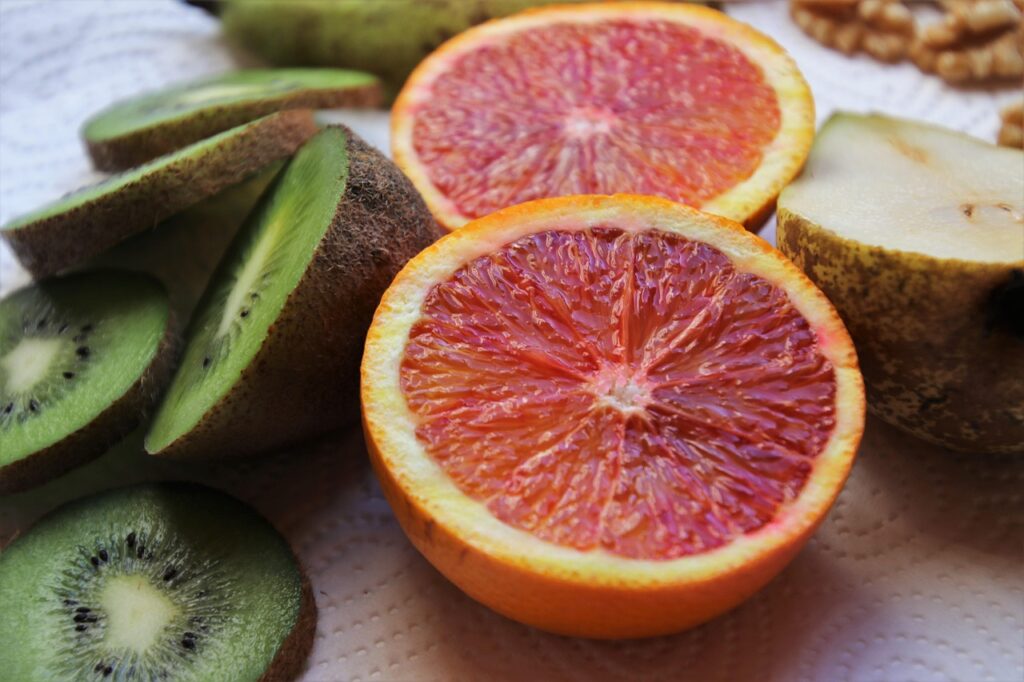
For vitamin C, load up on red and green bell peppers, citrus fruits, kiwi, strawberries, and broccoli. The NIH lists these as the best sources. Most women need about 75 mg daily. Men need 90 mg. Add 35 mg if you smoke. Red bell peppers, citrus, and kiwi make that easy.
For glutathione support, think sulfur. Broccoli, Brussels sprouts, kale, and cauliflower all help. So do garlic, onions, asparagus, and avocado. Quality protein matters too. Poultry, eggs, and fish supply cysteine directly. Plant-based eaters can find cysteine in oats, beans, seeds, and those same veggies.
Selenium deserves a mention. It helps glutathione do its work. Brazil nuts and seafood are excellent sources. A small handful of Brazil nuts a few times a week is plenty.
A recovery day that feeds the tag team
Here’s what a smart recovery day could look like:
- Breakfast: kiwi-strawberry smoothie with Greek yogurt. Whey protein is rich in cysteine.
- Lunch: broccoli slaw with orange segments and grilled chicken. Add a citrus vinaigrette.
- Dinner: salmon with roasted Brussels sprouts and red bell pepper.
Who should consider supplements? Heavy training blocks, restricted diets, smoking, and digestive issues all raise the need. However, if you eat a varied diet with plenty of produce and protein, every meal can support vitamin C glutathione teamwork. Your tag team is probably fine.
Supplements: what works, what doesn’t, and what to skip
Glutathione pills are tricky. Standard capsules have a real problem. Much of the dose breaks down in the gut before reaching your cells. As a result, several studies found no rise in blood glutathione with ordinary pills.
Liposomal glutathione is the exception. Think of it as a protective bubble that helps your body absorb the dose. In a 2018 study, healthy adults took 500–1,000 mg daily. Whole-blood glutathione rose up to 40% within two weeks. Immune-cell glutathione doubled. If you pick a pill, liposomal forms have the best proof.
NAC — short for N-acetylcysteine — is another route. It’s a building block your body uses to make glutathione. Some research suggests it raises levels more reliably than standard pills. Start low. High doses can upset the stomach.
No study has proven a perfect time of day for the pair. Consistency matters more than clock time.
Dosing guardrails
If you decide to try a vitamin C glutathione supplement, keep these limits in mind. For vitamin C, 200 mg to 1 gram a day is the range that lowers cell damage from hard exercise. The glutathione-support benefit tops out around 500 mg. Stay below the 2,000 mg upper limit. Higher doses cause diarrhea and cramps. For glutathione, study doses usually run 250–1,000 mg a day. No official daily intake exists.
What to skip
What about IV glutathione for general wellness? Skip it. There are real safety risks and unproven benefits. Likewise, skip mega-dose antioxidant formulas taken right around training. And skip any brand without third-party testing.
One more safety note. If you’re pregnant, nursing, or on medicine, talk to your doctor before adding supplements. High-dose vitamin C may interact with chemotherapy, radiation, and statins. Anyone with a history of kidney stones should keep doses moderate.
Promising vs. Proven
Proven: Vitamin C helps recycle glutathione in the body. Proven: Vitamin C lowers cell-damage markers after a single workout. Promising: The combined vitamin C + glutathione stack for better performance — only two small studies so far. Proven caution: Mega-dosing around training can slow your gains.
Frequently Asked Questions About Vitamin C and Glutathione
How do I know if my levels are low?
Fatigue, brain fog, and frequent infections can point to low antioxidant status. But routine testing isn’t standard. Those symptoms overlap with many other issues. A better move: eat the supporting foods daily. Talk to your doctor if you’re worried.
Can I get the recycling benefit from food alone?
Yes — for the daily recycling cycle. The cycle runs on vitamin C from food, plus protein and sulfur-rich veggies. Your body builds glutathione from food every single day. If you’re already well-nourished, the extra boost from pills is unproven. Food is the safest first step.
When should I take vitamin C around my workout?
If you take a pill, keep it moderate — 200 to 500 mg. Taking it with food is easier on your stomach. Avoid mega-dosing right before or after hard sessions. The gains from training matter more than any supplement.
I’m vegetarian. Can I still support glutathione?
Absolutely. Plant sources of cysteine include broccoli, Brussels sprouts, kale, garlic, onions, oats, beans, and seeds. Pair them with vitamin C–rich produce and Brazil nuts for selenium.
The Bottom Line: Feed the Tag Team, Skip the Mega-Dose
Here’s what I want you to remember. Vitamin C glutathione teamwork is real. The science is solid. It’s a great example of how nutrients work together. But “work together” doesn’t mean “more is better.”
Feed the tag team through food first. Colorful produce gives you vitamin C. Sulfur-rich vegetables and quality protein support glutathione. If you take supplements, keep vitamin C moderate — around 500 mg. Choose liposomal glutathione or NAC if you go that route.
And give your body time to adapt after hard sessions. That’s where fitness is actually built. Your workouts earn the progress. Smart food choices just make sure your body can use it.