
Osteoporosis Lifestyle Changes That Make Your Medication Work Better
Key Takeaways
- Your medication works better when you pair it with the right lifestyle habits — especially adequate protein
- Protein is the overlooked factor. New research shows low protein intake directly blunts how well your prescription works
- Weight-bearing exercise and strength training are non-negotiable for building and keeping bone density
- Fall prevention multiplies the benefits of everything else — balance training plus home safety checks
- Most women may be able to meet calcium needs through diet. In one study, 71% met their target of 1,200 mg from food and/or supplements — so routine calcium supplements may not be needed if your diet is adequate
You picked up your prescription, took your first dose, and felt relieved. You’re doing something about your bone health. But here’s the thing — medication alone is only half the equation. The other half depends on your osteoporosis lifestyle changes, the daily choices that determine how well that prescription actually works. New research suggests most women are missing one critical piece. And it’s not what you might expect.
Let’s look at what the science actually says about making your medication work harder — without adding another pill to your routine.
Quick Answer: What Else Should I Be Doing Besides Taking My Osteoporosis Medication?
Three things. First, get enough protein — aim for 1.0 to 1.2 grams per kilogram of your body weight every day. Second, do weight-bearing exercise and strength training on most days. Third, take fall prevention seriously. That means balance exercises like tai chi or standing on one foot, plus simple home safety upgrades like grab bars and better lighting. Together, these osteoporosis lifestyle changes can dramatically improve how well your medication works.
Why Osteoporosis Lifestyle Changes Matter More Than You Think
Here’s what’s actually happening inside your body. Most osteoporosis medications — bisphosphonates, denosumab, raloxifene — work by slowing down the cells that break bone down. They do not build new bone. They buy you time. But they can’t make your bones stronger on their own.
That’s where your osteoporosis lifestyle changes come in. Weight-bearing exercise signals your body to build bone. Protein provides the raw material for that bone-building process. And fall prevention keeps you from undoing all that progress with a single misstep. The National Institute on Aging confirms that lifestyle changes and medication work together — neither is enough alone when significant bone density has been lost.
Think of it this way: your medication is the brake. Your lifestyle is the engine. You need both to actually move forward. Muscular strength in women predicts longevity — and building that strength is one of the most powerful osteoporosis lifestyle changes you can make. The key osteoporosis lifestyle changes — protein, exercise, and fall safety — turn that engine on.
The Protein Factor: The Missing Piece in Most Treatment Plans
Here’s where things get interesting. A 2026 study in Osteoporosis International followed 586 older women from the Geneva Retirees Cohort over three and a half years. The researchers tracked women taking antiresorptive medications — drugs like bisphosphonates and denosumab — and measured how well their bone density and strength responded.
The results were striking. Women who ate less than the minimum recommended amount of protein — about 0.8 grams per kilogram of body weight per day — saw significantly weaker results from their medication. Their hip strength declined at 2.6% per year. Compare that to women who ate enough protein: their hip strength declined at just 0.5% per year. That’s a five-fold difference.
Even more telling, the inner part of the hip bone — the porous layer most vulnerable to fracture — told the same story. Women with low protein lost it at 2.8% per year. Women meeting the protein threshold lost just 0.3%. The message is clear: your medication can only do its job if you give your body the protein it needs. This is one of the most impactful osteoporosis lifestyle changes you can make.
How Much Protein Do You Actually Need?
The general recommendation for adults is 0.8 grams per kilogram of body weight. But for women on osteoporosis medication, experts suggest aiming higher — around 1.0 to 1.2 grams per kilogram. Here’s what that looks like in real food:
For a 140-pound woman (64 kg): 64 to 77 grams of protein per day
For a 160-pound woman (73 kg): 73 to 88 grams of protein per day
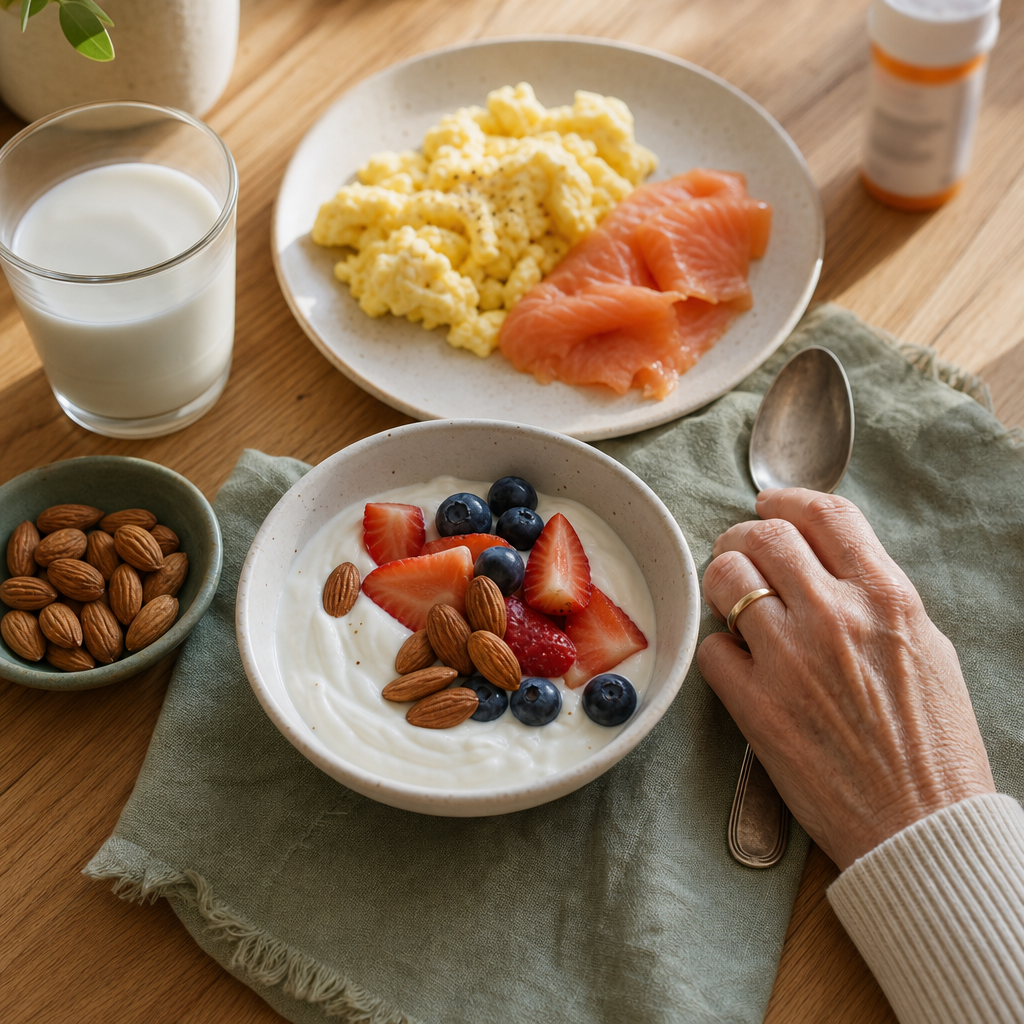
To put that in perspective: one large egg has 6 grams. Three ounces of chicken has about 26 grams. A cup of Greek yogurt has around 20 grams. A 2019 systematic review of over a dozen studies found that higher protein intake was linked to higher bone density and an 11% lower risk of hip fracture.
Exercise: The Non-Negotiable Partner to Your Prescription
Your medication slows bone breakdown. Exercise tells your body to build bone back up. You need both signals working together along with your other osteoporosis lifestyle changes.
The 2023 exercise guidelines from the Journal of Bone Metabolism analyzed 50 studies and found that resistance training plus impact exercise is the most effective combination for improving bone strength. The specifics: resistance training at moderate to high intensity, two to three days per week, plus impact exercises like brisk walking at least three days per week.
But here’s the important caveat — exercise needs to match your fracture risk. Not all exercise is safe for all stages of osteoporosis. Here’s a simple way to think about it based on your T-score:
Exercise by T-Score: What’s Safe at Every Stage
T-score above -2.0 (osteopenia or mild bone loss): Brisk walking, jogging, dancing, hiking, stair climbing, light jumping. Add resistance bands or light weights two to three days per week.
T-score between -2.0 and -2.5 (moderate bone loss): Stick with low-impact weight-bearing activities — brisk walking, elliptical, stair machine. Strength training with moderate weights. Avoid high-impact jumping or running.
T-score below -2.5 (osteoporosis): Focus on safe, supervised exercise. Work with a physical therapist. Walking, gentle resistance training, balance exercises. Avoid forward-bending of the spine (yoga poses like forward fold or toe touches can increase fracture risk).
No matter your T-score, balance training is essential for everyone. A 2021 systematic review in JAMA Network Open found that exercise to improve balance and strength is strongly recommended for fall prevention. Adding resistance training helps reduce falls even more.
The Calcium Question: Supplement or Skip?
You’ve probably heard for years that calcium supplements are essential with osteoporosis medication. The Geneva study challenges that assumption. Here’s the nuance: in the study, 71% of women met their daily calcium target of 1,200 mg through diet and/or supplements. Since 51% used supplements, we can’t say exactly how many hit the target through food alone. But the key finding is that among women already getting enough calcium from food, adding a supplement made no difference to their bone outcomes.
However, women with very low calcium intake — under 800 milligrams per day — who did NOT take a supplement saw no measurable benefit from their medication at all. So calcium matters. But the source matters too.
A 2022 review in the European Journal of Endocrinology confirms that getting calcium from food is preferable. Good food sources include dairy products, canned salmon with bones, sardines, almonds, dark leafy greens like kale and collards, and fortified plant milks. The Mayo Clinic recommends 1,200 milligrams of calcium per day for women over 50 — primarily from food, with supplements reserved for those who can’t meet that target through diet alone.
Fall Prevention: The Multiplier Effect
Here’s a tough truth: even the best medication and perfect nutrition won’t protect you if you fall. Fractures happen at the point of impact. Fall prevention isn’t optional — it’s the strategy that multiplies the value of everything else you’re doing. Adding fall prevention to your osteoporosis lifestyle changes is one of the smartest moves you can make.
A 2021 systematic review in JAMA Network Open analyzed 15 clinical practice guidelines on fall prevention. The strongest recommendations across all guidelines included: exercise to improve balance and strength, home safety modifications, medication review, and vision correction.
Your Weekend Fall-Proofing Checklist
✅ Secure loose rugs and remove tripping hazards like clutter and cords
✅ Install grab bars in the shower and beside the toilet
✅ Add night lights in hallways, bathrooms, and stairwells
✅ Put handrails on both sides of every staircase
✅ Improve outdoor lighting at entryways
✅ Keep a flashlight by your bed
✅ Wear non-slip shoes or slippers with grip
✅ Review your medications with your doctor — some can cause dizziness or low blood pressure
Also add balance exercises to your routine: tai chi, standing on one foot while brushing your teeth, walking heel-to-toe, or a gentle yoga class that avoids forward bends.
Frequently Asked Questions
Can I stop taking my medication if I make these lifestyle changes?
No. Osteoporosis lifestyle changes support your medication — they do not replace it. If your T-score is below -2.5, you need medical treatment. Think of these changes as the way to make your prescription work better, not as a substitute.
How do I know if I’m getting enough calcium from food?
Start by tracking what you eat for a few days. If you regularly eat dairy, leafy greens, canned fish with bones, or fortified foods, you’re likely meeting your needs. If your diet is low in these foods, talk to your doctor about whether a supplement (500-600 mg) makes sense for you.
What if I can’t eat dairy for protein?
Plenty of non-dairy options work well. Eggs, poultry, fish, legumes, lentils, tofu, nuts, and seeds all provide high-quality protein. If you struggle to meet your protein target through food alone, a plain protein powder (without added sugars or fillers) can help fill the gap.
The Bottom Line
Your prescription is an important part of protecting your bones, but it’s not the whole story. The research is clear: the women who get the best results from their osteoporosis medication are the ones who pair it with the right osteoporosis lifestyle changes. Adequate protein, weight-bearing exercise, strength training, smart calcium management, and fall prevention — these are not optional extras. They are essential partners to your treatment.
Start with one change this week. Maybe it’s adding a serving of protein to breakfast. Maybe it’s a 20-minute walk. Maybe it’s installing that grab bar you’ve been putting off. Small steps add up. And when you combine them with your medication, you’re giving yourself the best possible chance of keeping your bones strong for years to come.