

Kidney Stone Diet: What to Eat to Lower Your Risk
Key Takeaways
- Getting enough calcium from food lowers stone risk. Cutting dairy can raise it.
- The right kidney stone diet is rich in calcium, potassium, and fluids \u2014 not a list of forbidden foods.
- Drink 2.5\u20133 liters of fluid daily. Aim for pale yellow urine.
- Keep sodium under 2,300 mg a day. Most of it hides in packaged foods.
- Pair high-oxalate foods like spinach with calcium instead of avoiding them.
- See a doctor for severe side or back pain, fever, blood in urine, or vomiting that won’t stop.
Picture this: You or someone you love just passed a kidney stone. The memory of that pain changes how you see your plate. So you cut out milk, cheese, and yogurt \u2014 because calcium is in the name of the most common stone. Here’s the thing: that instinct is backwards. The kidney stone diet most people adopt may actually raise the risk of another stone.
It sounds wrong, but the science is clear. Cutting calcium is one of the biggest kidney stone mistakes you can make. In fact, Harvard-led research found that five factors drive over half of all kidney stones. They are low fluid intake, low dietary calcium, a poor eating pattern, excess weight, and sugary drinks. That’s good news. Every single one is something you can change.
Below, we break down what experts actually recommend. You’ll learn the daily targets that matter, the foods to add, and one thing to stop avoiding. Then you’ll get a full sample day. These pillars work for most people, no matter the stone type.
Quick Answer: What is the best kidney stone diet?
A kidney stone diet is a DASH-style way of eating. That means plenty of fruits and vegetables, calcium-rich foods, legumes, and whole grains. Moderate animal protein \u2014 read our deep dive on the low-protein diet for longevity \u2014 with very little added salt or sugar, rounds it out. It’s not about cutting calcium. It’s about keeping calcium in your meals so oxalate can’t build up in your urine.
The kidney stone diet most people get backwards
Let’s start with the biggest myth. Mayo Clinic urologists call the idea that milk causes stones a common misconception. In fact, skipping milk can raise your risk instead of lowering it. Here’s what’s actually happening. Calcium from food binds to oxalate in your gut. That keeps oxalate out of your kidneys, where crystals form.
Now, you might be thinking, “But calcium is right there in the stone.” True. However, that calcium mostly comes from your urine, not your food. When you eat too little calcium, your gut absorbs more oxalate. As a result, the extra oxalate ends up in your urine with nothing to bind it. That’s how stones get a foothold.
The NIDDK says it plainly: even though calcium sounds like the cause, it is not. In the right amounts, calcium blocks stone-forming substances in the digestive tract. Aim for 1,000 to 1,200 mg of calcium per day from food. That’s about three servings of dairy or fortified alternatives.
What the science actually says
Is there one perfect kidney stone diet? No. But the pillars are the same for most stone types. And the evidence behind them is fresh. The 2026 AUA guideline, from the American Urological Association, puts dietary changes at the center of stone prevention. A 2026 systematic review in Annals of Internal Medicine reached the same conclusion after analyzing 31 studies. Its authors found that more water, normal-to-high calcium, less protein, and less sodium may each reduce the chance of recurrence.
Mayo Clinic researchers tell a similar story with a new twist. They followed 411 people after a first stone. The chance of another stone within five years is about 30 percent. Their 2022 study in Mayo Clinic Proceedings found that lower calcium and potassium intake predicted that return stone. This held true even after adjusting for fluid intake. That’s why this guide puts calcium and potassium front and center.
The same eating pattern keeps showing up: vegetables, fruit, whole grains, and low-fat dairy. That’s the DASH diet \u2014 Dietary Approaches to Stop Hypertension \u2014 and a close cousin of the Mediterranean diet. The NIDDK reports that DASH-style eating lowers kidney stone risk. It also helps with blood pressure. That matters because high blood pressure raises stone risk.
Regular movement helps, too. Recent research links 30 to 60 minutes of daily activity with fewer stones. If you carry extra weight, lose it gradually. Skip crash diets \u2014 they can raise uric acid, a waste product that forms stones.
Your kidney stone diet daily targets
A kidney stone diet sounds vague until you put numbers on it. So let’s do that. These targets give you a clear picture of the day ahead.
Daily targets at a glance
- Fluid: 2.5\u20133 liters, or about 10\u201312 cups, spread across the day.
- Sodium: under 2,300 mg. One teaspoon of salt has about 2,325 mg.
- Calcium: 1,000\u20131,200 mg from food \u2014 roughly three daily servings.
- Animal protein: one modest, palm-sized serving per meal.
- Produce: 5\u20137 servings, with extra citrus and potassium-rich picks.
Here’s the thing about fluid: it’s your first line of defense. Your kidneys use urine to flush out stone-forming minerals. When you’re dehydrated, urine gets concentrated, and crystals have a better chance to form. For example, one expert review found that every extra 200 ml of fluid \u2014 under one cup \u2014 cut stone risk by about 13 percent.
How do you know you’re drinking enough? Skip the math and check your urine color. Pale yellow, like straw, means you’re on track. Darker urine means drink more. And spread fluids evenly. Chugging a liter at night doesn’t work like steady sipping does.
Sodium deserves your attention, too. The NIDDK sets the ceiling at 2,300 mg a day. A 2026 study in the FASEB Journal found that high salt intake more than doubled the odds of calcium oxalate stones. The effect goes beyond calcium. High salt seems to trigger gut-related inflammation that helps crystals form.
Where hidden sodium hides
Most of your daily sodium arrives before you pick up the salt shaker. Canned soups, deli meats, frozen meals, sauces, and restaurant dishes are the big sources. Check ingredient lists for MSG, sodium nitrate, baking soda, and disodium phosphate. On food labels, 5% DV sodium is low. 20% DV or more is high.
Foods to add: calcium and potassium first
Most stone advice leans on what to avoid. Mayo Clinic research flips that script. For people who’ve already had a stone, getting enough calcium and potassium mattered more than fluid intake. The team suggested eating about 1,200 mg of calcium daily, along with plenty of potassium-rich produce.
Here’s where the potassium angle becomes powerful. For example, bananas, oranges, cantaloupe, honeydew, apricots, mushrooms, peas, cucumbers, and zucchini all made the Mayo list. These foods help your body hold onto citrate and pull acid out of your urine. That makes stones less likely to form.
Calcium-rich foods do double duty. Milk, plain yogurt, kefir, and cheese are obvious picks. For plant-based eaters, there’s calcium-set tofu, fortified plant milk, white beans, kale, and bok choy. Broccoli adds a smaller amount. Almonds do too, but they’re high in oxalate, so pair them with a dairy food.
Citrus deserves special billing. Lemons, limes, and oranges are rich in citrate, a natural compound that blocks stone formation. A 2021 review found these fruits raise citrate levels in urine. Orange juice looked protective in large studies, too. One caveat: grapefruit juice has mixed evidence, with some large studies linking it to higher risk. So reach for lemon water and oranges instead.
The oxalate question: pair, don’t panic
You’ve probably seen “forbidden” lists: spinach, almonds, beets, rhubarb, tea, and chocolate. Let’s be honest \u2014 giving up spinach salad and almond butter sounds miserable. It’s also outdated. Expert dietetic guidance now says dietary oxalate is a minor risk factor for most people. Oxalate is a natural compound in many plant foods. What matters more is pairing oxalate foods with calcium.
Here’s the simple rule. When calcium and oxalate meet in the gut, they bind and leave in stool instead of urine. For instance, a spinach salad with cheese is fine. A spinach smoothie with no calcium is the trickier choice. If you’ve had calcium oxalate stones, a 24-hour urine test can tell you how strict to be.
The pair, don’t panic swap table
- Spinach: keep it. Pair with yogurt, cheese, or an omelet.
- Almonds: have them with dairy. Or snack on cheese and grapes instead.
- Sweet potatoes: top with a yogurt sauce or a little cheese.
- Beets and rhubarb: enjoy in small amounts, roasted with mild cheese.
- Tea: add a splash of milk. You keep the benefits and bind the oxalate.
- Chocolate: a small square with a glass of milk is a smart swap.
A sample kidney-friendly day
Now, you might be wondering what this looks like on a real plate. Here’s a kidney stone diet sample day. It delivers roughly 1,100 to 1,200 mg of calcium, plenty of potassium, and about 2.5 liters of fluid.
Your day, meal by meal
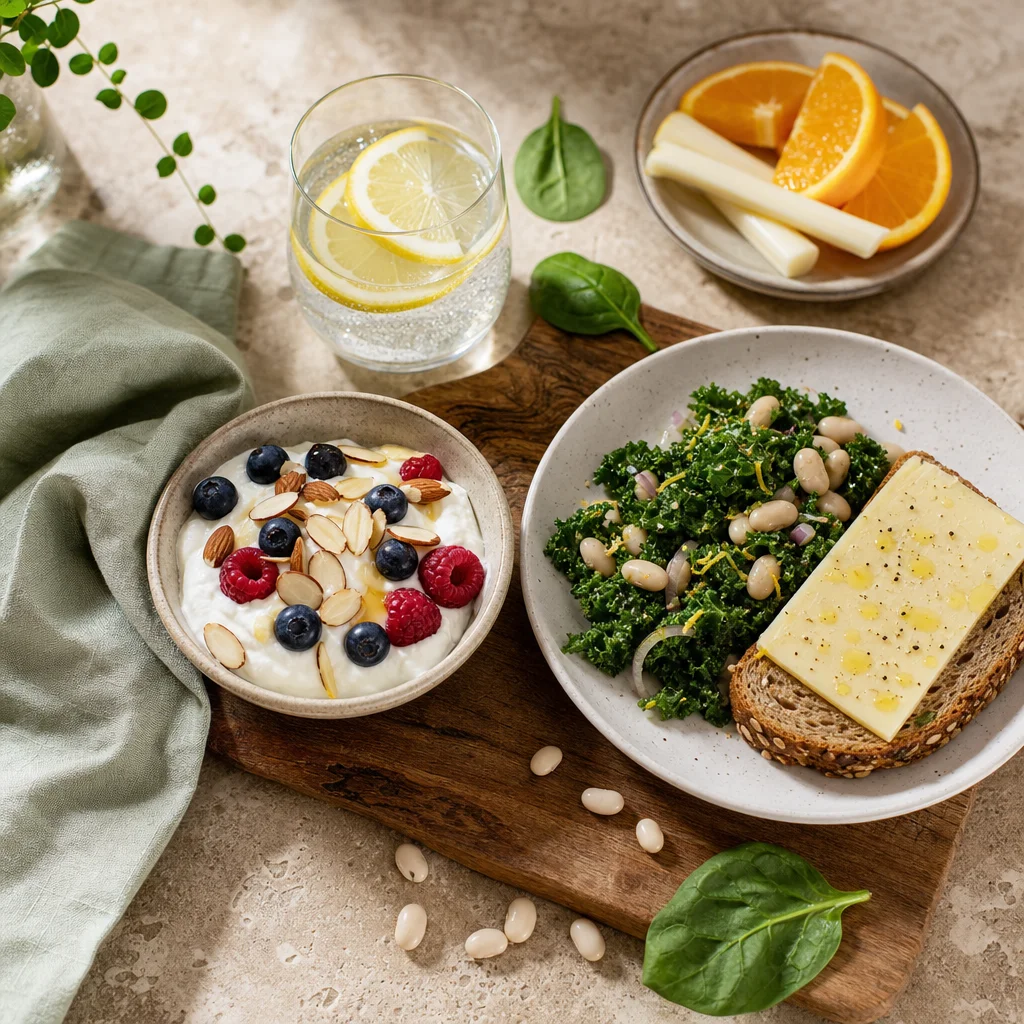
- Breakfast: Greek yogurt parfait. That’s 1 cup plain Greek yogurt, 1/2 cup berries, and 2 tbsp almonds. Serve with water and lemon.
- Lunch: Kale and white bean salad. Use 2 cups kale, 1/2 cup white beans, cucumber, and a lemon vinaigrette. Add whole-grain bread with 1 oz cheese.
- Snack: One orange and one string cheese. Swap the orange for a banana on days you want extra potassium.
- Dinner: Tofu and bok choy stir-fry. Use calcium-set tofu, bok choy, broccoli, brown rice, and lime juice. Finish with herbal tea.
- Fluid plan: 8\u201310 cups of water, lemon water, or unsweetened tea, spread from morning to night.
Plant-based or dairy-free?
You still have plenty of calcium options: calcium-set tofu, fortified plant milk, white beans, kale, bok choy, and broccoli. Shake fortified plant milk well before pouring, since calcium settles. Aim to include two or three of these foods at most meals.
When to see your doctor
Diet is powerful, but it’s not the whole story. Call your doctor or head to urgent care if you notice any of these warning signs.
Red flags that need attention now
- Sudden, severe pain in your side or lower back that won’t settle.
- Blood in your urine.
- Fever or chills \u2014 these can signal an infection.
- Nausea or vomiting that won’t stop.
- Trouble passing urine at all.
If you’ve had a stone, ask what type it was. That answer shapes your food choices. Your clinician may suggest a 24-hour urine test. It measures how your body handles calcium, oxalate, and citrate. The 2026 AUA guideline supports metabolic testing for recurrent stones. Also, talk with your doctor before taking calcium or vitamin C pills. Food calcium is protective. High-dose pills can work differently.
Some health conditions also raise stone risk. Diabetes, high blood pressure, gout, and obesity all play a role. So does a family history of stones. If any of these apply to you, a prevention plan is even more valuable.
A note on supplements
Get calcium from food first. Food calcium binds oxalate in the gut, which is exactly what you want. If you take a calcium supplement for bone health, take it with meals and ask your clinician about the dose. The same goes for vitamin C. Food sources are fine. High-dose pills, at 1,000 mg or more daily, can raise oxalate levels.
Your top questions, answered
Common kidney stone diet questions
Do I really need to give up spinach and almonds? No. Pair them with a calcium-rich food at the same meal. Blanket avoidance is outdated for most people.
How much water is enough? Roughly 2.5 to 3 liters of total fluid each day. Check for pale yellow urine to confirm you’re hydrated.
I’m dairy-free. How do I get calcium? Calcium-set tofu, fortified plant milk, white beans, kale, bok choy, and broccoli all count. Include two or three at most meals.
The Bottom Line
The kidney stone diet isn’t a punishment. It’s a return to the basics of healthy eating: water, produce, whole grains, and calcium-rich foods in sensible amounts. The biggest change for most people? Stop avoiding calcium, and start eating it on purpose.
Start with one swap today. Add a glass of milk or a cup of yogurt. Squeeze half a lemon into your water bottle. Choose lentils instead of beef once this week. Small steps, done consistently, add up to real protection for your kidneys. And if you have questions about your own risk, your doctor is the right next step.