

How Much Chamomile Tea Before Bed? Dose & Timing
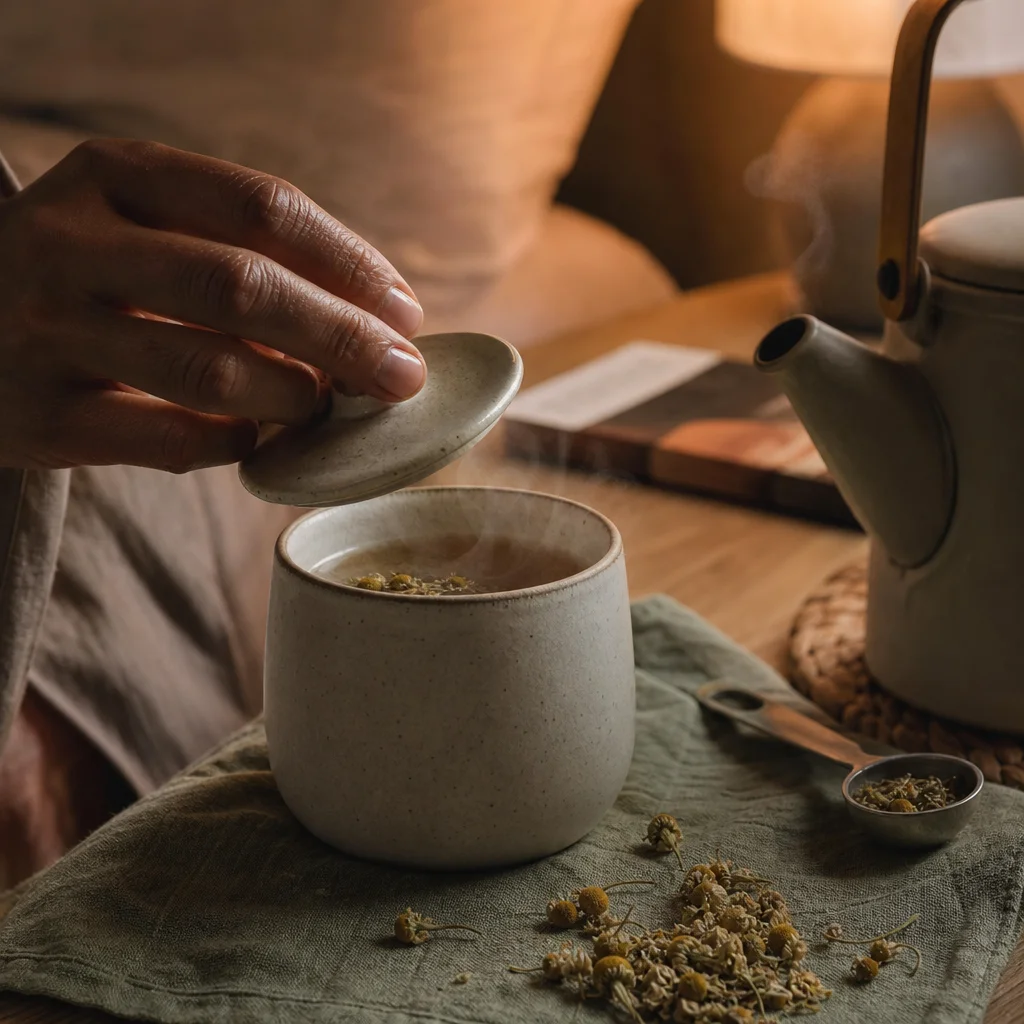
How much chamomile tea before bed actually helps you sleep? If you have been guessing at the kettle, you are not alone. Most people pour a mug and hope for the best. The short answer is one cup, brewed well, about 45 minutes before lights out.
Last updated: November 9, 2026
Below are the exact numbers, the brewing method, and the timing that fits a real evening. You will also see who should skip it, because chamomile is not right for everyone.
Quick Answer: How Much Chamomile Tea Before Bed?
One cup, about 240 ml (8 oz), made from 1 tea bag or 1 to 2 teaspoons (1.5 to 3 g) of dried chamomile flowers. Steep it covered for 5 to 10 minutes in water just off the boil, around 95°C. Drink it 30 to 45 minutes before lights out. Keep your evening total to 2 cups, and finish the last sip at least 30 minutes before bed. That gap protects you from a 2 a.m. bathroom trip.
How Much Chamomile Tea Before Bed: The Numbers That Matter
So how much chamomile tea does the research actually support? No health agency has set an official dose, and that is not a dodge. It reflects how thin the data still is.
Two sources give us the practical numbers. The first is the strongest trial that tested actual chamomile tea rather than an extract, in women with poor sleep. In that study, one cup nightly for two weeks was enough to improve their sleep scores. The second is the brewing convention used across the herbal-tea literature, which fills in the grams and the steep time. These numbers are convention, not regulation: no health agency publishes them.
Convention, not an official dose — the 12 oz row is scaled up from the 8 oz standard.
| Cup size | Dried flowers | Tea bags | Steep time | Best clock time |
|---|---|---|---|---|
| 180 ml (6 oz) | 1 tsp (about 1.5 g) | 1 | 5 to 10 min | 30 to 45 min before bed |
| 240 ml (8 oz) standard | 1 to 2 tsp (1.5 to 3 g) | 1 | 5 to 10 min | 30 to 45 min before bed |
| 350 ml (12 oz) | 2 tsp (about 3 g) | 1 to 2 | 5 to 10 min | 60 min before bed |
Notice that the flowers scale up but the steep time does not. If you want a stronger cup, add flowers. Past 10 minutes the tea turns bitter, and bitterness buys you nothing.
One catch: whole-herb tea is not standardized. Two brands can deliver different amounts of the plant’s active compounds. That is exactly why researchers who need precision use measured extracts instead.
How to Brew It: A Four-Step Method
Brewing is where most people lose the benefit. Four steps, five minutes of attention.
- Heat the water to about 95°C. Take the kettle off just before it boils, or let it rest 30 to 60 seconds after. A rolling boil flattens the aroma.
- Measure 1 to 2 teaspoons of dried flowers, or use one tea bag. Loose flowers usually taste fresher than a bag that has sat in a cupboard for a year.
- Cover the cup and steep 5 to 10 minutes. The lid keeps the aromatic oils in the cup instead of in the air above it.
- Skip the sugar. A cinnamon stick or a thin slice of ginger adds warmth without a blood-sugar spike. Our guide to making cinnamon tea shows how to get the most from that stick.
Chamomile Tea Before Bed Benefits: What Actually Changes
Chamomile is not a sedative. It will not knock you out, and expecting that sets you up for disappointment. What it does is milder and more useful.
A 2024 systematic review and meta-analysis pooled 10 trials with 772 people. Sleep quality scores improved by about 1.88 points on the Pittsburgh Sleep Quality Index, though the trials varied widely and the confidence interval was broad. Read that as a direction of effect rather than a precise number. Night wakings improved in two of the three studies that tracked them.
Three things did not change. Total sleep time stayed flat. Sleep efficiency did not improve — it was unchanged in two studies and slightly worse in one. Next-day energy and fatigue did not improve either.
An earlier meta-analysis of 12 trials found the same shape. Sleep quality improved by roughly 0.73 standard deviations. In people with a diagnosis of generalized anxiety disorder, symptoms on a clinical rating scale eased at two weeks and eased a little further by four weeks. Everyday, situational anxiety did not improve. Insomnia severity did not budge.
That last point matters, and one detail matters it. A review of 17 clinical practice guidelines found that guidelines do not recommend chamomile for insomnia, citing limited benefit and risk. Chamomile is a pleasant ritual with a modest evidence base. It is not a treatment.
Want a sense of how gentle it is? A small placebo-controlled pilot trial (34 adults) gave people with chronic insomnia 270 mg of chamomile extract twice daily for 28 days. Even at that concentrated dose, no sleep measure improved significantly — though the trial was too small to rule out small effects. A cup of tea is milder still.
Sleep is not chamomile’s only claim. Its anti-inflammatory reputation is a separate question with a separate evidence base, and our guide to chamomile tea for inflammation covers what dietitians actually recommend.
Chamomile Tea Before Bed: How Long Until It Works
Two timelines run at once, and mixing them up causes most of the frustration.
The first 30 to 60 minutes
Most people notice a softer, calmer feeling within about half an hour. Part of that comes from the plant and part from the warm drink itself. No study has pinned down an exact minute, so treat the window as practical guidance rather than a timer.
The first two to four weeks
Sleep scores in the postpartum trial improved after two weeks of nightly cups. The benefit faded within weeks of stopping. The generalized-anxiety rating-scale findings were stronger at four weeks than at two. Consistency does the real work.
The four-week checkpoint
If nothing has shifted after a month of nightly cups, stop spending money on it. Look at light exposure, caffeine timing, alcohol and stress instead. Or talk to a clinician about your sleep.
When to Drink Chamomile Tea Before Bed
Two clocks run at once here. One is the herb clock, the time it takes to feel calm. The other is the bladder clock. That second one matters more than most articles admit.
Thirty to 45 minutes before bed is the sweet spot. It leaves room for the tea to settle and for one bathroom trip before you lie down. If you already wake once a night, shift earlier to 60 or 90 minutes and brew a smaller cup.
Total evening fluid counts too. Two mugs of tea plus a big glass of water at 9 p.m. is a lot of liquid, chamomile or not. If you prefer something gentler on the stomach, our guide to anti-bloating tea covers herbal options for a slower evening.
Chamomile Tea Before Bed for Weight Loss: The Straight Answer
You may have seen chamomile described as a fat burner. There is no credible research behind that. It does not speed up how your body burns energy, and it does not target fat.
The real weight angle is behavioral. An unsweetened cup at 9 p.m. can replace a snack or a glass of wine. That swap cuts calories, and dropping alcohol also removes a known sleep disruptor. Chamomile helps the habit, not the metabolism.
Five Mistakes That Undo the Benefit
- Over-steeping. Fifteen minutes gives you a bitter, soapy cup. Five to ten minutes is plenty.
- The mega-mug. A 500 ml travel mug is two servings. Finish it and you have doubled your evening fluid.
- Honey overload. Two spoonfuls of honey is sugar before bed. Try a cinnamon stick, or read up on whether cinnamon tea is a better fit for you.
- Stacking sedatives. Chamomile plus melatonin plus an antihistamine is not a stronger plan. It is three unknowns at once.
- Expecting a knockout. Chamomile is a nudge. If you need a sedative effect, that is a conversation with a clinician.
Chamomile or melatonin?
They are not the same kind of thing. Melatonin is a hormone, and its dose and timing are their own question. Chamomile is a warm drink with a mild calming effect. Taking both does not make either one work better, and it makes it harder to know what helped.
Who Should Be Careful With Chamomile Tea
Chamomile is generally well tolerated. NCCIH’s chamomile fact sheet describes it as likely safe at the amounts found in tea and food. Even so, some groups should ask before making it a nightly habit.
Pregnancy and breastfeeding. Little is known about safety here. Ask your clinician before regular use.
Ragweed and daisy allergies. Chamomile sits in the Asteraceae family with ragweed, marigolds, chrysanthemums and daisies. If those make you react, chamomile can too, and reactions range from a rash to a severe event. Get urgent help for swelling or trouble breathing.
Blood thinners. A published case report describes serious internal bleeding in a 70-year-old woman on warfarin who used chamomile tea and lotion. The proposed cause is coumarin compounds in the plant. So this is a possible additive bleeding risk, not a vitamin K problem.
Sedatives and liver-processed drugs. NCCIH notes reported interactions with warfarin and with drugs broken down by the liver. A sedative interaction is theoretical but worth raising with your pharmacist.
Estrogen-sensitive conditions and hormonal birth control. This one deserves attention. NCCIH notes that chamomile may have some estrogen-like effects. Early studies suggest it could reduce how well birth control pills work, and it may worsen conditions that are sensitive to estrogen, such as breast or uterine cancer. Talk to your clinician.
Surgery. Standard guidance for herbal products is to stop about two weeks before a planned procedure. With chamomile the specific concerns are bleeding risk and possible interaction with anesthetic drugs. Tell your surgical team you drink it.
Chamomile Tea Before Bed: Your Questions Answered
Is chamomile tea before bed good for you?
For most healthy adults, yes. It has no caffeine, almost no calories, and a modest link to better sleep quality. It is not a cure for insomnia, and it is not right for everyone above.
How much chamomile tea before bed is too much?
Two cups in an evening is a sensible ceiling. More adds fluid and bathroom trips, not sleep benefit. Ask a clinician before drinking more than a cup or two a day long term.
Can I drink it every night?
Most healthy adults can. The trial that used real tea ran for two weeks, and benefits faded when participants stopped. Long-term safety data is thin, so mention it at your next check-up.
Does chamomile tea have caffeine?
No. That is a large part of why it suits an evening slot.
What if it does not work for me?
Give it four weeks of nightly use first. If nothing changes, dose is probably not the problem. Look at light, caffeine, alcohol and stress, or speak with a clinician.
If you like building a nightly ritual, you do not have to stay with one herb. Our guide to ginger cinnamon lemon tea benefits covers a warmer, spicier cup and what the research says about it.
The Bottom Line
One cup, 1 to 2 teaspoons of flowers or one bag, water just off the boil, covered for 5 to 10 minutes, and 30 to 45 minutes before lights out. Cap the evening at two cups. Expect a gentler wind-down and fewer 3 a.m. wake-ups, not a knockout. And check with your clinician first if you are pregnant, on a blood thinner, or managing an estrogen-sensitive condition.
How we researched this
We reviewed 7 sources, including government health agencies, meta-analyses, randomized controlled trials, systematic reviews, and peer-reviewed studies.
This article is for general information and is not a substitute for advice from your doctor or dietitian.