

Foods High in Calcium: Best Sources to Hit 1,000 mg
Key Takeaways
- Most adults need 1,000 mg of calcium daily. Women over 51 and pregnant or breastfeeding women need 1,200 mg.
- Dairy offers the most absorbable calcium, but dairy-free eaters can meet their needs with the right foods.
- Spinach is high in total calcium but low in “usable” calcium. Kale, collards, and bok choy are better choices.
- Canned fish with bones, calcium-set tofu, and fortified plant milks are standout non-dairy sources.
- Food comes first. If you supplement, keep doses at 500 mg or less and stay under 2,000–2,500 mg per day.
Here’s the thing about calcium: most of us are falling short without realizing it. A 2024 JAMA Network Open study found that nonpregnant women aged 20 to 44 average just 981 mg a day. That’s right below the 1,000 mg target. The fix doesn’t require a supplement. You can close the gap with foods high in calcium, many of which are probably already in your kitchen.
Whether you’re team dairy, fully plant-based, or somewhere in between, this guide has you covered. We’ll break down the best calcium sources with realistic serving sizes. We’ll also explain why absorption matters as much as the label. Plus, we’ll show you a full day of calcium-rich meals that actually add up.
Quick Answer: What Are the Best Foods High in Calcium?
Dairy products like milk, yogurt, and cheese lead the pack for absorbable calcium. However, canned sardines with bones, calcium-set tofu, fortified plant milks, collard greens, kale, and sesame seeds are excellent dairy-free options. Most adults need about 1,000 mg each day.
Why Foods High in Calcium Matter More Than You Think
Calcium is the most abundant mineral in your body. About 99% of it lives in your bones and teeth, where it provides structure and strength. The remaining 1% works hard in your blood and tissues. It helps muscles contract, nerves signal, blood clot, and blood vessels relax.
Here’s what happens when intake runs low: your body borrows calcium from bones to keep blood levels steady. Over time, that unpaid debt weakens bone. The National Institutes of Health links long-term shortfalls to osteoporosis — fragile bones that break more easily.
And this isn’t a niche problem. A 2024 analysis of NHANES data found that a large share of Americans don’t meet calcium needs. That’s true even when supplements are counted. In fact, dietary calcium intake has declined over the past decade. The good news? Many of the best foods high in calcium are everyday staples. Think yogurt, beans, leafy greens, and the sesame seeds on your bagel.
How Much Calcium Do You Actually Need?
The daily target is straightforward. Most adults need 1,000 mg of calcium per day, per the NIH calcium fact sheet. However, women over 51 and everyone over 70 need 1,200 mg. So do people who are pregnant or breastfeeding — the WHO recommends about 1,200 mg a day during pregnancy.
Daily Calcium Targets at a Glance
- Adults 19–50: 1,000 mg
- Women 51 and older: 1,200 mg
- Men 51–70: 1,000 mg
- Adults 70 and older: 1,200 mg
- Pregnant or breastfeeding: 1,200 mg*
*Per WHO guidance.
There’s also an upper limit. The tolerable upper intake level is 2,500 mg per day for adults under 51. For adults over 51, it’s 2,000 mg. Exceeding that — usually from supplements, not food — may increase kidney stone risk. That’s also why spreading foods high in calcium across the day helps your body absorb more.
The Best Foods High in Calcium, From Dairy to Plants
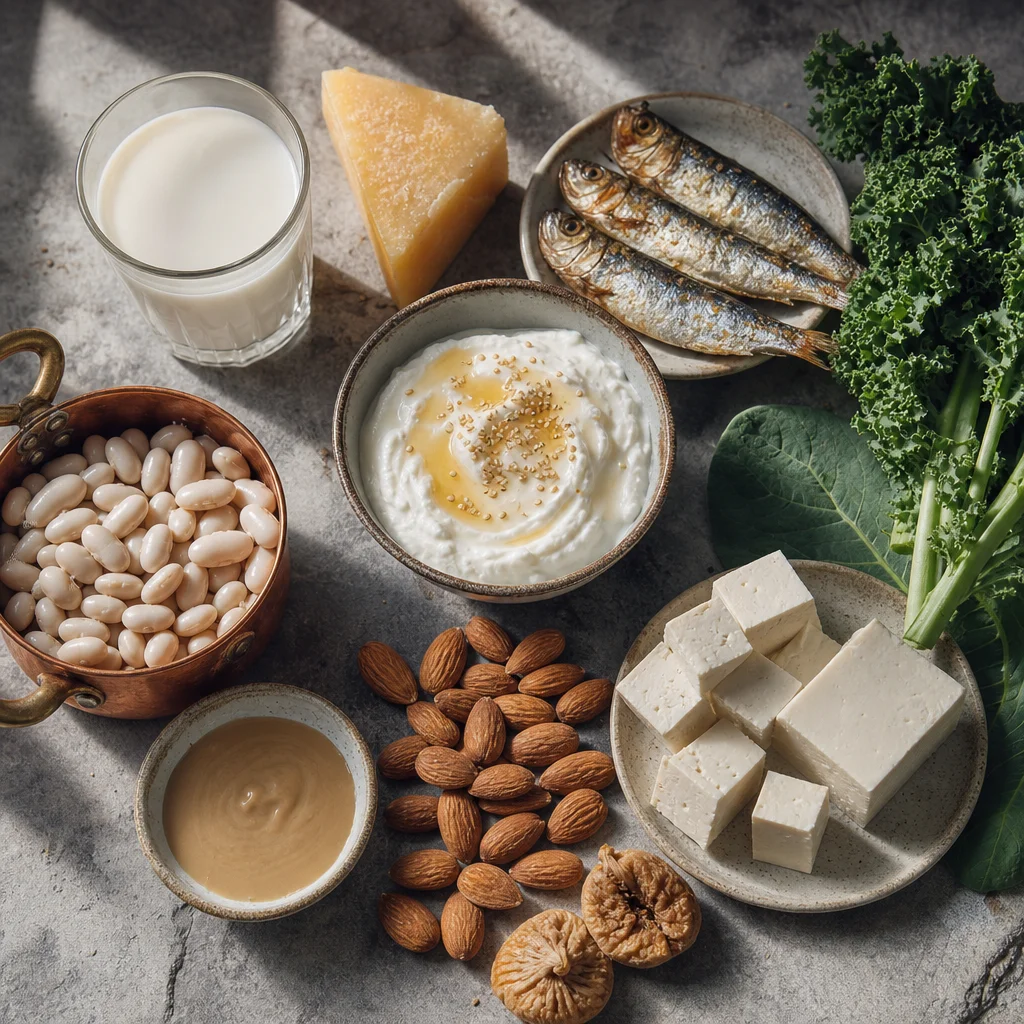
Now for the part you came for. These are the standout foods high in calcium, grouped by category with realistic serving sizes. Values come from Harvard Health, UCSF Health, and other reviewed sources that pull from the USDA food database; ranges reflect brand and preparation differences.
Dairy and fortified drinks
- Milk, 1 cup: about 300 mg
- Yogurt, 1 cup: about 270–450 mg (Greek yogurt runs lower)
- Cheddar cheese, 1 oz: about 200 mg
- Parmesan, 1 oz: about 242–335 mg, depending on type
- Fortified almond milk, 1 cup: up to 482 mg
- Fortified soy milk, 1 cup: about 399 mg
- Calcium-fortified orange juice, 1 cup: 300–350 mg
Fish with edible bones
- Sardines with bones, 3.75 oz can: about 351 mg
- Canned salmon with bones, 3 oz: about 181–241 mg
Leafy greens, 1 cup cooked
- Collard greens: about 324 mg
- Kale: about 177 mg
- Bok choy: about 158 mg
- Broccoli: about 62 mg
Tofu, nuts, seeds, and beans
- Calcium-set tofu, 1/4 block: about 553 mg
- Sesame seeds, 1 oz: about 280 mg
- Chia seeds, 1 oz: about 179 mg
- Tahini, 2 tbsp: about 130 mg
- Almonds, 1 oz: about 76 mg
- White beans, 1 cup: about 161 mg
- Edamame, 1 cup: about 130 mg
Fruit
- Dried figs, 4–5: about 54–70 mg
Notice what’s missing? Spinach. It has about 240 mg per cooked cup, but there’s a catch we’ll tackle next. One more note: if a food’s calcium comes with absorption blockers, the total number overstates what you actually get.
Why Absorption Matters More Than the Label
Here’s the key distinction most articles skip: calcium content and calcium absorption are not the same number. Your body doesn’t absorb everything you eat.
The NIH explains that absorption from dairy and fortified foods runs about 30%. Absorption from some plants is much lower. The culprits are oxalates and phytates. These natural compounds bind to calcium and carry it out before your body can use it.
That’s why spinach gets a bad rap. A cooked cup has about 240 mg of calcium. But its high oxalate content means you absorb only a fraction. A lab-based study in Food Chemistry found that absorption inhibitors often matter more than total calcium content. Low-inhibitor greens delivered nearly twice the usable calcium of high-inhibitor greens.
On the flip side, kale tells a better story. One cooked cup has 177 mg of calcium. Since kale is low in oxalates, your body can use far more of it. Collard greens are even stronger at 324 mg per cooked cup. Even better? A study in healthy women found that low-oxalate vegetables absorb calcium at 71% to 86% of the rate of milk.
The “Usable Calcium” Rule
Don’t compare foods by total calcium alone. Ask whether absorption blockers come with it. Reliable choices: dairy, fortified plant milks, calcium-set tofu, sardines with bones, kale, collard greens, and bok choy. Less reliable: spinach, Swiss chard, and rhubarb, which are high in oxalates.
Going Dairy-Free? Here’s How to Get Enough Calcium
Let’s be honest: going dairy-free takes more planning. But dairy-free foods high in calcium absolutely exist. You just need to know what to look for — and what to avoid.
The biggest trap is plant milk. Unfortified oat milk has about 16 mg per 200 ml — roughly a cup. Unfortified rice milk has about 22 mg. That’s nearly nothing. However, calcium-fortified soy milk delivers 240–400 mg per cup. Fortified almond milk can reach 482 mg. The International Osteoporosis Foundation is clear: only enriched plant milks really count.
Tofu is another label-check moment. Tofu made with calcium sulfate is a calcium powerhouse — about 553 mg per quarter block. Tofu made with other coagulants can be far lower. Check the ingredient list for “calcium sulfate” before you buy.
Label-Reading Shortcut
- Plant milk: Look for “calcium-fortified” and aim for 300+ mg per cup.
- Tofu: Look for “calcium sulfate” in the ingredients, or check the nutrition panel.
- Orange juice: Fortified versions provide 300–350 mg per cup.
- Cereals and breads: Some are fortified with 100–1,000 mg per serving. Check the label.
A Sample Day of Calcium-Rich Eating: 1,000+ mg
Aim for roughly 300–400 mg at each meal, plus a snack. Here are two sample days — one with dairy, one without — that clear the 1,000 mg mark. The math is simple once you know the numbers. For more protein-forward mornings, see our high-protein breakfast guide.
Day 1: With Dairy (~1,098 mg)
- Breakfast: 1 cup Greek yogurt (270 mg) + 1 tbsp chia seeds (60 mg) + 4 dried figs (54 mg) = 384 mg
- Lunch: Kale salad with 3 oz canned salmon with bones (177 + 181 mg) = 358 mg
- Snack: 1 oz almonds = 76 mg
- Dinner: Pasta with 1/2 cup white beans (80 mg) + 1 oz cheddar (200 mg) = 280 mg
Day 2: Dairy-Free (~1,608 mg)
- Breakfast: Smoothie with 1 cup fortified soy milk (399 mg) + 1 tbsp chia (60 mg) = 459 mg
- Lunch: Bowl with 1/4 block calcium-set tofu (553 mg) + 1 cup cooked broccoli (62 mg) = 615 mg
- Snack: 2 tbsp tahini with apple slices = 130 mg
- Dinner: Collard greens (324 mg) + 1/2 cup white beans (80 mg) = 404 mg
See how foods high in calcium add up? Neither day requires anything unusual. Both use everyday meals with simple swaps.
Protect Your Calcium: Vitamin D, Salt, and Caffeine
Getting calcium in is only half the job. Keeping it in matters just as much.
First, vitamin D. Your body needs it to absorb calcium in the gut. Without enough, even the best diet falls short. Fatty fish, egg yolks, and fortified milk provide some. Many women also benefit from having their level checked by a clinician.
Second, watch the salt. A 2025 systematic review in Frontiers in Endocrinology found that high sodium intake increases calcium loss in urine. On average, that’s about 29 mg more each day. Most of that sodium comes from packaged foods, not your salt shaker.
Third, caffeine gets a fair question. In moderate amounts, coffee has a small effect on calcium. A splash of milk in your latte and calcium-rich meals through the day easily offset it.
Calcium Supplements: When You Need Them — and the Safety Rules
Supplements have a place, but they’re not the default. The NIH recommends meeting needs through food first. Supplements are backup when diet can’t do the job. That includes diagnosed deficiency, very low dietary intake, or specific medical conditions. Even with plenty of foods high in calcium on your plate, some situations call for a supplement.
If you and your clinician decide a supplement makes sense, follow these safety rules:
- Keep each dose at 500 mg or less. Your body absorbs larger doses less efficiently.
- Take it with food to improve absorption.
- Stay under 2,000–2,500 mg total per day, counting food plus supplements.
- Space calcium 1–2 hours from medications like levothyroxine, quinolone antibiotics, lithium, and dolutegravir.
Two forms dominate the shelf. Calcium carbonate is common and best taken with food. Calcium citrate absorbs well on an empty stomach and may be gentler on digestion. Many calcium pills also include vitamin D, which supports absorption.
Frequently Asked Questions
Can I meet my calcium needs without dairy?
Yes, with planning. Dairy-free foods high in calcium — like fortified plant milks, calcium-set tofu, and sardines — can easily add up to 1,000 mg. Think collards, sesame seeds, and white beans too. Spread them across meals and check labels on packaged options.
Is spinach a good calcium source?
It’s complicated. Spinach is high in total calcium — about 240 mg per cooked cup — but oxalates block most of it. Choose low-oxalate greens like kale, collard greens, and bok choy for calcium your body can actually use.
Does coffee affect calcium?
Moderate coffee has only a small effect on calcium. A splash of milk in your cup and calcium-rich meals throughout the day easily offset it.
What are the signs of low calcium?
Mild deficiency often shows no symptoms at all. More serious cases can cause numbness or tingling in the hands and feet, muscle cramps, or spasms. If you’re concerned, talk to your clinician about a simple blood test.
The Bottom Line
The bottom line on foods high in calcium? They’re everywhere once you know what to look for. Most adults need about 1,000 mg a day — roughly three servings spread across meals. Dairy works beautifully. So do sardines, calcium-set tofu, and fortified plant milks. Low-oxalate greens like kale and collards count too.
Start with one small change this week. Swap your morning milk for fortified soy or almond milk. Add a handful of sesame seeds to a salad. Toss some white beans into your soup. Small swaps add up — and your bones will thank you for decades to come.