

Fish Oil for Brain Health: What a 2-Year Trial Found
Key Takeaways
- A two-year trial gave 365 at-risk adults 2 grams of DHA daily. The nutrient reached their brains. Memory and brain volume did not improve.
- For years, the standard defence of fish oil for brain health was that the nutrient never reached the brain. This trial closed that door.
- No trial has shown fish oil prevents dementia. This one found no benefit for memory — and no harm either.
- Three ounces of Atlantic salmon carries about six capsules’ worth of real omega-3s.
If you take fish oil for brain health, you probably believe one simple thing. You believe the omega-3s in that capsule reach your brain and quietly protect it. A two-year clinical trial just tested that idea head-on. The omega-3s did reach the brain. Memory did not improve.
That finding landed hard. Researchers measured omega-3 levels in cerebrospinal fluid, the fluid that cushions the brain. Delivery was confirmed. Then they followed 365 older adults for two full years. Thinking skills stayed flat. Brain volume showed no difference either.
So what does that mean for the bottle in your cabinet? Quite a lot, actually. Here’s what the research shows, what it doesn’t, and how to decide whether to stop, keep, or rethink your supplement.
Quick Answer: Does Fish Oil Protect Your Brain?
For healthy older adults, the best evidence says no. Put simply, the case for fish oil for brain health is weaker than the label on the bottle suggests. A 2026 randomised trial confirmed that high-dose DHA reached the brain and still produced no memory or brain-volume benefit. That is not the whole story, though. Fish oil still has real evidence for lowering triglycerides, and this is not a reason to stop something your doctor prescribed.
What the New Fish Oil for Brain Health Research Actually Found
Let’s start with what the study actually did. It is a good study, and the details matter.
Researchers at the Keck School of Medicine of USC recruited 365 adults aged 55 to 80. Everyone ate very little fish. Everyone carried at least one risk factor for dementia. Nearly half carried APOE4, the strongest known genetic risk for late-onset Alzheimer’s.
Half took 2 grams of DHA daily for 24 months. The other half took a placebo. Both groups were tracked with cognitive tests and brain scans. Neither the participants nor the researchers knew who got what.
The team also collected cerebrospinal fluid from a subset. That let them measure whether DHA reached the brain, not just the bloodstream. It did. The DHA-to-arachidonic-acid ratio rose sharply in the treatment group and stayed flat in the placebo group.
Then came the part nobody wanted. Cognition did not differ between groups. Brain volumes did not differ either.
The Detail Most Headlines Skipped
Dropout was 38%, mostly because of COVID-19 disruptions. That is a genuine weakness. A trial with heavy attrition has less power to catch a small effect. So read this as “no meaningful benefit,” not “mathematically zero.” The trial also tested 2 grams of DHA alone, not EPA. And the published results found no serious side effects attributed to the supplement.
The Omega-3s Reached the Brain. So Why Didn’t Memory Improve?
This is the question that makes the trial interesting.
For years, supplement supporters had a ready answer for failed studies. They said the trials were flawed. The omega-3 never got where it needed to go, they argued. Give people a better dose or a better form, and results would change.
This trial tested that explanation and quietly closed it. Delivery was confirmed. The nutrient arrived. Nothing happened.
There is a second detail here that almost nobody reported. Target engagement worked the same way in APOE4 carriers and non-carriers alike. The interaction was not significant. For years, researchers suspected this gene blocked omega-3 from entering the brain. In this trial, it did not.
So the bottleneck sits somewhere else. The study authors now suspect the problem is how the brain breaks down and uses DHA, not how much arrives. That is a hypothesis, not a proven answer. Still, it reframes everything. You cannot fix a processing problem by buying a bigger supply.
Capsules vs. Whole Fish: What’s Proven and What’s Just a Guess
Here is where the story gets slippery, and where plenty of coverage went too far.
The researchers offered a theory. Eating fish may do something a capsule cannot — fish is a whole food, and the nutrients around the omega-3s may matter. Their own explanation, which they offered as a suspicion rather than a finding, is that getting these nutrients through a healthy diet may offer benefits that supplements alone cannot provide.
It is a reasonable idea. It is also untested. No trial has ever compared whole fish against capsules for memory outcomes.
The NIH Office of Dietary Supplements is blunt about this. People who eat more fish have lower rates of several chronic diseases. Yet it is unclear whether that comes from the omega-3s, other parts of the fish, or simply from eating fish instead of something worse.
The Alzheimer’s Association says the same thing in different words. All dietary prevention evidence is associative. You can do everything right and still develop a serious health problem.
So keep the food-first idea, but hold it loosely. That is the honest state of the fish oil for brain health debate: a reasonable theory, not a proven fact.
How Much DHA and EPA You Actually Get From Real Food
Numbers cut through the noise here. This is where the fish oil for brain health question stops being abstract. Let’s compare what you actually swallow.
EPA + DHA per 3 oz Cooked Serving
| Food | EPA + DHA |
|---|---|
| Atlantic salmon, farmed | 1.83 g |
| Atlantic herring | 1.71 g |
| Sardines, canned | 1.19 g |
| Atlantic mackerel | 1.02 g |
| Pink salmon, canned | 0.91 g |
| Rainbow trout | 0.84 g |
| Oysters | 0.53 g |
| Shrimp | 0.24 g |
| Light tuna, canned | 0.19 g |
| Tilapia | 0.11 g |
| Pacific cod | 0.14 g |
Source: NIH Office of Dietary Supplements food composition data.
Now compare that to a capsule. One standard 1,000 mg fish oil softgel delivers about 180 mg of EPA and 120 mg of DHA. That is roughly 300 mg of actual omega-3s.
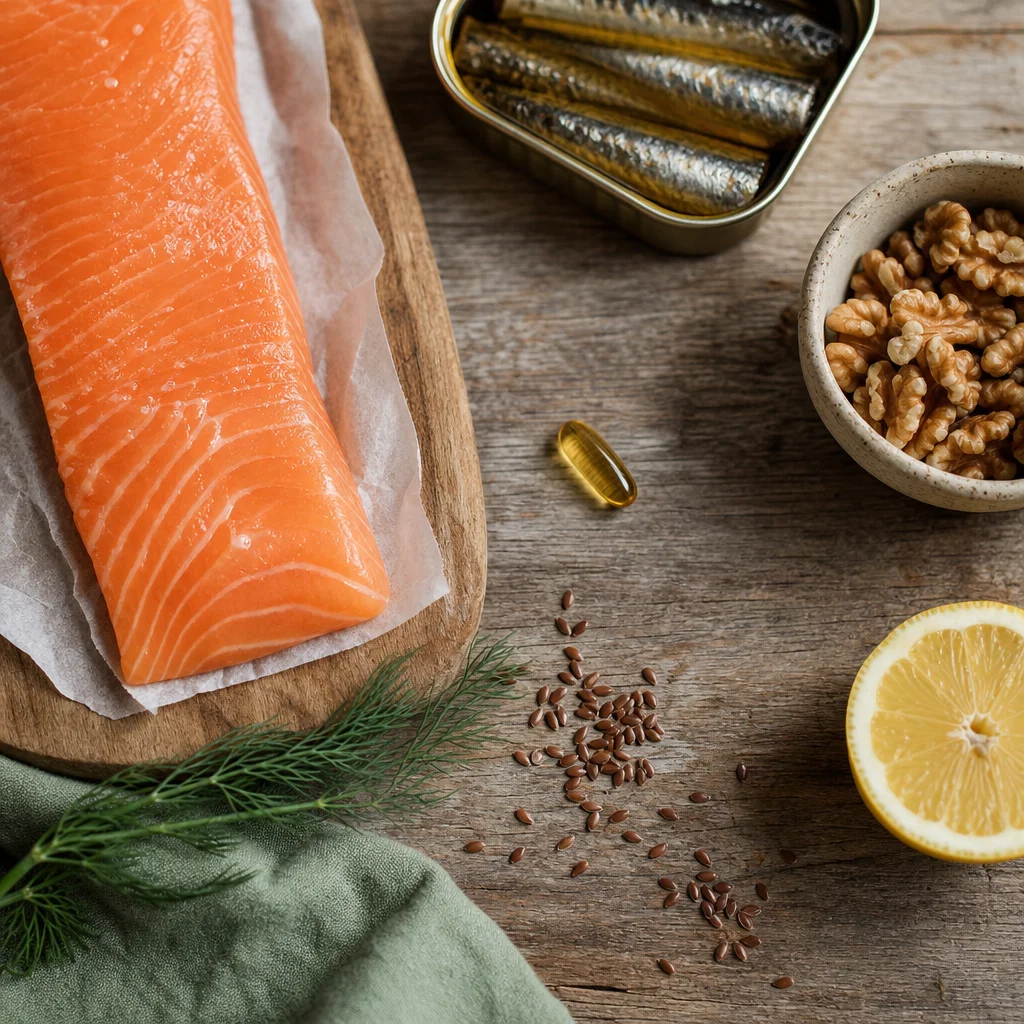
Three ounces of Atlantic salmon gives you about six capsules’ worth. A tin of sardines gives you about four.
Three ounces of salmon twice a week delivers more real omega-3s than a day’s worth of capsules. Tinned sardines and mackerel get you there without cooking, which is why they are worth keeping in the cupboard. For anyone weighing fish oil for brain health, that is the practical bottom line.
Plant sources matter, but they are not a swap. Flaxseed oil, chia seeds and walnuts supply ALA. Your body converts under 15% of that to EPA, and much less to DHA.
If you eat no fish at all, algal oil is your most direct plant-based option. In one small study cited by the NIH, DHA from algal oil was absorbed about as well as DHA from cooked salmon. Typical products supply 100 to 300 mg of DHA per serving, and some contain EPA as well.
One caveat worth knowing. The omega-3 content of farmed Atlantic salmon dropped significantly between 2006 and 2015 as fish feed changed. Farmed and wild are both good choices. Neither is a guarantee.
Should You Stop, Keep, or Reassess Your Supplement?
So should you stop fish oil for brain health? Ask yourself why you started. The answer sorts you into one of three groups.
Group one: you take it for memory or dementia prevention. The evidence does not support that use. That is the fairest reading of two years of data with confirmed brain delivery. Stopping is reasonable, and it is not dangerous.
Group two: you take it for triglycerides, or a doctor prescribed it. Then this trial says nothing about you. Prescription-strength omega-3 lowers triglycerides, and a Cochrane review of 86 trials of long-chain omega-3s across a wide dose range found roughly a 15% reduction. Do not stop a prescribed product without a conversation.
Group three: you have diagnosed mild cognitive impairment. This is the one grey zone. A 12-month DHA trial in adults with MCI reported cognitive and hippocampal benefits. Those effect sizes look implausibly large for a nutrient, and nobody has matched them since. Ask your neurologist, not a supplement aisle.
Not sure which group you are in? Then reassess rather than reload.
Who Should Be Careful, and Who Should Not Stop
Fish oil is generally well tolerated. Most side effects are mild: fishy burps, nausea, loose stools. However, a few groups need real caution.
Blood thinners. High doses can raise bleeding risk alongside blood thinners such as warfarin, and the NIH warns about this directly. The same caution applies if you take an antiplatelet medicine such as aspirin or clopidogrel. Tell your prescriber before you start, stop or change a dose.
Upcoming surgery. Mention fish oil at your pre-op appointment. Your surgeon may want you to pause it.
Very high doses and heart rhythm. At around 4 grams a day, prescription-level dosing, two large trials in people who already had heart disease, or were at high risk of it, reported a modest rise in atrial fibrillation. That is a far higher dose than the 2 grams of DHA used in this cognitive trial, which found no such signal. Dose and population matter.
Cod liver oil. It also carries vitamins A and D, and vitamin A can reach harmful levels if you take high doses for a long time. Do not treat it like a plain fish oil capsule.
Pregnancy. Eat 8 to 12 ounces of fish a week and choose varieties that are lower in mercury and higher in omega-3s, such as salmon, sardines and trout.
If you take fish oil for brain health and also take a blood thinner, this is your moment to call your doctor. Not because the supplement is dangerous alone. Because the combination changes the conversation.
What to Do This Week
Here is the practical version of everything above. Keep it simple and make it repeatable — and a brisk daily walk counts too.
- Pick two fish meals. Fresh, frozen or tinned all count — the American Heart Association recommends one to two servings of seafood a week.
- Buy the small fish. Sardines, mackerel, herring and anchovies are high in omega-3s and low in mercury.
- Keep tins in the cupboard. Sardines on toast with lemon is a five-minute lunch with about 1.2 grams of omega-3s.
- Add walnuts and ground flax. Good foods, but not an EPA or DHA substitute.
- Skip the dose escalation. In this trial, 2 grams a day already produced a large, measurable increase in brain DHA availability. Higher doses have not been shown to help — and around 4 grams a day has been linked to a higher rate of abnormal heart rhythm. More is not better.
- If you eat no fish, choose algal oil. Look for the DHA amount on the label, not the total oil weight.
The Bigger Picture on Brain Health
No capsule has been shown to protect memory. Other levers have better evidence behind them: regular movement, blood pressure control, social connection and a Mediterranean-style plate. The Alzheimer’s Association lists these explicitly, with one honest caveat. This evidence applies to populations, not to any single person.
Frequently Asked Questions
Is there a dose that works better?
Not that anyone has shown. If anything, higher doses bring more risk. The case for fish oil for brain health gets weaker, not stronger, as the milligrams climb.
Is fish oil bad for me now?
No. The trial found no benefit for cognition. It did not find harm. That distinction matters, and headlines keep flattening it.
What about krill oil or a fancier form?
Absorption differs slightly between forms. That is not the bottleneck here. Delivery was already confirmed in this trial, and cognition still did not change.
Could a small benefit have been missed?
Possibly. A 38% dropout rate and a 24-month window both limit sensitivity. But a Cochrane review and a trial in adults with low omega-3 intake found the same nothing.
I don’t eat fish at all. What now?
Try algal oil. It is the most direct plant-based source of ready-made DHA, and it comes from the same algae fish eat. Check the label — some products include EPA and some supply DHA only.
The Bottom Line
Here is the honest answer about fish oil for brain health. The nutrient matters. The capsule, for memory, does not appear to help.
That is not a scandal. It is a useful finding. It tells you the bottleneck is not supply, and buying a higher dose cannot fix a processing problem.
So feed your brain instead. Two servings of fatty fish a week, a plate built around vegetables and olive oil — close to the MIND diet pattern — and a blood pressure check you actually keep. None of that requires a subscription.
And if you take fish oil for your triglycerides, keep taking it. Just tell your doctor what you’re doing, and why.