

Are Almonds Nuts Healthy? A 7-Day Plan, Portions & Safety
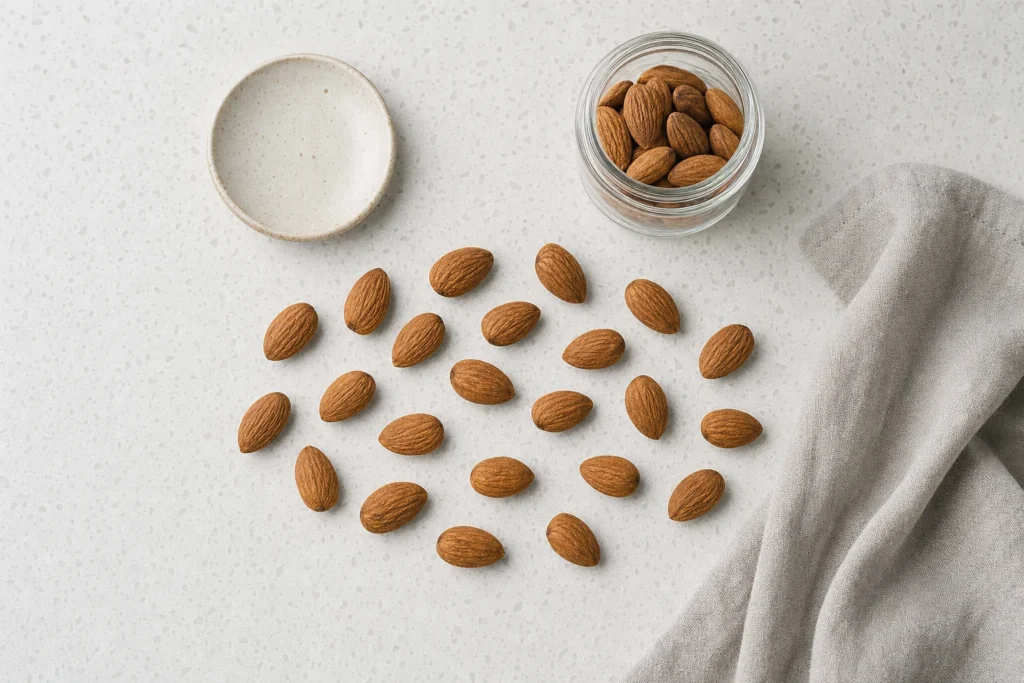
The family-size bag of almonds is open on the office kitchen counter again. You take a small handful. Then a second one. Then you pause and wonder whether you helped your heart or added 400 calories to your afternoon. So are almonds nuts healthy? That question deserves numbers, not a shrug.
Last updated: November 19, 2026
Quick Answer: Are Almonds Nuts Healthy?
Yes, for most adults. One ounce — 28.35 grams, about 23 whole almonds — delivers roughly 164 calories, 6 grams of protein, 3.5 grams of fiber and 14 grams of fat, about 9 of them monounsaturated, per USDA FoodData Central. You also get 7.3 mg of vitamin E and 76.5 mg of magnesium. One ounce a day fits a healthy eating pattern. Portion, format and salt decide whether it helps or backfires.
Almonds get sold as a superfood and warned about as a calorie bomb. Some people also blame them for every itchy mouth in hay fever season.
None of those stories holds up on its own. This is a working plan, not a list of virtues. You get the real numbers, a seven-day schedule and a buying guide for four formats. You also get the safety points most roundups skip.
Are Almonds Nuts Healthy? The One-Ounce Numbers
A label check first. Almonds are the seed inside a fuzzy drupe. So they are not a true botanical nut. Food packaging and allergy rules still count them as tree nuts. That matters for one reason. If you react to nuts, an almond follows the same rules as a walnut.
Now the numbers. One ounce, about 23 almonds, looks like this in USDA FoodData Central:
| Nutrient | Per 1 oz (28.35 g, ~23 almonds) |
|---|---|
| Calories | 164 kcal |
| Protein | 6.0 g |
| Total fat | 14.2 g |
| — Monounsaturated | 8.9 g |
| — Saturated | 1.1 g |
| Carbohydrate | 6.1 g |
| Fiber | 3.5 g |
| Sugars | 1.2 g |
| Vitamin E | 7.3 mg (about 48% of the 15 mg adult daily value) |
| Magnesium | 76.5 mg |
| Potassium | 208 mg |
| Calcium | 76 mg |
| Sodium | About 0.3 mg |
Two details are easy to miss. First, the fat is mostly monounsaturated, the same family as olive oil. One ounce holds only about 1 gram of saturated fat. Second, the fiber is real but modest.
Vitamin E is the standout. One ounce covers about half of a healthy adult’s daily need — about 48% of the 15 mg daily value.
Protein deserves a caveat. Six grams per ounce sounds strong. Yet almond protein is incomplete. It runs low on lysine and methionine. So it does not replace eggs or fish gram for gram. Pair almonds with yogurt or beans and the gap closes.
Almonds, Cholesterol and Blood Pressure: What the Evidence Shows
The strongest evidence for almonds concerns blood lipids. A 2022 meta-analysis of 26 randomized trials covered 1,750 adults. Almond intake lowered LDL cholesterol, total cholesterol, triglycerides and diastolic blood pressure.
However, that same analysis found no significant change in systolic blood pressure. It also found nothing for HDL cholesterol, fasting glucose, HbA1c or inflammatory markers. So almonds nudge the lipid picture. They do not overhaul it. The effect is smaller than the headlines suggest.
Dose matters. In adults with type 2 diabetes, a pooled analysis of nine trials found LDL fell by about 5 mg/dL. That result showed up mostly above 50 grams a day. That is nearly double the standard ounce.
Then there is the salt problem, which few articles address. Plain almonds hold about 1 mg of sodium per 100 grams, effectively zero. Salted and flavored versions are a different food altogether. Buy the salted bag and you trade a small pressure benefit for a sodium load pushing the other way. Our guide to nuts and blood pressure: the daily handful walks through that trade in detail.
Will a Daily Handful Make You Gain Weight?
This worry stops a lot of people from buying almonds at all. The evidence should settle it. A review of 86 randomized trials found nuts had no adverse effect on body weight, with high certainty. Six large cohorts covering more than 500,000 people linked nut intake to slightly lower rates of overweight.
Why does the arithmetic not bite? Cell walls. Some almond fat stays locked inside plant cells and never reaches your bloodstream. A 2023 review of 21 studies measured usable energy in raw almonds at 18.5 kJ per gram. That is below what the label math predicts.
This finding has a practical edge. Grinding and heating change the delivery. Whole almonds release the least energy, chopped a little more, flour the most. Butter and roasting push it higher still. Twenty-three whole almonds and a spoon of almond butter are not the same calorie event.
The bag is the real risk. Twenty-three almonds is 164 calories. A casual graze of 60 almonds is about 72 grams, or roughly 415 calories. That is no longer a snack. It is a meal. Portion first, then eat.
A Seven-Day Plan: When, How Many, and Instead of What
Almonds work as a swap, not an addition. That framing comes straight from the trials. In a four-week randomized trial of 137 adults, almonds lowered the post-meal glucose response. The effect was strongest when eaten alone as a snack, not folded into a meal.
What about a handful before lunch? No trial in this research tested a 20 to 30 minute preload directly. Treat that timing as a sensible experiment, not a proven protocol. Snack placement has the better support.
| Day | Slot and time | Almonds | Replaces |
|---|---|---|---|
| 1 | Mid-morning, 10:30 a.m. | 23 whole | The coffee-cart pastry |
| 2 | 20 min before lunch | 15 whole | Bread-basket nibbling |
| 3 | 3:00 p.m. | 23 whole | Vending-machine chips |
| 4 | Breakfast, with yogurt | 12 sliced | Granola topping |
| 5 | 20 min before dinner | 15 whole | Cheese and crackers |
| 6 | 3:00 p.m. | 23 whole | The office candy jar |
| 7 | Breakfast | 23 whole | The glass of juice |
Keep the swap real. On every day, the almonds should displace something — pastry, chips, crackers. They should not sit on top of a full day of eating. Adults in the 2013 trial naturally ate less of everything else. That compensation is the mechanism.
One caution from the same evidence pool. A 2023 trial compared almonds to a carb snack bar. The C-peptide response — a marker of how much insulin you release — was 47% smaller after almonds. Yet hunger ratings and intake at the next meal did not differ. Almonds are a better metabolic trade for the same calories. They are not an appetite suppressant.
How Much and Which Format to Buy
One ounce a day is the sensible default for most adults. It is easy to count, easy to store and fits a normal calorie budget. If you are still weighing are almonds nuts healthy for your own plate, the answer is a daily ounce, not a daily bag.
Higher doses are a real option, but going above the standard ounce is a decision to make with your doctor or dietitian, especially if you are managing diabetes or a cholesterol problem. The trials behind these effects used about 43 grams a day, and the LDL effect in adults with type 2 diabetes showed up mainly above 50 grams a day. That is nearly double the standard ounce. Yet 50 grams costs about 290 calories. Spend that budget deliberately or not at all.
| Format | Best for | Watch out for |
|---|---|---|
| Raw whole | Default snack, easy counting | Keeping them cool and sealed so they do not go stale |
| Dry-roasted, unsalted | Crunch without sodium | Check the label — oil-roasted versions add oil; dry-roasted should list almonds and nothing else (or almonds and salt) |
| Sliced | Yogurt, oats, salads | Very easy to over-pour |
| Almond flour | Baking swaps | More absorbable calories per gram |
| Almond butter | Flavor in measured spoons | Sneaks past fullness signals |
Storage decides whether the last handful still tastes good. Almonds are high in oil, and oil goes stale — a general kitchen point, not something the trials above tested. Keep the large bag in the freezer and refill a small glass jar for the counter. A one- to two-ounce jar is a portion system: when it empties, you stop. Our notes on how to store nuts so they stay fresh cover the shelf-life details.
For daily use, raw or dry-roasted unsalted almonds are the simplest buy. Sliced almonds belong with yogurt and oats, where a measured scatter beats a free pour. Almond flour is a baking swap, not a snack-cupboard staple.
Who Should Be Careful With Almonds
Allergy comes first. Almond is a genuine tree nut allergen. A 2025 analysis of the European Anaphylaxis Registry listed almond among the frequent triggers in adults. Only 21% of those adults knew about their allergy beforehand.
Two patterns exist, and they need different answers. Pollen-food syndrome shows up as itching or tingling in the mouth within minutes. It usually appears in someone with hay fever. The BSACI guideline on tree nut allergy treats it as a separate, usually milder disorder. Primary tree nut allergy can bring hives, swelling, vomiting or trouble breathing. It requires strict avoidance and a written emergency plan.
If a reaction is happening now, treat it as an emergency. Throat tightness, widespread hives or trouble breathing all mean urgent help, not a wait-and-see approach. Our overview of tree nut allergy symptoms worth taking seriously lists the signs in detail.
Kidney stones come next. Almonds contain oxalate, so a calcium-oxalate stone history deserves a conversation with your clinician. Please do not self-restrict, though. Guidance on stone prevention stresses fluids, balanced calcium, less sodium and less animal protein. Cutting calcium is the more common and more harmful error.
Choking is a quieter risk. If you have a swallowing problem (dysphagia), whole nuts are hard work, whatever a nutrition study says about their benefits. Rushing through a handful while walking is how it happens. Sit down, chew properly, and follow your clinician’s texture advice before adding whole nuts to your day.
Finally, the calorie trap. Nuts are dense, and grazing from a family bag adds up fast. That is not a reason to avoid them. It is a reason to own a small jar.
How we researched this
We reviewed 14 sources, including the USDA FoodData Central database, meta-analyses, systematic reviews, randomized controlled trials, clinical guidelines, and peer-reviewed studies.
- USDA FoodData Central — nutrient data
- The effect of almond intake on cardiometabolic risk factors, inflammatory markers, and liver enzymes: A systematic revie — meta-analyses, 2022, 1,750 participants
- Are fatty nuts a weighty concern? A systematic review and meta-analysis and dose-response meta-regression of prospective — meta-analyses, 2021, 569,910 participants
- The Metabolizable Energy and Lipid Bioaccessibility of Tree Nuts and Peanuts: A Systematic Review with Narrative Synthes — systematic reviews, 2023, 21 studies
- Appetitive, dietary and health effects of almonds consumed with meals or as snacks: a randomized, controlled trial — randomized controlled trials, 2013, 137 adults
This article is for general information and is not a substitute for advice from your doctor or dietitian.
Frequently Asked Questions
Are almonds nuts or seeds?
Both, depending on who is asking. Botanically, the almond is a seed inside a drupe. Legally and clinically, it counts as a tree nut. That is why it appears on allergen labels and in allergy advice.
Are almonds nuts healthy to eat every day?
For most adults, yes. One ounce daily fits comfortably. Rotate the format so you are not eating almond butter by the spoon. Keep the salted bag out of the rotation if your blood pressure runs high.
Is almond butter as healthy as whole almonds?
Same fats, different delivery. Grinding breaks the cell walls, so butter releases more usable energy than whole nuts. Measure it in tablespoons, because it disappears fast on toast.
Are salted almonds bad for you?
Not automatically, but they are a different product. Plain almonds carry essentially no sodium. Salted ones can jump to a number you have to read on the panel. If blood pressure is a concern, buy unsalted.
How long until almonds change my cholesterol?
The almond trial with the clearest timing measured post-meal effects over four weeks. The reviews that pooled almond trials suggest giving a consistent intake a few months before judging. The pooled effect on LDL is small. Keep taking any prescribed medication — almonds are a food, not a treatment.
The Bottom Line
A one-ounce handful — about 23 almonds — is a genuinely healthy daily habit for most adults. It brings 6 grams of protein, 3.5 grams of fiber, nearly half your vitamin E and a mostly unsaturated fat profile.
What makes it work is what it replaces and how much you eat. Count them out, buy unsalted, keep the big bag cold, and skip the almond butter spoons. Check with your clinician first if you have a nut allergy, a stone history or trouble swallowing.