

Menopause Treatment Guidelines: What Changed in 2026
Key Takeaways
- The American College of Obstetricians and Gynecologists just updated its guidance on menopause symptoms. It is the first update since 2014.
- The old “just push through” message grew out of a 2002 trial. The women in that trial did not match most women seeking help today.
- Hormone therapy is one option, not the only one. It still is not right for everyone.
- Local vaginal treatment and whole-body treatment solve two different problems.
- Non-hormonal drugs, therapy, and daily habits are real choices, not consolation prizes.
If you were told years ago to white-knuckle your way through hot flashes, you deserve an update. The American College of Obstetricians and Gynecologists just revised its menopause treatment guidelines. It is the first revision since 2014.
For nearly two decades, many women heard one message. Hormones carry risk, so push through. That message grew out of a 2002 study. The nuance got lost along the way.
Here is what the menopause treatment guidelines mean for you. We will look at who hormone therapy may suit. We will compare local and whole-body treatment. We will also cover non-hormonal options that hold up.
Quick Answer: Do the New Rules Mean Hormones Are Safe Now?
No. No honest guideline says a treatment is safe for everyone. The new menopause treatment guidelines focus on how to treat symptoms. Whether hormone therapy fits you still depends on your own history and risk factors.
What the New Menopause Treatment Guidelines Actually Change
Start with the headline. The college has revised its advice on treating menopause symptoms. That covers hot flashes, night sweats, and the sleep loss that rides along with them.
The old caution was not baseless. It was built on a single large trial. The message that followed flattened those results into one rule for everyone.
That trial was the Women’s Health Initiative, published in 2002. Researchers reported higher rates of breast cancer, heart attack or death from heart disease, and stroke. The findings applied to women taking combined hormone therapy. Headlines followed fast.
However, that trial enrolled women aged 50 to 79. That range extends well beyond perimenopause, when hot flashes most often begin. Yet the findings got applied to everyone.
How those results should be applied to women in their 40s and early 50s is still debated. What is no longer in dispute is that a single 2002 headline was never meant to be a rule for every woman.
That reframing is the backdrop for this whole conversation. It is not a green light for everyone. It is a return to care built around one person at a time.
The One Sentence That Matters Most
There is no universal yes or no. There is a yes-or-no for you, based on your history, your symptoms, and how you feel about the trade-offs.
Why Menopause Treatment Guidelines Point to a Personal Decision
Here is the thing. A guideline can list options. It cannot examine you. That is why the menopause treatment guidelines can only take you so far.
Clinicians generally consider hormone therapy for moderate to severe hot flashes and night sweats. Sleep loss driven by those symptoms counts too. Mild symptoms you can manage comfortably usually do not need it.
Timing matters, and it is one of the main things your clinician will weigh. Dose and route matter too.
Estrogen comes as a pill. It also comes as a patch, gel, or spray absorbed through the skin. Some clinicians lean toward the skin route for women with migraine or clot concerns.
If you are in your 40s and still having periods, your plan will look different. You would usually take a progestin in cycles, not every day. Your clinician will also rule out pregnancy before you start.
Safety still comes first. Your clinician will screen your history before prescribing anything. Some histories change the answer.
This is the part of the menopause treatment guidelines that gets the least airtime: the screening conversation. Sometimes that screening needs a specialist’s sign-off.
Other times it needs a careful talk. Sometimes it comes back as a clear no. Neither outcome means you were failed. It means the decision was taken seriously.
Local Treatment vs. Whole-Body Treatment: Why the Split Matters
Not every symptom needs the same tool. This is where vague advice does real harm.
Whole-body therapy means estrogen that travels through your system. If you have a uterus, you also take a progestin to protect the uterine lining. This is the option aimed at hot flashes and night sweats.
Local therapy means low-dose vaginal estrogen. It comes as a cream, ring, or tablet placed right in the vagina. It eases dryness, burning, and pain with sex. Only a small amount reaches your bloodstream at these low doses.
Many women can use local treatment long term without a progestin. Ask about it by name. Plenty of women never do.
That silence is worth naming. If sex has become uncomfortable and nobody has mentioned vaginal estrogen, bring it up yourself. It is one of the most underused options in the whole conversation.
Non-Hormonal Options That Are Real Choices
What if hormones are not right for you? You still have options. And they are not leftovers.
Skip the viral fix-all blends while you are at it. Our breakdown of menopause symptom relief explains why that viral cocktail falls short.
Certain antidepressants and other prescription medicines, at low doses, are used to reduce hot flashes. If you take tamoxifen for breast cancer, say so out loud. Some of these medicines can interfere with how tamoxifen works. Your care team will steer you to a different option.
Other prescription drugs are sometimes used when night-time symptoms break up your sleep. Ask what is available, and what the side effects would look like for you.
Newer non-hormonal drugs work on a pathway in the brain that controls body heat. They do not act on estrogen. Ask what monitoring, if any, your option requires.
Cognitive behavioral therapy (CBT) and clinical hypnosis are sometimes used for hot flashes and night sweats. Both are worth asking about.
Now, you might be thinking that talking therapy sounds soft next to a prescription. Let’s be honest about that. These approaches target how your body and brain respond to a flush. Many women find that useful.
Daily Habits That Help With Flashes and Broken Sleep
No guideline promises that lifestyle changes erase symptoms. They do help you cope. Some also remove triggers.
Try layers you can shed in seconds. Keep the bedroom cool and a fan within reach. Notice whether alcohol, spicy food, or caffeine sets off your flushes.
Regular movement supports sleep, mood, bone, and heart health. Strength training and HIIT for menopause heart health belong in the mix, not just walking.
And if you smoke, quitting is worth doing for its own sake. Smoking is associated with more troublesome hot flashes.
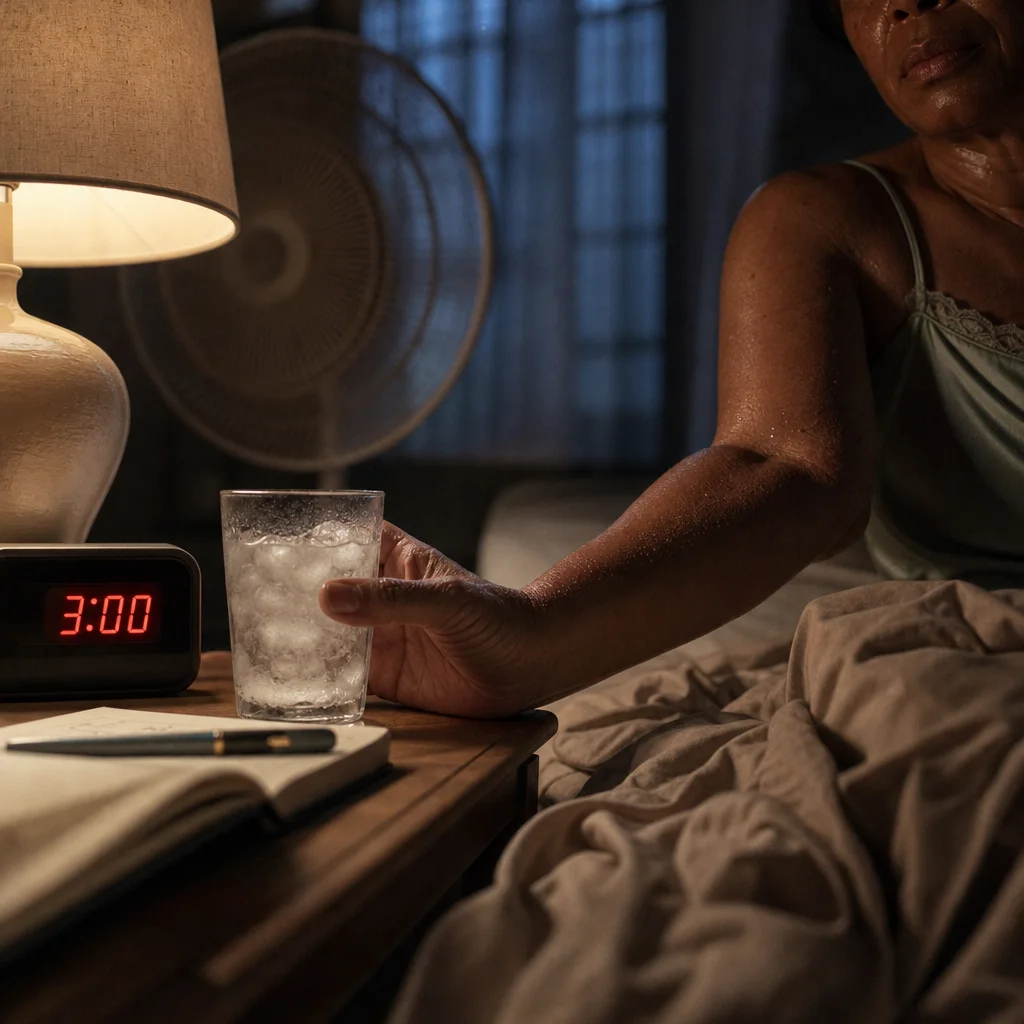
For the 3 a.m. wake-ups, ask about CBT for insomnia by name. It is a skills-based approach you can keep using after treatment ends. Many women never hear it mentioned as an option.
Keep a simple log for two weeks. Note the time, the trigger, and how long the flush lasted. That record turns a vague complaint into something your clinician can actually work with.
Questions to Bring to Your Next Appointment
Reading the menopause treatment guidelines is step one. Your appointment is where the real plan gets built. Bring a written list.
- Which symptoms would hormone therapy target in my case, and at what dose?
- Would a patch or gel suit me better than a pill, given my health history?
- Should I use local treatment alongside, or instead?
- Which non-hormonal options fit safely with my other medications?
- Do any of my current prescriptions interact with the options you are suggesting?
- How will we judge whether this is working, and when?
Also ask what “moderate” means for your body. Severity is personal. Your answer should shape the plan, not a checkbox.
Finally, ask what happens if the first option fails. Most clinicians treat symptoms as a trial-and-adjust process, not one shot at getting it right.
Common Questions Women Are Asking Now
Here are the questions that come up most often now that the menopause treatment guidelines have changed.
Do I have to stop hormone therapy at a certain age?
There is no fixed cliff. Most clinicians reassess benefits and risks at intervals and check whether you still need the same dose.
Is hormone therapy an option after breast cancer?
Usually not. Non-hormonal drugs, therapy, and local treatments are the usual paths. If you take tamoxifen, mention it explicitly. Some antidepressants used for hot flashes can interfere with how tamoxifen works, so other options are usually chosen. Your oncology team should be part of that talk.
Are “bioidentical” hormones safer?
The word is used more in marketing than in medicine. FDA-approved hormone products are reviewed for dose, purity, and consistency. Compounded versions are not FDA-approved and are not monitored the same way. Ask exactly what you are getting, who made it, and what is in it.
Is it too late if I am years past menopause?
Not too late for relief. But the risk math changes with distance from your last period. That makes a detailed history and an honest talk essential. If your periods stopped early, our guide to early menopause and Alzheimer’s risk covers what to ask next.
The Bottom Line
Here is the honest summary. Nothing about this update says hormones are risk-free. What it does is put the decision back with you and your clinician.
Good menopause care weighs your timing, history, and preferences. It does not start from a headline written in 2002.
You do not have to tough it out. You also do not have to rush. Name your worst symptom and ask for a plan you actually understand.
Start with the menopause treatment guidelines, then bring your own questions. That is how a general update becomes a plan for your body.
Primary Source
The 2002 trial referenced in this article is indexed in PubMed. You can read the original abstract there.