

Melatonin Rich Fruits: A Realistic Guide to Sleep
Key Takeaways
- One 3 mg gummy holds roughly a thousand to a million times more melatonin than a serving of fruit.
- Tart cherries lead the fruits you’d eat as fruit, at 13.46 nanograms per gram. Strawberries are close behind at 11.26.
- Fruits are the lowest-melatonin plant food group. Pistachios measure 233,000 nanograms per gram.
- Two hours before bed is the sweet spot, based on when melatonin peaks in your blood.
- For ongoing insomnia, a talking therapy called CBT-I has far better evidence than melatonin supplements.
Melatonin rich fruits sound like a simple fix for a night spent staring at the ceiling. You eat a bowl of cherries, and sleep arrives. That is the promise behind a lot of headlines this year. Here’s the thing, though: the details matter far more than the headline.
A melatonin gummy delivers milligrams of the hormone. Fruit delivers nanograms. That is a gap of roughly a thousand to a million times. So why do studies keep showing that eating fruit changes melatonin levels in your blood? Because both things are true at once.
Let’s walk through which fruits truly carry melatonin, how much they hold, and how to build a bedtime routine that works with your body instead of against it.
Quick Answer: Do Melatonin Rich Fruits Help You Sleep?
They can support a healthy sleep routine, but they will not knock you out. Fruit raises your melatonin gently and briefly. Think of it as one helpful piece of a routine — not a replacement for sleep habits, and not a treatment for insomnia.
Melatonin Rich Fruits: What the Numbers Actually Say
Melatonin rich fruits do contain the hormone. They just do not contain much of it. A 2017 review of dietary melatonin sources found that fruits generally hold the lowest melatonin of any plant food group. Seeds, leaves and nuts hold the most.
That detail rarely makes it into sleep articles. Here are the real numbers.
Melatonin Content of Common Foods
| Food | Melatonin | Basis |
|---|---|---|
| Tart cherry | 13.46 ng/g | fresh weight |
| Strawberry | 11.26 ng/g | fresh weight |
| Tomato | 14.77 ng/g | fresh weight |
| Walnut | 3.5 ng/g | basis not stated (single study) |
| Grape skin | 8.9–158.9 ng/g | dry weight |
| Mushrooms | 4,300–12,900 ng/g | dry weight |
| Pistachio | 233,000 ng/g | dry weight |
The walnut figure comes from a single study, and other published values differ.
Two caveats sit behind that table. First, fresh weight and dry weight are not the same measure. Grape skin numbers are read dry, so they look inflated next to a fresh cherry. Second, the review warns that some lab tests overestimate melatonin. Assays called RIA and ELISA can read high.
So treat those figures as solid estimates, not printed labels.
Melatonin Rich Fruits vs. a 3 mg Gummy: The Dose Math
To compare melatonin rich fruits with a supplement, you have to work in the same units. One milligram equals one million nanograms.
A typical 3 mg gummy holds 3,000,000 nanograms of melatonin. At tart cherry’s 13.46 nanograms per gram, matching that gummy would take roughly 223 kilograms of cherries. That is about 490 pounds of fruit.
Mango sits lower — one analysis put a whole mango at about 235 nanograms, or roughly 0.7 nanograms per gram. So you would need several thousand kilograms to match a gummy.
Now flip the comparison. Pistachios measure 233,000 nanograms per gram on a dry-weight basis. About 13 grams of kernels — roughly two tablespoons — works out to about 3 mg. That is on the same dry-weight basis. Because pistachios hold little water, the fresh-weight figure lands close to it.
Treat that as an estimate, though. The review cautions that some lab methods read melatonin high.
So the interesting matchup is not fruit against fruit. It is fruit against nuts, seeds and grains.
Does that mean fruit is pointless for sleep? Not at all. Research suggests dietary melatonin is absorbed and enters the bloodstream. A crossover study in the Journal of Pineal Research measured what happened after people ate fruit. Blood melatonin jumped in relative terms.
Both facts hold together. Fruit can raise your melatonin meaningfully from a low baseline, while still delivering a tiny absolute amount.
The Fruits Worth Reaching For — and the Honest Evidence
If you want melatonin rich fruits you can actually eat as fruit, tart cherries and strawberries lead the pack. But melatonin content and sleep benefit are two different questions. Here is how each fruit performs.
Tart Cherries: Best Evidence, Mixed Results
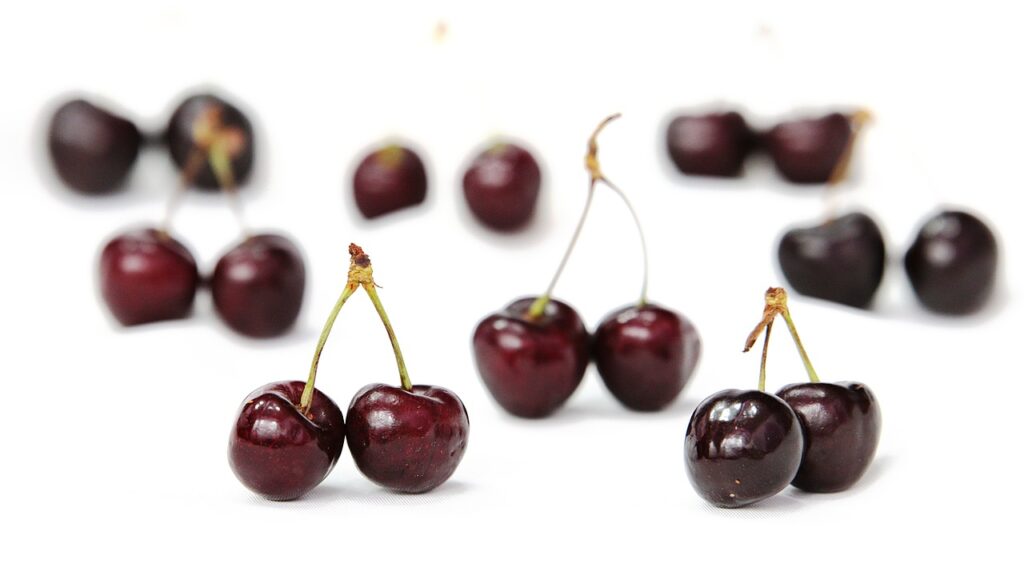
Tart cherries average 13.46 nanograms of melatonin per gram. That is the highest of the fruits you would actually eat as fruit. Tomato measures slightly more at 14.77 nanograms per gram. Grape-skin values up to 158.9 are reported on a dry-weight basis, which is not comparable to fresh fruit.
Tart cherries also carry tryptophan and polyphenols, which may support sleep on their own.
The evidence is genuinely mixed, though. A randomised, placebo-controlled trial found that 7 days of tart cherry concentrate improved time in bed, total sleep time and sleep efficiency.
A larger 2026 trial told a different story. Forty-four adults took Montmorency tart cherry as juice or capsules for 30 days. Researchers found no difference in sleep time or quality. The authors said their results conflict with earlier data.
A third pilot study in older adults with chronic insomnia found just one benefit against placebo: less time awake during the night. The researchers called their effect sizes “moderate and in some cases negligible.”
Translation: tart cherries are a pleasant, low-risk thing to try. They are not a treatment for insomnia.
Kiwifruit: Famous, But Overstated
The famous two-kiwi rule comes from one 2011 study. Twenty-four adults ate two kiwis an hour before bed for four weeks. Sleep quality scores improved by about 42%, and falling asleep got roughly 35% faster.
Read the fine print, though. That study had no placebo group and no blinding. Everyone knew they were eating kiwi for sleep. So expectation could explain part of the result.
Kiwi’s benefit also probably does not come from melatonin. Its likely helpers are serotonin, vitamin C and folate. It is still a lovely bedtime snack. Just do not expect it to work like a drug.
Strawberries, Pineapple and Mango
Strawberries come close behind, at 11.26 nanograms per gram. That is the second-highest fresh-weight figure for a fruit you would eat as fruit. Pineapple and orange raised blood melatonin in that same crossover study, peaking two hours after eating.
Mango holds only a trace — one analysis put it near 0.7 nanograms per gram. Its bigger gift may be vitamin B6, a nutrient your body uses in the pathway that converts tryptophan toward melatonin production.
Pair mango with protein or fat — chia seeds, milk or yogurt — so your blood sugar stays steady overnight.
Fruits That Support Melatonin Production
Some fruits carry almost no melatonin at all. They still belong in a melatonin rich fruits routine. They supply the raw materials your body uses to make its own. If you want a wider list of foods that carry melatonin directly, our guide to natural melatonin sources covers seven of them.
Bananas: The Honest Answer
You have probably read that bananas are packed with melatonin. That is not quite right. Bananas hold some. Their real value is tryptophan, vitamin B6 and magnesium.
The Journal of Pineal Research study measured what two whole bananas did. Blood melatonin rose from 32 to 140 pg/mL, with the peak at 120 minutes.
Ripeness does shift melatonin levels in plant foods. The 2017 Nutrients review names the ripening process among the factors that change a plant’s melatonin content. Even so, no study pins down a banana-specific figure.
A ripe or spotted banana is still a fine bedtime snack. It also pairs more easily with protein than a green one. Add peanut butter or plain Greek yogurt for staying power.
Tomatoes: The Bridge Case
Tomatoes measure 14.77 nanograms per gram, which edges past tart cherries. But they are acidic. If you get heartburn, keep them at dinner and skip them before bed.
When to Eat Them: The Two-Hour Rule
Advice online splits between one hour and three hours before bed. The pharmacokinetic data settles it. In the banana, orange and pineapple study, serum melatonin peaked at exactly 120 minutes.
Eating melatonin rich fruits about two hours before bed lines up with that peak. It also leaves time to digest. Finish larger meals at least two to three hours before you lie down.
Light matters just as much as food. Melatonin rises in darkness and falls when light hits your eyes. Bright screens at 11 p.m. can blunt your own production, no matter what you ate. Your sleep environment matters too — we’ve looked at the trade-offs in sleeping with your pet.
So dim the lights, put the phone down, and give your body the darkness signal it is waiting for.
Food First, Supplement Second
Here is where the food-first argument gets stronger. The NIH’s melatonin fact sheet reports that major sleep guidelines do not recommend melatonin for chronic insomnia. The evidence is not strong enough. Those same guidelines strongly recommend cognitive behavioral therapy for insomnia, known as CBT-I, as a first treatment.
Labels are another issue. A 2023 study found that 22 of 25 melatonin gummies did not match their labels. Actual levels ranged from 74% to 347% of the stated amount. An earlier study found 26% of melatonin supplements contained serotonin, a hormone with effects of its own.
Then there is the safety angle. The CDC estimated 11,000 emergency room visits between 2019 and 2022. Those visits were for children 5 and younger who swallowed melatonin without supervision.
Think of melatonin rich fruits and other whole foods as the everyday layer. Supplements are a targeted tool for specific problems, like jet lag, where the evidence is strongest. Use them with a clinician, not by default.
Safety: Who Should Be Careful
Melatonin Supplements: Who Should Be Careful
Sleep Foundation guidance says melatonin is generally not recommended for people who are pregnant or breastfeeding, have a bleeding disorder, experience depression, have seizures, or have received an organ transplant. Birth control pills, some antidepressants and caffeine may intensify its effects. If any of that applies to you, talk with your clinician before using it.
The NIH’s melatonin fact sheet adds two more cautions. People with epilepsy and those taking blood thinners need medical supervision while using it. The American Academy of Sleep Medicine also recommends against melatonin for people with dementia. Long-term safety is still unknown.
One more dose detail is worth knowing. How much melatonin your body absorbs from a pill is only around 15%. Research also suggests that number is nearly twice as high in women as in men. That is another reason low doses are the sensible starting point.
Frequently Asked Questions
Is canned or frozen fruit still useful?
Frozen tart cherries are available all year. They keep the fiber, polyphenols and vitamin C that make fruit a good evening snack. But there is no good data on how freezing or canning changes melatonin content. So choose them for convenience and nutrition, not as a measured melatonin dose. Choose unsweetened versions when you can.
Does red wine count as a melatonin source?
Wine does contain melatonin, but alcohol also suppresses your own production and fragments sleep. If you want grape melatonin, eat the grapes instead.
How long should I try this before deciding?
Give melatonin rich fruits two weeks with a consistent bedtime. If sleep is still a struggle after a month, that points toward a behavioral program like CBT-I, not more fruit.
The Bottom Line
A bowl of melatonin rich fruits will not knock you out, and that is exactly why it is a healthy habit worth keeping. What you are really building is a signal — food, darkness and a steady bedtime telling your body that night has arrived. Fruit also earns its place for reasons beyond melatonin — see our picks for the best fruits for brain health.
Start with a simple pairing two hours before bed: tart cherries or strawberries with Greek yogurt, or a banana with peanut butter. Add morning daylight and an earlier caffeine cutoff. That combination does more for your sleep than any single snack.
And if sleep has been hard for a month or more, skip the supplement aisle. Ask your clinician about CBT-I. That is where the strongest evidence sits — and you deserve the version of support that actually works.