

High-Protein One-Pan Dinners: The 4-Part Formula
Key Takeaways
- Most roundups call a dinner “high-protein” at 15 grams per serving. The current U.S. daily target works out closer to 25 to 30 grams at dinner.
- A repeatable four-part formula — protein, fiber-rich base, vegetable, flavor builder — beats a stack of recipes.
- A protein-rich dinner blunts hunger for a few hours. Research shows this at doses under 35 grams.
- One pan still means real food. Shortcuts are fine if you rinse, choose low-sodium, and taste before salting.
- Protein supports muscle and bone. However, it does not replace strength training.
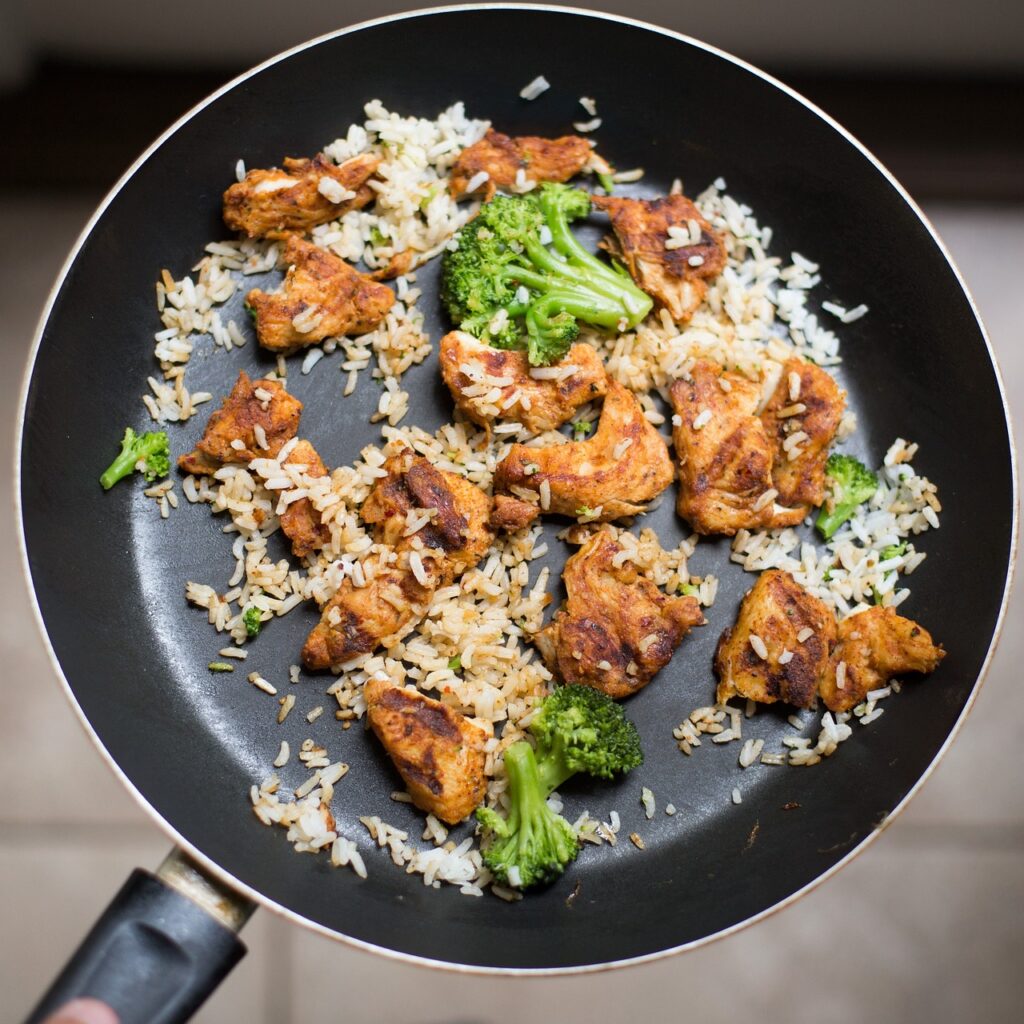
Picture this: it’s 6:30 on a Tuesday, you’re hungry, and the sink is already full. That is the moment high-protein one-pan dinners earn their keep. One pan. About 30 minutes. A plate that actually holds you until morning.
Here’s the thing, though. Most dinners labeled “high-protein” land around 15 grams per serving. That’s a fraction of what many adults need in a full day.
So this guide takes a different route. You’ll get a repeatable formula, a five-night plan, a flexible shopping list, and honest notes on the sodium hiding in everyday shortcuts.
Quick Answer: How Much Protein Belongs in High-Protein One-Pan Dinners?
Aim for roughly 25 to 30 grams of protein per serving, cooked in one pan in about 30 minutes. Federal guidance puts adult protein needs at 1.2 to 1.6 grams per kilogram of body weight per day. Dinner is the easiest meal to close that gap.
What Actually Makes High-Protein One-Pan Dinners Work
Let’s start with the number everyone repeats. Search for a one-pan protein dinner and the same bar keeps showing up: 15 grams per serving.
That 15-gram bar is a round number, not a per-meal target. Meanwhile, the 2025-2030 Dietary Guidelines for Americans set the first official daily protein target: 1.2 to 1.6 grams per kilogram of body weight.
The same guidance asks for protein at every meal, three servings of vegetables and two of fruit a day, and whole grains instead of refined ones.
Run the math and the gap appears fast. Cleveland Clinic dietitians explain it simply: divide your weight in pounds by 2.205, then multiply by 1.2. A 170-pound person lands near 92 grams a day.
Now add up three 15-gram meals. You get 45 grams. As a result, dinner has to carry real weight — closer to 25 or 30 grams.
One caveat is worth knowing. This target is new and debated. A 2026 perspective in The Journal of Nutrition argues it leans on weight-management studies. It should not be treated as one universal prescription for everyone. So treat it as the current benchmark, not settled science.
High-Protein One-Pan Dinners Start With a Simple Formula
Here’s the shift that makes weeknights easier. High-protein one-pan dinners work best as a formula, not a fixed recipe list.
Think of it as four parts, stacked in one pan.
The Four-Part One-Pan Formula
- Protein anchor — chicken thighs, lean ground meat, shrimp, salmon, canned tuna, eggs, tofu, Greek yogurt, beans, lentils, chickpeas.
- Fiber-rich base — whole-grain pasta, brown rice, farro, barley, potatoes with skin, or extra beans.
- Vegetable — whatever looks good: cabbage, spinach, broccoli, peppers, tomatoes, or a frozen blend.
- Flavor builder — garlic, ginger, lemon, vinegar, mustard, harissa, cumin, smoked paprika, dried herbs.
Once you see the pattern, you can build a new dinner on a Wednesday with no recipe at all. You also stop buying specialty ingredients you’ll use exactly once.
How Much Protein Belongs on Your Plate at Dinner?
The American Heart Association offers a handy ruler for portions. A 3-ounce serving of lean meat — about the size of a deck of cards — carries roughly 21 grams of protein.
A cup of legumes adds about 16 grams. Then a cup of yogurt brings about 11 grams, and a glass of milk about 8.
Stack those together and the target becomes concrete. Chicken plus half a cup of beans lands near 29 grams. Chickpeas plus a cup of yogurt gets you to roughly 27.
One more thing is worth clearing up. The Heart Association still cites the older 0.8 grams per kilogram recommendation. That figure is a minimum meant to prevent deficiency, not an ideal target. Both things can be true at once.
The same guidance also notes that most Americans fall short on seafood, nuts, seeds and soy. Therefore, if you eat fish, aim for it two to three times a week.
What Protein at Dinner Actually Does for You
Fullness is the most immediate payoff. A review pooling 49 randomized trials found that protein reduced hunger and raised fullness in the hours after eating.
Here’s the detail that matters for planning. Those appetite effects showed up at protein doses under 35 grams. That sits right in the range of a well-built one-pan meal.
However, the same review found long-term appetite effects were not sustained. So keep the promise small. A protein-rich dinner helps you feel satisfied until bedtime, and that’s it.
Muscle and bone get support too. A UK Biobank study followed 132,807 adults for a median of 12.4 years. The highest protein intake group had 18% lower risk of any fracture and 37% lower hip fracture risk.
That was an observational study, so it shows a link rather than proof. Even so, the pattern was steady and appeared with both plant and animal protein.
Spreading protein across the day may help as well. In a two-year study of 712 adults, those who ate protein more evenly had more lean mass. It did not change how quickly lean mass dropped, though.
And here’s the honest part. High-protein one-pan dinners do not build muscle on their own. Resistance training drives that. Dinner simply gives your body the material to work with.
Your Five-Night One-Pan Dinner Plan
Here’s what a week of high-protein one-pan dinners looks like in practice. Treat it as a template, not a rulebook — or start with our high-protein one-pot dinner recipes. Swap in whatever is cheap, frozen, or already in your fridge.
Monday — Chicken, White Bean and Tomato Skillet
Sear a deck-of-cards portion of chicken in olive oil. Then add garlic, cherry tomatoes, half a cup of cannellini beans and a few handfuls of spinach. Protein check: about 21 grams from the chicken and 8 from the beans, so roughly 29 grams.
Tuesday — Crispy Chickpea and Spinach Skillet With Lemon Yogurt
Crisp a cup of chickpeas in a hot pan with cumin and paprika. Wilt spinach into it, then finish with lemon. Protein check: about 16 grams from the chickpeas, plus 11 from a cup of Greek yogurt stirred in off the heat.
Wednesday — Shrimp, White Bean and Greens Skillet
Cook a deck-of-cards portion of shrimp with garlic and red pepper flakes. Add a cup of white beans and a bag of greens. Protein check: the beans carry about 16 grams, and the shrimp adds more on top.
Thursday — Ginger Turkey and Cabbage Rice Skillet
Brown ground turkey with ginger and scallions. Add shredded cabbage and cooked brown rice. Protein check: start with a deck-of-cards portion of turkey, then add half a cup of beans for another 8 grams.
Friday — Smoky Bean and Egg Skillet
Simmer a cup of beans with smoked paprika, tomatoes and a splash of low-sodium broth. Crack eggs on top and cover until set. Protein check: the beans bring about 16 grams, and a cup of yogurt on the side adds 11 more.
Plant-Forward Dinners That Still Hit the Target
Plant-forward high-protein one-pan dinners work well, but they need a slightly different approach. A 2026 review in Nutrients found that people who strength train gain similar muscle mass and strength on plant- and animal-based diets when total protein, per-meal dose and calorie intake are all adequate.
Gram for gram, animal protein is more efficient. Plant protein simply needs a bigger serving and better pairing to keep up.
In practice, that means aiming closer to 30 grams on a plant-forward night. Also, use two sources instead of one — beans with whole grains, or beans with seeds. For more pairings, see our high protein bean dinners.
A cup of legumes gives you about 16 grams on its own. Adding a whole grain and a spoonful of seeds pushes that higher — which is why pairing two plant sources matters on these nights.
Choosing Your Protein: What to Reach For and What to Watch
Protein source matters as much as protein amount. And this is exactly where high-protein one-pan dinners can quietly go wrong.
The American Heart Association protein guidance recommends leaning on legumes, nuts, lentils and chickpeas first. Then add fish and seafood, and use lean or skinless meat in smaller amounts.
It also warns that extra protein often arrives through meats high in saturated fat, which can raise LDL cholesterol. Processed meats — sausage, bacon, pancetta, cured deli meat — are the ones to keep occasional.
For seafood, salmon, sardines, mackerel and tuna are the strongest choices. Fried seafood does not carry the same benefits.
The Honest Tradeoffs in Convenience Shortcuts
Canned beans, jarred sauce, rotisserie chicken and low-sodium broth are genuinely useful. They are also where most of the sodium in a weeknight dinner hides.
Sodium deserves a mention because the payoff is real and uneven. A review of 160 studies found each 50 mmol per day of higher sodium intake was linked to 1.76 mm Hg higher systolic blood pressure.
According to that same research, the benefit of cutting back is largest for older adults and for anyone already managing blood pressure. So if your numbers run high, these swaps matter more, not less.
In practice, four habits handle most of it. Rinse canned beans. Choose low-sodium broth and no-sugar-added sauce. Taste before you salt. And use sausage, bacon or cheese as a flavor accent rather than the protein anchor.
On the flip side, the same dinners add potassium through beans, lentils and vegetables. That pushes in the opposite direction.
Cooking from scratch also trims packaged food. A review of 51 studies covering nearly 8.8 million adults linked higher ultra-processed food intake to higher risk of heart disease, diabetes and early death. The authors grade the certainty as low to moderate, so treat it as a strong signal rather than a verdict.
Smart Swaps and a Flexible Shopping List
A few small swaps keep high-protein one-pan dinners convenient without the sodium creep. They protect the convenience and trim the tradeoffs.
Five Swaps That Do the Most Work
- Heavy cream → a cup of Greek yogurt stirred in off the heat, or blended white beans for body.
- Fresh shrimp → a bag of frozen shrimp. It cooks in minutes and wastes nothing.
- Rotisserie chicken → shred it, skip the skin, and stretch it across two dinners.
- Jarred pasta sauce → look for no-sugar-added, lower-sodium versions. Add your own garlic and herbs.
- A block of mild cheese → a strong one like pecorino or feta in small amounts. Flavor carries further.
Your Flexible Shopping List
- Protein: eggs, chicken thighs, lean ground turkey, frozen shrimp, canned salmon or tuna, tofu, canned beans and lentils, Greek yogurt.
- Fiber-rich bases: whole-grain pasta, brown rice, farro, potatoes, whole-grain bread.
- Vegetables: onions, garlic, spinach, cabbage, broccoli, bell peppers, tomatoes, frozen vegetable blends.
- Flavor builders: olive oil, lemons, vinegar, Dijon mustard, harissa, cumin, smoked paprika, dried oregano, low-sodium broth.
Buy the protein and the flavor builders first. The base and the vegetables are the flexible parts, so let sales and seasons decide.
Frequently Asked Questions
Is 15 grams of protein enough for dinner?
Usually not. Three 15-gram meals add up to 45 grams, which falls well short of what most adults need. Roughly 25 to 30 grams per serving is the working target for high-protein one-pan dinners.
Can I hit that target without meat?
Yes. Use two plant sources instead of one. Beans with whole grains, or beans with seeds, gets you there. You may want to aim closer to 30 grams on those nights.
Do I need protein powder in a one-pan dinner?
No. Eggs, Greek yogurt, beans, fish and poultry all work well in a skillet. Honestly, they taste far better than powder in a savory dish.
Will a high-protein dinner build muscle on its own?
No. Protein gives your body the building blocks. Resistance training is what signals muscle to grow, so keep both in the picture.
Is eating more protein safe?
For most healthy adults, yes. However, Cleveland Clinic notes that people with kidney disease may be advised to keep protein intake lower. Check with your clinician before increasing it.
The Bottom Line
High-protein one-pan dinners are less about willpower and more about a repeatable pattern. One pan, four parts, about 30 minutes.
Aim for roughly 25 to 30 grams of protein per dinner. Build it from real ingredients, and let beans, whole grains and vegetables do a lot of the lifting. See our high-protein dinners that also deliver on fiber.
Then keep two honest notes in mind. Rinse, choose low-sodium, and taste before salting. Also remember that dinner supports your muscles — it does not train them.
Start with one night this week. Pick a protein, a base, a vegetable and a flavor builder. The rest gets easier from there.