

High Calorie Foods That Are Good for You: 6 Picks
Key Takeaways
- Calories don’t decide a food’s health value — nutrient density does.
- High calorie foods like nuts are linked to a lower risk of overweight and obesity.
- One egg a day fits a heart-healthy pattern for most healthy adults.
- The latest Dietary Guidelines now allow full-fat dairy.
- White rice is fine for most people, but portions and pairings matter.
Picture this: You’re at the store, eyeing the nuts. You know they’re good for you. But a little voice whispers, “Those are high calorie foods — better skip them.” If that sounds familiar, you’re not alone. Diet culture has spent decades turning calories into the enemy. However, the science tells a different story.
But calories alone don’t tell you whether a food nourishes your body. What matters more is nutrient density — the vitamins, minerals, protein, fiber, and healthy fats packed into every bite. In this guide, we’ll explore six misunderstood calorie-dense foods: nuts, full-fat dairy, cheese, eggs, rice, and potatoes. You’ll learn what the evidence really says, who should be careful, and how to enjoy them without food guilt.
Quick Answer: Are High Calorie Foods Bad for You?
No — not when they’re nutrient-dense. That’s because a food’s health impact depends on what it carries beyond calories: protein, fiber, healthy fats, vitamins, and minerals. Calorie-dense foods that are also nutrient-rich — like nuts, eggs, dairy, cheese, rice, and potatoes — fit into a healthy eating pattern. The ones to limit are high in calories but low in nutrients. Think pastries, chips, and sugary drinks.
Why High Calorie Foods Aren’t the Enemy
Calories are a measure of energy, not a moral judgment. Yet we’ve learned to label foods “good” or “bad” based on a number. The NIH MedlinePlus guide to weight control makes this clear. Weight and health depend on many factors — sleep, stress, emotions, environment, and activity. More than 70% of U.S. adults live with overweight or obesity. Calories matter, but they’re not the whole story.
Take nuts, for example. They’re among the most calorie-dense foods on the shelf. But a 2021 systematic review and meta-analysis of 6 cohort studies and 86 clinical trials found something surprising. Regular nut eaters had a 7% lower risk of overweight and obesity. Clinical trials showed no weight gain from nuts. In fact, researchers linked higher nut intake to lower body weight and body fat.
So here’s the reframe: the enemy isn’t high calorie foods. It’s empty calories — foods that deliver energy without nutrients. When a food brings protein, fiber, healthy fats, or key vitamins, those calories work for you. When it’s mostly sugar or refined starch, they don’t.
6 High Calorie Foods Worth Eating
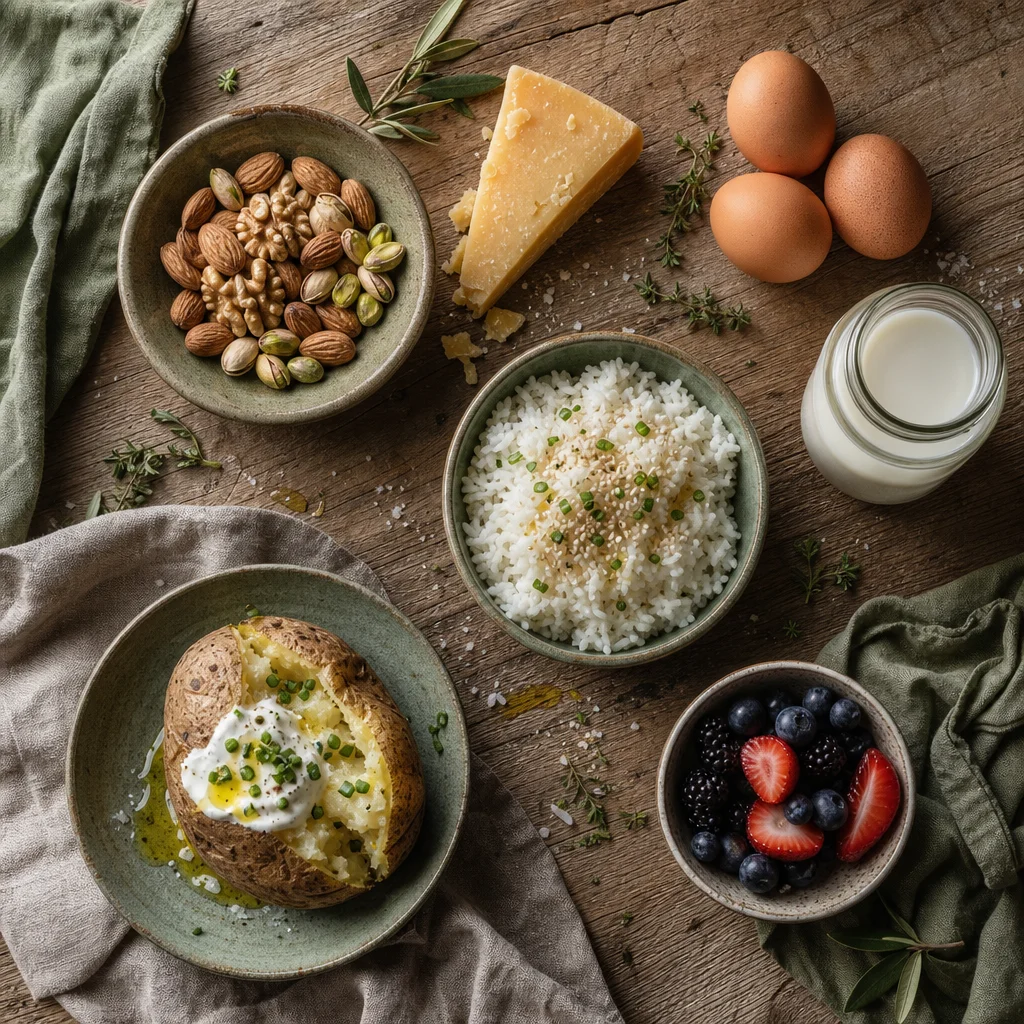
These six foods are often written off as “too fattening.” But each one shows that high calorie foods and good nutrition can go hand in hand. Let’s look at the evidence, one food at a time.
Nuts
Beyond the calories, almonds, walnuts, and pistachios deliver healthy fats, plant protein, fiber, magnesium, and polyphenols. Polyphenols are plant compounds that support heart and gut health. Because they’re satisfying, they can help curb cravings later in the day. Aim for about 1/4 cup, or one small handful. Sprinkle them over yogurt, oatmeal, or salads — and for more ideas, see our guide to anti-inflammatory foods.
Full-Fat Dairy
Whole milk is only 3.25% fat. Most people are surprised by that. And the old advice to always choose low-fat dairy is shifting. For example, a 2024 review of the dairy-fat matrix examined 59 studies. Most showed no link between regular-fat dairy and heart problems. Dairy fat sits in a unique structure called the milk fat globule. That structure changes how your body processes it. What’s more, a broader umbrella review of dairy studies found similar results. The review linked dairy intake to a lower risk of colorectal cancer, hypertension, and heart disease. Even a 2026 analysis of the new Dietary Guidelines notes that the guidelines now allow full-fat dairy. Try whole-milk yogurt with berries, or blend whole milk into your morning smoothie.
Cheese
To start, one ounce of cheese packs about 7 grams of protein and roughly 20% of your daily calcium — see our list of foods high in calcium. In the EPIC study of 409,885 Europeans, researchers linked cheese intake to a lower risk of heart disease. A second analysis, the EPIC-CVD study, looked at saturated fat sources. Interestingly, cheese behaved differently than butter or red meat. Cheese carried neutral to protective effects, while butter and red meat carried higher risk. So keep servings to about 1 ounce — the size of a pair of dice.
Eggs
One large egg has about 74 calories and 6 grams of protein, plus choline, vitamin D, B12, and selenium. The American Heart Association science advisory confirms that dietary cholesterol is no longer a specific target. Overall eating patterns matter more. Similarly, a 2022 meta-analysis of 33 prospective studies found no link between eggs and heart disease or stroke mortality. It concluded that up to one egg a day fits a healthy diet. However, a 2022 Circulation meta-analysis found small mortality associations at higher intakes. So what’s the verdict? One egg a day is fine for most healthy adults. Just boil or poach them, and serve them with vegetables — see our guide to foods to pair with eggs.
Rice
Cooked white rice provides steady energy. It’s also a low-FODMAP food, so it’s gentle for many people with IBS. The evidence on rice is more nuanced than most articles admit. First, a 2023 meta-analysis of 28 cohort studies found no link between white rice and heart disease or cancer. It also found no link to other metabolic conditions. But it did find a modest link to type 2 diabetes. Researchers found a 6% higher risk for every additional 150 grams per day — about 1 cup. The link was stronger in women. So the practical fix? Enjoy rice in portions of about 1 cup cooked. And pair it with protein, vegetables, or healthy fats. For a gentler option, brown rice and cooled rice are excellent swaps.
Potatoes
Potatoes deliver potassium, vitamin C, and fiber — keeping the skin on adds even more of each (see our list of high-fiber foods). They’re also among the most satisfying foods you can eat. A randomized crossover study found that a potato’s glycemic index didn’t affect fullness. People ate the same amount later, no matter which potato they’d had. But preparation matters more than the potato itself. Baked or boiled potatoes with skin beat fried versions every time. A medium potato is about the size of a computer mouse. Then, top it with Greek yogurt, chives, and a little cheese.
Who Should Be More Careful With These Foods?
These foods are healthy for most people. However, some readers should be more mindful. If you have heart disease or high cholesterol, clinical experts often suggest limiting egg yolks to about four per week. If you have diabetes or prediabetes, keep rice portions moderate and pair it with protein and fiber. If dairy doesn’t agree with you, choose lactose-free milk or fortified plant-based yogurts. And if you have kidney disease, talk to your clinician about potassium-rich foods like potatoes. Even high calorie foods deserve attention to portion and personal health.
A Simple Portion Cheat Sheet
Portion awareness isn’t about restriction. It’s about freedom. When you know what a serving looks like, you can eat without second-guessing. Even healthy high calorie foods work best in reasonable amounts. Here are some easy visual cues:
- 1/4 cup nuts = a golf ball
- 1 ounce cheese = a pair of dice
- 1 cup cooked rice = a baseball
- 1 medium potato = a computer mouse
- 6 ounces Greek yogurt = a small yogurt cup
A One-Day Menu Built Around These Foods
Here’s what a balanced day might look like with these foods in the spotlight. No apps. No tracking. No guilt.
- Breakfast: two eggs scrambled with spinach and a slice of whole-grain toast
- Morning snack: full-fat Greek yogurt with berries and a small handful of almonds
- Lunch: a rice bowl with grilled chicken, avocado, and sauteed greens
- Afternoon snack: an apple with 1 ounce of cheddar
- Dinner: a baked potato topped with Greek yogurt and chives, roasted salmon, and a side salad
Overall, this pattern delivers protein, fiber, healthy fats, and key vitamins and minerals. Plus, it’s satisfying, budget-friendly, and simple to prep.
Frequently Asked Questions
Will eating high calorie foods make me gain weight?
Not on their own. Weight change depends on your total calorie intake, activity, sleep, and hormones. In fact, foods like nuts are linked to a lower risk of overweight and obesity, and satisfying, protein-rich foods like eggs can help you feel fuller longer. On the other hand, the bigger risk is oversized portions prepared with lots of added butter, oil, or sugar.
How can I tell if a calorie-dense food is a good choice?
Run the nutrient test. Does it provide protein, fiber, healthy fats, vitamins, or minerals? If yes, it earns its place on your plate. If it’s mostly sugar, refined flour, or low-quality oils, enjoy it less often.
Can I eat these foods every day?
Absolutely — in sensible portions. Variety still matters. Rotate your nuts, try different cheeses, and mix white and brown rice.
The Bottom Line
Here’s the takeaway: high calorie foods are not the enemy. Nutrient-poor foods are. When you choose foods that carry protein, fiber, healthy fats, and key vitamins, those calories work for you. And they support your energy, heart, gut, and mood. Give yourself permission to enjoy them. Build a plate that nourishes you. That’s what healthy living looks like — and it starts with letting go of food guilt.