

Non-Toxic Food Storage: What Toxicologists Want You to Know
Key Takeaways
- Non-toxic food storage starts with a simpler question than you think. It’s about migration, not presence — whether chemicals move from a container into your food at levels that matter.
- Glass is the gold standard. It’s chemically inert, resists odors and stains, and shows minimal migration.
- Stainless steel is durable and low-release. Just don’t microwave it, and use glass for acidic foods.
- Food-safe plastic is fine when used correctly: no heat, no damage, replaced when worn.
- Start with the swap that matters most: glass for hot foods. Small changes add up.
Here’s the thing about non-toxic food storage: it’s not about the container. It’s about what moves from the container into your food. “Non-toxic” gets tossed around so loosely that it’s almost meaningless now. Let’s look at what toxicologists actually say.
Picture this: you’re staring at a shelf of storage containers. Some are glass. Some are plastic. A few are scratched. One says “BPA-free.” Another claims to be “microwave-safe.” Which ones do you keep? Which do you replace? Here’s the good news. You probably don’t need to throw everything out today.
This guide explains the science behind food storage materials. You’ll learn which containers deserve your trust. And you’ll find out which plastics are fine to keep. Plus, we’ll show you how to swap smart without breaking your budget.
Quick Answer: What makes food storage containers truly non-toxic?
The real question for non-toxic food storage isn’t whether a container contains chemicals — nearly all materials do. It’s whether those chemicals migrate into your food at levels that matter. Glass wins because it’s chemically inert. Stainless steel is a strong second. Food-safe plastic works if you use it cold, keep it undamaged, and replace it when scratched.
What Non-Toxic Food Storage Really Means
Marketing loves the word “non-toxic.” But there’s no legal definition for it on kitchenware. So the label alone tells you very little.
Toxicologists focus on something else: migration. Board-certified toxicologist Dr. Leslie Patton puts it simply. We shouldn’t worry about whether a substance exists in a container. We should ask whether it moves into our food at levels that could affect health. Containers built for food storage keep chemical migration low.
Why does migration matter? Some chemicals in plastic — like bisphenols and phthalates — are endocrine disruptors. That means they can interfere with the body’s hormones. The NIEHS notes that even low doses of these chemicals may be unsafe, since hormones act in tiny amounts. That’s not a reason to panic. It’s a reason to be informed.
So when you see “non-toxic food storage” on a package, dig deeper. Ask three questions. What material is it? What food will touch it? Will it ever get hot? The answers matter far more than the label.
The Science of Non-Toxic Food Storage: Heat, Time, and Migration
Here’s what the research actually shows. The science of non-toxic food storage comes down to three things: heat, time, and wear.
Heat is the biggest driver. Microwaving plastic releases far more micro and nanoplastics than cold storage, a 2023 Environmental Science & Technology study found. In lab tests using water and acidic food simulants, some containers released up to 4.22 million microplastic particles per square centimeter in three minutes of heating. That’s a strong reason to reheat in glass.
Even polypropylene — resin #5, the plastic often labeled “microwave-safe” — sheds particles. Hot water rinses released more nanoplastics from polypropylene containers, a 2025 Journal of Agricultural and Food Chemistry study found. Room-temperature water released far fewer.
Here’s the takeaway: “microwave-safe” means the plastic won’t melt. It doesn’t mean nothing migrates.
BPA, Regulators, and the Precautionary Choice
What about BPA? One national survey found BPA in 93% of urine samples. The NIEHS says diet is the main exposure source.
BPA can leach from polycarbonate containers and some can linings. Heat raises the leaching rate. The agency advises glass, porcelain, or stainless steel for hot food and liquids.
Now for the balanced part. The FDA says BPA is safe at the current levels found in food. Both views can be true.
Regulators assess one chemical at a time. Independent researchers point to low-dose and combined exposures.
Your move? Take the low-cost precaution. Use glass for hot food. It’s simple, and it costs nothing extra.
Glass: The Gold Standard
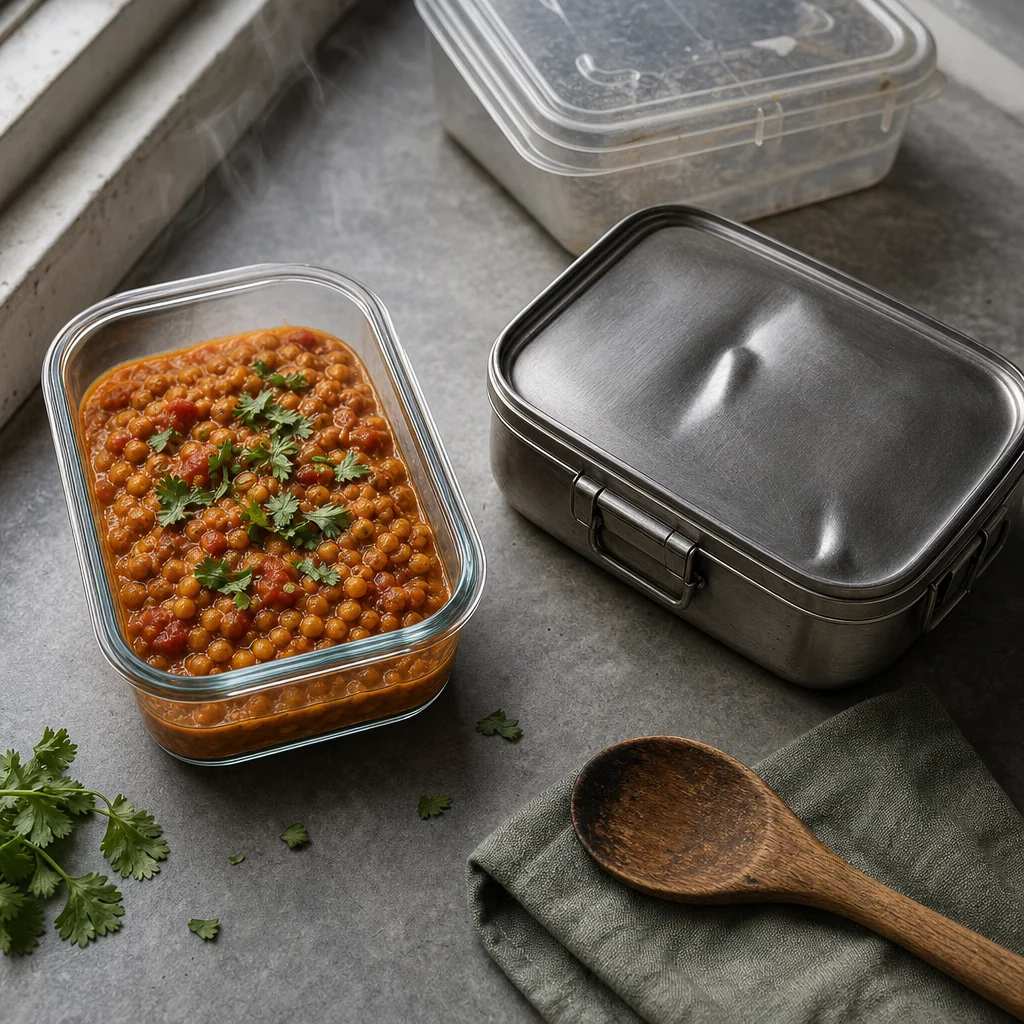
For everyday use, glass is the gold standard of non-toxic food storage. It’s chemically inert, so it doesn’t react with food or release particles. It won’t absorb odors either. Last week’s curry won’t flavor this week’s oatmeal.
Glass handles heat well. Most tempered glass containers go from fridge to microwave to table without issue. Check the label for oven and freezer safety.
Watch the lids, though. Many glass sets come with plastic lids. That’s a fair tradeoff, since lids rarely touch hot food. For a fully plastic-free option, look for sets with glass lids and silicone seals.
Price-wise, glass sets run about $33 to $40 for a starter bundle. That’s roughly $5 to $7 per container. Not bad for something that can last decades. Pair those glass containers with our storage tips for leafy greens, and your produce will stay crisp longer, too.
Stainless Steel and Silicone: The Strong Alternatives
Stainless steel is the durability champion. It’s lightweight, nearly unbreakable, and shows very low chemical release under normal use. It’s excellent for packed lunches, dry goods, and food on the go.
Two caveats. Never put steel in the microwave. Choose glass for acidic foods like tomato sauce or citrus.
Acid can slowly corrode steel and let trace metals leach into food. For a quick meal, steel is fine. For days of storage, glass is better.
What about silicone? Food-grade silicone is flexible, freezer-safe, and heat-resistant. It’s a great swap for plastic bags. Quality matters, though.
Look for platinum-cured silicone with food-grade certification. Skip cheap versions with fillers. A popular industry test: pinch and twist. If it turns white, it may contain fillers. It’s a handy check, though not a lab-verified method.
If You Keep Plastic: A Resin-Code Cheat Sheet
Let’s be honest. Most of us have plastic containers we like. You don’t need to toss them all. You need to know which ones work for non-toxic food storage — and how to use them safely.
Which Plastic Numbers Are Safest?
Flip the container over. You’ll see a triangle with a number inside. That’s the resin ID code. An expert review on plastic food container safety ranks them like this. These are expert guidelines, not official FDA classes.
- #2 (HDPE) and #5 (polypropylene): lowest leaching risk. Good for cold storage. Don’t heat them.
- #4 (LDPE): fine as a solid container. Avoid food wrap made from it.
- #1 (PET/PETE): okay for single use. Less predictable when reused.
- #6 (polystyrene): skip when possible. Never heat it.
- #3 (PVC) and #7 (other): the ones to avoid. PVC contains phthalates. #7 can include polycarbonate with BPA or its substitutes.
Three rules for plastic you keep. Never microwave it. Wash it gently — dishwasher heat speeds up wear.
Replace it once it’s scratched, cloudy, or warped. Damaged plastic sheds more particles.
One more thing. Those takeout containers? They likely aren’t designed for repeated use. Treat them as single-use, not permanent storage.
A Smart-Shopping Checklist for Healthier Storage
Ready to buy? Here’s a simple checklist for smart non-toxic food storage purchases:
- Glass first for leftovers, hot food, and acidic dishes.
- Stainless steel for lunches, dry goods, and travel.
- Check the lids. Plastic lids are common; glass or silicone lids are plastic-free.
- Look for sturdy seals. Silicone gaskets and locking latches keep food fresh and stop leaks.
- Know your budget. Glass runs $5 to $7 per container. Steel sets of four cost about $29 to $36.
- Skip resin codes #3 and #7.
On a tight budget? Start small. Replace the container you microwave most often first. That’s your highest-exposure scenario.
Then work through the rest over time. Every swap counts. And when you’re ready to upgrade other kitchen gear, the same lens applies to appliances — our guide to non-toxic air fryers breaks down what to look for.
Microplastics: What We Know, What We Don’t
You’ve seen the headlines about microplastics. Here’s an honest summary of the evidence.
A 2024 New England Journal of Medicine study found microplastics in the artery plaque of 58.4% of surgical patients. Those with microplastics in plaque had a 4.5 times higher risk of heart attack, stroke, or death over about 34 months. That sounds alarming. But it’s an association, not proof of cause.
A 2026 systematic review reports that microplastics build up in human organs and correlate with inflammation. It adds that study limits prevent proof of cause. Harvard experts note that microplastics appear in many foods and drinks. Tissue levels seem to climb over time.
So what do we do? We make reasonable choices. We don’t live in fear of every plastic in the kitchen. We prioritize the swaps that matter most: glass for hot foods, steel for lunches, and replacing worn plastic. That’s precaution with perspective.
It’s the same evidence-based approach we take in our non-toxic mattress guide: cut exposure where it’s easy, without letting fear drive the decision.
Frequently Asked Questions
Is BPA-free plastic actually safe?
“BPA-free” is a start, not a finish. When makers removed BPA, many switched to similar chemicals like BPS and BPF. Early research hints they may act like BPA, though human data is limited. For non-toxic food storage, the bigger question is material and use. For hot food, glass or steel beats any plastic.
Can I microwave plastic if it says “microwave-safe”?
Technically, yes. The plastic won’t melt. But “microwave-safe” refers to heat tolerance, not migration. Studies show heating plastic increases particle release. Reheat in glass instead. Your food will taste better too.
Do plastic lids on glass containers defeat the purpose?
Not really. Food spends most of its time in the container, not on the lid. Just remove plastic lids before heating. If you want zero plastic, some brands sell glass lids with silicone seals.
Is stainless steel safe for acidic foods?
Glass is better for long contact with acidic foods like tomato sauce. Acid can slowly corrode steel and release trace metals. For a quick meal, steel is fine. For marinating or storing leftovers for days, use glass.
The Bottom Line
Non-toxic food storage doesn’t require a perfect kitchen. It requires knowing what matters: material, heat, and wear. Keep glass for hot and acidic foods. Use stainless steel for lunches and dry goods. If you keep plastic, use it cold, keep it undamaged, and replace it when it shows wear.
And remember — you don’t have to do it all at once. Swap the container you heat most often first. Small changes, done consistently, build a healthier everyday kitchen.