

Visceral Fat Exercises: 15-Minute Body-Weight Circuit
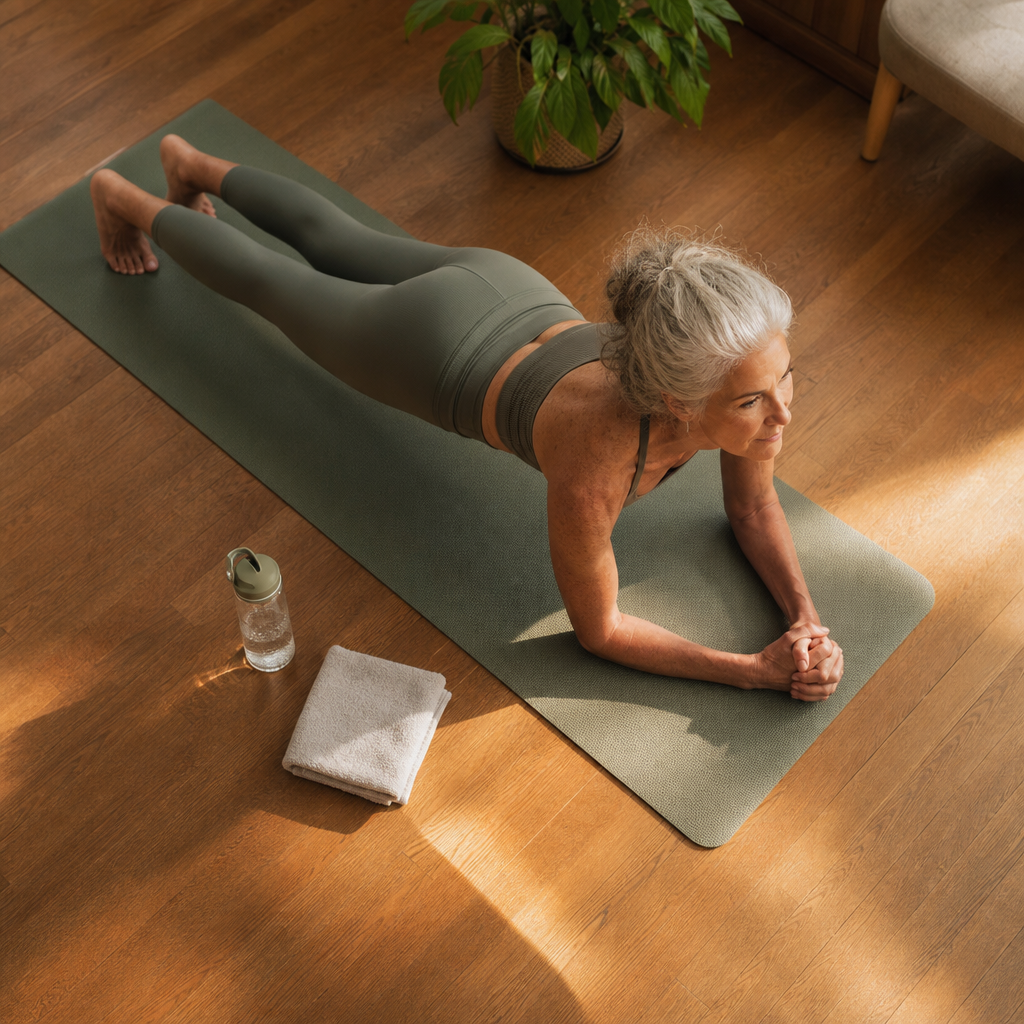
You’ve noticed the change. Your clothes fit differently around the middle, even though your eating habits haven’t shifted much. That stubborn belly fat isn’t just about getting older or eating a few too many snacks. It’s actually driven by something specific happening inside your body — and the right kind of movement can directly counter it. Here’s what you need to know about visceral fat exercises that actually work, why they matter, and how to build a simple routine you can do at home with zero equipment.
Key Takeaways
- Visceral fat is hormonally driven. Declining estrogen during perimenopause and menopause directly causes your body to store more fat deep in your abdomen — it’s not your fault.
- Body-weight exercises are proven to work. A 2025 study found that home-based, equipment-free interval training significantly reduced waist circumference and body fat in postmenopausal women — and we break down a full set of similar moves in our guide to body-weight visceral fat exercises for women over 50.
- Combined training beats cardio alone. A large 2023 meta-analysis of over 5,600 women showed that pairing strength training with aerobic exercise is the most effective strategy for reducing visceral fat.
- You can’t spot-reduce. Crunches and sit-ups alone won’t target visceral fat. Full-body exercises that engage multiple muscle groups are what create real change.
- Sleep, protein, and daily movement compound your results. Exercise works best when paired with quality sleep, adequate protein, and moving more throughout the day.
Let’s start with the part most articles skip: why this happens. Understanding the “why” makes the “what to do about it” feel a lot more empowering.
Why Visceral Fat Increases After 50
Here’s the thing: visceral fat isn’t the same as the pinchable fat just under your skin. It’s the deeper fat that wraps around your liver, pancreas, and intestines — and it’s metabolically active, meaning it directly affects how your body works.
During perimenopause and menopause, your body undergoes a major metabolic shift. As estrogen declines, your resting energy expenditure drops — your body simply burns fewer calories at rest than it used to. Your ability to burn fat for fuel also decreases. According to a 2026 review in Climacteric, the journal of the International Menopause Society, declining estrogen during menopause reduces energy expenditure and increases visceral fat storage. This isn’t about willpower. It’s biology.
But here’s the good news: exercise directly counteracts these hormonal changes. It improves insulin sensitivity, reduces inflammation, and helps your body use energy more efficiently — all of which work against visceral fat accumulation.
Quick Answer: Can Body-Weight Exercises Really Reduce Visceral Fat?
Yes. A 2025 randomized controlled trial published in Physiological Reports found that home-based body-weight exercise improved weight and waist circumference without any equipment in postmenopausal women. Participants did interval-style body-weight exercises three times per week for eight weeks and saw significant reductions in weight, BMI, and waist circumference. Adherence rates were high — 85 to 96 percent — suggesting this approach is both effective and sustainable.
The Science Behind Visceral Fat Exercises
You might be wondering: do I need heavy weights or a gym membership to see results? The research says no — but the type of exercise matters.
A 2026 systematic review found that combined training significantly reduces visceral fat — and it does so more effectively than it reduces subcutaneous fat. The review, published in BMC Public Health, analyzed 18 studies and found that combining aerobic exercise with resistance training preferentially targets the deep belly fat that poses the greatest health risk.
What’s the optimal dose? The research points to at least three sessions per week, 60 minutes per session, for 15 weeks or longer. But don’t let that intimidate you. Even shorter sessions — like the 15-minute circuit we’ll share below — can make a meaningful difference when done consistently.
A large meta-analysis of over 5,600 postmenopausal women found combined training most effective for reducing body fat. The 2023 review in Frontiers in Endocrinology analyzed 101 studies and concluded that the combination of aerobic and resistance training is the best strategy for improving body composition in postmenopausal women.
5 Body-Weight Visceral Fat Exercises for a 15-Minute Circuit
Here’s a complete circuit you can do at home, in your living room, with no equipment. Perform each exercise for 45 seconds, rest 15 seconds, then move to the next. Complete the full circuit twice for a 15-minute workout. Aim for three sessions per week.
1. Body-Weight Squats
Squats target the largest muscles in your body — your glutes, quads, and hamstrings. Big muscles demand more energy, which means they help your body burn more calories and use glucose more efficiently. A 2023 RCT published in Maturitas found that a 15-week resistance training program reduced abdominal fat in postmenopausal women, measured by MRI.
How to do it: Stand with feet shoulder-width apart. Engage your core and keep your chest lifted. Bend your knees and push your hips back as if sitting into a chair. Lower until your thighs are nearly parallel to the floor — or as low as you can comfortably go. Push through your heels to return to standing.
Beginner modification: Use a sturdy chair. Sit toward the edge, stand up fully, then slowly lower back down with control.
2. Step-Ups
Step-ups mimic climbing stairs — a movement pattern you use every day. They challenge your balance, elevate your heart rate, and recruit multiple muscle groups at once. This combination makes them efficient for both strength and cardiovascular fitness.
How to do it: Stand in front of a low, stable step or bench. Step up with your right foot, pressing through your heel. Bring your left foot up to meet it. Step your left foot back down slowly, controlling the descent. Repeat for 45 seconds, then switch legs.
Beginner modification: Use a lower step — even a single stair works. Focus on slow, controlled movements rather than speed.
3. Plank
The plank is a full-body isometric exercise that builds core strength, shoulder stability, and endurance. A strong core supports better posture and helps you perform other exercises with proper form — which matters for both safety and effectiveness.
How to do it: Start face-down with your forearms on the floor, elbows directly under your shoulders. Step your feet back to form a straight line from your head to your heels. Engage your core and glutes. Breathe steadily and hold for 45 seconds.
Beginner modification: Lower your knees to the ground while keeping your upper body in a straight line. You’ll still build core strength without the full body weight demand.
4. Modified Pushups
Pushups strengthen your chest, shoulders, arms, and core simultaneously. They create significant metabolic demand — meaning your body has to work hard, which supports fat burning and muscle preservation.
How to do it: Start on your knees with your hands slightly wider than shoulder-width apart. Keep your body in a straight line from your head to your knees. Lower your chest toward the floor by bending your elbows — keep them at a 45-degree angle from your body, not flared out. Push back up.
Beginner modification: Use a wall or countertop. Stand facing it, place your hands on the surface, and perform the same movement. The more upright you are, the easier it is.
5. Walking Lunges
Walking lunges engage your legs, glutes, and core while raising your heart rate. They also challenge your balance and coordination — skills that become increasingly important as we age. A 2020 study in Medicine and Science in Sports and Exercise found that HIIT was more effective than steady-state cardio for reducing deep belly fat in postmenopausal women. Walking lunges, done at a brisk pace, fit perfectly into a HIIT-style circuit.
How to do it: Stand with your feet together. Step forward with your right leg and lower your body until both knees form 90-degree angles. Push through your right heel to stand, bringing your left leg forward into the next step. Continue alternating for 45 seconds.
Beginner modification: Perform stationary lunges instead — step forward and back to the same starting position. This reduces the balance demand while still working the same muscles.
Your Weekly Visceral Fat Exercise Schedule
Consistency matters more than intensity. Here’s a simple weekly template that follows the research-backed approach of combining strength and cardio:
- Monday: 15-minute body-weight circuit (the one above) + 20-minute brisk walk
- Tuesday: 30-minute walk or light bike ride
- Wednesday: 15-minute body-weight circuit
- Thursday: Rest or gentle stretching
- Friday: 15-minute body-weight circuit + 20-minute brisk walk
- Saturday: Longer walk or fun activity (hike, bike, dance)
- Sunday: Rest
This schedule gives you three strength sessions and meets the U.S. Physical Activity Guidelines recommend at least 150 minutes of aerobic activity and two strength sessions per week.
Lifestyle Habits That Compound Your Results
Exercise is powerful, but it works best as part of a bigger picture. Here are three habits that directly support visceral fat reduction:
Prioritize sleep. Poor sleep raises cortisol — your stress hormone — and cortisol is directly linked to increased visceral fat storage. Aim for seven to nine hours of quality sleep. If you struggle with sleep, even small improvements make a difference.
Eat enough protein. Your muscles need protein to repair and grow after strength training. Aim for 20 to 30 grams of protein at each meal — think eggs at breakfast, grilled chicken or lentils at lunch, fish or tofu at dinner. Protein also keeps you full, which helps with overall calorie balance.
Move more throughout the day. A 15-minute workout is great, but if you sit for the other 15 hours, you’re working against yourself. Take short movement breaks every hour — a few minutes of walking, some desk squats, or stretching. These small bursts add up.
How to Track Your Progress
You don’t need a medical scan to know if your visceral fat is decreasing. The simplest at-home measure is your waist circumference. Use a tape measure around your bare abdomen at the level of your belly button. Breathe out normally, then measure. For women, a waist measurement of 35 inches or more may indicate excess visceral fat. Measure once a month — not daily, as it fluctuates with digestion and hydration. A decreasing trend over several months is a great sign that your approach is working.
Safety and When to Check With Your Clinician
Before starting any new exercise routine, especially if you’ve been inactive or have existing health conditions, it’s wise to check with your healthcare provider. This is especially important if you have joint pain, high blood pressure, heart concerns, or are managing a chronic condition like diabetes or thyroid disease.
Listen to your body. Sharp pain is a signal to stop. Muscle soreness after a workout is normal — joint pain is not. Start with the beginner modifications and progress only when you feel ready. The goal is sustainable consistency, not pushing through pain.
Frequently Asked Questions About Visceral Fat Exercises
How long does it take to see results from visceral fat exercises?
Research shows measurable changes in as little as 8 to 15 weeks with consistent training. The 2025 home-based exercise study showed improvements in 8 weeks. The 2023 resistance training study showed MRI-confirmed visceral fat reduction in 15 weeks. Be patient — visceral fat is metabolically active and responds to consistent effort, but it doesn’t change overnight.
Can I lose visceral fat without losing weight overall?
Yes. This is one of the most important things to understand. Exercise — especially resistance training — can reduce visceral fat while preserving or even increasing muscle mass. The scale might not change much, but your body composition improves. Your waist circumference is a better measure of progress than your weight.
Is walking enough to reduce visceral fat?
Walking is excellent for overall health and can support weight management, but research suggests that adding resistance training produces better results for visceral fat specifically. The combination of walking (aerobic) with body-weight strength exercises is the most effective approach. Think of walking as your foundation and strength training as the targeted strategy.
What if I have knee pain? Can I still do these exercises?
Yes, with modifications. For squats, use a chair and focus on controlled movement. For lunges, keep them stationary and take a smaller step. The plank and modified pushups are generally knee-friendly. Always stop if you feel sharp pain and consult a physical therapist for personalized guidance.
The Bottom Line
Visceral fat after 50 isn’t a sign that you’re doing something wrong. It’s a sign that your hormones are shifting — and that’s completely normal. The good news is that your body still responds beautifully to the right kind of movement.
Body-weight exercises — squats, step-ups, planks, pushups, and lunges — are proven to reduce visceral fat, improve insulin sensitivity, and preserve the muscle mass that keeps your metabolism running. You don’t need a gym, expensive equipment, or punishing workouts. You need consistency, patience, and a routine that fits your life.
Start with the 15-minute circuit three times this week. Pair it with good sleep, enough protein, and more daily movement. Measure your waist today, then again in a month. Small steps, done consistently, create real change.