
Petroleum-Based Food Dyes: What the FDA Just Did
Have you checked the ingredient list on your orange juice lately? Or the label on that bag of bright orange cheddar snacks? If you have, you may have spotted something called “Citrus Red No. 2” or “Yellow No. 6.” These are petroleum-based food dyes — synthetic colors made from crude oil — and they are finally on their way out of the U.S. food supply. Here is what you need to know about the FDA’s latest actions, which dyes are affected, and how to shop smarter starting today.
Key Takeaways
- Breaking news: On July 22, 2026, the FDA revoked Orange B and proposed revoking Citrus Red No. 2 — two petroleum-based food dyes that were already abandoned by industry.
- Big picture: The FDA is phasing out all petroleum-based food dyes from the U.S. food supply, with most major brands committed to removing them by the end of 2027 according to the agency’s most recent industry pledge tracker.
- Health concerns: Research links these dyes to behavioral issues in children, and some have been found to contain cancer-causing contaminants.
- What to do now: Learn the names of the six remaining dyes to avoid, and look for products that have already switched to natural alternatives.
What the FDA Just Did — and Why It Matters
On July 22, 2026, the FDA announced two major actions targeting petroleum-based food dyes. First, it issued a final order revoking the authorization for Orange B — a dye that had been approved but was no longer used by any manufacturer. Second, it proposed revoking Citrus Red No. 2, a dye used since 1959 to color the skins of fresh oranges.
Here is the thing: both of these dyes were already abandoned by the food industry. The FDA’s move is essentially a cleanup — similar to its recent scrutiny of PFAS in produce — formally removing outdated approvals that no longer reflect what is actually in our food. But it is also a clear signal. The agency is methodically working through every petroleum-based food dye on its books.
The public can comment on the Citrus Red No. 2 proposal until August 24, 2026. After that, the FDA will make a final decision. Given that the dye is already unused, the outcome is not really in doubt.
The Bigger Picture: FDA’s Plan to Phase Out Petroleum-Based Food Dyes
These July 2026 actions are just the latest step in a much larger shift. In April 2025, the FDA and HHS announced a comprehensive plan to phase out all petroleum-based food dyes from the nation’s food supply. The plan includes:
- Establishing a national standard and timeline for industry transition
- Working with manufacturers to eliminate the six remaining synthetic dyes — originally targeted by end of 2026 in the April 2025 plan, with the FDA’s June 2026 industry pledge tracker now showing a target of end of 2027
- Fast-tracking approval of four new natural color additives
- Partnering with the NIH for research on how food additives affect children’s health
This follows the January 2025 revocation of Red No. 3 under the Delaney Clause — a law that prohibits any food additive found to cause cancer in animals or humans. Red No. 3 was shown to cause cancer in male rats, triggering the ban. (The FDA notes the cancer mechanism is rat-specific and does not occur in humans, but the law is clear.)
Timeline: How We Got Here
- January 2025: FDA revokes Red No. 3 authorization under Delaney Clause
- April 2025: FDA/HHS announce comprehensive phase-out of all petroleum-based food dyes
- July 2026: FDA revokes Orange B, proposes revoking Citrus Red No. 2
- By end of 2027: Six remaining synthetic dyes targeted for elimination (per FDA’s June 2026 industry pledge tracker)
Which Petroleum-Based Food Dyes Are Still in Use?
As of July 2026, six petroleum-based food dyes are still approved for use in U.S. foods. These are the ones you will see on ingredient labels:
- FD&C Red No. 40 (Allura Red AC) — one of the most common dyes in the U.S. food supply
- FD&C Yellow No. 5 (Tartrazine)
- FD&C Yellow No. 6 (Sunset Yellow)
- FD&C Blue No. 1 (Brilliant Blue)
- FD&C Blue No. 2 (Indigo Carmine)
- FD&C Green No. 3 (Fast Green)
Red No. 3 is also still technically allowed until the compliance deadline of January 2027 for foods and January 2028 for drugs. After that, it will be gone too.
On labels, these dyes may also appear as “Red 40 Lake,” “Yellow 5 Lake,” or by their European E-numbers (E129 for Red 40, E102 for Yellow 5, etc.).
Health Concerns: What the Science Actually Says
Now, you might be thinking: “If these dyes have been approved for decades, how bad can they really be?” It is a fair question. Here is what the research shows.
The strongest evidence links artificial food dyes to behavioral issues in children. A 2024 systematic review in the Archives of Disease in Childhood found that artificial azo dye food colorants cause disturbed behavior in children. The review also noted that these dyes may have neurotoxic properties through gut microbial generation of toxic metabolites. The author recommended that azo dye food colorants should be banned.
A 2013 meta-analysis in The American Journal of Psychiatry found that eliminating artificial food colors from the diet produced a statistically significant reduction in ADHD symptoms — especially in children with known food sensitivities. The effect was larger than what researchers found for free fatty acid supplements.
Cancer concerns are more complicated. A 2012 review in the International Journal of Occupational and Environmental Health found that all nine U.S.-approved dyes at the time raised health concerns. Red No. 3 causes cancer in animals. Red No. 40, Yellow No. 5, and Yellow No. 6 have been found contaminated with benzidine — a known human carcinogen. A 2023 review in Current Topics in Medicinal Chemistry found that Blue No. 1 causes kidney tumors in mice, while Blue No. 2 and Citrus Red No. 2 are associated with brain and urinary bladder tumors.
On the flip side, the FDA has stated that most children do not experience adverse effects from color additives when consumed within regulatory limits. The agency’s position is that the scientific evidence does not support claims that approved dyes put people at risk.
Here is the honest truth: the science is not settled. But what everyone agrees on is that these dyes have no nutritional value. They exist only to make food look more appealing. And safer alternatives now exist.
Which Companies Have Already Removed Petroleum-Based Food Dyes?
The FDA tracks industry commitments to remove petroleum-based food dyes. As of June 2026, 27 companies have made public pledges. Some have already completed the transition:
- Already dye-free: Nestlé USA, In-N-Out Burger, Tyson Foods, Sam’s Club, Target, PIM Brands (Welch’s fruit snacks)
- Committed by 2027: Mars (M&Ms, Skittles), PepsiCo (Cheetos, Doritos, Gatorade), General Mills (Trix, Cinnamon Toast Crunch), Kraft Heinz (Kool-Aid, Jell-O), Hershey, Campbell’s, Conagra, Danone, Kellanova, and more
The European Union requires warning labels on foods containing Red 40, Yellow 5, and Yellow 6 — a regulatory difference the FDA’s current actions are narrowing. Many of these major brands already sell dye-free versions of their products in Europe and are now bringing those formulations to the U.S. market.
What Natural Alternatives Are Companies Using?
The FDA is fast-tracking approval of four new natural color additives: butterfly pea flower extract, gardenia blue, Galdieria extract (a red algae), and calcium phosphate. Other natural color sources have been used in foods for years and may grow more popular as manufacturers reformulate. Here is what you will start seeing on labels:
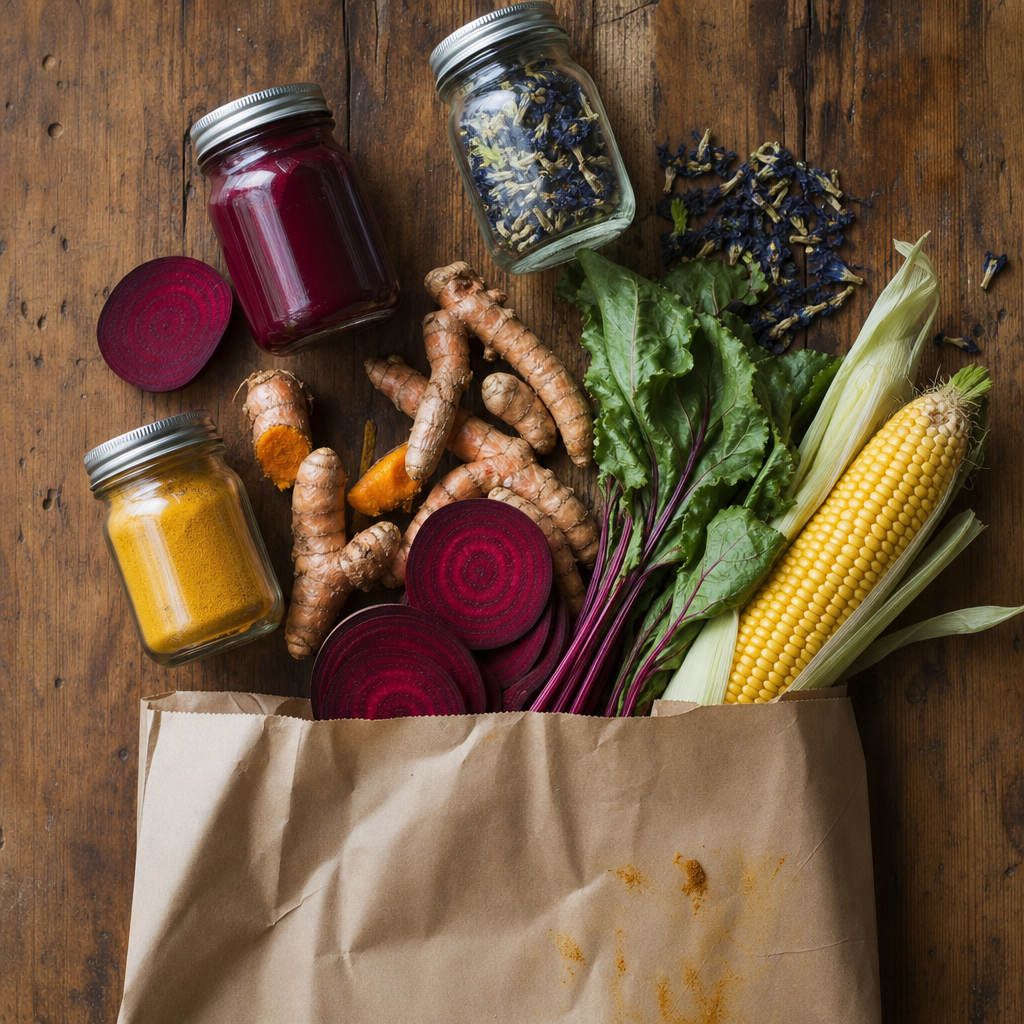
- For reds and pinks: Beet juice, carrot extract, elderberry juice, pomegranate concentrate
- For yellows and oranges: Turmeric, annatto, beta carotene from carrots
- For blues and purples: Butterfly pea flower extract, gardenia blue, Galdieria extract, purple carrot concentrate
- For greens: Spirulina extract, chlorophyll, spinach powder
These natural alternatives are generally less stable and produce less vibrant colors than their petroleum-based counterparts. That is why your favorite neon-colored snack may look a little different after reformulation. But many people consider that a small trade-off for a cleaner ingredient list.
How to Shop for Dye-Free Foods Right Now
While the industry transition is underway, here is how you can avoid petroleum-based food dyes starting today:
- Read the ingredient list. Look for FD&C Red No. 40, Yellow No. 5, Yellow No. 6, Blue No. 1, Blue No. 2, and Green No. 3. Also watch for “Lake” versions (e.g., “Red 40 Lake”).
- Choose certified organic. Organic products cannot contain synthetic food dyes. If you see the USDA Organic seal, you are safe.
- Look for “no artificial colors” on the front of the package. This claim is regulated and means the product uses only natural colorings.
- Be aware of surprising sources. Smoked salmon, pickles, salad dressings, and even some brands of oranges (with Citrus Red No. 2 on the skins) can contain artificial dyes.
- Check the FDA’s industry pledge tracker. If your favorite brand is on the list, reformulation is coming soon.
Label Reading Cheat Sheet
When scanning ingredient lists, look for these exact names:
Red dyes: FD&C Red No. 40, FD&C Red No. 3, Red 40 Lake, Allura Red AC
Yellow dyes: FD&C Yellow No. 5, FD&C Yellow No. 6, Yellow 5 Lake, Tartrazine, Sunset Yellow
Blue dyes: FD&C Blue No. 1, FD&C Blue No. 2, Blue 1 Lake, Brilliant Blue, Indigo Carmine
Green dyes: FD&C Green No. 3, Fast Green
Frequently Asked Questions
Are petroleum-based food dyes dangerous?
The answer depends on who you ask. The FDA says approved dyes are safe when used according to regulations. Independent research has found links to behavioral issues in children and contamination with carcinogens. The most honest answer is that these dyes have no nutritional value, and safer alternatives exist — which is why the FDA is phasing them out.
When will all petroleum-based food dyes be removed from food?
The FDA’s target is the end of 2027 for the six remaining synthetic dyes, per the agency’s most recent industry pledge tracker. Red No. 3 must be removed from foods by January 2027. Some companies have already completed their transitions. Others are still working on it.
What is the difference between natural and artificial food colors?
Artificial colors are synthetic chemicals made from petroleum. Natural colors are derived from plants, minerals, or other natural sources. The FDA is now fast-tracking approval of natural alternatives like butterfly pea flower, gardenia blue, and beet juice.
Do organic foods contain petroleum-based food dyes?
No. Certified organic products cannot contain synthetic food dyes. If you see the USDA Organic seal, the product uses only natural colorings.
The Bottom Line
The FDA’s July 2026 actions on Orange B and Citrus Red No. 2 are the latest milestones in a historic shift. Petroleum-based food dyes are being phased out of the U.S. food supply — not because of a single dramatic finding, but because the science, the law, and consumer demand have all moved in the same direction.
For now, the best thing you can do is read labels. Know the names of the six remaining dyes. Choose organic when you can. And remember: the fact that a dye is still legal does not mean it is in your best interest to eat it. The FDA itself is moving away from these additives. You can too.
The grocery store is changing. Your shopping cart can change with it.