

PCOS Lab Tests: Your Complete Follow-Up Guide
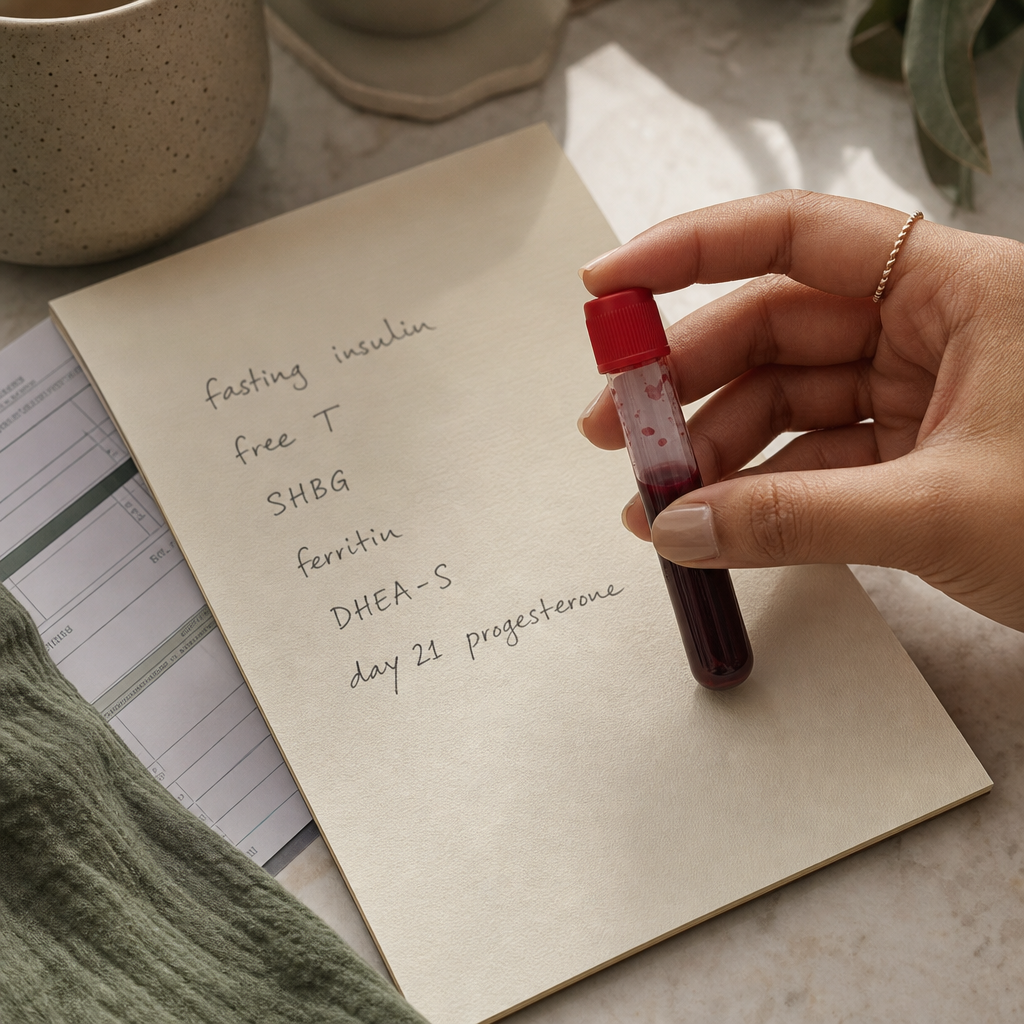
You got the call. Your basic labs are back, and everything looks normal. But your cycles are still off. You still feel exhausted, or you’re dealing with stubborn weight gain and acne that won’t quit. You’re not alone in feeling stuck. It’s a frustrating place to be, and it’s a story I hear from women with PCOS all the time. The good news? A ‘normal’ first round of labs doesn’t mean nothing is going on. It often means the right tests weren’t run. According to the CMAJ review on PCOS laboratory diagnosis, standard blood panels check basic markers like TSH, fasting glucose, and routine hormone levels, but PCOS requires a more targeted set of tests to reveal the underlying metabolic and hormonal patterns. This guide is built for that exact moment. We’ll walk through which PCOS lab tests to ask for next, why they matter, and how to get them ordered so you can finally get some answers.
Key Takeaways
- Normal labs don’t rule out PCOS. Standard panels often miss the specific markers that reveal what’s really happening.
- Fasting insulin is a key first test. A normal fasting glucose can hide significant insulin resistance, which is a core driver of PCOS for many women.
- Free testosterone matters more than total. Your total testosterone can look fine while the active form is elevated.
- Timing is everything. Most hormone tests need to be done on specific days of your cycle to give accurate results.
- You have options. You can request these tests from your doctor or, in many states, order them directly through services like Quest’s GoodLabs.
Why Your First Round of PCOS Lab Tests Might Have Looked Normal
Here’s the thing. A routine panel might check your thyroid (TSH), a basic hormone level, and a fasting glucose. But PCOS is a metabolic and hormonal condition. The tests that reveal what’s really going on are often not the ones routinely offered. The Mayo Clinic on PCOS diagnosis confirms that there is no single test for the condition. Diagnosis requires looking at a pattern across multiple tests, your symptoms, and often an ultrasound.
For example, the CMAJ review on PCOS laboratory diagnosis notes that biochemical hyperandrogenism (elevated male hormones in the blood) is found in only about 60% of PCOS cases. That means 4 out of 10 women with PCOS will have normal androgen levels on a basic test. Your labs can be ‘normal’ and you can still have PCOS.
The Complete PCOS Lab Tests Checklist: What to Ask For Next
So, what should you actually ask for? I’ve broken this down into categories. This is your doctor-ready list. Take it to your next appointment.
1. Metabolic Markers: The Insulin Connection
This is the most common miss. Your doctor checked your fasting glucose, and it was fine. But insulin resistance can be present for years before blood sugar starts to rise. The WHO PCOS fact sheet highlights that PCOS is a chronic metabolic condition. The CMAJ review states that hyperinsulinemia (high insulin) is present in 75% of lean PCOS patients and 95% of those with a higher BMI.
- Fasting Insulin: This is a strong first-line screening test for insulin resistance and is widely used in practice. It measures the level of insulin in your blood after an 8-12 hour fast. A high level indicates insulin resistance, even if your glucose is normal. However, the 2023 International PCOS Guideline and CMAJ review note that the oral glucose tolerance test (OGTT) is the preferred method for comprehensive assessment. Fasting insulin is an excellent starting point if OGTT is not accessible. For a deeper look at what these results mean and how to get tested, check out our guide to the PCOS insulin resistance test.
- Hemoglobin A1c (HbA1c): This gives you a 3-month average of your blood sugar levels. It’s a good baseline, but it can miss early-stage insulin resistance that fasting insulin catches.
- Oral Glucose Tolerance Test (OGTT): This is a more comprehensive test. You drink a sugary liquid, and your blood is drawn at intervals to see how your body handles the sugar load. It’s the most thorough way to check for insulin resistance.
Why Fasting Insulin Matters
Think of insulin as the key that unlocks your cells to let sugar in for energy. In PCOS, the locks get rusty (insulin resistance). Your body makes more and more keys (insulin) to force the door open. High insulin then tells your ovaries to make more testosterone, worsening your symptoms. A normal blood sugar test just means the keys are still working, not that the locks are in good shape.
2. Androgen Panel: The Hormones Behind Acne, Hair, and Cycles
This is where the ‘normal’ result often falls apart. A basic test might only check total testosterone. But the active form is free testosterone, and a protein called SHBG controls how much of it is free.
- Free Testosterone: This is the biologically active form. It’s what causes symptoms like acne and hair growth. It can be high even when total testosterone is normal.
- Sex Hormone-Binding Globulin (SHBG): This protein binds to testosterone, making it inactive. In PCOS, SHBG is often low, which means more free testosterone is circulating. A low SHBG is a very common finding.
- DHEA-S: This is an androgen produced by your adrenal glands. If it’s high, it suggests your adrenals are contributing to the problem, which can point to a different root cause.
- Androstenedione: Another androgen that can be elevated. It’s a precursor to testosterone.
3. Reproductive Hormones: The Cycle Regulators
These tests help map out what your ovaries and pituitary gland are doing. Timing is critical here.
- LH and FSH: These are the hormones that signal your ovaries to release an egg. In PCOS, the LH:FSH ratio is often elevated (greater than 2:1). This is a supporting clue, not a diagnosis on its own.
- Estradiol (E2): A baseline estrogen level, usually checked on day 2-4 of your cycle.
- Progesterone: This test is done on day 21 of a 28-day cycle (or 7 days before your expected period). A high level confirms that you ovulated. A low level means you likely didn’t.
- Anti-M\u00fcllerian Hormone (AMH): This is often significantly elevated in PCOS. The 2023 International Guideline now supports using AMH as an alternative to ultrasound for diagnosis in adults.
4. Rule-Out Tests: Making Sure It’s Not Something Else
Before settling on a PCOS diagnosis, your doctor needs to rule out other conditions that can look just like it.
- TSH, Free T4, and Thyroid Antibodies: A full thyroid panel is essential. An underactive or overactive thyroid can cause irregular cycles, weight changes, and fatigue.
- Prolactin: High prolactin levels can stop ovulation and cause symptoms that mimic PCOS.
- 17-Hydroxyprogesterone (17-OHP): This test rules out non-classic congenital adrenal hyperplasia (NCAH), a genetic condition that causes high androgens and irregular periods.
5. The Often-Overlooked Tests: Ferritin, Iron, and Vitamin D
Many women with PCOS have heavy periods, which can lead to iron deficiency. Fatigue is a major symptom of both PCOS and low iron. A ferritin test checks your iron stores. Similarly, a Vitamin D deficiency in PCOS study found that 84% of women with PCOS had low vitamin D levels, which is linked to worse insulin resistance and hormone imbalances. These are simple, cheap tests that can make a big difference in how you feel.
When to Schedule Your PCOS Lab Tests: The Cycle Timing Guide
This is a huge piece of the puzzle. Getting the right test on the wrong day can give you a misleading result.
Your Lab Timing Cheat Sheet
- Days 2-4 of your cycle (early follicular phase): LH, FSH, Estradiol, Total and Free Testosterone, DHEA-S, SHBG, 17-OHP. This is the baseline window.
- Day 21 (or 7 days before your expected period): Progesterone. This confirms ovulation.
- Any day, after an 8-12 hour fast: Fasting insulin, Fasting glucose, HbA1c, Lipid panel, Ferritin, Vitamin D, TSH, Prolactin.
- If you don’t have a period: Your doctor may do a random draw or use a progesterone challenge to induce a bleed and then test on day 2-4.
How to Get These Tests Ordered: Your Action Plan
You have a few paths forward. The best one depends on your insurance and your doctor.
Option 1: Ask Your Doctor. This is the most straightforward path. Bring the checklist from this article to your appointment. Say something like, “My symptoms are still bothering me, and I’d like to rule out insulin resistance and check my free testosterone. Can we order a fasting insulin, SHBG, free testosterone, and a full thyroid panel?” Most good doctors will appreciate a specific, informed request.
Option 2: See a Specialist. If your gynecologist is not responsive, an endocrinologist is the specialist for hormonal and metabolic conditions like PCOS. They are much more likely to order a comprehensive panel. If your primary doctor is hesitant to refer you, our guide on how to get a PCOS endocrinologist referral can help.
Option 3: Direct-to-Consumer Lab Testing. In most US states, you can order your own lab tests through services like Quest’s GoodLabs or Labcorp OnDemand. You pay out of pocket, but you get the results directly. This is a great option if you’re hitting a wall with your doctor and just want the data. You can then take those results to a specialist for interpretation.
What About ‘Optimal’ vs. ‘Normal’ Ranges?
This is where it gets nuanced. Lab ‘normal ranges’ are based on the general population. But for PCOS, we often look for ‘optimal’ ranges that are tighter. For example, a TSH of 4.0 mIU/L might be flagged as normal by the lab, but some endocrinologists prefer to see it below 2.5, especially for those trying to conceive, though standard lab ranges often go higher. A fasting insulin of 15 mIU/L might be within the lab’s normal range, but it is strongly associated with insulin resistance. This is why seeing a specialist who understands PCOS is so valuable. They interpret your results in the context of your symptoms, not just against a population average.
Frequently Asked Questions About PCOS Lab Tests
Q: My doctor said my labs are normal. Should I get a second opinion?
Absolutely. If your symptoms are real and impacting your life, you deserve a doctor who takes them seriously. A second opinion, especially from an endocrinologist, is a very reasonable next step.
Q: How often should I repeat my PCOS lab tests?
The CMAJ review recommends annual health assessments for metabolic markers (fasting insulin, lipids) and hormone panels, unless you are actively trying to conceive or making significant lifestyle changes, in which case more frequent testing can be helpful to track progress.
Q: Does being on birth control affect my test results?
Yes, significantly. Combined hormonal contraceptives (the pill, patch, ring) raise SHBG and lower your measured androgen levels. This can mask the underlying PCOS. If you are on the pill, your test results will not reflect your natural hormone state. A 3-month washout is typically needed for accurate testing, but you should never stop medication without discussing it with your doctor first.
The Bottom Line
Getting a ‘normal’ result on your first round of labs is not the end of the road. It is a signal that you need a more targeted approach. PCOS is a condition of patterns, not single numbers. By understanding which PCOS lab tests to ask for, when to take them, and how to interpret them, you move from being a passive patient to an active partner in your own health. You don’t have to accept ‘everything looks normal’ when your body is telling you otherwise. Take this list, make an appointment, and start getting the answers you deserve.