
Microwave Plastic Safety: 3 Quick Checks Before You Reheat
You’ve got leftovers from last night’s dinner, you’re hungry, and the microwave is right there. You grab the plastic container, pop it in, and hit start. It’s something most of us do without a second thought. But here’s the thing: the science on microwave plastic safety has shifted in a big way over the last few years. What was once a simple question about BPA has become a much more complex story about billions of tiny plastic particles ending up in your food. Let’s sort through what the latest research actually says — and give you a clear, practical plan for what to do about it.
Key Takeaways
- Microwave-safe doesn’t mean particle-free. That label means the container has been tested not to melt or leach regulated chemicals — but that testing wasn’t designed to measure microplastic particle release, which newer research shows can still occur.
- Heat + plastic = particle release. Multiple studies confirm that microwaving plastic releases billions of microplastics and nanoplastics, especially with oily foods.
- Three quick checks before you microwave: Look for the microwave-safe symbol, check for stains or scratches, and never microwave single-use takeout containers.
- Glass and ceramic are the safest choices. They don’t release particles when heated and last longer too.
- You don’t have to switch overnight. A gradual upgrade from plastic to glass works — start with the containers you use most for reheating.
The Science: What Research Actually Says About Microwave Plastic Safety
Here’s where things get interesting. For years, the main concern about microwaving plastic was chemical leaching — specifically BPA and phthalates. These are chemicals added to plastic to make it hard or flexible, and they’re known as endocrine disruptors. That means they can mess with your hormones. The FDA has long required manufacturers to test for this, and containers that pass get the microwave-safe label.
But a landmark 2023 University of Nebraska-Lincoln study changed the conversation entirely. Researchers found that microwaving plastic containers and reusable food pouches released billions of tiny plastic particles into the food. We’re talking up to 4.22 million microplastics and 2.11 billion nanoplastics from just one square centimeter of plastic in only three minutes of heating. That’s a lot of particles.
A more recent 2026 study in Advanced Science added another layer. It found that when you microwave oily foods in plastic, the release of nanoplastics increases by about 125 times compared to water. The oil-derived particles were also four times more toxic to cells in lab tests. And the co-release of plastic additives and heavy metals jumped by up to 309-fold. This is a big deal because so many leftovers — think pasta with sauce, stir-fry, curry — contain oil or fat.
What This Means for You
The science is clear: microwaving plastic releases particles into your food. The amount depends on the type of plastic, the temperature, the cooking time, and what’s in the food. Oily foods are the biggest concern. But here’s the good news — you don’t need to panic. You just need a simple system for making better choices.
The Three Quick Checks for Microwave Plastic Safety
Before you hit start on that microwave, run through these three checks. They take about 10 seconds total and can make a real difference.
Check 1: Look for the Microwave-Safe Symbol
Flip the container over and look at the bottom. You’re looking for a symbol that looks like a microwave with wavy lines, or the words “microwave safe.” This means the manufacturer has tested it and the FDA has reviewed the data. But here’s the catch — as we discussed, this testing was designed for chemical safety, not for microplastic particle release. So while it’s a good first check, it’s not a guarantee of zero particle release.
Check 2: Inspect for Stains, Scratches, or Cracks
This is a big one that most people skip. If your plastic container has deep stains, visible scratches, or any cracks, it’s time to retire it. According to Lisa Yakas, a microbiologist at NSF, stains can indicate that the plastic has absorbed food components, which increases the risk of chemical leaching — especially in the microwave. Scratches create more surface area for particles to break off from. A good rule: if it looks worn, don’t microwave it.
Check 3: Is It a Single-Use Container?
That takeout container from last night’s Thai food? The yogurt tub you washed out? The margarine tub you’ve been using for years? None of these are designed for microwave use. They’re made from thinner, less heat-stable plastics that break down more easily. According to Harvard Health, most takeout containers and single-use plastics are not microwave-safe. The USDA recommends only using containers labeled for microwave use. If it came with food in it, it’s meant for one-time use only.
Quick Reference: Plastic Resin Codes
Look for the recycling number on the bottom of your container. Here’s what they mean for microwave safety:
- #1 (PET) — Water bottles, soda bottles. Not microwave-safe. Single use only.
- #2 (HDPE) — Milk jugs, detergent bottles. Sometimes microwave-safe if labeled. More heat-stable.
- #3 (PVC) — Cling wrap, some food containers. Never microwave. Can release harmful chemicals.
- #4 (LDPE) — Squeeze bottles, bread bags. Not microwave-safe.
- #5 (PP) — Most reusable food storage containers, yogurt tubs. The safest plastic for microwaving if labeled. Releases fewer particles than other plastics.
- #6 (PS) — Styrofoam, takeout containers. Avoid microwaving. Can leach styrene.
- #7 (Other) — Mixed plastics, includes BPA-containing polycarbonate. Avoid microwaving.
Oil + Heat: A Particularly Risky Combination
Let’s talk about that 2026 study again, because it’s really important for how you actually cook. The researchers found that when they microwaved plastic containers with cooking oil, the release of nanoplastics shot up by 125 times compared to water. Why does this matter? Because most of the foods we reheat — soups, stews, pasta dishes, stir-fries — contain some amount of oil or fat.
The oil essentially acts as a solvent, pulling more particles and chemicals out of the plastic. And those oil-coated particles were more toxic to cells in lab tests. A 2024 study in the Journal of Hazardous Materials also found that higher microwave power levels and longer heating times increase nanoplastic release. So that five-minute blast on high power? That’s the worst-case scenario.
Practical Tips for Today
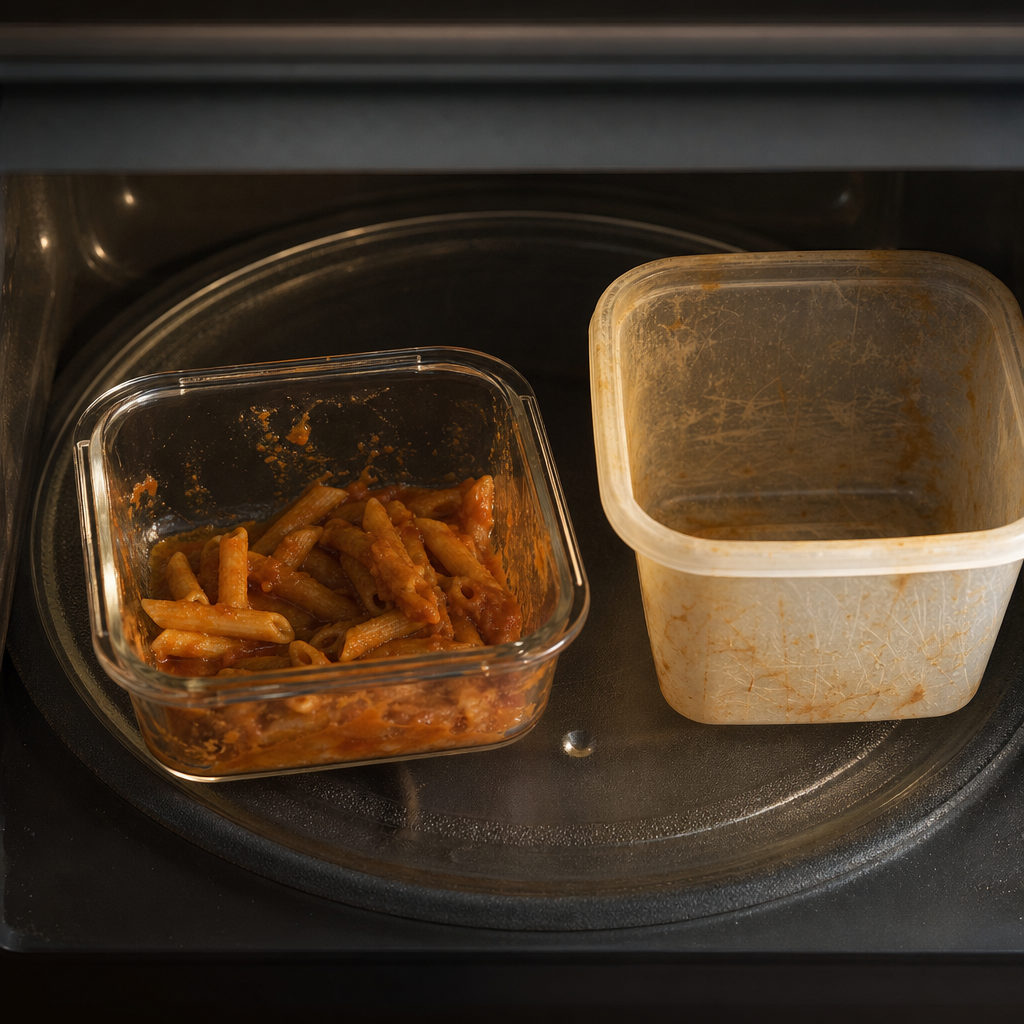
If you must microwave food in a plastic container (we get it — sometimes you’re in a rush), here’s how to reduce your exposure: transfer the food to a microwave-safe plate or bowl first. If you can’t do that, at least use a lower power setting and shorter heating time. And never microwave oily or fatty foods in plastic — that’s the highest-risk scenario.
The Upgrade Ladder: Moving from Plastic to Safer Alternatives
Whether you’re upgrading plastic containers or switching to safer cookware alternatives, a gradual approach works best. Here’s the honest truth: switching all your food storage to glass or ceramic overnight can be expensive. A good set of glass containers can cost $30 to $80 or more. So let’s be practical about this. Here’s a step-by-step approach that works with any budget.
Step 1: Stop Microwaving Plastic (Free)
This costs nothing. Just transfer your food to a ceramic plate or bowl before microwaving. You already have these in your kitchen. This single change dramatically reduces your exposure.
Step 2: Retire Worn Plastic Containers (Free)
Go through your plastic containers right now. Any that are stained, scratched, or cracked? Toss them or repurpose them for non-food use (hardware storage, craft supplies, kids’ toys). This removes the highest-risk containers from your rotation.
Step 3: Buy One Glass Container at a Time ($10-$20 each)
You don’t need to buy a whole set at once. Start with one or two glass containers for the foods you reheat most often. Look for options like the Rubbermaid Brilliance glass line (mid-range, around $15-20 per container) or Pyrex glass containers (budget-friendly, around $10-15). For a premium option, OXO Good Grips glass containers are durable and well-designed.
Step 4: Keep Plastic for Cold Storage Only
Your existing plastic containers are still useful for storing leftovers in the fridge or freezer — just don’t microwave them. The research shows that refrigeration and room-temperature storage also release some particles, but at much lower levels than microwaving. So use your plastic containers for cold storage and your glass ones for reheating.
What About BPA-Free Plastics?
You’ve probably seen containers labeled “BPA-free.” This means they don’t contain bisphenol A, the chemical that’s been linked to health concerns. But here’s the thing: BPA-free doesn’t mean chemical-free. And BPA-free doesn’t address the microplastic particle issue at all. So while BPA-free is a step in the right direction, it’s not a solution to the broader concern about particle release during microwaving.
Frequently Asked Questions
Can I microwave plastic wrap?
It’s best to avoid it. Plastic wrap can melt and leach chemicals into food. If you need to cover food in the microwave, use wax paper, parchment paper, white paper towels, or a microwave-safe lid or plate.
What about microwave steam bags?
Products like Ziploc Zip ‘n Steam are designed for microwave use and are made from materials that are more heat-stable. However, they’re still plastic, and the same principles apply — heat can cause particle release. Use them sparingly and follow the package directions exactly.
How much microplastic is actually harmful?
This is the million-dollar question, and researchers are still working on it. The UNL study found that at very high concentrations in a lab dish, the particles caused cell death. But real-world exposure levels are much lower. The precautionary principle suggests it’s wise to reduce exposure where you can, even if we don’t have exact harm thresholds yet.
The Bottom Line
Here’s what I want you to take away from all of this. The science on microwave plastic safety has evolved, and the simple answer is: it’s better to avoid microwaving plastic when you can. The three quick checks — look for the symbol, check for damage, avoid single-use — will catch most of the risk. And the upgrade ladder gives you a realistic path to safer alternatives without breaking the bank.
You don’t need to be perfect. You don’t need to throw away all your plastic containers today. Just start with one change: transfer your food to a plate or bowl before microwaving. That one habit, done consistently, will make a bigger difference than any other single change you can make.
And when you’re ready to upgrade, glass and ceramic are your best friends. They’re safer, they last longer, and they won’t release tiny particles into your carefully prepared leftovers. Your future self — and your body — will thank you.