

Sleep Architecture & Women’s Weight Loss: Why Your Sleep Stages Matter More Than Hours
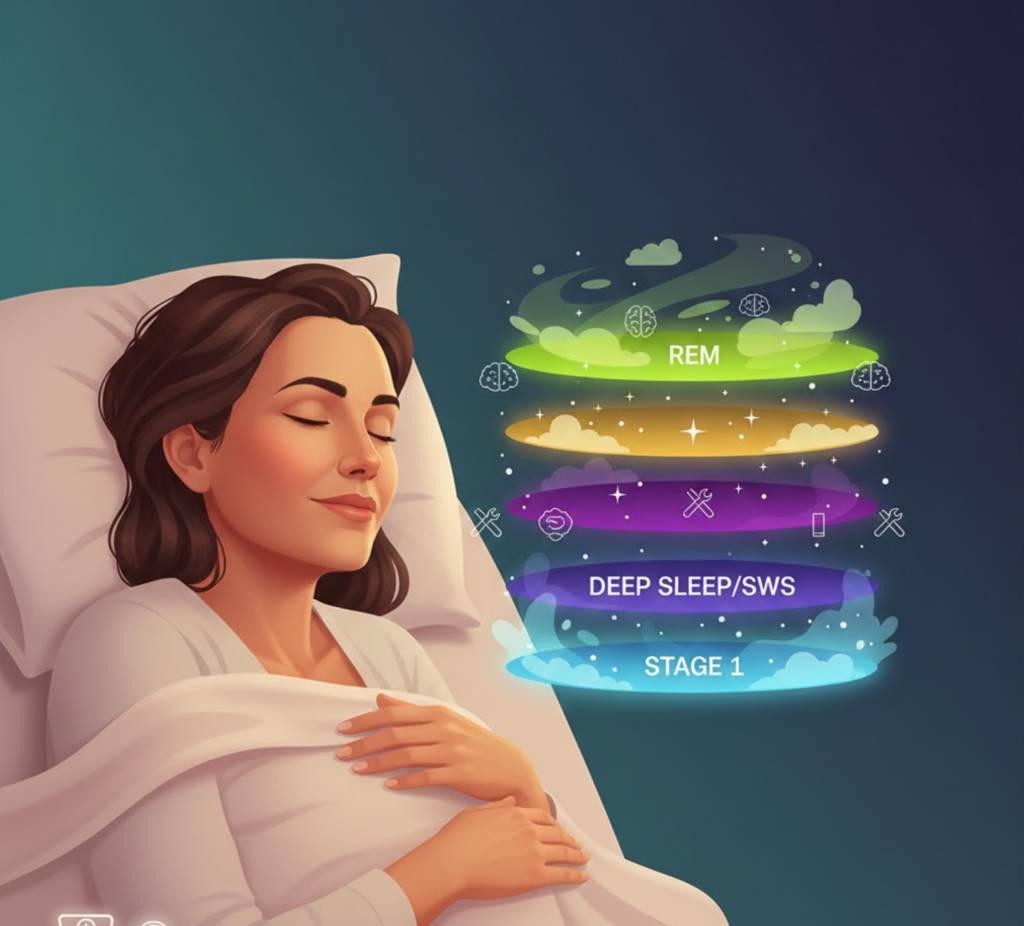
You sleep 8 hours but still can’t lose weight? Your sleep architecture women weight loss connection might be broken. While most weight loss advice for women over 40 focuses on diet and exercise, sleep quality is just as critical. The difference isn’t about hours in bed. It’s about whether you’re getting enough deep sleep to rebuild muscle, enough REM sleep to control hunger, and enough Stage 2 sleep to stop cravings.
Here’s the truth: you can sleep 8 hours and have terrible sleep architecture. When your sleep stages are disrupted—especially deep sleep and REM—your body loses 55% less fat and 60% more muscle during calorie restriction. Plus, perimenopause steals about 30 minutes of deep sleep nightly, making weight loss feel impossible for women over 45.
This article shows you exactly how to optimize each sleep stage naturally. No $300 Oura Ring needed. Just actionable strategies that work.
Quick Answer: What Is Sleep Architecture & Why Does It Matter?
Sleep architecture = the structure of your sleep stages throughout the night. Women with better sleep architecture are 33% more likely to lose weight successfully. Poor architecture causes your body to lose 55% less fat and 60% more muscle. Perimenopause disrupts deep sleep and REM, making fat loss harder—but you can optimize each stage naturally without expensive devices.
What Is Sleep Architecture? (And Why Your Doctor Never Explained It)
Sleep architecture is the pattern your brain follows as you cycle through sleep stages each night. Think of it like a building blueprint—your sleep has a specific structure that either supports fat loss or sabotages it.
Here’s what your brain does during a normal night:
Stage 1 (Light Sleep): You’re dozing off at a red light. This is the transition phase—5% of your night. Minimal impact on weight loss.
Stage 2 (Light Sleep): Your body’s dishwasher cycle. This makes up 50% of your night and regulates appetite hormones. Research shows Stage 2 sleep duration is inversely related to cravings for sweet and salty foods—meaning less Stage 2 = more midnight snacking.
Deep Sleep (Stage 3/SWS): Your body’s construction crew. This is when growth hormone surges and your body rebuilds muscle tissue, strengthens bones, and regulates blood sugar. Women over 40 naturally lose about 30 minutes of deep sleep nightly due to perimenopause—which directly impacts fat loss.
REM Sleep (Dream Sleep): Your brain’s filing cabinet. REM sleep organizes hunger signals and burns calories. Also, reduced REM sleep is directly associated with increased hunger the next day, and a 1-hour decrease in REM sleep triples the odds of being overweight.
Poor sleep architecture affects more than weight—it impacts brain function and mental clarity, making it harder to stick to healthy habits. But unlike sleep duration (which just measures hours), sleep architecture measures quality—how efficiently you move through these critical stages.
Why Sleep Architecture Matters More Than Sleep Duration for Women’s Weight Loss
You can sleep 8 hours and still have terrible sleep architecture. Here’s why that matters for weight loss.
Stage 2 Sleep: The Appetite Hormone Regulator
Stage 2 sleep makes up half your night, and it’s where your body processes leptin and ghrelin—the hormones that control hunger and fullness. When Stage 2 is disrupted, you wake up ravenous even after eating well the day before.
A study tracking sleep curtailment found that Stage 2 sleep duration was inversely related to appetite for sweet foods and salty foods. Translation: Less Stage 2 = more cravings for cookies and chips. Stage 2 sleep also regulates appetite hormones. When disrupted, you’ll crave sugar and carbs—which is why understanding your macros for weight loss becomes even more important when sleep-deprived.
Deep Sleep (SWS): The Muscle Rebuilding Stage
Deep sleep is when your body rebuilds muscle from strength training. Without adequate SWS, you lose muscle instead of fat—even on a calorie deficit.
Here’s the shocking truth: In a 14-day calorie restriction study, participants sleeping only 5.5 hours lost 55% less body fat and 60% more fat-free mass (muscle) compared to those sleeping 8.5 hours. Their bodies defended fat stores at the expense of muscle because they weren’t getting enough deep sleep for tissue repair.
Growth hormone is typically elevated during slow-wave sleep—creating optimal conditions for tissue repair and muscle building. Without it, your metabolism tanks because muscle burns calories at rest (about 6 calories per pound per day). Lose muscle, lose your metabolic advantage.
REM Sleep: The Hunger Signal Controller
REM sleep directly regulates hunger. Research demonstrates an inverse relationship between REM sleep duration and hunger—meaning less REM = more hunger the next day.
But there’s more: REM sleep affects leptin amplitude. Higher percentages of REM sleep are associated with greater overnight reductions in leptin, which may contribute to better appetite suppression throughout the day. Think of leptin like a gas gauge—it tells your brain when you’ve had enough to eat. REM sleep keeps that gauge working properly.
Eating adequate protein throughout the day stabilizes blood sugar overnight, improving Stage 2 sleep quality and reducing nighttime wake-ups.
The Perimenopause Sleep Architecture Problem (That No One Talks About)
If you’re a woman between 45-55, here’s what’s happening to your sleep architecture—and why weight loss suddenly feels impossible.
Declining estrogen = less deep sleep. Women in perimenopause lose approximately 30 minutes of slow-wave sleep nightly compared to premenopausal women. That’s 3.5 hours of muscle-rebuilding, metabolism-regulating deep sleep lost per week. If you’re experiencing hot flashes and night sweats, check our complete guide to weight loss for women over 50, which addresses sleep disruption specifically.
Hot flashes fragment REM sleep. Night sweats don’t just wake you up—they pull you out of REM sleep before your brain completes its hunger signal processing. Result: dysregulated appetite hormones, increased cravings, harder fat loss. For women over 60, sleep architecture changes are even more pronounced. Our guide for women over 60 includes age-specific sleep strategies.
Worse glucose regulation. Deep sleep is when your body processes insulin most efficiently. Less deep sleep = worse blood sugar control = your body storing more calories as fat instead of burning them.
Cross-sectional analysis in 400 women showed that not only sleep duration but also sleep architecture—specifically minutes of slow-wave sleep—were inversely related to waist circumference. Translation: Less deep sleep = bigger waist, even at the same weight.
This isn’t your fault. It’s biology. But you can work with your biology instead of against it.
How to Optimize Each Sleep Stage for Better Weight Loss
You don’t need a $300 Oura Ring to improve your sleep architecture. Here’s what actually works.
How to Get More Deep Sleep (SWS)
Strength training 4 hours before bed. Resistance exercise increases slow-wave sleep duration. Our strength training programs for women include optimal workout timing guidance for sleep.
Magnesium glycinate 400mg at dinner. Magnesium supports GABA production (the calming neurotransmitter) and deepens sleep cycles. Glycinate form absorbs better and won’t cause digestive upset.
Cool your bedroom to 65-68°F. Your core body temperature needs to drop for deep sleep. A warm room keeps you in lighter sleep stages.
Avoid alcohol. Alcohol fragments deep sleep even though it makes you drowsy initially. You fall asleep faster but spend less time in restorative SWS.
How to Get More REM Sleep
Consistent wake time (even weekends). REM sleep is concentrated in the last third of the night. Sleeping in on weekends disrupts your circadian rhythm and reduces REM efficiency.
Avoid late-night eating. Digestion during sleep pulls blood flow to your gut instead of your brain, reducing REM quality. Stop eating 2-3 hours before bed.
Manage evening stress. Elevated cortisol blocks REM sleep. Try 10 minutes of deep breathing or journaling before bed to lower cortisol naturally.
Use a sleep mask. Even small amounts of light disrupt REM sleep. Blackout curtains or a quality sleep mask protect this critical stage.
How to Improve Stage 2 Sleep
A protein shake 2-3 hours before bed stabilizes blood sugar. Check our guide to weight loss shakes for women for evening-friendly recipes that won’t disrupt sleep.
White noise machine. Stage 2 sleep is fragile—easily disrupted by sounds. White noise masks environmental noise without waking you.
Dark room. Light exposure (even from phones) suppresses melatonin and keeps you in lighter sleep stages.
Creating a calming bedtime ritual helps. Try cinnamon and warm water before bed—it stabilizes blood sugar and promotes relaxation. Avoid caffeine after 2pm, but herbal anti-bloating tea in the evening can support better sleep.
Inflammation disrupts sleep architecture. Consider our anti-bloat meal plan, which reduces inflammation naturally.
How to Track Your Sleep Architecture Without Expensive Devices
You don’t need polysomnography or a sleep tracker. Your body gives you clear signals about sleep architecture quality.
Signs of poor deep sleep (SWS): Morning grogginess even after 7-8 hours, muscle soreness that won’t go away, frequent illness (weakened immune system), increased belly fat despite calorie control.
Signs of poor REM sleep: Afternoon sugar cravings (especially 2-4pm), brain fog and difficulty concentrating, emotional reactivity or mood swings, increased hunger despite eating enough. Morning brain fog is covered in depth in our article on why your brain feels foggy after bad sleep.
Signs of poor Stage 2 sleep: Waking frequently during the night, feeling like your sleep is “light” or unrefreshing, waking with your mind racing, increased cravings for salty/sweet foods.
When to consider a sleep study: If you snore loudly, wake up gasping, or your partner reports breathing pauses, you may have sleep apnea—which destroys sleep architecture. See a sleep specialist. CPAP therapy can restore normal sleep stages.
Who Should NOT Focus on Sleep Architecture Right Now
Sleep architecture optimization isn’t for everyone. Here’s when to skip it.
Skip this if:
- You have diagnosed sleep apnea (get CPAP first, then optimize architecture)
- You’re a shift worker (focus on meal timing and carb cycling instead)
- You have a newborn (sleep deprivation is temporary, wait 6 months)
- You have severe insomnia (see a sleep specialist or therapist trained in CBT-I)
If sleep is currently disrupted, focus on other jumpstart strategies first, then optimize sleep architecture later when your life allows it.
The 30-Day Sleep Architecture Optimization Plan
Here’s how to improve your sleep stages systematically over 30 days.
Week 1: Establish Consistent Sleep-Wake Times
Same bedtime and wake time daily (including weekends). Goal: Train your circadian rhythm. Expected result: Easier time falling asleep.
Week 2: Cool Your Environment + Add Magnesium
Drop bedroom temp to 65-68°F. Start magnesium glycinate 400mg at dinner. Goal: Increase deep sleep duration. Expected result: Wake feeling more refreshed.
Week 3: Time Your Protein Intake
Eat protein at every meal (especially dinner). Stop eating 2-3 hours before bed. Goal: Stabilize blood sugar for better Stage 2 sleep. Expected result: Fewer nighttime wake-ups.
Week 4: Add Evening Strength Training
Resistance training 4-5 hours before bed, 3x weekly. Goal: Maximize deep sleep for muscle recovery. Expected result: 20-30% more deep sleep, better body composition.
After 30 days, you should notice: better energy, reduced cravings, easier fat loss, improved mood, and better strength training recovery.
Frequently Asked Questions
Q: Do I need an Oura Ring or sleep tracker?
No. While devices can provide data, you don’t need them to improve sleep architecture. Track subjective markers: How do you feel in the morning? Are you hungry all day? Is brain fog clearing? These signals tell you what’s working.
Q: Should I use protein powder for evening stabilization?
Yes, evening protein helps stabilize overnight blood sugar for better sleep. See our guide: best protein powder for women’s weight loss for sleep-friendly options.
Q: I’ve tried everything—what am I missing?
Sometimes the issue isn’t obvious. Read the unspoken truth about women’s weight loss for overlooked factors including sleep quality that sabotage even the best diet and exercise plans.
The Bottom Line on Sleep Architecture and Women’s Weight Loss
Sleep architecture matters more than sleep duration for weight loss—especially for women over 40. Among 245 overweight women enrolled in a 24-month program, better subjective sleep quality increased the likelihood of weight-loss success by 33%.
You need deep sleep to rebuild muscle and regulate blood sugar. You need REM sleep to control hunger and process stress. And Stage 2 sleep to manage cravings. When sleep-deprived, your body preserves fat at the expense of muscle.
Perimenopause steals deep sleep, making weight loss harder—but you can optimize each stage naturally with strength training, magnesium, temperature control, and protein timing. You don’t need expensive devices. You need consistent habits.
Try the 30-day protocol. Track how you feel. And if you’ve been doing everything “right” but still can’t lose weight, your sleep architecture might be the missing piece.
Related Articles You’ll Love:
- Complete Weight Loss Guide for Women Over 40
- Strength Training Programs for Better Sleep & Fat Loss
- Why Your Brain Feels Foggy After Bad Sleep
- Best Protein Powder for Sleep & Weight Loss
- Cinnamon Water Before Bed for Better Sleep
- Weight Loss for Women Over 50
- Weight Loss for Women Over 60
- How Much Protein Women Need Daily
- Calculate Your Macros for Weight Loss
- The Unspoken Truth About Women’s Weight Loss