

Women’s Weight Loss Secrets: The Unspoken Truth Nobody Tells You
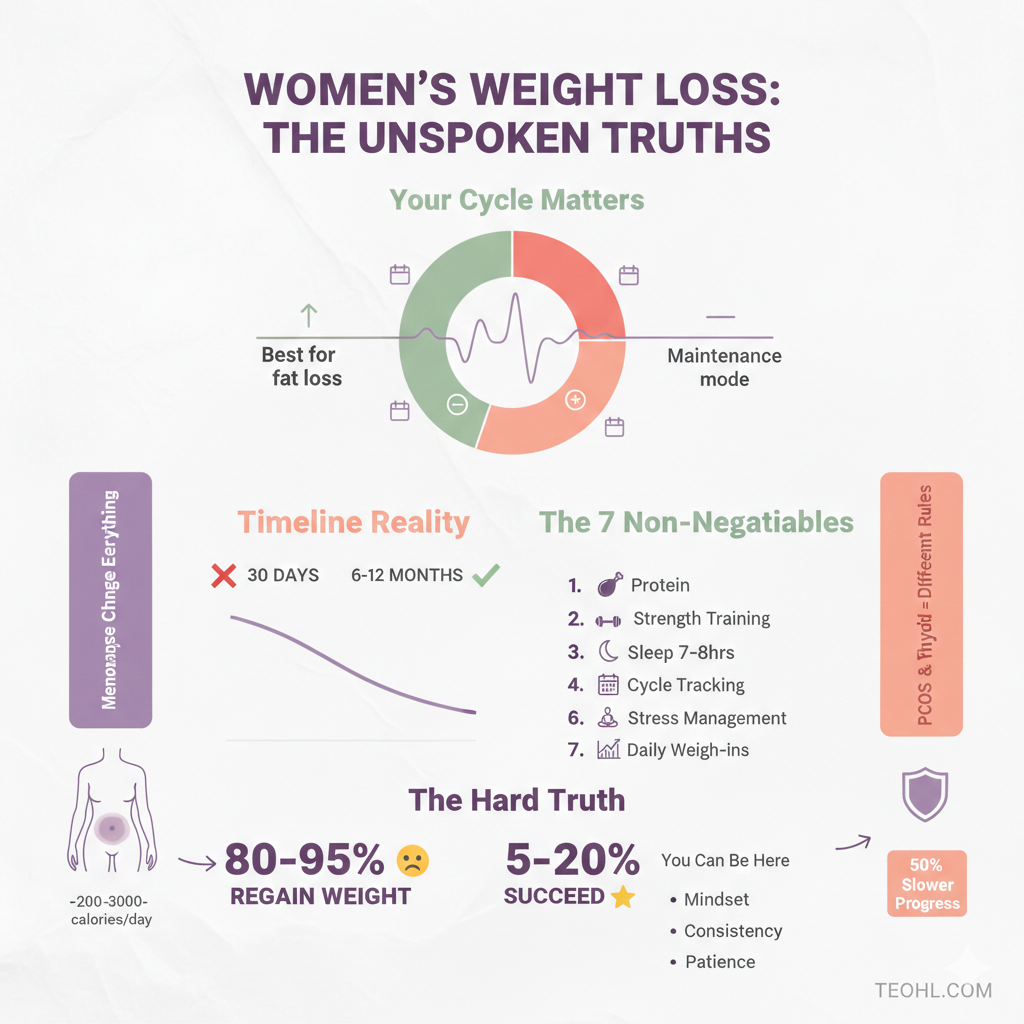
You’ve tried every diet. You’ve followed the rules. You’ve counted calories, skipped desserts, and dragged yourself to the gym. Yet somehow, the scale barely budges while your male partner loses 10 pounds eating the same food. Moreover, every article you read gives the same tired advice: “eat less, move more.”
Here’s what nobody tells you: women’s weight loss secrets the unspoken truth goes far deeper than calories in versus calories out. In fact, the fitness industry has been feeding you incomplete information designed for male bodies, leaving you frustrated and blaming yourself for “not trying hard enough.”
Throughout this guide, you’ll discover the biological and psychological truths that explain why conventional weight loss advice fails women. Also, you’ll learn exactly what successful women do differently—not the Instagram highlights, but the real, unglamorous strategies that actually work long-term.
By the end, you’ll understand why your body responds differently, how to work with your unique female physiology, and what realistic success actually looks like. No more mystery, no more guessing—just honest answers.
🔑 Key Unspoken Truths
- Your menstrual cycle controls weight loss: You can’t compare week-to-week progress—hormones change everything
- Menopause isn’t a death sentence: But it requires a fully different strategy than what worked in your 30s
- PCOS and thyroid issues change all the rules: Standard advice will fail you—you need condition-specific approaches
- It takes 2-3X longer than you think: Real transformation is 6-12+ months, not 30 days
- Maintenance is harder than losing: 80-95% regain weight within 5 years—long-term success requires permanent lifestyle change
- Your friends might sabotage you: Weight loss can threaten relationships in unexpected ways
Quick Answer: The Biggest Women’s Weight Loss Secrets
The unspoken truths the fitness industry doesn’t want you to know:
1. Your menstrual cycle matters more than daily calories. Hormonal fluctuations throughout the month affect hunger, energy, water retention, and fat burning. Therefore, you must adjust your approach based on cycle phase, not follow the same plan every day.
2. What works for men often fails women. Women have 15-20x less testosterone, slower metabolisms, different fat storage patterns, and hormonal challenges men never face. As a result, male-designed programs set you up for failure.
3. Menopause changes everything. Estrogen loss triggers belly fat accumulation, muscle loss accelerates, and metabolism drops 200-300 calories daily. In particular, women over 40 need different strategies than younger women.
4. PCOS and thyroid conditions require specialized approaches. Standard “eat less, move more” advice ignores insulin resistance, hormonal imbalances, and metabolic dysfunction these conditions create.
5. Realistic timeline: 6-12+ months, not weeks. Healthy fat loss is 0.5-1% of body weight weekly. For a 150 lb woman, that’s 0.75-1.5 lbs per week. Slower progress means you keep muscle and maintain results long-term.
6. Maintenance requires forever vigilance. Research shows 80-95% of people regain lost weight within 5 years. Therefore, successful women treat this as a permanent lifestyle change, not a temporary diet.
These truths explain why you’ve struggled. Indeed, when you understand your unique biology and adjust accordingly, sustainable weight loss becomes achievable.
The Biological Secrets Nobody Tells You
Secret #1: Your Menstrual Cycle Controls Weight Loss
This is the biggest secret the fitness industry ignores: your hormones fluctuate greatly throughout the month, fully changing how your body responds to food and exercise. Even so, most programs tell you to follow the same plan every single day.
Research published in the Journal of Applied Physiology confirms that menstrual cycle phases greatly impact metabolic rate, hunger, and performance. In particular, hormonal changes affect everything from cravings to water retention to how efficiently you burn fat.
Follicular Phase (Days 1-14): Your Weight Loss Sweet Spot
Hormonal changes: Estrogen rises gradually, boosting energy, mood, and insulin sensitivity.
Weight loss impact: This is when creating a calorie deficit feels easiest. Also, you have more energy for workouts and better muscle recovery.
Action plan: Push harder during this phase. Increase workout intensity, create a slightly larger deficit (200-300 calories), and take advantage of high energy levels. Also, this is the best time for strength training programs.
Ovulation (Around Day 14): Peak Fat-Burning Window
Your body now: Estrogen peaks, testosterone rises slightly, and you feel invincible.
Fat burning now: Metabolism is at its highest. As a result, your body burns calories most efficiently during this 2-3 day window.
Action plan: Maintain your deficit and crush your workouts. This is when you’ll see the best results on the scale.
Luteal Phase (Days 15-28): Time to Ease Up
Key shift: Progesterone dominates, estrogen drops, and everything gets harder.
Challenges ahead: Cravings intensify (especially for carbs and sweets), water retention increases (2-5 lbs is normal!), energy plummets, and fat burning slows down.
Your strategy: Increase calories by 100-200 daily. Focus on maintenance, not aggressive fat loss. Moreover, prioritize nutrient-dense carbs to manage cravings and consider anti-bloating strategies.
Menstruation (Days 1-5): Gentle Maintenance
During menstruation: All hormones drop to baseline. You feel tired, crampy, and emotional.
Scale reality: Don’t even look at the scale! Water retention from the luteal phase starts dropping, but you’re still retaining fluid.
Best approach: Eat at maintenance, move gently (walking, yoga), and be kind to yourself. The follicular phase is coming—that’s when you’ll see progress again.
💡 The Critical Truth About Cycle-Based Weight Loss
You can’t compare week-to-week weight. Instead, compare the same point in your cycle. For example, weigh yourself on Day 7 of each cycle, not every Monday. Otherwise, hormonal water retention will drive you crazy and make you think you’re not making progress when you actually are.
Secret #2: Menopause Changes Everything (And Nobody Prepares You)
If you’re over 45, here’s the harsh truth: what worked in your 30s won’t work anymore. In particular, estrogen loss during menopause triggers a cascade of metabolic changes that make weight loss greatly harder.
According to research from the National Institutes of Health, menopause causes predictable body composition changes including increased belly fat, muscle loss, and metabolic slowdown. Even so, these changes aren’t inevitable—they just require different strategies.
Why menopause makes weight loss harder:
- Estrogen loss triggers visceral fat storage: Your body preferentially stores fat around organs (belly) instead of hips/thighs. As a result, you develop the “menopause middle” even without gaining overall weight.
- Muscle loss accelerates: You lose 3-5% of muscle mass annually (vs 1-2% pre-menopause). Since muscle burns calories, this slows metabolism by 200-300 calories daily.
- Insulin resistance increases: Cells become less responsive to insulin, making carb management critical.
- Sleep disruptions: Hot flashes and night sweats wreck sleep quality, which sabotages weight loss efforts.
Strategies That Actually Work
For menopausal women, these approaches make the difference:
1. Increase protein greatly: Aim for 1.0-1.2g per pound of target body weight. Therefore, a 150 lb woman needs 150-180g daily. Learn more about optimal protein intake.
2. Strength training becomes non-negotiable: Cardio alone won’t work anymore. You must lift weights 3-4 times weekly to combat muscle loss. Also, compound movements like squats provide the biggest metabolic boost.
3. Adjust your timeline expectations: Pre-menopause, you might see changes in 4-6 weeks. Post-menopause, expect 8-12 weeks before visible progress. Moreover, the scale will move more slowly—0.5 lbs weekly is excellent progress.
4. Consider hormone replacement therapy (HRT): For some women, HRT makes weight management greatly easier by restoring estrogen levels. Discuss with your doctor whether this option suits your situation.
5. Prioritize sleep optimization: Poor sleep sabotages everything else. Also, sleep deprivation affects hormones and decision-making, making adherence nearly impossible.
For comprehensive strategies, read our complete guide on weight loss for women over 40.
Secret #3: PCOS and Thyroid Issues Change All the Rules
Here’s what doctors often fail to explain: if you have PCOS or hypothyroidism, standard weight loss advice will fail you. Indeed, these conditions fundamentally change how your body processes food and burns fat.
PCOS (Polycystic Ovary Syndrome):
Affecting 1 in 10 women, PCOS creates insulin resistance that makes weight gain easy and weight loss brutally difficult. Research shows that women with PCOS require specific exercise and nutrition strategies different from the general population.
- Why standard advice fails: High insulin levels promote fat storage regardless of calorie intake. Therefore, you can eat the same calories as someone without PCOS and still gain weight.
- Better approach: Lower carbohydrate intake (100-150g daily), higher protein, and emphasis on strength training over excessive cardio. Also, adjusting your macros to 35% protein, 30% carbs, 35% fat often yields better results.
- Realistic expectations: Weight loss will be 50% slower than average. As a result, expect 0.25-0.5 lbs weekly instead of 1-2 lbs. Even so, slow progress is still progress.
- Consider medical support: Metformin or inositol supplements can improve insulin sensitivity, making weight loss more achievable. Also, some women benefit from peptide therapy under medical supervision.
Hypothyroidism (Underactive Thyroid):
Affecting 1 in 8 women, hypothyroidism slows your metabolism, increases fatigue, and makes every aspect of weight loss more difficult.
- Critical first step: Optimize thyroid medication before attempting weight loss. If TSH is above 2.5, you’ll struggle regardless of diet and exercise perfection.
- Why you gain weight easily: Low thyroid hormone reduces metabolic rate by 200-400 calories daily. Moreover, it causes water retention, making the scale misleading.
- The solution: Once medication is optimized, follow the same principles as everyone else—but expect slower results. Also, focus on measurements and how clothes fit rather than obsessing over scale weight.
Secret #4: Muscle Matters Way More Than Cardio (But Everyone Pushes Cardio)
Walk into any gym and you’ll see women spending hours on treadmills while avoiding the weight room. Meanwhile, men lift weights and get the “toned” physique women actually want. This isn’t coincidence—it reveals one of the biggest women’s weight loss secrets the unspoken truth about body composition.
According to research on sex differences in training, women respond differently to exercise than men, but both genders need strength training for optimal results. Even so, women avoid weights due to fear of getting “bulky”—a myth that costs them the results they want.
Strength training advantages for women:
- Muscle burns calories 24/7: Each pound of muscle burns ~6 calories daily at rest. In contrast, fat burns only 2. Therefore, building muscle permanently raises your metabolism.
- The “toned” look requires muscle: That defined, sculpted appearance comes from muscle with low body fat. Simply losing weight without building muscle leaves you “skinny fat” with no shape.
- Prevents metabolic adaptation: Aggressive dieting plus excessive cardio causes muscle loss, which slows metabolism. However, strength training preserves muscle, keeping metabolism high during weight loss.
- Fights aging: Women lose 3-8% of muscle mass per decade after 30, accelerating post-menopause. As a result, strength training is the only proven way to prevent this decline. Learn more about maintaining wellness as you age.
The “bulky” myth debunked: Women have 15-20 times less testosterone than men, making it physically nearly impossible to build large muscles without years of specific training, extreme dedication, and often performance-enhancing drugs. Instead, lifting weights creates the lean, defined look you see on fitness influencers—who all lift heavy!
For a complete strength training approach, check out our 12-week training program for women.
The Psychological Secrets They Don’t Discuss
Secret #5: All-or-Nothing Thinking Sabotages Women More Than Men
You’ve experienced this: you eat one cookie, decide the whole day is “ruined,” then proceed to eat everything in sight because “I already messed up anyway.” notably, research on emotional eating patterns shows that women exhibit more all-or-nothing thinking than men, making sustainable weight loss harder to achieve.
Understanding the Root Causes
Understanding the root causes:
- Perfectionism: Women are socialized to be “good” and follow rules perfectly. Therefore, any deviation feels like complete failure.
- Diet culture trauma: Years of restrictive dieting create rigid “good food” vs “bad food” thinking. As a result, eating “bad” food triggers shame and rebellion.
- Black-and-white mindset: Either you’re “on a diet” or “off the wagon”—no middle ground exists.
The solution: 80/20 thinking
Successful women follow their plan 80% of the time and allow flexibility 20% of the time. Moreover, they understand that one cookie doesn’t erase yesterday’s workout or make tomorrow’s healthy breakfast meaningless. Instead, they treat each meal as an independent choice, not part of a “ruined” day.
Also, intuitive eating principles can help break free from restrictive diet mentality while still achieving weight loss goals.
Secret #6: Emotional Eating Runs Deeper Than “Just Stop”
Men usually eat when hungry and stop when full. In contrast, women use food for comfort, stress relief, celebration, rebellion, and self-care. Therefore, telling women to “just eat less” ignores the complex emotional relationship many have with food.
Common emotional eating triggers for women:
- Caretaking exhaustion: After taking care of everyone else all day, food becomes the one thing just for you. As a result, evening snacking feels like deserved self-care.
- Stress and overwhelm: Women juggling careers, children, and household responsibilities use food to cope with chronic stress. Moreover, high cortisol from stress increases cravings for sugar and fat.
- Emotional suppression: Women are taught to be “nice” and avoid conflict. Therefore, unexpressed anger, frustration, or sadness gets numbed with food instead of addressed.
- Loneliness or boredom: Food provides comfort and entertainment when feeling disconnected or understimulated.
Effective Solutions for Emotional Eating
Here are proven strategies that help:
- Identify your specific triggers: Keep a mood-food journal for two weeks. Notice patterns—do you eat when tired, stressed, angry, lonely? Also, awareness is the first step to change.
- Develop non-food coping mechanisms: Create a list of alternatives for each trigger. For stress: 10-minute walk, deep breathing, calling a friend. For boredom: engaging hobby, good book, creative project.
- Address root causes: If you’re using food to cope with depression, anxiety, or past trauma, professional help (therapist, counselor) isn’t weakness—it’s strategic. Also, unresolved emotional issues will sabotage weight loss efforts until addressed.
- Practice self-compassion: Beating yourself up for emotional eating creates more stress, which triggers more eating. Instead, notice the pattern without judgment and choose differently next time.
Secret #7: Your Friends and Family Might Sabotage You (And They Don’t Even Realize It)
This is one of the most painful women’s weight loss secrets the unspoken truth about how relationships change when you start succeeding. In particular, the people closest to you might become your biggest obstacles—not out of malice, but out of their own insecurity and discomfort with change.
Common sabotage tactics:
- “You’re no fun anymore”: Friends who bonded over happy hours and desserts feel rejected when you decline. As a result, they pressure you to “just have one” or accuse you of being obsessed.
- “You’re getting too skinny”: Once you start seeing results, some people feel threatened by your transformation. Therefore, they express “concern” that’s actually jealousy disguised as caring.
- “One won’t hurt”: Family members who show love through food feel rejected when you refuse their cooking. Moreover, your discipline reminds them of their own lack of it, creating discomfort.
- Enablers: Partners who bring home your trigger foods “by accident” or suggest ordering pizza when you had healthy dinner planned. Often, they’re scared your transformation might make you “too good” for them.
Protecting Your Progress
How to protect your progress:
- Set clear boundaries: “I appreciate your concern, but I’m following medical advice and feel great. Please support me.” Also, repeat as necessary without over-explaining.
- Find new communities: Connect with people who share your health goals. Online groups, fitness classes, or weight loss communities provide support when family doesn’t.
- Suggest alternative activities: Instead of meeting friends for drinks, suggest walking together, trying a fitness class, or meeting for coffee instead of dinner.
- Accept that some relationships may change: Sometimes friendships were built on shared destructive habits. When you change, the relationship foundation crumbles. This is painful but necessary for growth.
The Harsh Realities Nobody Wants to Admit
Secret #8: It Takes WAY Longer Than You Think
Fitness influencers show 30-day transformations. Magazine covers promise quick fixes. Meanwhile, sustainable fat loss happens slowly—much slower than anyone admits.
Realistic timeline for women:
- Weeks 1-2: Initial 3-5 lb drop (mostly water weight from reduced carbs and inflammation). You feel great but this isn’t fat loss yet.
- Weeks 3-8: Real fat loss begins. Expect 0.5-1.5 lbs weekly. Moreover, the scale might not move some weeks due to menstrual cycle water retention.
- Weeks 9-12: First plateau likely hits. Your body adapts to the deficit. Therefore, you might need to reduce calories or increase activity.
- Months 4-6: Continued slow progress with periodic plateaus. This tests your commitment—many quit here.
- Months 7-12: Loss slows to 0.25-0.5 lbs weekly as you approach goal weight. Even so, this is when body recomposition happens—you’re losing fat while building muscle, which doesn’t show greatly on the scale.
The advantage of gradual progress: Research on long-term weight maintenance shows that people who lose weight gradually (0.5-1 lb weekly) are greatly more likely to maintain their loss compared to rapid losers. Also, slow loss preserves muscle mass and prevents metabolic damage.
Secret #9: You Can’t “Boost” Your Metabolism Greatly
Every fitness magazine promises to “rev up your metabolism” with special foods, supplements, or workout tricks. However, here’s the uncomfortable truth: your metabolism is primarily determined by genetics, body size, and muscle mass—factors largely outside your control.
Metabolism myths debunked:
- “Eat spicy foods to boost metabolism”: Capsaicin from peppers increases calorie burn by ~50 calories daily. That’s one bite of chocolate cake.
- “Green tea burns fat”: Studies show minimal effect—maybe 50-100 extra calories burned daily. Similarly, cinnamon helps with blood sugar but won’t greatly boost metabolism.
- “Eat small meals frequently”: Meal frequency doesn’t greatly impact metabolism. Total daily calories matter, not when you eat them.
- “Do HIIT to burn calories for hours after”: The “afterburn” effect exists but is vastly overstated—maybe 50-150 extra calories over 24 hours.
Proven Methods (With Realistic Expectations)
These methods provide real results:
- Build muscle: Each pound of muscle burns ~6 calories daily. Gain 10 lbs of muscle and you burn an extra 60 calories daily—helpful but not huge.
- Stay active throughout the day: NEAT (non-exercise activity thermogenesis) like fidgeting, walking, taking stairs adds up. Indeed, naturally lean people burn 200-300 more daily calories through unconscious movement.
- Eat enough protein: Protein has a higher thermic effect than carbs or fat. Therefore, 25-30% of protein calories are burned during digestion. Check our guide on choosing protein powder for convenience.
The acceptance required: Your metabolism is what it is. Instead of chasing mythical “boosts,” work with your actual calorie needs and adjust as you lose weight. Also, this mindset shift prevents wasting money on useless supplements and miracle foods.
Secret #10: Maintenance is Harder Than Losing Weight
Here’s the statistic nobody mentions upfront: according to National Weight Control Registry research, 80-95% of people regain lost weight within 5 years. Moreover, many regain even more than they originally lost.
The maintenance challenge:
- Metabolic adaptation: Your body defends against weight loss by reducing calorie burn. Therefore, someone who lost 30 lbs must eat 10-15% less than someone who naturally weighs that amount. This is permanent.
- Hunger hormone changes: Ghrelin (hunger hormone) increases while leptin (fullness hormone) decreases after weight loss. As a result, you feel hungrier at a lower weight than before dieting—forever.
- Psychological exhaustion: Constant vigilance around food, daily weigh-ins, meal planning, and exercise requires mental energy. Eventually, “diet fatigue” sets in and old habits creep back.
- Life happens: Stress, illness, injury, holidays, travel—any disruption to routine can trigger regain. Moreover, the structure that worked during weight loss may not fit your regular life.
Habits of Long-Term Winners
Successful maintainers share these behaviors:
- Daily weigh-ins: This might seem obsessive, but research shows maintainers who weigh daily catch regain early and course-correct immediately. Also, they understand 2-3 lb fluctuations are normal.
- Continued food tracking: Over 75% of successful maintainers still track food intake, at least loosely. They don’t guess portion sizes or eyeball calories.
- High protein forever: Maintainers keep protein at 25-30% of calories (0.8-1.0g per lb body weight) permanently. Also, adequate protein shakes can help hit targets easily.
- Non-negotiable exercise: They work out 4-6 days weekly, treating it like brushing teeth—not optional. Moreover, exercise benefits extend far beyond weight, providing motivation even when scale doesn’t cooperate.
- Environmental control: They don’t keep trigger foods at home. If it’s not there, they can’t eat it in a weak moment.
- Support systems: Maintainers stay connected to communities, accountability partners, or professionals who keep them engaged.
The mindset shift required: This isn’t a temporary diet with an end date. Instead, successful weight loss means permanently changing how you live, eat, and move. Also, acceptance of this reality is crucial—otherwise, you’ll regain everything once you “finish” dieting.
What Actually Works: The Real Women’s Weight Loss Secrets
After all the harsh truths, here’s the good news: sustainable weight loss IS possible for women. However, it requires following research-backed principles consistently, not chasing quick fixes.
The 7 Non-Negotiables
1. High Protein (0.8-1.0g per pound of target weight)
Why: Protein preserves muscle during weight loss, increases satiety (you feel fuller longer), and has the highest thermic effect of all macronutrients.
Daily target: For a 150 lb woman targeting 140 lbs: 112-140g protein daily. Spread across 4 meals: ~28-35g per meal.
Sources: Chicken, fish, lean beef, Greek yogurt, cottage cheese, eggs, quality protein powder, and protein shakes.
2. Strength Training (3-4x Weekly Minimum)
Why: Prevents metabolic adaptation, preserves muscle, creates the “toned” look, and fights age-related muscle loss.
What to do: Full-body workouts or upper/lower splits. Focus on compound movements (squats, deadlifts, rows, presses). Progressively increase weight over time.
Get started: Follow our complete 12-week training program for women.
3. Strategic Calorie Cycling (Match to Menstrual Cycle)
Why: Fighting hormones is exhausting and often fails. Working with them makes adherence easier and results more consistent.
Implementation: Follicular phase (Days 1-14): Create 300-400 calorie deficit. Luteal phase (Days 15-28): Reduce deficit to 100-200 calories or eat at maintenance. Period: Maintenance calories, gentle movement.
Macros matter: Learn how to calculate your needs with our macros for weight loss guide.
4. Food Tracking (At Least 75% of Days)
Why: Studies consistently show people underestimate calorie intake by 30-50% when eyeballing portions. Therefore, what you think is 1,500 calories might actually be 2,000+.
Implementation: Use apps like MyFitnessPal or Cronometer. Weigh foods initially to calibrate your estimates. Track honestly—including “bites, licks, and tastes” that add up.
Long-term: Successful maintainers continue tracking. It becomes a habit like brushing teeth, taking just 5-10 minutes daily.
5. Daily Weigh-Ins (Track Trends, Not Daily Fluctuations)
Why: Research shows daily weighers maintain weight loss better than weekly or occasional weighers. Moreover, you quickly learn your normal fluctuation patterns.
How to do it right: Weigh same time daily (morning, after bathroom, before eating). Use an app to track trends. Expect 2-5 lb swings across your cycle—fully normal! Focus on the trend line over weeks, not day-to-day changes.
Mental health note: If daily weighing triggers anxiety or obsession, weigh weekly at the same point in your menstrual cycle instead.
6. Sleep Optimization (7-8 Hours Non-Negotiable)
Why: Poor sleep increases ghrelin (hunger hormone), decreases leptin (fullness hormone), raises cortisol (stress hormone that promotes belly fat), and reduces willpower. According to research, sleep deprivation greatly impairs weight loss outcomes.
Implementation: Same sleep/wake times daily (even weekends), cool dark bedroom (65-68°F), no screens 1 hour before bed, limit caffeine after 2pm, consider magnesium supplement.
Learn more: Understand how poor sleep sabotages everything.
7. Stress Management (Can’t Out-Exercise Cortisol)
Why: Chronic stress elevates cortisol, which promotes visceral fat storage (belly fat), increases cravings for sugar and fat, and makes adherence to healthy habits nearly impossible.
The solution: Daily meditation (even 5 minutes), therapy or counseling, saying “no” to non-essential commitments, regular walks outdoors, hobbies that bring joy, strong social connections.
Important: You can’t “cardio away” stress eating. Address the root cause—chronic overwhelm, toxic relationships, unfulfilling career—rather than just managing symptoms.
Frequently Asked Questions
Why can’t I lose weight during my period?
You’re likely not failing—you’re retaining 2-5 lbs of water from hormonal changes. Progesterone dominates the week before and during your period, causing fluid retention and bloating. Also, you might be eating slightly more due to legitimate hunger increases. Don’t weigh yourself during this week! Instead, compare weight at the same point in your cycle month-to-month. Moreover, anti-bloating strategies can help you feel more comfortable.
Does menopause make weight loss impossible?
No, but it makes it greatly harder and slower. Estrogen loss causes metabolic slowdown (200-300 calories daily), accelerated muscle loss, and preferential belly fat storage. However, women who increase protein to 1.0-1.2g per lb, prioritize strength training 4x weekly, and accept slower timelines (expect 8-12 weeks before visible changes) fully can lose weight. Also, some benefit from HRT under medical supervision. Read our complete guide for women over 40.
How long does it REALLY take to see results?
Honestly? Weeks 1-2: water weight drop (3-5 lbs). Weeks 4-6: clothes fit slightly better. Weeks 8-12: visible changes in photos. Months 4-6: others start noticing. Months 6-12: dramatic transformation. Therefore, if you’re expecting 30-day results, you’ll be disappointed and likely quit. Instead, commit to 6-12 months minimum for real, lasting change.
Why does everyone else lose faster than me?
Several reasons: (1) Men lose faster due to higher metabolism and muscle mass, (2) Younger women lose faster than older women, (3) People with more to lose drop weight faster initially, (4) PCOS, thyroid issues, or menopause slow your rate, (5) Social media shows edited highlights, not reality. Moreover, comparing yourself to others is pointless—your only competition is yesterday’s version of you.
Can I ever eat “normally” again?
Define “normal.” If normal means unconsciously overeating, then no—that’s what got you here. However, if normal means eating foods you enjoy in appropriate portions, then yes! Successful maintainers follow the 80/20 rule: eat nutritiously 80% of the time, allow flexibility 20%. Also, they’ve redefined their relationship with food through approaches like intuitive eating, eating when hungry and stopping when satisfied rather than eating emotionally or mindlessly.
What if I have PCOS or thyroid issues?
You can fully lose weight, but you must acknowledge it will be 50% slower and require condition-specific strategies. PCOS: Lower carbs (100-150g daily), higher protein, manage insulin resistance. Hypothyroid: Optimize medication first (TSH under 2.5), then follow standard principles with patience. Also, consider working with an endocrinologist and registered dietitian who specialize in these conditions. Some women also benefit from medical peptide therapy under supervision.
Why do I keep sabotaging myself?
Common reasons: (1) All-or-nothing thinking (“I had one cookie so day is ruined”), (2) Using food for emotional comfort rather than nutrition, (3) Unresolved trauma or mental health issues, (4) Fear of success (weight loss might bring unwanted attention or change relationships), (5) Self-worth tied to being “the fat friend.” Therefore, if you repeatedly self-sabotage despite wanting results, consider working with a therapist who specializes in eating behaviors. This isn’t weakness—it’s strategic.
Is loose skin inevitable with major weight loss?
Partially. Genetics, age, how much weight you lose, and how quickly all affect skin elasticity. Lose 100+ lbs? You’ll likely have some loose skin. Lose 20-30 lbs slowly? Probably minimal. Moreover, no cream, supplement, or exercise “tightens” loose skin greatly—only surgery does. However, strength training helps fill loose skin with muscle, improving appearance. Also, slow weight loss (0.5-1 lb weekly) gives skin more time to adapt.
The Truth Will Set You Free
You now know women’s weight loss secrets the unspoken truth that the fitness industry has been hiding. In particular, you understand why your menstrual cycle matters, how menopause changes everything, why PCOS and thyroid issues require different approaches, and why maintenance is actually harder than losing.
Moreover, you’ve learned the psychological truths: all-or-nothing thinking sabotages women disproportionately, emotional eating runs deeper than “just stop,” friends and family might sabotage you, and the timeline is 2-3X longer than anyone admits.
Most importantly, you understand what actually works: high protein, strength training, strategic calorie cycling, food tracking, daily weigh-ins, sleep optimization, and stress management. These aren’t sexy or exciting. Even so, they’re what research and real-world success stories consistently demonstrate.
This knowledge is power. Indeed, when you stop fighting your biology and instead work with it, sustainable weight loss becomes achievable. Also, when you adjust your timeline expectations and prepare for the psychological challenges, you’re far less likely to quit when things get hard.
Your next steps:
- Start tracking your menstrual cycle and notice patterns in hunger, energy, and cravings
- Calculate your personal macro targets based on your body and goals
- Begin a structured strength training program this week
- Find one support person who understands your goals and will support you through challenges
- Accept that this is a 6-12+ month journey, not a 30-day transformation
The women who succeed aren’t the ones with perfect genetics, unlimited willpower, or magical metabolism. Instead, they’re the ones who understand the truth, adjust their approach accordingly, and keep going when it gets hard.
You can be one of them. The truth has set you free—now use it.
Related Articles:
- Weight Loss for Women Over 40: Complete Guide
- 12-Week Training Programs for Women’s Weight Loss
- Macros for Weight Loss Women: Complete Calculator
- Best Protein Powder for Women’s Weight Loss
- Intuitive Eating for Beginners: Break Free from Dieting
- Anti-Bloat Meal Plan: 7-Day Reset